 |
 Summer’s over….well maybe
 27 August 2012 | by
 Or at least that’s how it always feels to me with the last bank holiday of the summer done and no more until Christmas!
As I blogged last week, the conditions are changing and there’s been noticeably less Es this weekend. I did work EA7DUD on 50MHz in a brief opening yesterday and I noticed some Es around 27MHz from Italy and Scandinavia.
Having had a bad cold/cough most of last week (I was forced to abandon a QSO last Friday owing to a failing voice), I’ve been on 14MHz JT65A most of the weekend, often remote controlling the PC from the sofa with Pippi the cat on my lap. Some nice QSOs, most notably with LU2XPK in Tierra Del Fuego and also a couple of UA0 stations in furthest Siberia as well as many enjoyable QSOs closer to hand.

Tim Kirby, G4VXE, is a regular contributor to AmateurRadio.com and writes from Oxfordshire, England. Contact him at [email protected].
Portable in Devon
The summer here in the UK may have been the home of the Olympics and Paralympics, in fact I’ve just worked 2O12L, the special event station for the Paralympics. But one thing over everything else has dominated every Englishman’s mind. Just exactly how wet and miserable has the summer been. As I write this it is chucking it down again and the temperature is sliding towards ‘Autumn’. I can confirm that not all the UK is under water, all the time.
That said I have had a lovely week in a small village in Devon called Instow. We rented a small house opposite the beach and did the usual things with the kids. Sand castles, ice creams and cream teas as well as a bit of body boarding (for the kids, not me. I didn’t manage to get a surf board out but that’s probably a good thing). I did manage to sneak in my FT817 and Prowhip antennas fishing rod antenna into the car before the XYL spotted it.
Not many contacts to add into the log but it was nice to hit a US special event station W9IMS in Indianapolis with just a couple of watts. Perhaps it was the overly relaxed operating position.

Alex Hill, G7KSE, is a regular contributor to AmateurRadio.com and writes from Cumbria, UK. Contact him at [email protected].
New Transceiver from ICOM: IC-7100
ICOM has shown the new IC-7100 at the JARL show in Tokyo. The interwebz is buzzing with information, including a preliminary data sheet.
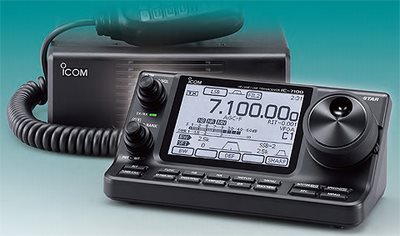
My scan of the preliminary datasheet indicates that this radio is in the class of the IC-7000 or even the IC-706. It covers all modes on HF plus 6 Meters, 2 Meters and 70 cm. (It also has the 70 MHz band which is a nice add for the European countries that have that band.) The radio includes DV (D-STAR) modulation capability and has a new touchscreen user interface. The slanted control panel is meant to make the touchscreen more accessible.
A new HF plus VHF/UHF radio always gets my attention (see my plea for an FT-950 with 2 Meters). I am starting to think that the real benefit of this rig is the addition of D-STAR capability, which would a good but not essential feature to have.
What do you think?
73, Bob K0NR
Update (30 Aug 2012): Universal Radio has the radio on its website.
There’s a good video look at the radio here.
Bob Witte, KØNR, is a regular contributor to AmateurRadio.com and writes from Colorado, USA. Contact him at [email protected].
Contemplating "The Magic"
On this next to last weekend of “Summer” 2012, my wife Marianne suggested we take the kids down to the shore for the day. The last time we were down there with them was when they were just babies, and they don’t even remember that trip. Since then, both Joey and Cara have learned how to swim (even though their Dad never learned) and they are both excellent swimmers. With dangerous rip tides and undercurrents, it was a priority of ours that they be excellent swimmers before allowing them to venture into the surf.
So today, after Sunday Mass, we went down to Belmar, NJ.

And while Marianne, Joey and Cara enjoyed the surf, I did “Dad Duty” and played sentry, watching all our “stuff” on the beach. Not a tough job, mind you, sitting in beautiful sunshine, enjoying the salt air and sea breezes and the view.
And it’s the view that ALWAYS get me when we go anywhere near the ocean.
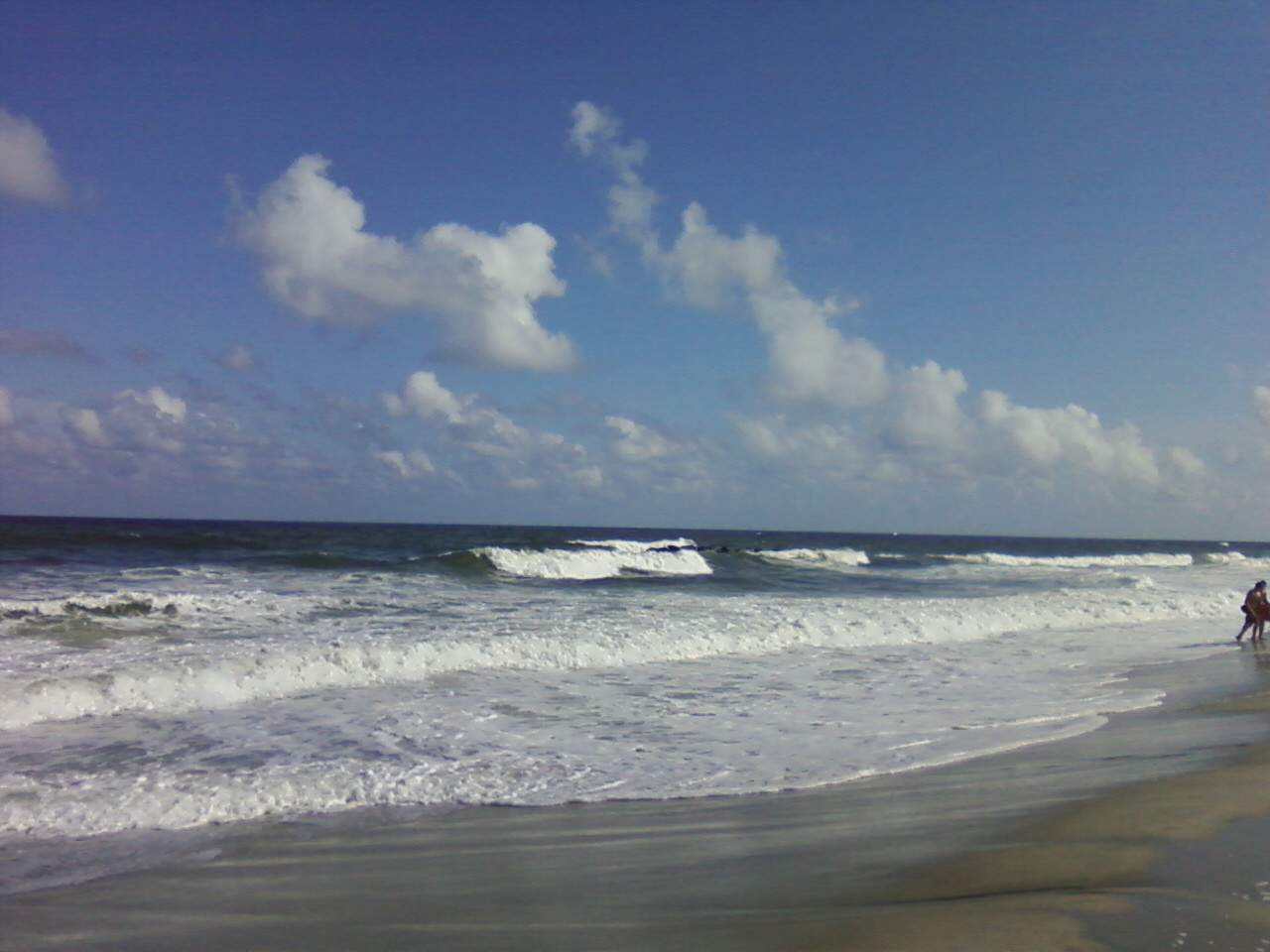
Inevitably, as a Ham, I look at the ocean differently than most folks. I look at that vast expanse of water and that flat horizon, and in my mind’s eye, I can picture the far off countries that lay on the other side of all that water. And I think of my 5 Watts of RF energy crossing all that water and reaching out to all those far away places and it just boggles my mind!
We’ve become jaded. Today’s technology – heck, the technology of the past 40 or so years has shrunken the world and we take so much for granted. Satellites, cell phones, the Internet have all done their part to shrink vast distances and make the world seem so small. Communications are instantaneous and we can find out about just about anything, anywhere on the globe in the blink of an eye. And now, it’s come to the point where we demand and expect that instant communication.
But then you take a trip to the ocean. You feel the warm sand beneath your feet and the cool water lapping at your ankles and you look out upon ALL that water. And you look, and you look and all your eye can see is water and horizon. And it hits you how small you are and how big this world really is.
Then you think of the QSOs – OK1DX, EA6UN, HA5AGS, D3AA, 2012L and it goes on an on. All those places on the other side of all that water – as far as the eye can see. And those QSOs all happened with 5 Watts of power. Less power than the night light that each night illuminates the upstairs bedroom hallway in our house, zipping across that vast expanse – dits and dahs forming letters and words – making acquaintances and friends.
Awesome – truly awesome to think about it. I can’t help but thinking that if Mr. Marconi were alive today, he would be a QRPer. Once the airwaves were conquered, I think it would tickle him to no end to see just how far he could go with lesser and lesser power. If anyone was thrilled by “The Magic”, it was him.
On another note, I received a nice e-mail this morning from none other than Steve WGØAT. He included a link to a video of his 2012 Skeeter Hunt effort.
My sincere thanks to Steve and to all of you who partook in the Hunt this year. And thank to all of you who have sent logs and summaries so far, it’s so gratifying to know that you enjoyed the Skeeter Hunt as much as I did. The results are racking up, and very shortly after the September 12th deadline, I will make a full posting of scores, sopabox comments, photos and videos.
72 de Larry W2LJ
QRP – When you care to send the very least!

Larry Makoski, W2LJ, is a regular contributor to AmateurRadio.com and writes from New Jersey, USA. Contact him at [email protected].
Planning My New QTH: Taking Inventory Of My Evolving Interests – Part 1 of 3
We moved to Glade Park, Colorado last November and, unusual for me, I’ve been planning my new QTH before commencing construction (QTH = ham radio ‘Q code’ for ‘location’ which hams use to as a catch all term for their home and ham station). I’ve had pretty big ‘antenna farms’ over the years in Malibu, California, Tiffany, Colorado and East Topsham, Vermont. Each time my enthusiasm to get back on air led me to ‘plan’ as I built. Although each of these stations performed very well on the air, I eventually realized that each station could have been better. So this time, it’s different…
My inspiration to be patient and plan has been the detailed and thoughtful strategic planning that my friend Tom Taormina, K5RC, is employing in the updating of his potent ‘contest station’ (a ham radio station optimized for radio contesting a/k/a ‘radio sport’) near Reno NV. Tom has a club callsign that he uses in contests, W7RN. If you’re a radio contester you no doubt recognize this callsign.
Tom was a NASA executive during the Project Apollo glory days and today is an author and ‘Forensic Business Pathologist’ using his NASA expertise to advise corporations on employing rocket science – literally – to operate their businesses better. Tom’s contest station planning is extraordinary in scope and detail. (Tom’s business Website is www.itwasrocketscience.com and you can learn more about his contest station at www.w7rn.com.)
Since re-entering the amateur radio hobby in 1989 I have spent most of my ‘on air’ time operating radio contests on the HF bands (HF is technically ‘High Frequency’ 3 to 30-Mhz, but most hams consider the Medium Frequency 1.8-MHz ham band to also be part of the HF spectrum) and in between contests making contact with as many countries as I could on each different amateur radio band between 1-MHz (’16o meters’) and 50-Mhz (’6 meters’).
By 2003 I passed 2,800 total ‘band-countries’ (total number of countries contacted on each band added together). 2003 was the year my daughter was born and also when my professional responsibilities – then in the music business – multiplied. Fatherhood and career conspired to soak up my ham radio time and my station, we were living in Vermont at the time, gathered dust for 8 years by which time I had changed careers and moved the family back west.
Most mornings I wake up and gaze at the sun rising east of our 35 high desert acres in Glade Park CO, where we moved late last year. Glade Park is a small community perched on a high plateau west of Grand Junction. Its rural, scenic, private, dry, sunny and as far as I can tell, a great place to ‘grow some aluminum’ and ‘work the world.’ Sipping my morning coffee I frequently wonder what signals are being refracted down all around me from the solar energized ionosphere and ponder what antennas I should build to find out. I’ve also been taking careful of the moon as it traverses the sky above our property, especially moonrises (more on that later). Gradually, day by day as the sun and moon rise and fall, a station plan has come into focus.
The first step in the planning process was taking inventory of my evolving ham radio interests. This hobby is a big tent with close to a million licensees in the U.S.A. alone. Some hams enjoy providing communications as a public service during natural (and man made) disasters – ‘when all else fails amateur radio gets through,’ others enjoy long, ‘rag chew’ conversations with friends old and new around the world, some enjoy building and tinkering with gear, some ‘chase DX’ (make contact with odd bits of geography, the further away and more obscure the better), and some focus their energy on radio contesting.
In the past radio contests and DXing motivated me to get on the air. My years away from operating my station have given me time and space to meditate on exactly why I love this hobby. I eventually realized that it wasn’t so much the contest scores or the growing list of countries contacted, although there was pleasure in these accomplishments, my core interest is my fascination with the physics of what makes a radio signal propagate around the world. Take the energy used by a common household lightbulb, push it down a coax cable connected to a bit of aluminum and, voila! electromagnetic waves are launched into the ether coming back to earth thousands of miles away. This has intrigued me since I was a teen age ham radio operator in the 1960s.
DXing and contesting activities tend to reveal the most extraordinary radiowave propagation; this I have come to realize is why I enjoy DXing and contesting and why I will continue to contest and chase DX but with changed focus – some of the most extraordinary propagation modes and paths are revealed during radio contests and while chasing DX.
My passion for antennas is direct by product of my passion for propagation. Better antennas allow you to explore more exotic propagation modes and paths. At this point perhaps you shouldn’t be surprised to learn that I became a partner in an antenna company last year – InnovAntennas, Ltd. of Canvey Island, England – after becoming enthralled by the groundbreaking antenna designs company founder Justin Johnson (also a ham, callsign G0KSC) was creating. My passion now = my career. (More info: www.InnovAntennas.us for North America and www.InnovAntennas.com for Europe and ROW.)
I’ll now steer this blog entry back to my station planning. The ham radio band with the most exotic propagation is the 50-MHz (6 meter) band. This is adjacent in the electromagnetic spectrum to TV Ch. 2. Can you imagine tuning into 100+ countries and all continents on your living TV set via its rooftop antenna? Well, that’s the challenge of 50-MHz. Most of the time radio waves on this band propagate ground wave, maybe 100 miles, and not much further. Whereas other ham allocations such at the 14-MHz (’20 meter’) band routinely offer up global contacts, long distance contacts on 50-MHz are always special and much of the propagation at this part of the spectrum is not well understood.
There have been midsummer 50-MHz contacts between Japan and the southern USA – nearly half-way around the globe – in recent years and the propagation mechanism for these contacts is not well explained by the known physics of the ionosphere, yet these contacts are real and happening. My friend Dr. Lew Sayre, W7EW, made over a hundred contracts all across Europe on 50-Mhz from Oregon late last June. This is a long, long way and traverses the northern polar regions – usually death for such high frequency radiowaves – how did those radiowaves take that trip? Incredible! Dr. Jim Kennedy, KH6/K6MIO, a physicist and a ham, has been presenting papers on ‘extreme’ 50-MHz propagation at ham radio conventions in recent years which are utterly fascinating due to both what is explained and what remains mysterious.
Thus, my new station will be well-equipped with antennas for 50-MHz. I want to have the capability to access exotic propagation modes that a pedestrian system would never detect. My friend Dennis Motschenbacher, K7BV is building a MASSIVE 50-MHz antenna system at his Turkey, NC home: a stack of six ’11 element LFA Yagi’ antennas (InnovAntennas models, thanks Dennis!) nearly 70-feet long apiece spread across a nearly 200-foot tall radio tower. Dennis and I, it should be obvious, are lucky to married to women who in addition to being beautiful are tolerant of our hobbies. I am thinking about building something similar.
I’m splitting this blog entry into three parts. This first missive shows how I put a big 50-MHz antenna system on the top of my priority list. The next two parts will cover (a) why the new Flex-Radio 6700 transceiver (a device that transmits and receives radio signals) has caused me to put all of my other ham radio transcievers – except for my beloved Elecrafts – for sale and motivated my business partner Justin Johnson to develop a new antenna design which will find a home at my station, and (b) why I have become so interested in the moon and why I will be building at least four antennas systems which will be aimed at our planet’s lone natural satellite.
73
Bill AA7XT
Bill Hein, AA7XT, is a regular contributor to AmateurRadio.com and writes from Colorado, USA. He is co-owner of Force 12 and InnovAntennas. Contact him at [email protected].
It has been a Captchas morning!!!
 |
| Its been one of those days |

Mike Weir, VE9KK, is a regular contributor to AmateurRadio.com and writes from New Brunswick, Canada. Contact him at [email protected].
Planning My New QTH (Ham Radio Station) Part I Of III: Taking Inventory Of My Evolving Interests
We moved to Glade Park, Colorado last November and, unusual for me, I’ve been planning my new QTH before commencing construction (QTH = ham radio ‘Q code’ for ‘location’ which hams use to as a catch all term for their home and ham station). I’ve had pretty big ‘antenna farms’ over the years in Malibu, California, Tiffany, Colorado and East Topsham, Vermont. Each time my enthusiasm to get back on air led me to ‘plan’ as I built. Although each of these stations performed very well on the air, I eventually realized that each station could have been better. So this time, it’s different…
My inspiration to be patient and plan has been the detailed and thoughtful strategic planning that my friend Tom Taormina, K5RC, is employing in the updating of his potent ‘contest station’ (a ham radio station optimized for radio contesting a/k/a ‘radio sport’) near Reno NV. Tom has a club callsign that he uses in contests, W7RN. If you’re a radio contester you no doubt recognize this callsign.
Tom was a NASA executive during the Project Apollo glory days and today is an author and ‘Forensic Business Pathologist’ using his NASA expertise to advise corporations on employing rocket science – literally – to operate their businesses better. Tom’s contest station planning is extraordinary in scope and detail. (Tom’s business Website is www.itwasrocketscience.com and you can learn more about his contest station at www.w7rn.com.)
Since re-entering the amateur radio hobby in 1989 I have spent most of my ‘on air’ time operating radio contests on the HF bands (HF is technically ‘High Frequency’ 3 to 30-Mhz, but most hams consider the Medium Frequency 1.8-MHz ham band to also be part of the HF spectrum) and in between contests making contact with as many countries as I could on each different amateur radio band between 1-MHz (’16o meters’) and 50-Mhz (’6 meters’).
By 2003 I passed 2,800 total ‘band-countries’ (total number of countries contacted on each band added together). 2003 was the year my daughter was born and also when my professional responsibilities – then in the music business – multiplied. Fatherhood and career conspired to soak up my ham radio time and my station, we were living in Vermont at the time, gathered dust for 8 years by which time I had changed careers and moved the family back west.
Most mornings I wake up and gaze at the sun rising east of our 35 high desert acres in Glade Park CO, where we moved late last year. Glade Park is a small community perched on a high plateau west of Grand Junction. Its rural, scenic, private, dry, sunny and as far as I can tell, a great place to ‘grow some aluminum’ and ‘work the world.’ Sipping my morning coffee I frequently wonder what signals are being refracted down all around me from the solar energized ionosphere and ponder what antennas I should build to find out. I’ve also been taking careful of the moon as it traverses the sky above our property, especially moonrises (more on that later). Gradually, day by day as the sun and moon rise and fall, a station plan has come into focus.
The first step in the planning process was taking inventory of my evolving ham radio interests. This hobby is a big tent with close to a million licensees in the U.S.A. alone. Some hams enjoy providing communications as a public service during natural (and man made) disasters – ‘when all else fails amateur radio gets through,’ others enjoy long, ‘rag chew’ conversations with friends old and new around the world, some enjoy building and tinkering with gear, some ‘chase DX’ (make contact with odd bits of geography, the further away and more obscure the better), and some focus their energy on radio contesting.
In the past radio contests and DXing motivated me to get on the air. My years away from operating my station have given me time and space to meditate on exactly why I love this hobby. I eventually realized that it wasn’t so much the contest scores or the growing list of countries contacted, although there was pleasure in these accomplishments, my core interest is my fascination with the physics of what makes a radio signal propagate around the world. Take the energy used by a common household lightbulb, push it down a coax cable connected to a bit of aluminum and, voila! electromagnetic waves are launched into the ether coming back to earth thousands of miles away. This has intrigued me since I was a teen age ham radio operator in the 1960s.
DXing and contesting activities tend to reveal the most extraordinary radiowave propagation; this I have come to realize is why I enjoy DXing and contesting and why I will continue to contest and chase DX but with changed focus – some of the most extraordinary propagation modes and paths are revealed during radio contests and while chasing DX.
My passion for antennas is direct by product of my passion for propagation. Better antennas allow you to explore more exotic propagation modes and paths. At this point perhaps you shouldn’t be surprised to learn that I became a partner in an antenna company last year – InnovAntennas, Ltd. of Canvey Island, England – after becoming enthralled by the groundbreaking antenna designs company founder Justin Johnson (also a ham, callsign G0KSC) was creating. My passion now = my career. (More info: www.InnovAntennas.us for North America and www.InnovAntennas.com for Europe and ROW.)
I’ll now steer this blog entry back to my station planning. The ham radio band with the most exotic propagation is the 50-MHz (6 meter) band. This is adjacent in the electromagnetic spectrum to TV Ch. 2. Can you imagine tuning into 100+ countries and all continents on your living TV set via its rooftop antenna? Well, that’s the challenge of 50-MHz. Most of the time radio waves on this band propagate ground wave, maybe 100 miles, and not much further. Whereas other ham allocations such at the 14-MHz (’20 meter’) band routinely offer up global contacts, long distance contacts on 50-MHz are always special and much of the propagation at this part of the spectrum is not well understood.
There have been midsummer 50-MHz contacts between Japan and the southern USA – nearly half-way around the globe – in recent years and the propagation mechanism for these contacts is not well explained by the known physics of the ionosphere, yet these contacts are real and happening. My friend Dr. Lew Sayre, W7EW, made over a hundred contracts all across Europe on 50-Mhz from Oregon late last June. This is a long, long way and traverses the northern polar regions – usually death for such high frequency radiowaves – how did those radiowaves take that trip? Incredible! Dr. Jim Kennedy, KH6/K6MIO, a physicist and a ham, has been presenting papers on ‘extreme’ 50-MHz propagation at ham radio conventions in recent years which are utterly fascinating due to both what is explained and what remains mysterious.
Thus, my new station will be well-equipped with antennas for 50-MHz. I want to have the capability to access exotic propagation modes that a pedestrian system would never detect. My friend Dennis Motschenbacher, K7BV is building a MASSIVE 50-MHz antenna system at his Turkey, NC home: a stack of six ’11 element LFA Yagi’ antennas (InnovAntennas models, thanks Dennis!) nearly 70-feet long apiece spread across a nearly 200-foot tall radio tower. Dennis and I, it should be obvious, are lucky to married to women who in addition to being beautiful are tolerant of our hobbies. I am thinking about building something similar.
I’m splitting this blog entry into three parts. This first missive shows how I put a big 50-MHz antenna system on the top of my priority list. The next two parts will cover (a) why the new Flex-Radio 6700 transceiver (a device that transmits and receives radio signals) has caused me to put all of my other ham radio transcievers – except for my beloved Elecrafts – for sale and motivated my business partner Justin Johnson to develop a new antenna design which will find a home at my station, and (b) why I have become so interested in the moon and why I will be building at least four antennas systems which will be aimed at our planet’s lone natural satellite.
73
Bill AA7XT
Bill Hein, AA7XT, is a regular contributor to AmateurRadio.com and writes from Colorado, USA. He is co-owner of Force 12 and InnovAntennas. Contact him at [email protected].
 Ham Radio Deluxe |
 W5SWL Electronics |
 Ham Radio Prep |
 KB3IFH QSL Cards  Hip Ham Shirts  HamRadioAuctions HamRadioAuctions Reliance Antennas Reliance Antennas Enigma Shop Enigma Shop |  morseDX  Ni4L Antennas  R&L Electronics R&L Electronics antennas.us antennas.us QRV QRV |
- Matt W1MST, Managing Editor
