 |
 Ham Nation 66
 27 September 2012 | by
http://dts.podtrac.com/redirect.mp4/twit.cachefly.net/video/hn/hn0066/hn0066_h264m_1280x720_1872.mp4
http://dts.podtrac.com/redirect.mp4/twit.cachefly.net/video/hn/hn0066/hn0066_h264m_864x480_500.mp4
http://dts.podtrac.com/redirect.mp4/twit.cachefly.net/video/hn/hn0066/hn0066_h264b_640x368_256.mp4
http://www.podtrac.com/pts/redirect.mp3/twit.cachefly.net/hn0066.mp3
Hosts: Bob Heil (K9EID), Gordon West (WB6NOA), and George Thomas (W5JDX).
Capacitor and resistor substitution boxes, remote Ham radio operation, and videos from viewers.
Guests: Cheryl Lasek (K9BIK), Don Wilbanks (AE5DW), and Julian Frost
Download or subscribe to this show at http://twit.tv/hn.
Submit your own video to Ham Nation! See the Video Guidelines, http://www.frozen-in-time.com/guide/
We invite you to read, add to, and amend our show notes at wiki.twit.tv.
Thanks to Joe Walsh who wrote and plays the Ham Nation theme.
Thanks to Cachefly for the bandwidth for this show.
Dr. Bob Heil, K9EID, is the founder of Heil Sound and host of TWiT.tv's Ham Nation which streams live each Tuesday at 6:00pm PT (9:00pm ET) at http://live.twit.tv. Contact him at [email protected].
PARP News – Episode 59 and Transcripts

It’s been a while since I posted any new news regarding the Practical Amateur Radio Podcast (PARP). However, I did want to pass along two points of interest. First, PARP 59 was released yesterday. PARP 59 is titled “The Well Equipped Ham Shack”. In this episode I share some thoughts on items to consider other than the usual transceiver, tuner etc.
Second, I received an email yesterday from a fellow ham who just discovered PARP. He introduced himself and explained he was hearing impaired and asked if written transcripts were available. He was aware of the quality of content in my PARP episodes but is unable to listen to my audio podcasts.
Some may know that I prepare a written script which I read from for each of my shows content. I do this for several reasons. One, I believe those who can sit down in front of a microphone and just begin talking without stumbling, stammering, inserting hmmmms and ahhhhhs truly have a gift. I’m not one of these individuals and I’m OK with that.
Second, while I understand the content I discuss…..I try very hard to ensure what I put out for my listeners is accurate. Yes…sometimes I make a mistake…but after all I’m only human. For me, writing out a script just helps make sure I have all the information I need to communicate already available to me in the script. Since I already have the written script I use to record my audio podcasts, it was really simple to fulfill the request for a transcript.
Going forward, each regular monthly PARP episode as well as the weekly PARP Plus editions will include a link in the show notes to a downloadable transcript in Adobe PDF format. Just visit MyAmateurRadio.com and view the show notes. You’ll see a link labeled “Transcript”. I’ve also linked all regular monthly PARP episodes recorded in 2012 and 2011 with their transcript. I’m working on 2010 and 2009 as I have time. Unfortunately, I can only go back to episode 16 as the first 15 scripts have disappeared.
I hope you’ll help me share this news with any of our fellow hearing impaired hams you may know.
Thank you for your time.
Until next time…
73 de KDØBIK
Jerry Taylor, KD0BIK, is a regular contributor to AmateurRadio.com and writes from Colorado, USA. He is the host of the Practical Amateur Radio Podcast. Contact him at [email protected].
Activity update; UHF tropo, 28MHz DX, some late summer Es, new valves and antenna!
The last week or two seem to have had their share of interesting propagation, but little time to blog about it.
The morning of Sunday, 16th September was an interesting one on 432MHz. Thanks to Steve M0BPQ on Twitter, I gathered that there was some good tropo into the south of France and Spain. I went up to the shack not really expecting to hear much, but there was a French contest on and I was surprised to hear signals. The first couple of stations that I worked were in the north of France but with excellent signals. I came across F6EZS/P who was very loud and I assumed he was in Normandy. I was a bit surprised when it turned out that he was in IN93 square in the Pyrenees – we had an easy QSO. I was also pleased to work into JN03 square with F2JR/P (from memory) – another nice QSO at just under 1000 km. I wasn’t able to stick around too long as I had a busy day planned, but thoroughly enjoyed the QSOs.
Over the last week or so, 28MHz has shown some great improvements in propagation. Like last year, I have been playing on JT65A and although have not made so many QSOs, have been interested to see what has been coming through and where I have been heard, even when I’ve been working other stations close by – the PSK Reporter website is very useful in that regard.
I was pleased to find 50MHz open last Saturday afternoon – to Poland and Germany mostly – I even found some new squares! Signals improved and improved and I decided to try 70MHz. OK1VBN was a great signal who I was able to work – and nice to work YO2LAM for a new square. 9A2SB was around too. Quite late in the season for 70MHz Es. Although I didn’t work it, there was apparently some Es+TEP to southern African on 50MHz, with ZS6WN being worked from the UK. On Sunday, 50MHz was open again but with weaker signals and nothing on 70MHz that I could detect.
The Virtual Radar experiment is proving quite interesting on 1090MHz with planes showing up over distances of 50-60 miles on a regular basis. I am looking forward to seeing what happens in tropo conditions.
A pair of replacement 4CX350As have been found – following the demise of the valve in the ‘melted aerial’ incident – so will be able to get the 144MHz amp going again.
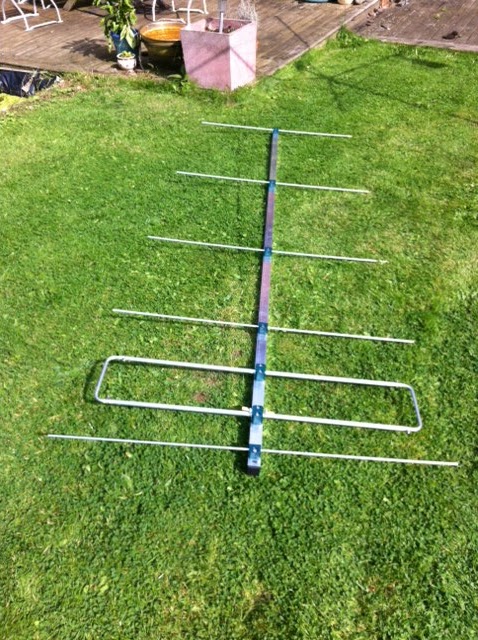
The new Innovantennas 6el yagi is constructed and awaiting some testing – I was hoping to do that last weekend, but a bad cold got in the way. As it may be a little time before I can get the 6el up on the mast, I may even hook it up on a stepladder in the back garden and point it at the moon and see what happens.
All good fun and plenty going on!

Tim Kirby, G4VXE, is a regular contributor to AmateurRadio.com and writes from Oxfordshire, England. Contact him at [email protected].
Inspiration
In my links section, I have a link to W6AQ, Dave Bell’s e-book, “Worlds Best Hobby”. I’ve mentioned the book on the blog here, before. I’d like to make a couple of points about it.

Larry Makoski, W2LJ, is a regular contributor to AmateurRadio.com and writes from New Jersey, USA. Contact him at [email protected].
Handiham World for 26 September 2012
Pat Tice, WA0TDA, is the manager of HANDI-HAM and a regular contributor to AmateurRadio.com. Contact him at [email protected].
10m wide open!
Ten metres has been wide open today. Stations have been heard or worked in just about all directions. I ran 2 watts of WSPR during the periods that I wasn’t in the shack and the program screen resembled 30m!
 |
| WSPR spots on 10m at G4ILO, 26/9/2012 |
After a short period of WSPR I switched to voice mode and made a nice SSB contact with Ken, JA2FJP near Nagoya (nothing to do with cheap Chinese antennas!) After a rubber-stamp contact with R100BG I found phone a bit hard going with all the QRM and pileups so I retreated to the more restful pastime of working digimodes.
 |
| Digital stations hrd/wkd at G4ILO, 26/9/2012 |
I made one more Japanese contact – with JI4POR – and made my first-ever China contact – with BG8GAM – all on PSK31. I heard several more stations from those countries and also one from Korea (South, presumably) and one from Indonesia but didn’t manage to work them. Better luck next time!
A session of calling CQ produced an endless succession of Russian stations. Where do they all come from? There is no chance of working interesting DX unless you search and pounce on the DX stations. Even when calling a specific DX station I was being called by Russian stations! Why do they do it? I lost the chance of a couple of first contacts because of it.
As the afternoon wore on many stations from North America and Canada started to be in evidence. My final PSK31 contact for the day was with Bob KZ0G in Missouri which is probably a first for that state for me.
Not a bad haul for a few hours listening / operating using a maximum of 40 watts PSK31 to an attic dipole. I wish there were more days like that!

Julian Moss, G4ILO, is a regular contributor to AmateurRadio.com and writes from Cumbria, England. Contact him at [email protected].
Bike Ride in East Andover (QRP to Europe)
Fall colors are starting to show. I could see them every where during my brief bike ride in East Andover. I stopped on the trail at a small brook, and set up at a picnic table. I worked Russia, Czech Republic and England.

It was a short afternoon ride… maybe three miles. On a whim I stopped by a small bridge and set up some gear. I stayed on 20 meters with a half wave wire and 4 watts from the HB-1B. Right off I heard Alex, R2UZ in Russia calling CQ. He answered and gave me a 559. Up the band a bit, Jan OK1RO in the Czech Republic gave me a 569. A few minutes later, I came across Dave, G0GKH. He gave me a 569, but said there was lots of QSB on my signal. Non-the-less, he copied all of my information. He was running 100 watts to a G5RV.
After 15 minutes of operating, I packed up and continued on the ride. It was a perfect day for an outing. The sun was warm even though the ambient temperature was only around 60F. I kept a light fleece jacket on throughout.
Jim Cluett, W1PID, is a regular contributor to AmateurRadio.com and writes from New Hampshire, USA. Contact him at [email protected].
 Ham Radio Deluxe |
 W5SWL Electronics |
 Ham Radio Prep |
 KB3IFH QSL Cards  Hip Ham Shirts  HamRadioAuctions HamRadioAuctions Reliance Antennas Reliance Antennas Enigma Shop Enigma Shop |  morseDX  Ni4L Antennas  R&L Electronics R&L Electronics antennas.us antennas.us QRV QRV |
- Matt W1MST, Managing Editor
