 |
 Handiham World for 19 September 2012
 19 September 2012 | by
 Pat Tice, WA0TDA, is the manager of HANDI-HAM and a regular contributor to AmateurRadio.com. Contact him at [email protected].
How Much Does That Second Band Cost?
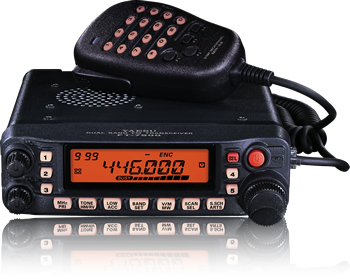 I encourage newly licensed radio amateurs to go ahead and get a dual-band FM rig…handheld, mobile or both. I think the additional cost of the dualbander with both 2 Meters (146 MHz) and 70 cm (440 MHz) is justified by having the ability to operate on the additional ham band. I have noticed that the price of the single-band 2 Meter mobiles are pretty low, less than $200… a real bargain in terms of technology. This made me wonder what the price premium for the second band (70 cm) really is.
I pulled all of these prices from the same major ham radio web site, trying to keep some consistency among the price of the various models. (I ignored specials and coupon pricing.) I looked at a basic 2 Meter FM rig and any comparable dual band models from the same manufacturer. I tried to stick to the basic transceivers and not include models that had advanced features such as D-STAR and APRS in them.
The data is captured in the table below. Note that I differentiated between a single receiver (one frequency at a time) dual-band radio and a two receiver dual-band radio, since the latter variety is much more expensive. I calculated a percent premium for each of the dual-band transceivers, calculated as the percent increase in price over the single-band radio from the same manufacturer. I think this is the most objective way to describe the extra cost of a dual-band radio.
| Transceiver | Price | Bands | Percent Premium |
| Yaesu FT-2900R | $185 | 2M | |
| Yaesu FT-7900R | $330 | 2M/70cm | 78% |
| Yaesu FT-8800R | $460 | 2M/70cm Dual Receiver | 149% |
| ICOM IC-2300H | $260 | 2M | |
| ICOM IC-2820H | $670 | 2M/70cm Dual Receiver | 158% |
| Alinco DR-135T | $170 | 2M | |
| Alinco DR-635T | $320 | 2M/70cm Dual Receiver | 88% |
| Kenwood TM-281A | $145 | 2M | |
| Kenwood TM-V71A | $395 | 2M/70cm Dual Receiver | 172% |
It is worth noting that only Yaesu and Alinco offer a single-receiver dual-band rig. These two radios are 78% and 88% more expensive than their single band counterparts (less than twice the cost). The two-receiver dual-band radios are consistently more expensive, with a price premium ranging from 149% to 172%. While these rigs are often described as having two radios in one, they are more than twice as expensive as a single-band radio.
Although I appreciate the extra utility of the two-receiver radios, it looks to me like the best value is with the single-receiver dual-band rigs.
What do you think?
73, Bob K0NR
Bob Witte, KØNR, is a regular contributor to AmateurRadio.com and writes from Colorado, USA. Contact him at [email protected].
Skeeter Hunt results delay
I had intended to post the 2012 Skeeter Hunt results last weekend; but alas, some family stuff has come up which has taken away my discretionary free time.
Results will be posted this coming weekend on the Skeeter Hunt page of my blog and at http://www.qsl.net/w2lj/
72 de Larry W2LJ
QRP – When you care to send the very least!

Larry Makoski, W2LJ, is a regular contributor to AmateurRadio.com and writes from New Jersey, USA. Contact him at [email protected].
Antarctica!
Interesting conditions on 15m this afternoon.

Amazing where 2 watts of WSPR can end up!

Julian Moss, G4ILO, is a regular contributor to AmateurRadio.com and writes from Cumbria, England. Contact him at [email protected].
Author interview: Dennis Blanchard’s (K1YPP) “Three Hundred Zeroes: Lessons of the Heart on the Appalachian Trail”
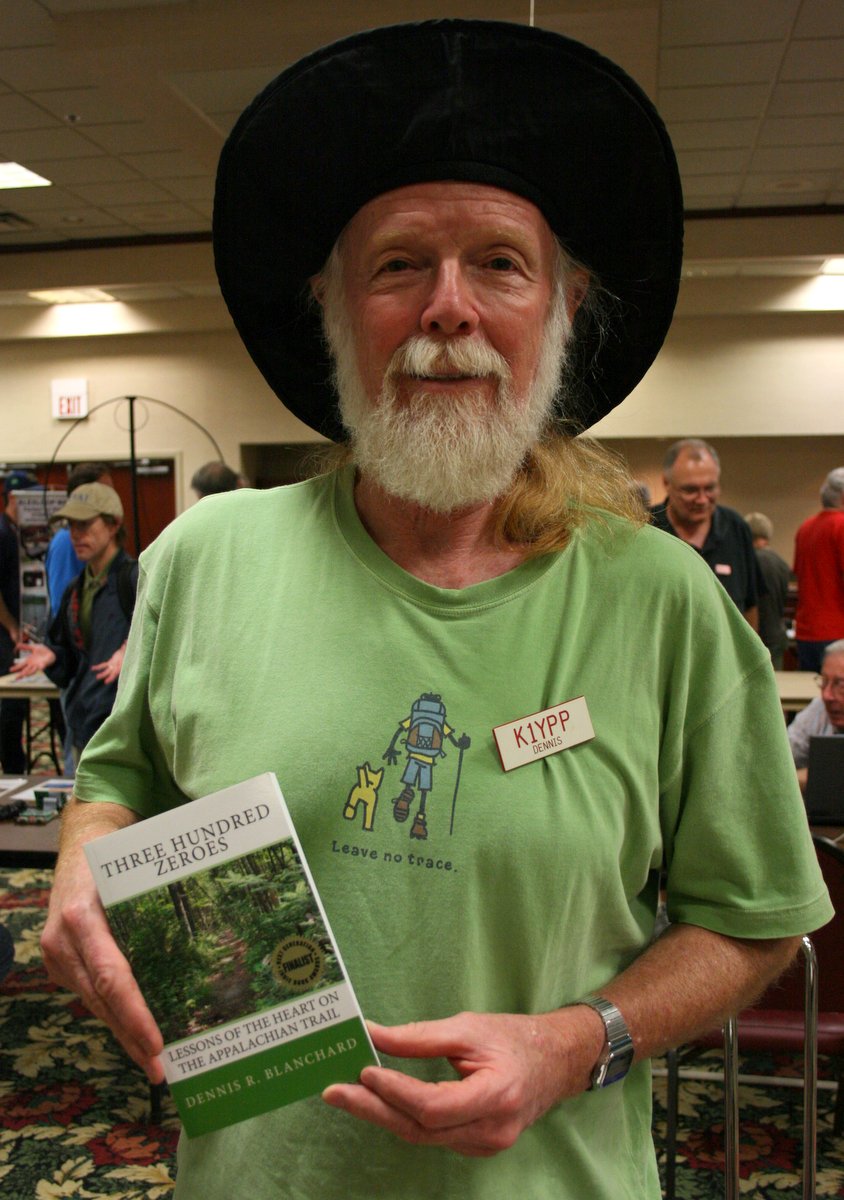
Dennis Blanchard (K1YPP) at Four Days In May 2012 (Photo: QRPer.com)
This year, at the Four Days in May (FDiM) Dayton QRP gathering, I had the pleasure of meeting Dennis Blanchard (K1YPP) and his wife, Jane, as Blanchard signed copies of his book, Three Hundred Zeroes: Lessons of the Heart on the Appalachian Trail. I had previously heard about Blanchard’s book, and it was great meeting the author in person. Both he and his wife were most friendly, and I instantly felt a connection–after all, he is a fellow QRPer!
As a result of this meeting, I recently decided to purchased a copy of Three Hundred Zeroes on my Kindle eBook reader. Though I’ve always been a fan of turning pages on a traditional book, the eReader does afford one instant gratification, as you can order it on-the-go and start reading immediately. And that’s exactly what I did…
The result? I’m very glad I took the time to read Blanchard’s Three Hundred Zeros. Though I don’t like to spend much time away from my young family at present, I’ve always thought it would be a wonderful challenge and adventure to through-hike the AT (Appalachian Trail); reading this book was a vicarious opportunity to do so. Indeed, my favorite trail, the BT–the Bartram Trail, which follows the path of early American naturalist and explorer William Bartram–which I hike when I can, and whose NC chapter I’ve served as a board member for nearly 10 years now, parallels the AT at different points. So the temptation to hike (and QRP, of course) continues.
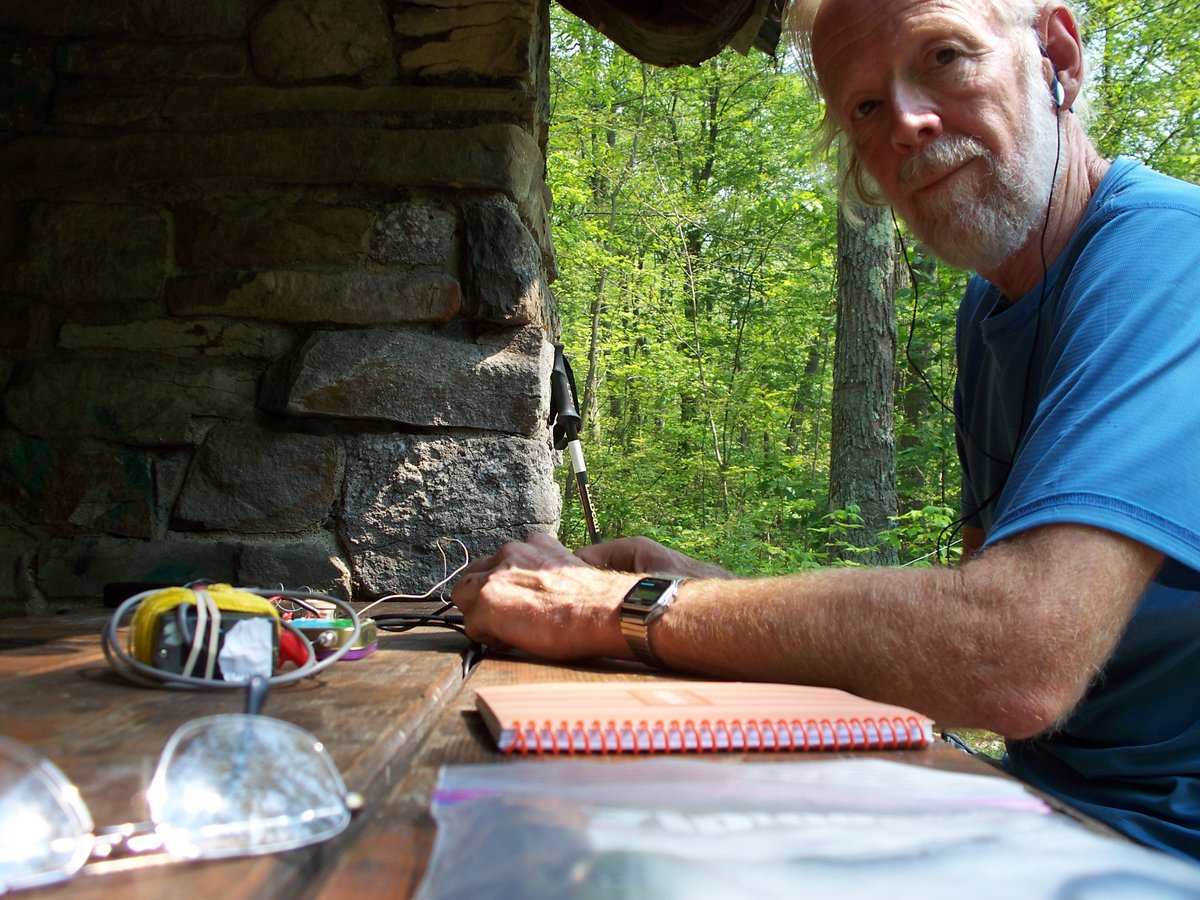
“This photo was taken in NJ. Shortly after I took these photos, and walked down the trail about a 100 feet, a bear came over to check the table to see if I had left anything.” (Photo: K1YPP)
Blanchard’s book gives me hope. Three Hundred Zeroes is a well-documented, informative, and–despite his truly serious heart condition–often humorous journal-style account of his successful thru-hike of this 2176 mile trail. His writing style is very informal and likeable, focusing on the many personal interactions that make the trail hiker’s experience unique, and interweaving his day-to-day accounts with trail lore and history.
In contrast with the arduous journey Bill Bryson describes his well-known (and hilarious) book, A Walk in the Woods, in Three Hundred Zeros Blanchard calmly and routinely deals with misadventures and hair-raising encounters with wildlife, rolling with the punches and somehow emerging unscathed. He describes the journey as “long stretches of boredom, punctuated by brief moments of excitement” in the lively and unpredictable form of bears, mice, snakes, and even other hikers, to some degree. Blanchard was obviously a great hiking companion, thus rarely hiked alone–no doubt, other hikers sought his company.
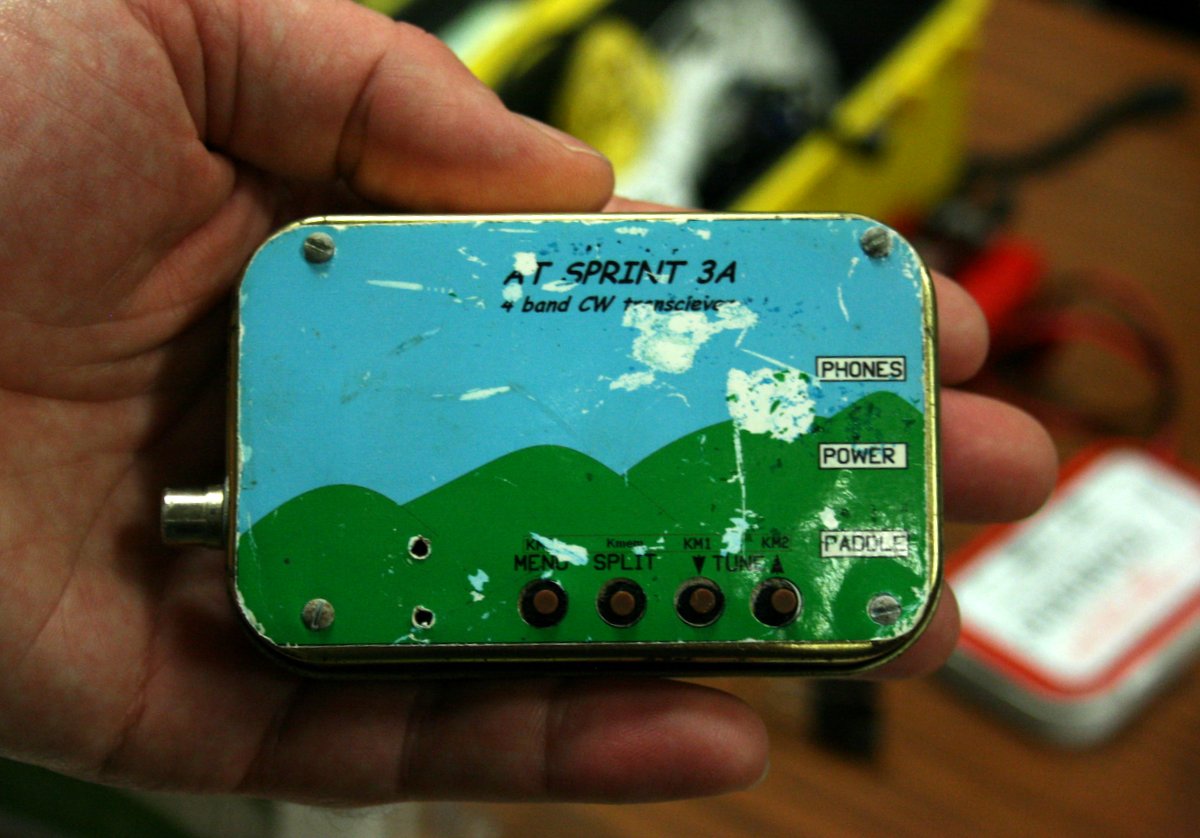
A closeup of Dennis’ AT Sprint 3A taked at Four Days in May (Click to enlarge, Photo: QRPer.com)
With QRP in mind, I had a few questions for Blanchard after reading his book. He has kindly taken the time to respond to QRPer.com‘s questions, as follows.
QRPer: I always thought that the AT would be a lonely place, but your book certainly changed my mind. Were there many stretches of trail where you were completely alone while trekking or camping at night?
Blanchard: There were times when I was alone for extended periods. However, “alone” is a relative term. Throughout the day I would encounter other hikers going in the other direction, or people that were slower or faster than I. In 180 days on the trail, I think I had three nights when I camped alone.

“2007-Damascus, VA was where I operated Field Day in 2007. It was shortly after this that I left the trail for the heart surgery.” (Photo: K1YPP)
QRPer: What was your favorite stretch of trail?
Blanchard: That’s difficult to answer…The trail is so varied and weather can change one’s views of any section. For me, it was a coin toss between the New Hampshire White Mountains and the 100 Mile Wilderness in Maine. The remoteness of both areas was just so spectacular. Of course the high altitudes made for great antenna opportunities as well.
QRPer: Did you bring a radio to listen to local AM/FM or shortwave?
Blanchard: For most of the hike, I carried a Yaesu VX-1R 2/440 handi-talkie. I think I used it about three times on two-meters. In a few situations, such as up in the White Mountains, I used the VX-1R to tune in NOAA for weather news. It also has AM/FM and on a few very rare occasions, I tuned into local stations for news. Would I carry it again? I don’t know. It is wise to have something for emergencies, and the radio wasn’t too big or heavy, but it was extra weight.
QRPer: Specifically, what ham gear did you take with you? Do you have a photo?
Blanchard:As noted in the book, I did carry a home-brewed 80/40 meter CW rig for the first 600 miles. For the rest of the hike I carried Steve Weber’s ATS-3A. The radio was powered by six Energizer disposable lithiums, in a home-brewed battery pack. The pack could also charge my cell phone and power the 2-meter VX-1R radio. I used a 51 foot random wire for the antenna and some counterpoise wire, usually about 15 feet. Altogether, the gear weighed around two pounds.
QRPer: If you were to do the hike again, would you take the same equipment?
Blanchard: I’m not certain I would carry the VX-1R again. I didn’t use it much and it is extra weight. However, the NOAA weather, and 2-meter capability could prove extremely useful in an emergency.
QRPer:What was it like coming back off the trail once you completed it? Any especially notable things about how you perceived the world around you? Did it change you? Any culture shock?
Blanchard: The only real “culture shock” was riding in automobiles. Everything seemed to move so quickly. I much more enjoy walking and biking now. I would be happy if I never had to drive again.
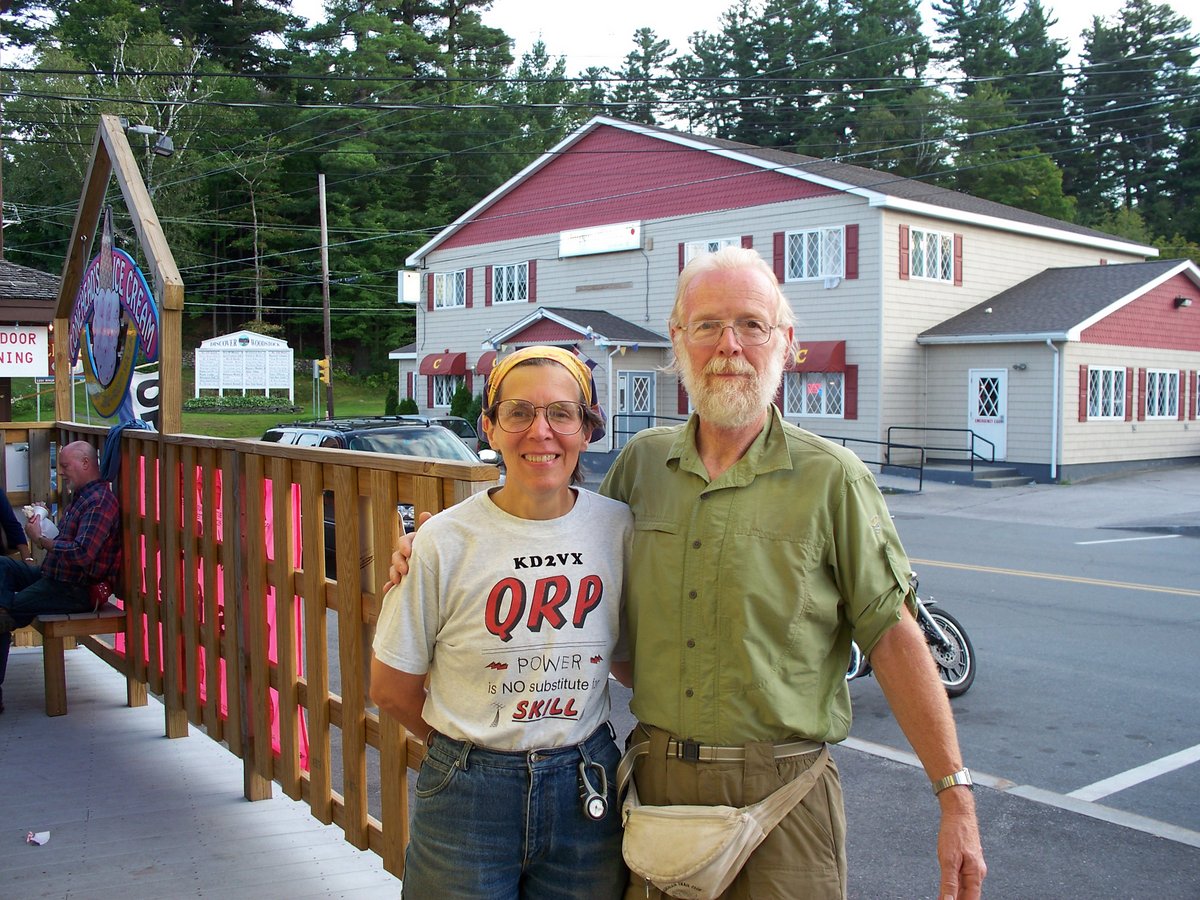
“KD2VX, Kathy, was the trail angel that helped out with my hike up in New Hampshire. She is a QRP fan.” (Photo: K1YPP)
QRPer: How many other hams did you meet on the AT who were either through-hiking the AT, or hiking sections?
Blanchard: Since we [hikers] don’t wear being a “ham” on our sleeve[s], I can’t really say how many hams I encountered. The few that I was aware of were mostly section hiking. One benefit of setting up my QRP station along the way was public visibility for ham radio. On a number of occasions I inspired my fellow hikers to look into ham radio when they returned home. I’ve even had a few readers of the book write me to tell me they went off and got a ham license based on inspiration from the book.
QRPer: If any other QRPers are inspired by your story, and are thinking about hiking the entire AT, how much money should they budget for such an adventure? Based on what I read, there are a number of budgetary considerations for shuttles, food, gear, and the like.
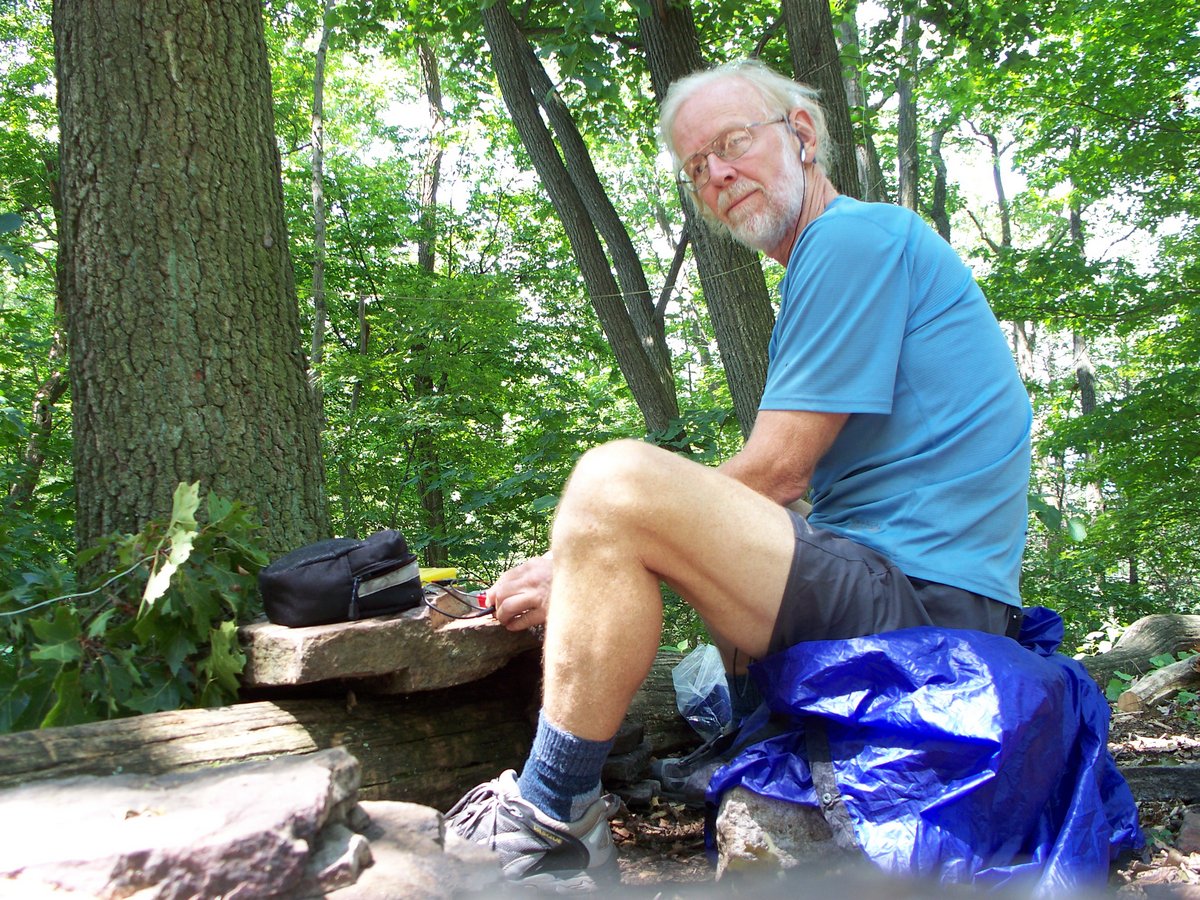
“Duncannon, PA was were I operated Field Day. The station table was a few rocks I moved around.” (Photo: K1YPP)
Blanchard: The answer to this question depends on how many “creature comforts” one wishes. Hiking as I did, with stops along the way about every 5-10 days, can cost about $1-$3 a mile. Those on a tight budget could do it for much less, and those that enjoy getting to hotels and eating in fancier places could spend more. Most of the shuttles were really not that expensive, at least those that cater specifically to hikers. The hostels are a real bargain, compared to standard hotels, but one may have to tolerate annoyances, such as snoring and people coming and going at unusual hours. If you’re a light sleeper, this could be an issue.
QRPer: On zero days [based on your descriptions] it seems like hikers simply stuff themselves with food. I’m really curious what you typically ate on the trail?
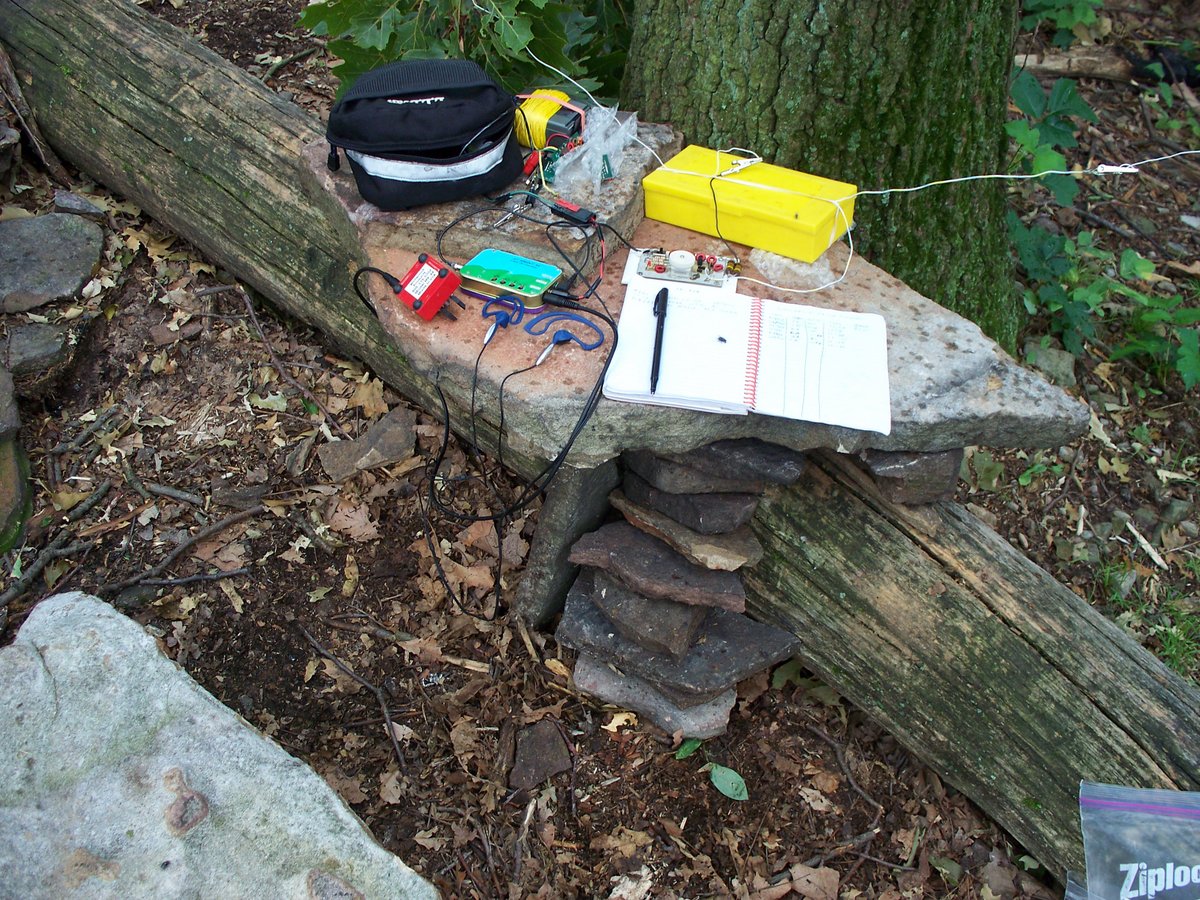
K1YPP’s 2008 Field Day “table” in Duncannon, PA (Click to enlarge, Photo: K1YPP)
Blanchard:The short answer is: I ate everything. I’m not fussy, and don’t have any diet limitations. If someone is diabetic, or vegetarian, it is still possible to undertake such a hike, it just might require more preparation. My typical day was a few Pop Tarts first thing in the morning, or hot oatmeal on cold days, followed by an on-trail mid-morning snack, such as a Snickers Bars or trail mix.
Lunch was usually something that didn’t need cooking. Roll-up tortillas, or bagels with peanut butter won out most of the time. In the colder weather, bagels and cream cheese was a favorite. Gatorade powder mix, or hot chocolate in cold weather, was my favorite drink for lunch.
The evening meal was usually a pasta-based affair, or couscous. I really preferred the couscous; it is very light to carry, needs very little energy to cook, and is loaded with nutrients. I would usually stir in some dried vegetables with it, or dried meat. As a side I would carry a dried sausage, such as pepperoni, which could also serve as a snack for lunch. I usually carried some desert items as well, such as cookies or dried fruit. Of course energy bars would supplement all of this along the way. Many hikers preferred candy bars, but I tried to avoid them in the warmer weather since they melt.
 Overall, even though the diet sounds bland, it wasn’t bad. Of course, whenever we hit a town, I would stuff on everything in sight. I actually did eat well, but couldn’t find enough calories to maintain my weight. I ended up losing 35 pounds at the end of the hike and looked like a refugee.
Well, Dennis–all I can say is that I hope you’ve gained back some of those lost pounds, continue to be in good heart-health, and are able to enjoy a little QRP on your forthcoming hikes. Thanks very much for taking the time to answer our questions; we wish you the very best!
You can purchase Dennis’ book from Amazon.com or Barnes and Noble and visit his website at threehundredzeroes.com.
Tom Witherspoon, K4SWL, is a regular contributor to AmateurRadio.com and writes from North Carolina, USA. Contact him at [email protected].
DX from Hunkins Pond
This afternoon I hiked from Shute Hill to Hunkins Pond. Once there, I set up in a farm field with a remarkable view. I worked Finland, Cuba, Russia and Spain.
The hike was about 2 miles cross country on an old logging road. The day was so perfect… about 70 degrees, sunny with a sky as blue you could ever imagine. I started out across from a cemetery on the top of Shute Hill. From there I headed south and crossed a small brook coming from a large beaver pond.

As I gained elevation, I went through a brilliant field of golden rod. The sound of buzzing bees was so loud, I could have been inside the hive itself.

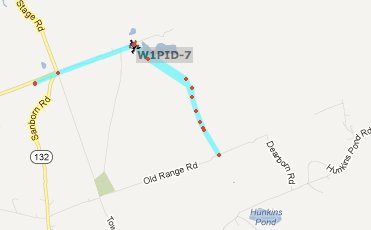
The trail goes through the woods and over a pretty high elevation and down toward Hunkins Pond where it meets an old range road at a gate.

I brought my Kenwood TH-D72 APRS handie with me. Here’s an image of my track captured from http://aprs.fi – I continued down the Old Range Road to the east another quarter of a mile, but I couldn’t hit an APRS digipeater from there so it doesn’t show in the image below.
The range road borders the Swain’s dairy farm. The fields are simply gorgeous and so are the views. I set up my little HB-1B on 20 meters underneath one of the huge maple trees that David Swain taps each year for syrup.

I operated here for about 20 minutes using 4 watts and a half wave wire. I had good luck as you can see from the log.
17 Sep-12 1910 14.015 OH/DJ9DZ CW 599 599 Finland
17 Sep-12 1921 14.013 CO6RD CW 599 599 Cuba
17 Sep-12 1923 14.033 UA6AES CW 579 599 Russia
17 Sep-12 1930 14.060 EA2LU CW 559 579 Spain
The last QSO was certainly the most notable. After working the low end of the band, I went to 14.060, the QRP frequency. Hearing no one, I called CQ. Jorge, EA2LU returned the call. He was also QRP. He was running a K3 at 5W with a 3 element yagi. Jorge and I have had at least 20 QSOs in the last five years, and it’s always a joy to hear him.
After this, I packed up for the return hike. It takes about 45 minutes back to the cemetery. These are prime outdoor days in New Hampshire. The bugs are few, the air is crisp and fragrant, and there’s plenty of incentive with cold weather ahead. It’s supposed to rain tomorrow.
Jim Cluett, W1PID, is a regular contributor to AmateurRadio.com and writes from New Hampshire, USA. Contact him at [email protected].
Show Notes #090
Introduction:
- Join us this episode as our intrepid hosts, Richard and Russ (mad posstcatter!), interview John Hays of NorthWest Digital Radio.
Topics:
- Interview with John Hays (K7VE) from NorthWest Digital Radio.
- John has been a licensed amateur radio operator for 40 years. His wife and all of his children are hams, too!
- A couple years ago John gave a presentation at TAPR, and discussed his wish for a reasonably priced radio for digital communications with just a few connections: antenna, power and Ethernet.
- Bryan Hoyer (now K7UDR) approached John and volunteered to build one. Their collaboration (with Basil Gunn) resulted in NorthWest Digital Radio.
- Their first product will be the UDR56K-4 Universal Digital Radio, planned for availability in early 2013.
- John goes on to discuss the features of their digital radio and some of the design decisions the company made.
- Specifications (subject to change, of course):
- 25W 70cm Transceiver
- 4800 to 56Kbps
- FSK, GMSK, 4FSK
- Open Source Linux Platform — a full Linux-based web server is built-in. It uses the Debian kernel, running on an ARM processor (faster than a Raspberry Pi).
- Web Interface over Ethernet
- 4 USB Host Ports
- Applications:
- The radio can be completely controlled through the web interface or the command line.
- John talks about other potential applications for their radio platform.
- Keep an eye on the website for more information and to sign up for email announcements.
- You may also be interested in John’s blog.
Contact Info:
- Contact Richard at [email protected], Russ at [email protected], or both at the same time at [email protected].
- Listen to the live stream every other Tuesday at 8:00pm Central time. Check the LHS web site for dates.
- Leave us a voice mail at 1-909-LHS-SHOW (1-909-547-7469), or record an introduction to the podcast.
- Sign up for the LHS mailing list.
- Sign up for the MAGNetcon mailing list.
- LHS merchandise is available at the Merch link on Web site. Check out the Badgerwear or buy one of the other LHS-branded items at PrintFection.com/lhs or Cafe Press. Thanks!
- Thanks to Dave from Gamma Leonis for the theme music.
Russ Woodman, K5TUX, co-hosts the Linux in the Ham Shack podcast which is available for download in both MP3 and OGG audio format. Contact him at [email protected].
 Ham Radio Deluxe |
 W5SWL Electronics |
 Ham Radio Prep |
 KB3IFH QSL Cards  Hip Ham Shirts  HamRadioAuctions HamRadioAuctions Reliance Antennas Reliance Antennas Enigma Shop Enigma Shop |  morseDX  Ni4L Antennas  R&L Electronics R&L Electronics antennas.us antennas.us QRV QRV |
- Matt W1MST, Managing Editor
