 |
 PSK31 to Amman, Jordan
 15 September 2012 | by
 Conditions have been good recently on 15m. On that band I have a choice of two antennas – the multiband dipole or the magnetic loop. The multiband dipole doesn’t actually have elements for 15m so on that band I think the 40m element must do the work. The K3 ATU is needed to produce a good match.
There is quite a big difference in performance between the two antennas on 15m. The magnetic loop, surprisingly, has a higher noise level but it also produces stronger signals on some stations. On other stations the dipole seems best. It’s a pity I don’t have a sub-receiver in the K3. It would be interesting to try diversity reception one day.
 |
| Amman, Jordan |
Whenever a band is open you can usually find some PSK31 activity even if you can’t hear any phone. That was the case yesterday on 15 metres when I worked Nart, JY5IB from Amman, Jordan. That’s an all-time new country for me so I was very pleased to get him into the log. On this occasion it was the magnetic loop that did the job.

Julian Moss, G4ILO, is a regular contributor to AmateurRadio.com and writes from Cumbria, England. Contact him at [email protected].
My Elecraft P3 YouTube video

Mike Weir, VE9KK, is a regular contributor to AmateurRadio.com and writes from New Brunswick, Canada. Contact him at [email protected].
Whither "DE" ???
Listening to some QSOs on 30 and 40 Meters tonight, I have noticed an increasingly less usage of “DE”.
VERY often, I seem to be hearing (for instance) “W2WK W2LJ” instead of “W2WK DE W2LJ”.
Was “DE” tossed out the window? Did I not receive the memo? I know it’s gone by the wayside in contests. Lord knows, the hour and a half it takes to send two letters will really cut down on the ol’ QSO per Hour rate. But in casual rag chews?
Call me a curmudgeon, call me old fashioned, but I’ll stop using “DE” when I stop using my rotary phone, my 5.5″ floppy disks, my Smith Corona typewriter and stop wearing my spats.
72 de Larry W2LJ
QRP – When you care to send the very least!

Larry Makoski, W2LJ, is a regular contributor to AmateurRadio.com and writes from New Jersey, USA. Contact him at [email protected].
Ham Nation 64

http://dts.podtrac.com/redirect.mp4/twit.cachefly.net/video/hn/hn0064/hn0064_h264m_1280x720_1872.mp4
http://dts.podtrac.com/redirect.mp4/twit.cachefly.net/video/hn/hn0064/hn0064_h264m_864x480_500.mp4
http://dts.podtrac.com/redirect.mp4/twit.cachefly.net/video/hn/hn0064/hn0064_h264b_640x368_256.mp4
http://www.podtrac.com/pts/redirect.mp3/twit.cachefly.net/hn0064.mp3
Hosts: George Thomas (W5JDX),
Gordon West (WB6NOA), and Bob Heil (K9EID).
Winners were selected in the Icom contest, George finishes building a shortwave radio, and “heads-up” mobile installations.
Guests: Cheryl Lasek (K9BIK), Clayton Cullen (W6CEC), Don Wilbanks (AE5DW), and Ray Novack
Download or subscribe to this show at http://twit.tv/hn.
Submit your own video to Ham Nation! See the Video Guidelines, http://www.frozen-in-time.com/guide/
We invite you to read, add to, and amend our show notes at wiki.twit.tv.
Thanks to Joe Walsh who wrote and plays the Ham Nation theme.
Thanks to Cachefly for the bandwidth for this show.
Dr. Bob Heil, K9EID, is the founder of Heil Sound and host of TWiT.tv's Ham Nation which streams live each Tuesday at 6:00pm PT (9:00pm ET) at http://live.twit.tv. Contact him at [email protected].
GB80PW
The magazine Practical Wireless is celebrating 80 years of publication this year and has a permit to use the special call GB80PW. I don’t usually make a point of hunting for special callsigns but as a reader of the magazine I particularly wanted to work this one which I knew would be on today it being the publication date of the October issue and the actual 80th anniversary day.
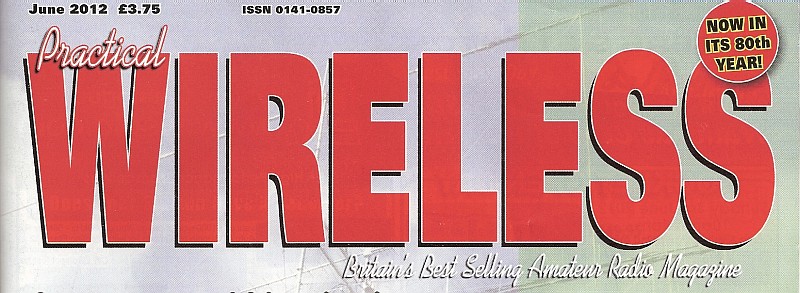
I switched the K3 to 40 metres which I thought the station would be operating on and and began tuning down the band. Lo and behold, GB80PW was the first station I heard, on 7120kHz, coming in at 5 and 7 at the top of the QSB. I switched the magnetic loop from 30m APRS duty over to the K3 so I had a choice of either the loop or the multiband dipole. Switching between the two there was almost nothing to choose between the two antennas but the magnetic loop just seemed to have the advantage by a whisker so that is what I chose to use.
I cranked the power up to 100 watts. After my first call it was clear that Rob had quite a pile-up of people wanting to work him and he couldn’t pick anything out of the pile. For the second call I gave my call twice, once phonetically, and added “… in Cockermouth, Cumbria.” Straight away Rob came back with “the station in Cockermouth, Cumbria.” I thought that would get his attention as the magazine’s technical editor G1TEX comes from here! I went on to have a very nice, if brief, chat with Rob before letting him get back to the pile.

Julian Moss, G4ILO, is a regular contributor to AmateurRadio.com and writes from Cumbria, England. Contact him at [email protected].
Deep breath….and relax
2 months to supply a switch, 2 months!
My PSU has a faulty switch (as diagnosed by a telephone conversation with a the suppliers service dept). Ah ha a replacement should fix that sir. Great, well I can live with the mark up if it turns up quickly and I can get back on the air.
A completely different switch was supplied. Several conversations and apologies later a second one was despatched, second class. Again different and again returned. This so far has taken 2 months and a lot of chasing on my part.
I felt a ‘snot-o-gram’ was needed, one was crafted and sent yesterday evening. Today I received a phone call and more apologies after then being passed around 3 people the last person told me to de-solder the one they are going to send to me and re-solder the wires on the switch of mine that they have. Good quality British customer service.
Would it not have been easier to say this 2 months ago?
I will now be taking some deep breaths.
Alex Hill, G7KSE, is a regular contributor to AmateurRadio.com and writes from Cumbria, UK. Contact him at [email protected].
Happy 80th birthday, Practical Wireless magazine
Today, September 13th, Practical Wireless is 80 years old! In 1932, the very first Practical Wireless was published and was at that time a weekly.
Amateur radio magazines available on the High Street have come and gone over the years; ‘Short Wave Magazine’ of course. Who remembers the UK’s ‘Ham Radio Today’ and ‘Amateur Radio’ in the 1980s? For one reason or another all these have come to an end leaving ‘Practical Wireless’ as the only remaining solely Amateur Radio magazine that can be purchased at your newsagent.
My grandfather loved Practical Wireless and as a boy, we worked on crystal sets and transistor radios together. It gives me a thrill that now I am able to contribute in a small way to the magazine and I hope, enthuse people to enjoy our hobby.
Look out for GB80PW being operated today from the home of PW’s Editor, Rob Mannion, G3XFD. I gather there are plans to be on 7MHz SSB (or, in PW style s.s.b.) during the morning and early afternoon, after which time the station will move to 14MHz SSB – with hopefully some 3.5MHz PSK31 in the early evening.
If, like me, you’ll be at work today, look out for GB80PW on Saturday 15th September – the plan is to be on 7MHz SSB between around 0930 and 1500 local time (0830-1400z).
Happy birthday, Practical Wireless!

Tim Kirby, G4VXE, is a regular contributor to AmateurRadio.com and writes from Oxfordshire, England. Contact him at [email protected].
 Ham Radio Deluxe |
 W5SWL Electronics |
 Ham Radio Prep |
 KB3IFH QSL Cards  Hip Ham Shirts  HamRadioAuctions HamRadioAuctions Reliance Antennas Reliance Antennas Enigma Shop Enigma Shop |  morseDX  Ni4L Antennas  R&L Electronics R&L Electronics antennas.us antennas.us QRV QRV |
- Matt W1MST, Managing Editor
