 |
 QRP v QRO – Blood on the Floor?
 24 September 2012 | by
 The mighty, omnipotent sun that our precious emerald and sapphire orb circulates is nearing the crescendo of its eleven year repeat-performance.

FT-817 tuned to 10m
Rob Law, MW0DNK, is a regular contributor to AmateurRadio.com and writes from Anglesey, Wales. Contact him at [email protected].
QRP v QRO – Blood on the Floor?
 |
| FT-817. 5W on 10m. |

Rob Law, MW0DNK, is a regular contributor to AmateurRadio.com and writes from Anglesey, Wales. Contact him at [email protected].
Ultimate QRSS kit
The kit building is carrying on at my garage before the cold weather comes and means that it’ll be less than appealing to go in there. This time it is a seemingly simple kit from Hans Summers, G0UPL called the Ultimate QRSS kit. Ultimate because presumably the kit does more than QRSS, however the kit is essentially a QRP (~150mW) beacon transmitter for QRSS and other modes, the attraction for me is that it also generates the tones for WSPR and as well as offering the QRP transmitter it also has the ability to generate just the audio for use with another transceiver. I was drawn to it because it offers the opportunity for a little bit of experimentation. Although things haven’t quite gone as smoothly as I’d hoped for.
The list of features for such a price is quite impressive. This is taken directly from Hans Summers’ website (http://www.hanssummers.com/qrsskitmm.html). Which is well worth a visit if not for this kit.
The kit supports the following modes:
– QRSS mode (plain on/off keyed slow CW)
– FSK/CW mode (frequency shift keyed slow CW)
– DFCW mode (dual frequency CW)
– WSPR mode (Weak Signal Propagation Reporter)
– Slow-Hellschreiber (frequency shifted slow-Hell)
– Full-speed Hellshreiber
– Half-speed ("DX") Hellshreiber
– CW (plain CW)
– Customisable FSK patterns
Other features:
– 24-character LCD + two-button user interface
– User-programmable (callsign, message, speed, FSK, mode, etc.), settings stored in EEPROM
– GPS interface, for locking the frequency in slow-speed modes
– On-chip generation of WSPR encoded message (no PC required)
– WSPR maidenhead locator can be generated from GPS-derived latitude/longitude
– Selectable “frame” size, for stacked QRSS reception
– Plain CW callsign identifier at selectable interval
– Produces 150mW RF output, or AF output for driving an SSB transceiver
– Higher output power by additional PA transistor and/or higher PA supply voltage
My 30m version has been sat on the shelf whilst the good weather (ahem!) was continuing. This came to head over the weekend when I warmed up the soldering iron and started piecing it all together. The kit took a few hours to build and I would image that a skilled builder would have it all together much quicker than I could with the excellent instructions.

Unfortunately on powering up things haven’t exactly gone according to plan. It only seems to power when it fancies it and certainly doesn’t generate the tones as you might expect although I am receiving a carrier roughly in the right area. The other small issue is that the LED doesn’t appear to do anything visual, this may be a design feature but seems a little bit odd to me.

All these faults are almost certainly a result of my work, not the kit although it didn’t help having to scratch off the solder mask from the coil connections. I think the fault finding will take longer than the building in this instance but with a bit of luck it will involve some learning and there is no harm in that.
Still where’s the fun in it working first time?
Alex Hill, G7KSE, is a regular contributor to AmateurRadio.com and writes from Cumbria, UK. Contact him at [email protected].
Beautiful Autumn Day
The weather was sunny, and mild – not hot. A gorgeous Autumn day with crisp, blues skies and big, puffy white clouds. We spent the early afternoon picking apples at a nearby “pick your own” orchard. We got some great looking Red and Golden Delicious, Winesap, Jonathan and Macintosh apples. Probably about 15 pounds of apples all told. Great snacks for a person (yours truly) who has sworn off junk food in an effort to drop some poundage.
After returning home, I spent some time on the radio and worked some DX as the bands were open. 20,17, 15 and 12 Meters were active and I even heard some stations on 10 Meters, too. I managed to snare the following:
PA6XX on 15 Meters
PA3FQA on 12 Meters
S57DX on 17 Meters
EA8DO on 12 Meters.
I heard a ZL1 station on 10 Meters; but from listening, it was apparent he was running QRO and was only about 569/579 here and there was quite a pileup. Getting him in the log would have been nice, and I gave a few tries; but decided that hanging around too long was not going to bear fruit. As the song says, “You’ve got know when to hold ’em and when to fold ’em.” And sometimes you do “just know” when it’s not going to work, and sometimes perseverance also means “not today; but some other time”.
I also worked two stateside stations. One was Terry WA0ITP, on 20 Meters, who was working portable from Pioneer Ridge County Park near Ottumwa, Iowa. Terry self posted onto QRPSPOTS and sure enough, I was able to get into his log. That was fun, as I consider Terry to be one of the better known QRPers and it’s always a delight to work a QRP “celebrity”.
QRPSPOTS is (if you’re not already familiar) a QRP Spotting site, sponsored by the Four States QRP Group.. QRPers who are going portable will often spot themselves in advance of their outing in order to let everyone know that they are active in the field. There are a lot of spots posted for SOTA activities and many QRPers will spot juicy DX that they have been able to work with low power. Nothing like spreadin’ the wealth, man! QRPSPOTS is a boon to QRPers and many thanks to the Four States QRP Group for the service they make available to us.
The other QSO was after dinner with Adam N0SSS who answered my CQ on 20 Meters. Adam is a younger Ham (relatively speaking) at 32 years of age and only 4 years as a Ham. But I have a feeling that Adam will go a long ways in the QRP world. He was using his KX1 at 2 Watts with a Moxon antenna that he built himself this summer. When he turned the antenna so that I was in his sites, his signal went from 559 to 599+. We had a very enjoyable chat that lasted for over a half an hour. I sure hope we run into each other again sometime.
72 de Larry W2LJ
QRP – When you care to send the very least!

Larry Makoski, W2LJ, is a regular contributor to AmateurRadio.com and writes from New Jersey, USA. Contact him at [email protected].
The magic of 10 meters………….
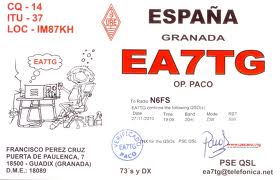 |
| Almost broke my all time QRPp record with this one |
anymore..
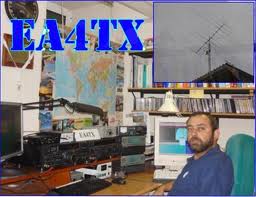 |
| 500mW contact |
was no new DXCC's for me to be had but lots of DX. It was 2pm in the afternoon local time and that was very odd for 10 meters to be this active but heck who is arguing. It seems I had a direct line to Spain, sure there was Germany and other European countries but they had huge pileup's waiting for a contact. It seemed to workout that I would fall upon Spanish stations calling CQ and it would work out that they were just waiting for me to come back to them. I made four contacts with as little power as possible. Since I worked stations with the minimum power it tends to drag out contacts as I start with 100mW"s or less and work my way up from there.
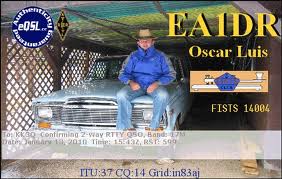 |
| 500mW contact. |
Mike Weir, VE9KK, is a regular contributor to AmateurRadio.com and writes from New Brunswick, Canada. Contact him at [email protected].
VHF SOTA Activation (W0/ SP-081)
It was another great day for Summits On The Air (SOTA) activity. I hiked up to Kaufman Ridge HP (W0/SP-081) with Joyce K0JJW to do the first SOTA activation of that summit. This summit is just south of Kaufman Ridge North (W0/SP-085) mentioned in this post.
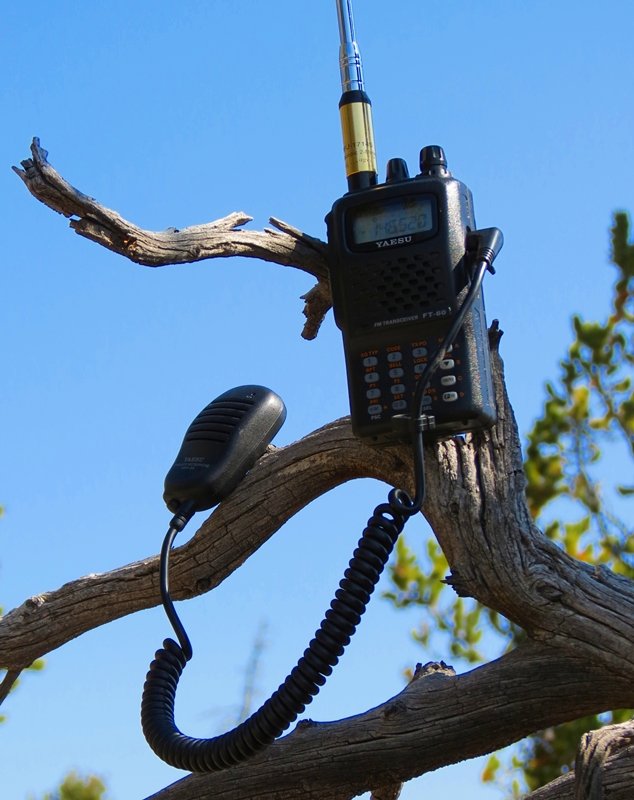
Unlike some of my previous SOTA activations, I actually kind of sort of planned this one. I had my Yaesu FT-60 HT with a decent omni antenna for 2 Meters (the MFJ-1714). I also took along the VX-8GR handheld for use as an APRS station. Note the innovative In The Tree mounting scheme for the FT-60:
On the way up, I heard Steve WG0AT on the summit of Mount Rosa (W0/FR-034) calling on 146.52 MHz. I gave a quick call to Steve to let him know I was hearing him but that I was not at the summit yet. About 20 minutes later, I was on top and worked Steve and his hiking partner Frank K0JQZ, for a summit-to-summit contact.
A call on 146.52 MHz got a reply from John N0EVH who was operating mobile. Then I worked Bill KD0PFF who was driving up a 4WD road to Red Cone Peak. Later, I worked his 4WD partner Stan KD0PFC. Fred WA0SIK, a regular in the various VHF contests, came up on five two to give me another contact. Then I got a call from Dave K0HTX who spends many weekends over on the other side of South Park. Finally, I caught Randy KN0TPC and Jeremy KD0MWT on 147.555 MHz, near Divide at a Boy Scout Camporee.
It was really cool to catch all these folks out having fun in the mountains. It was a glorious fall day and the aspen trees were at their peak fall color.
73, Bob K0NR
Bob Witte, KØNR, is a regular contributor to AmateurRadio.com and writes from Colorado, USA. Contact him at [email protected].
ICQ Podcast S05 E20 – Operating Aboard (23 September 2012)
Series Five Episode Twenty of the ICQ Podcast has been released. News Stories include :-
- Amateur Radio Astronomy
- Two commercial operations evicted from amateur bands
- Icom UK releases Amateur Radio IP Software
- Banbury Canal Day
- California QSO Party
- 3D2C DXpedition to Conway Reef
- End of an era for MKARS at Bletchley Park
- First Thames Amateur Radio Group Meeting
Listener mailbag and Martin (M1MRB) discusses operating aboard
Colin Butler, M6BOY, is the host of the ICQ Podcast, a weekly radio show about Amateur Radio. Contact him at [email protected].
 Ham Radio Deluxe |
 W5SWL Electronics |
 Ham Radio Prep |
 KB3IFH QSL Cards  Hip Ham Shirts  HamRadioAuctions HamRadioAuctions Reliance Antennas Reliance Antennas Enigma Shop Enigma Shop |  morseDX  Ni4L Antennas  R&L Electronics R&L Electronics antennas.us antennas.us QRV QRV |
- Matt W1MST, Managing Editor
