 |
 The Elecraft KX3 has a pulse……..
 30 September 2012 | by
 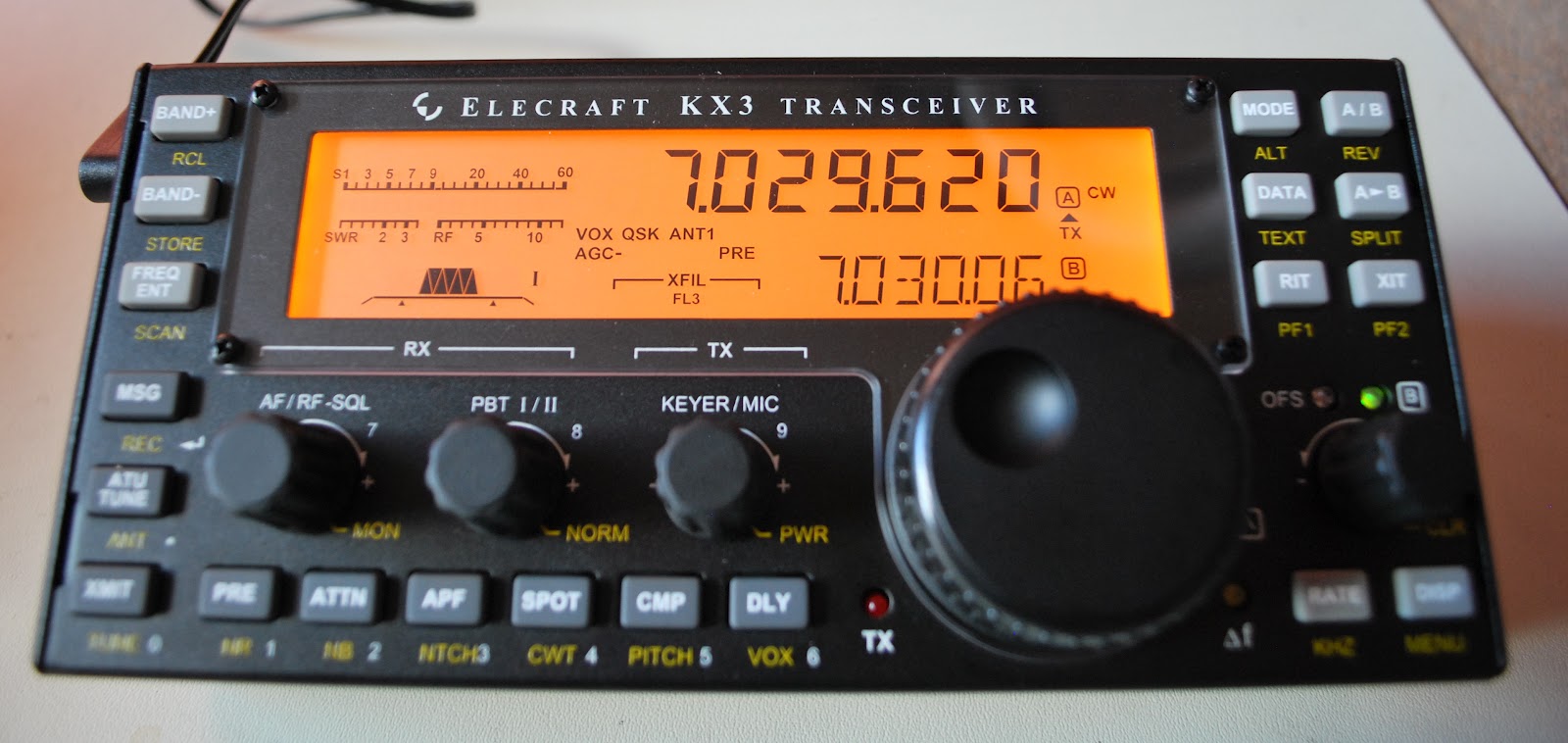 |
| KX3 serial number 1990 |
Mike Weir, VE9KK, is a regular contributor to AmateurRadio.com and writes from New Brunswick, Canada. Contact him at [email protected].
WWVBTrigger
If you have been following my adventures, specifically with the Etherkit OpenBeacon, you will know that I was investigating a method of triggering WSPR transmissions without leaving it attached to a computer. My requirements were that it be Arduino based, since I am learning about that as well, and have a very stable time source as necessitated by WSPR.
The available options for stable time sources in the Arduino time library include NTP, RTC, and GPS sources, I decided to go a different direction!
While investigating time sources I ran across the WWVBClock Project on Github and thought WWVB would make an interesting time source for this project. The first step was to find a receiver, which are far less common from online shops than I expected, but I was able to find one at my local Wal-Mart in the form of a self setting alarm clock for the reasonable cost of $10.
 WWVBTrigger Clock
As soon as I got home I opened it up to ensure that the module was not integrated into the main PCB as that would be of little use and to my delight it was a separate unit as shown below. It is the module on the left hand side of the larger PCB and the antenna is located at the top. A pair of cutters and one minute later, I had a WWVB receiver module.
 WWVBTrigger Clock Inside
Locating a datasheet for the module proved a little challenging, but I was able to locate the datasheet for IC used on the module, which is located here.
 WWVBTrigger Module
Having all of the necessary information, it was time to start playing. I breadboarded all of the components as show in the schematic and started hacking apart the code from the WWVB Clock Project.
 WWVBTrigger Schematic
 WWVBTrigger Breadboard
My initial plan was to use the WWVB receiver and the Arduino time library to set the internal clock with hopes that it would keep accurate time when a WWVB signal wasn’t available. This proved to be a lost cause as it was 4 seconds behind after 90 minutes without a WWVB signal, far beyond the 2 seconds of accuracy required by WSPR.
The second, and current implementation, only transmits when a WWVB signal is available to guarantee accurate timing. The code by default will transmit at 4 minute intervals, but this value is configurable by manipulating the triggerInterval variable. During normal operations the code displays, via the serial port, each time an output signal is sent, enabling you to not only track transmissions, but also the availability of the WWVB signal in your area.
 WWVBTrigger Output
Here are the spots as reported on WSPR for the last 24 hours all of which have been triggered by this project.
 WSPR Spots
This project has been a lot of fun and works quite well! A WWVB signal is consistently available here in Central Arkansas, in the Central time zone, from about 7PM through the 10AM, honestly much more than I expected. The code for the project is available on Github, so feel free to use it and experiment!
Robert Garcia, K5DTE, is a regular contributor to AmateurRadio.com and writes from Arkansas, USA. Contact him at [email protected].
FT8900 in the shack: 50MHz FM added to the monitoring mix
With the Wouxun dual band mobile rig here to be reviewed for Practical Wireless, I thought I would pop it in the car for a week or so. I did that yesterday and took the FT8900 out of the car. Since all the connections are the same as the FT7900 I use in the shack for 144/432MHz FM, I thought I would use it in the shack.
It seems to be working well, and nice to have 50MHz on it too, though no 50MHz FM QSOs yet. I’ve a couple of memories set up for 29MHz and though it’s only on the 50:144/432 MHz collinear, good signals have been coming through on 29MHz FM.
More of course on the Wouxun in Practical Wireless!

Tim Kirby, G4VXE, is a regular contributor to AmateurRadio.com and writes from Oxfordshire, England. Contact him at [email protected].
AlexLoop gets an airing
Several of my readers have been patiently waiting to know how the AlexLoop and KX3 have been performing together. I am interested too, but I’m not yet well enough to attempt any outings with a rucksack full of radio gear. Today it was raining and I wouldn’t have wanted to go out anyway. So I decided to operate portable from inside the warm, dry shack instead.
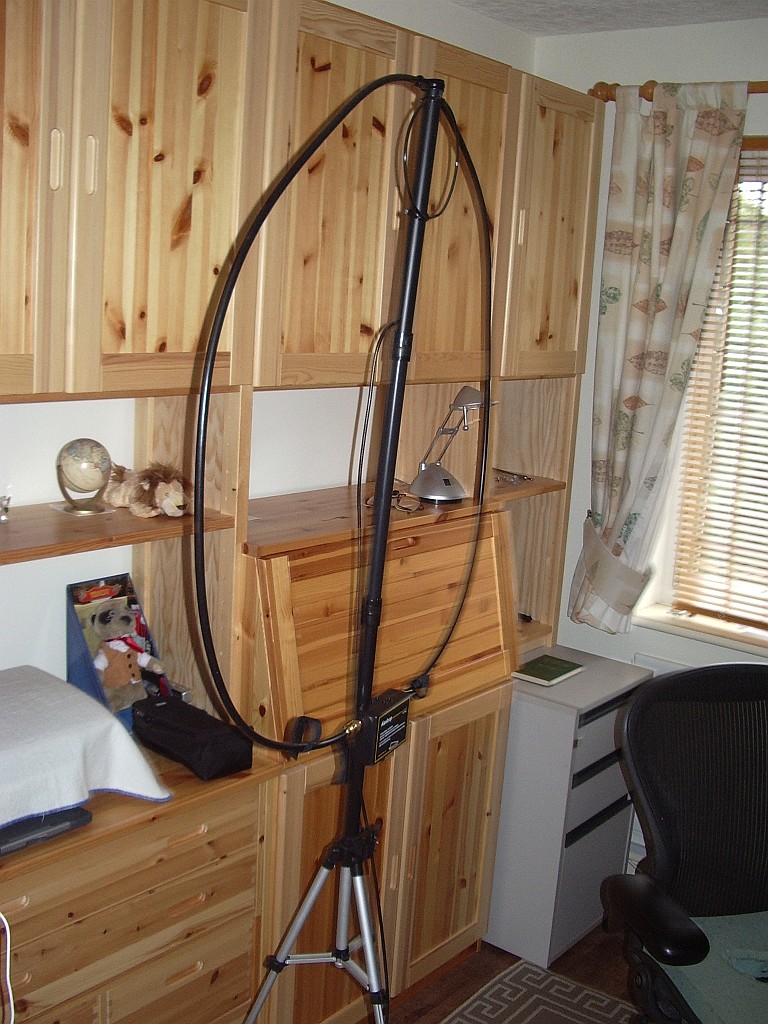
The AlexLoop was assembled, mounted on its tripod and stood in a corner of the shack. The position is far from ideal: my shack is really small and the antenna was too close to the shelves containing books, magazines and equipment. I could only get an SWR of around 5 to 1 on the higher bands. I used the KX3’s built-in AMU to take care of it. That’s not how a magnetic loop is supposed to be used, but in this situation there’s no alternative.
The KX3 was run off the shack power supply so the power out was the full 10 watts. I hope to find a battery that will provide enough volts that I can run 10 watts in the field, but as I don’t yet have one this was a little bit of cheating!
The first band I tried was 12 metres. Here, Valery, ER3ZZ in Moldova came back to my first call and gave me a 5 and 5 report. Easy peasy.
Next stop was 10 metres, where Yakov RA9XAU quickly replied to my call. Another 5 and 5 was logged. Can, TA3GO was next in the log. This time a 5 and 9 was received.
One EA9 didn’t want to talk to me as I wasn’t DX. That would actually have been an all-time new country for me, as I think Ceuta-Melilla is a separate entity from Spain. Victor, RV3RM was working other G stations and gave me a 5 and 8 report.
After lunch I spent some time listening to, and attempting to call, Stateside stations. Some were very strong but I couldn’t be heard over the pile of stations calling them. That would have been quite a scoop – to cross the Atlantic with QRP and a portable antenna. I heard Yuri UT9MZ working Europe so I called him and 5 and 9 reports were exchanged.
I spent some time listening on other bands. Peter I5CTE was a massive signal – genuinely peaking more than S9+20dB on the KX3’s S meter. on 15m. Italy is a good direction for me, for some reason. We had a proper chat lasting several minutes and Peter told me that my QRP signal peaked over 5 and 9 at times.
My very subjective conclusion is that the AlexLoop feels no different in operation than my attic multiband dipole and MFJ magnetic loop. I didn’t even feel at a particular disadvantage from the low power, except perhaps when I was attempting to work USA stations. The AlexLoop is a very good antenna and together with the Elecraft KX3 make for a potent combination, especially if you can take advantage of the KX3’s full 10 watts output.

Julian Moss, G4ILO, is a regular contributor to AmateurRadio.com and writes from Cumbria, England. Contact him at [email protected].
Android
I am making this brief post on a very inexpensive Android tablet that I purchased through eBay. Not the ideal way to do this, but fun in any case.
I was amazed on finding so many Amateur Radio apps in the Google Play Store.
I have a few installed, including Ham Log. It will be interesting to see if this tablet can be used as an effective portable ops logging device. Reminds me of the time that I used to use a Palm Pilot for that purpose.
One concern would be that the battery life on this thing isn’t all that great. It will be fun to experiment, though.
72 de Larry W2LJ
QRP- When you care to send the very least!

Larry Makoski, W2LJ, is a regular contributor to AmateurRadio.com and writes from New Jersey, USA. Contact him at [email protected].
New QRP operating event
A new QRP operating event will occur NEXT Saturday – October 6th from 17:00 to 21:OO UTC. It is sponsored by the 4 States QRP Group and is called the “4X4 QRP Sprint”.
For particulars, please visit:
http://www.4sqrp.com/FourByFour/4%20State%204×4%20QRP%20Sprint.pdf
This was the announcement that hit the QRP e-mail reflectors:
QRPsports has a new Sprint to provide lots of fun!
The 4 State QRP Group is sponsoring the new: 4×4 QRP Sprint……..4 hours and your best 4 bands! October 6, 2012……1700 to 2100 UTC
Special Bonus Points for being portable
Special Bonus Points for making a contact with a station using a HamCan
Extra Points for being a member of the 4sqrp reflector or having attended OzarkCon
More on the rules, awards, online downloadable scoring, and Bonus Points, see: http://www.4sqrp.com/4sqrpOnTheAir.php
Scroll to the 4×4 QRP Sprint information. Its gonna be fun!
72/73….Walter – K5EST – 4×4 QRP Sprint Coordinator
I can deeply appreciate the endeavor of launching a new QRP event! And any excuse to get outside and operate is a good one as far as I am concerned. I hope to get out next Saturday and jump into the fray. The AccuWeather outlook for next weekend in Central NJ is clear with daytime highs in the 60s (18C). So if that holds true, it can potentially be beautiful outdoor operating conditions.
As far as QRP events go – the more the merrier. Please consider joining in to make the 4 States QRP Group’s new event a rousing success!
72 de Larry W2LJ
QRP – When you care to send the very least!

Larry Makoski, W2LJ, is a regular contributor to AmateurRadio.com and writes from New Jersey, USA. Contact him at [email protected].
10m WSPR spots 29 Sep 2012
 |
| 10m WSPR spots – 29 Sep 2012 |

Julian Moss, G4ILO, is a regular contributor to AmateurRadio.com and writes from Cumbria, England. Contact him at [email protected].
 Ham Radio Deluxe |
 W5SWL Electronics |
 Ham Radio Prep |
 KB3IFH QSL Cards  Hip Ham Shirts  HamRadioAuctions HamRadioAuctions Reliance Antennas Reliance Antennas Enigma Shop Enigma Shop |  morseDX  Ni4L Antennas  R&L Electronics R&L Electronics antennas.us antennas.us QRV QRV |
- Matt W1MST, Managing Editor
