 |
 10m WSPR spots 31 Oct 2012
 31 October 2012 | by
  |
| 10m WSPR spots @ G4ILO 31 October 2012 |

Julian Moss, G4ILO, is a regular contributor to AmateurRadio.com and writes from Cumbria, England. Contact him at [email protected].
Lucky
Last night was a rather sleepless night. As Larry W2LJ mentioned, the rain wasn’t so bad, but the wind was downright scary. Up until about midnight I periodically went outside and walked around the house looking for damage, keeping my back and weight to the wind in order to not get pelted in the face or get blown over. The wind sounded like a freight train coming over the ridge. I was so glad I put temporary guy lines on the tower. Other than some siding on corners popping out, there was no permanent damage occurring, however I noticed my HF tribander and 6 meter beam misaligned on the tower. Under the force of the wind the tribander was beginning to turn and go off azimuth. I rotated the antennas in an attempt to use the wind to true up the tribander.
About 3 AM I awoke to metal banging against the house. I got dressed, went outside and found a 10 foot piece of aluminum flashing or trim dangling from the roof eave which shortly fell to the ground. Other than that, no more damage. Amazingly we still had electricity.
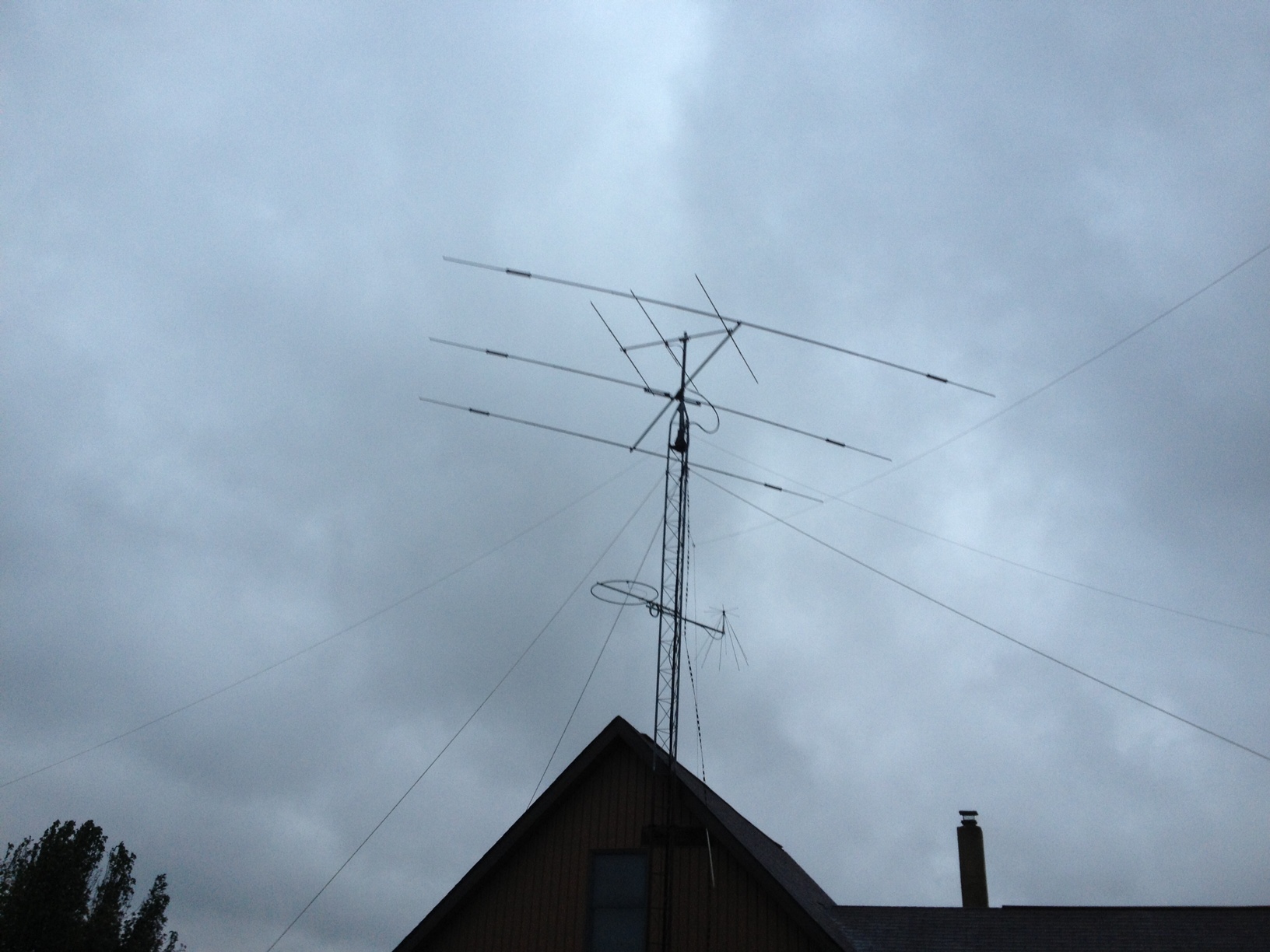
This morning when I awoke it was still quite windy and blowing the rain sideways, though not as violent as last night. There was no further damage to the house, but the antennas were more misaligned than before. So we were lucky here in Pennsylvania, and are thankful for having power and a home. A lot of people in New York, New Jersey, and to the south and west of us in PA did not fare so well.

WSJT-X for LF: Now I really will have to look at a top band antenna…
A couple of days ago, I read a post that the wonderful Joe Taylor, K1JT was working on a new mode for use on LF. It wasn’t until this evening that I read up a little more.
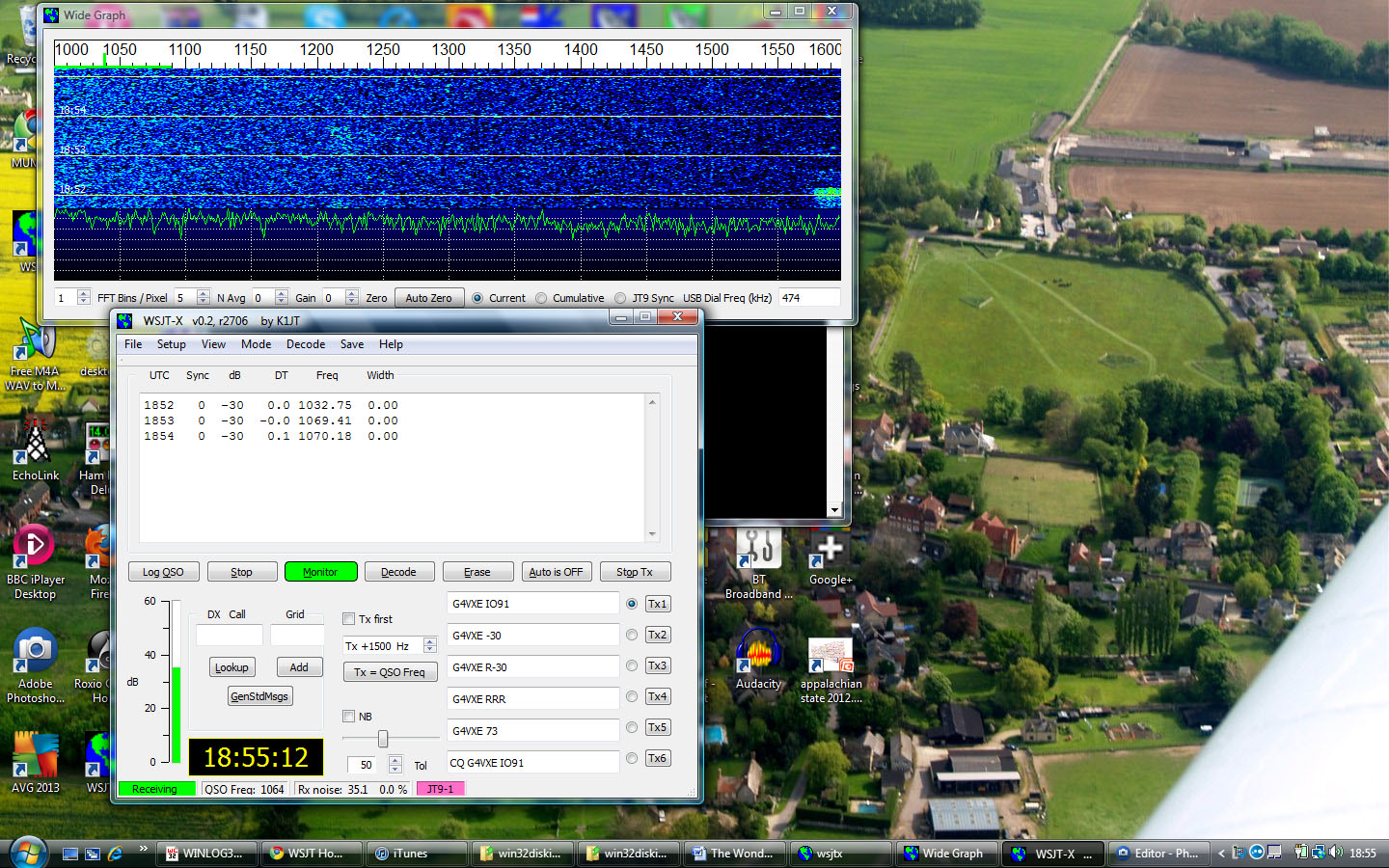
Joe says, on wsprnet.org
“If you are on 160 meters, or perhaps on 472 or 137 kHz, you may be interested in a new mode called JT9, designed especially for making QSOs on these bands. JT9 uses the structured messages introduced in 2003 for the JT65 mode, now widely used for EME and for QRP operations at HF. JT9 can operate at signal levels as low as -27 dB (in a 2500 Hz reference bandwidth), with one-minute timed transmissions. It also offers slower transmissions of 2, 5, 10 and 30 minutes duration, and the slowest mode can decode signals as weak as -40 dB. With one-minute transmissions, submode JT9-1 has a total bandwidth of 15.6 Hz — less than one-tenth the bandwidth of a JT65A signal. The other submodes are narrower still: a JT9-30 signal occupies about 0.4 Hz total bandwidth.
http://www.physics.princeton.edu/pulsar/K1JT/WSJT-X_Quick_Start_Guide.pdf ,
and an early version of WSJT-X can be downloaded from
http://physics.princeton.edu/pulsar/K1JT/WSJTX_01r2695.exe .
Tim Kirby, G4VXE, is a regular contributor to AmateurRadio.com and writes from Oxfordshire, England. Contact him at [email protected].
10m WSPR spots 30 Oct 2012
 |
| 10m WSPR spots @ G4ILO 30 October 2012 |
Sorry, Tim!

Julian Moss, G4ILO, is a regular contributor to AmateurRadio.com and writes from Cumbria, England. Contact him at [email protected].
Landfall !!!
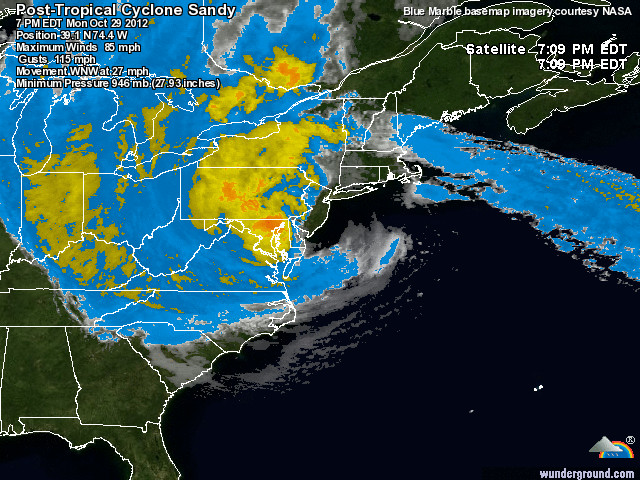
Hurricane Sandy has doubled her speed from 14 MPH to 28 MPH and has made landfall around the Cape May area of New Jersey.

Larry Makoski, W2LJ, is a regular contributor to AmateurRadio.com and writes from New Jersey, USA. Contact him at [email protected].
Two to four hours from landfall
and the winds are picking up. This is the maple in the backyard that serves as the center support for my 88′ EDZ.
So far, recorded gusts from nearby weather stations have topped out at 45 MPH. That may double as Sandy makes landfall. I heard a loud crack before. Turns out a branch in the neighbor’s back yard snapped. Hope that’s not in store for us.
Power has gone out briefly several times already. Marianne has called to inform me she might be stuck overnight at the dialysis clinic where she’s an RN. Seems that some of the local roads have been closed.
72 de Larry W2LJ
QRP – When you care to send the very least!

Larry Makoski, W2LJ, is a regular contributor to AmateurRadio.com and writes from New Jersey, USA. Contact him at [email protected].
28MHz WSPR 29th October 2012 – or ‘How does Julian hear all those W6s?’
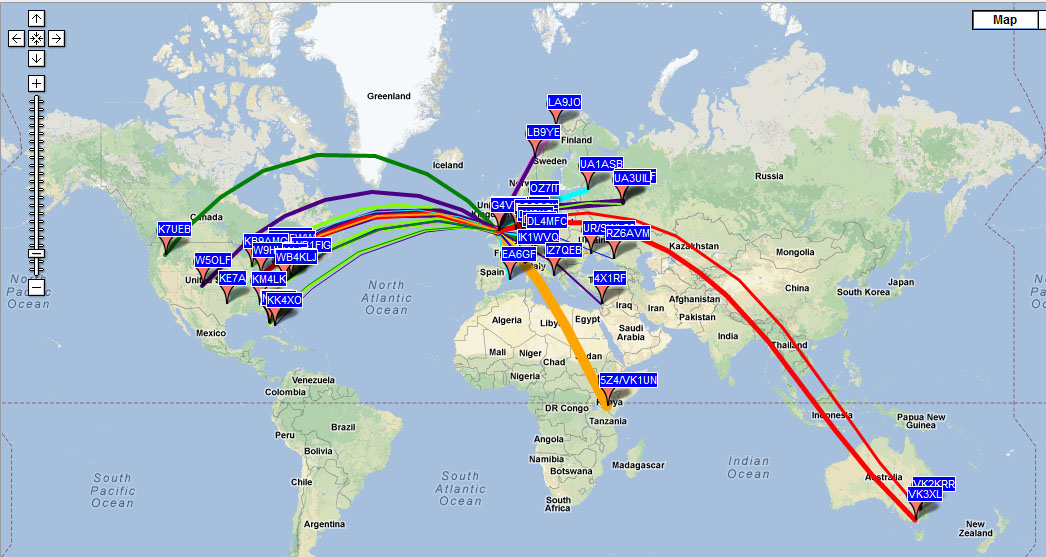
Unexpectedly I was at home today so I ran the 1W 28MHz WSPR again. As ever, conditions were a bit different. VK3XL was a very prominent path this morning, but my 1W didn’t get there! Nevertheless, some interesting conditions. 5Z4/VK1UN was a consistently good signal for most of the morning and heard me, which was very pleasing.
The US opening was pretty good to and I was pleased to be heard at K7UEB. Shortly after the band closed to North America, once again, there were some very strong signals from southern Germany, with DK6UG once again being excellent copy.
Looking at the difference between Julian G4ILO’s results and my own, I am tempted to take down the Butternut and use a loft dipole! Of course, the difference could be down to all sorts of things, I have a long feeder run of not very nice coax, which could be making a difference. Julian’s receiver is probably better than mine! I’m starting to wonder whether the lime tree, immediately behind the antenna in the direction of the west coast of the US isn’t shielding some of the weak signals. Who knows! It’s fascinating to contrast the results and in any event, I am amazed that 1W is getting as far as it is. But well done, Julian!
Tim Kirby, G4VXE, is a regular contributor to AmateurRadio.com and writes from Oxfordshire, England. Contact him at [email protected].
 Ham Radio Deluxe |
 W5SWL Electronics |
 Ham Radio Prep |
 KB3IFH QSL Cards  Hip Ham Shirts  HamRadioAuctions HamRadioAuctions Reliance Antennas Reliance Antennas Enigma Shop Enigma Shop |  morseDX  Ni4L Antennas  R&L Electronics R&L Electronics antennas.us antennas.us QRV QRV |
- Matt W1MST, Managing Editor
