 |
 It’s magic!
 17 November 2012 | by
I’m starting to believe that my attic dipole does have magical powers on 10 metres. Right now I’m hearing or being heard by 8 different stations but they are only hearing or being heard by me!

Julian Moss, G4ILO, is a regular contributor to AmateurRadio.com and writes from Cumbria, England. Contact him at [email protected].
Visiting 409shop in Hong Kong

A stop-over on my way from Sydney to Oslo gave me the opportunity today to visit Apliu street in Hong Kong. This is where all the electronics products are found. As I had purchased a Baofeng UV-5R from them before it was fun to stop by the 409shop as well. Their address is on their web site, and the word “showroom” really made me expect something larger than what I found. It turns out to be just one small store among hundreds of others in this street.
I bought a handheld frequency counter, Yaege FC-1, and a better antenna, Nagoya NA-666, for the UV-5R and got a good deal – I like to think that it is because I presented myself as a previous internet customer.
On the other side of the street there was another store with communications equipment as well, Yee Fu Technology Shop, where I bought a 13.8V/20 A switch mode power supply, HK Products Electronics SPS-200MA.
It even had a noise-offset control which I have come to appreciate in my other power supply, the Alinco DM-330MV. It is particularly nice to have on 160 m. How they avoid Alinco’s pending patent on this feature is something I don’t know. There seems to be several other supplies on the market with this feature also, such as the Watson Power-Mite-NF (NF for Noise offset Function), so maybe Alinco’s patent application hasn’t been granted?
Sverre Holm, LA3ZA, is a regular contributor to AmateurRadio.com and writes from Norway. Contact him at [email protected].
10m 16 November 2012
 |
| 10m WSPR spots @ G4ILO 16 November 2012 |

Julian Moss, G4ILO, is a regular contributor to AmateurRadio.com and writes from Cumbria, England. Contact him at [email protected].
A good day’s VHF
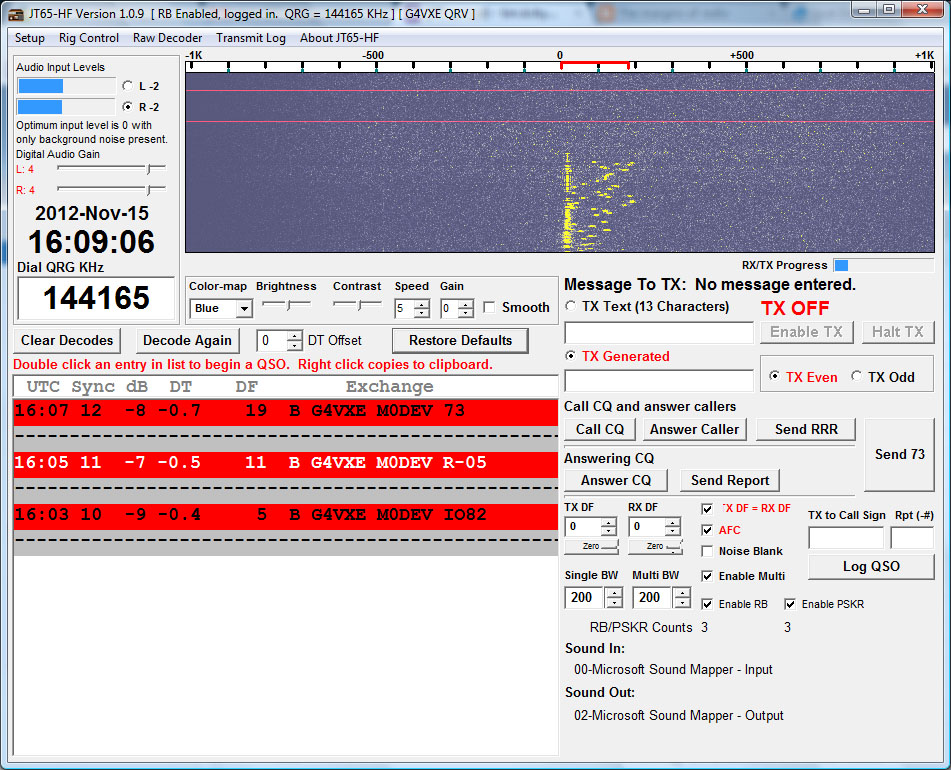
It was nice to hear from Mark M0DEV following our exchange of WSPR signals on 144MHz. It turned out that I was the most distant WSPR signal that he’d heard on 144MHz at that point. We decided it would be fun to try a QSO and decided that since we both used JT65-HF regularly, we’d use that rather than the more usual variant for VHF/UHF JT65B.
Running 10W at each end, both into collinears, it was an easy QSO over a path of around 140km. Not massive DX of course, but very satisfying. Following a successful exchange of signals we then turned down our power as low as it would go – around 1W in my case and were still easy able to exchange signals. Mark calculated that given the conditions at the time, around 150mW would have probably done the trick. Sadly I can’t run that little power – at least not readily!
Tim Kirby, G4VXE, is a regular contributor to AmateurRadio.com and writes from Oxfordshire, England. Contact him at [email protected].
PigRig Transceiver
Diz, W8DIZ of Kits and Parts dot Com, has come out with a new transceiver kit – The Flying Pigs “PigRig”.
It is a single frequency transceiver. Sound strange? Maybe it is, but listen to Diz’s own words:
“This transceiver was designed for Radio Clubs and/or Special Events. You turn the radio on…you listen…you do not tune…you do not switch anything…you do not search. If you hear someone on “your special frequency”, there is a good chance it could be a member of your group.
Here is what it is and is not.
It is a club radio.
It is not another me-too qrp contender
It is a single conversion design
It does not receive 2 sidebands…only one
It does have a full 5 watts output at about 13.6 volts
It does not have any tuning controls
It does have a piggie custom keyer chip
It is like a ham version of Channel 19 using CW only
The size of the PCB is only 2.5″ (63,5 mm) by 3.8″ (96,5 mm), and Yes…it does produce a full 4.99 watts RF out and it is as sensitive as just about anything else that you may have in your radio shack. Custom club/group frequencies are available for 40 meters. The name of this radio shall henceforth be labeled as the “Flying Pig Rig”.
For details – schematic and building guide as well as information on how to order, click here.
72 de Larry W2LJ
QRP – When you care to send the very least!
Larry Makoski, W2LJ, is a regular contributor to AmateurRadio.com and writes from New Jersey, USA. Contact him at [email protected].
Ham Nation 73

http://dts.podtrac.com/redirect.mp4/twit.cachefly.net/video/hn/hn0073/hn0073_h264m_1280x720_1872.mp4
http://dts.podtrac.com/redirect.mp4/twit.cachefly.net/video/hn/hn0073/hn0073_h264m_864x480_500.mp4
http://dts.podtrac.com/redirect.mp4/twit.cachefly.net/video/hn/hn0073/hn0073_h264b_640x368_256.mp4
http://www.podtrac.com/pts/redirect.mp3/twit.cachefly.net/hn0073.mp3
Hosts: Bob Heil (K9EID), Gordon West (WB6NOA), and George Thomas (W5JDX).
A look back at Ham newsletters, Bob’s tower project, and tracing coax cable with a cassette player.
Guests: Don Wilbanks (AE5DW), and Dan Vanevenhoven (N8LVS).
Download or subscribe to this show at http://twit.tv/hn.
Submit your own video to Ham Nation! See the Video Guidelines, http://www.frozen-in-time.com/guide/
We invite you to read, add to, and amend our show notes at wiki.twit.tv.
Thanks to Joe Walsh who wrote and plays the Ham Nation theme.
Thanks to Cachefly for the bandwidth for this show.
Dr. Bob Heil, K9EID, is the founder of Heil Sound and host of TWiT.tv's Ham Nation which streams live each Tuesday at 6:00pm PT (9:00pm ET) at http://live.twit.tv. Contact him at [email protected].
SOTA Logging
Pencil is mightier than the keyboard…discuss
I’m a pen and paper kind of guy at heart but thought I’d try and find an electronic solution, just in case my pencil breaks and my phone is the only workable solution.
Bet you’ve never heard that before.
Well after a lot of scratching around I found VK Port-a-log. It is an android solution so tough luck fruit based phone users. A really easy to use solution for those who carry a phone. The screenshot below is pretty neat and from the original website. Well worth checking out. To get it you need to be able to install the .apk from the Yahoo Group. Thats a bit of a pain but hey ho no big deal really.

But I still like a pencil!!
Of course you do, it is the most versatile solution. But adding the data into the SOTA databse can be a slow process. So here is another Windows tool that is really very good. I’ll run through the idea.
Log as normal with a pencil and pen. Instead of getting home and logging via the website. Use Fast Log Entry (FLE) instead. This uber geeky method by DF3CB allows you to type the information as you need and then export a SOTA compatible csv file ready for upload. I found it really quick and easy to use. Here is a screen shot from the authors website so you get the idea.

Type in the left using the tags to identify what it is you are saying. Press F5 and hey presto the log appears on the right of the screen. There is a sample file to crib from.
So thats me sorted for this years mini adventures into the fells. Once again, very happy to use these great tools. Thanks to both the developers for making stuff that works just as we want it.
Alex Hill, G7KSE, is a regular contributor to AmateurRadio.com and writes from Cumbria, UK. Contact him at [email protected].
 Ham Radio Deluxe |
 W5SWL Electronics |
 Ham Radio Prep |
 KB3IFH QSL Cards  Hip Ham Shirts  HamRadioAuctions HamRadioAuctions Reliance Antennas Reliance Antennas Enigma Shop Enigma Shop |  morseDX  Ni4L Antennas  R&L Electronics R&L Electronics antennas.us antennas.us QRV QRV |
- Matt W1MST, Managing Editor
