 |
 CCRs Defeated Again! (A Temporary Vertical Antenna)
 19 November 2012 | by
 My “permanently installed” home HF station in my cursed covenant protected neighborhood employs a stealthy pine tree-mounted fan dipole to radiate nicely on 10m, 20m, and 40m. But I’ve been missing out on a lot of fun on some of those other higher HF bands… until recently. I’ve found another way around the CCR Nazis with a temporarily erected portable ¼ wave vertical set up in my driveway. I used it today to make contacts from Minnesota to Switzerland with 100 watts on 10m and 17m bands, but it works just as fantastically on 12m, 15m, and 20m bands. Here’s the setup.
Radiating Element: The radiating element I’m using is the MFJ-1979 stainless telescopic whip [~ $60]. It’s a pretty solid large extendable element that pulls out to 17 feet, so it’s effective down to 20m band without a tuner. It collapses down to just 27 inches, so it can also be used for everything up to 50 MHz and it stows away nicely. I tune it to a given band by simply extending or contracting it while measuring SWR with an analyzer, and I have marked the telescoping segments with permanent ink so I can zip quickly from one band extension to another without the analyzer hassle. Yes, it’s a little extra trouble compared to using a true multiband antenna or a tuner, but I can usually obtain 1.2:1 SWR or better with only a few seconds of finagling. Plus, I like to set up a station outdoors, either in the shade of the pines or just inside the garage within a few step of the well-stocked refrigerator, so it’s not too inconvenient to stroll over to the antenna to adjust it when I’m ready to switch bands.

Mounting Arrangement: The telescopic element fits into a High Sierra Jaws Antenna Mount [~ $35 ]. This is a really nicely designed antenna mount with an adjustable clamp that’ll hold firmly onto almost anything. It has a standard 3/8 – 24 thread female mount into which the MFJ-1979 fits and an SO-239 “UHF” connector on the opposite side. It also has a convenient hole drilled into the clamp body on the electrical ground side through which a screw can be used to attach ground radials. I like to have the Jaws clamp chomp down onto the wooden handle of a common dirt tamper. The tamper has a heavy, flat metal base that is more than sufficient to support the fully extended vertical element, and the Jaws clamp works nicely with the wooden handle. Plus it’s usually just hanging out in my garage and is conveniently portable. A fat stake driven into the earth will do just as well with the Jaws clamp.


Ground Radials: I constructed four bundles of ground radial wires, each bundle comprised of six wires soldered into a #10 ring terminal. Each of the four bundles spreads out into a quadrant of radials under the telescopic element, 24 radials total. The four ring terminals are stacked over the Jaws clamp hole and attached with a small stainless screw and nut. Each radial wire is about 16 feet long. I calculated the perimeter chord distance between evenly spaced radials for the 15 degree angle subtended between radials (about 49 inches), and I cut a stick to that length to make it easy to evenly space the radial wires when spreading them along the ground. Since I store the wires in coiled bundles, I use a rock or a small tent stake to keep them held straight.

Set Up & Take Down: It usually requires about 10 – 15 minutes to set up the entire antenna, with the bulk of that time dedicated to unfurling, spreading, and anchoring the ground radial wires. I route about 40 feet of coax to the radio, typically outdoors as previously noted, or through a window to a comfortable operating location on cold days. Antenna deconstruction is even quicker – kick the rocks aside, collect the quadrant ground radial bundles at the antenna and roll them up, securing each with a zip tie. I leave them attached to the Jaws clamp ready to go for next time. Scrunching up the telescopic element and detaching it from the clamp is a breeze, and it all tucks away in moments.

Results: I’ve used this antenna several times in recent weeks at my home and with a portable station for Boy Scout Jamboree On The Air (JOTA), each time with fantastic results. Today with nice F2 and sporadic E conditions I made many contacts into Europe and across North America with the 100 watts of a barefoot Yaesu FT-897D. This simple antenna gets me onto those “other bands” that I’ve been missing out on, 12m, 15m, and 17m, as well as the familiar 10m and 20m bands that my fan dipole also delivers. In particular, I have really come to enjoy 17m band’s more relaxed and gentlemanly character. Maybe I’ll catch you there sometime soon!
This antenna can well serve the ham in a CCR protected neighborhood with a quick and easy temporary installation that won’t attract a lot of attention. It also offers the convenience of portability, so it can be readily hauled to the local park, camp, forest or mountain location for relaxing outdoor operation. Look for a feature article and video about this antenna set up coming soon to HamRadioSchool.com.
Stu Turner, WØSTU, is an author and professional educator who served as a US Air Force Academy engineering professor for eight years where he honed his skills of making difficult topics easy to understand. Contact him at [email protected].
10m 19 November 2012
Another day of good propagation allowed my love affair with 10m to continue.
| 2012/11/19 | 12:34 | 28.121 | BPSK31 | NP4EG | 599 | 599 | Edgar | N. Puerto Rico | ||
| 2012/11/19 | 12:50 | 28.122 | BPSK31 | UT5AJ | 599 | 599 | Vlad | Kramatorsk | ||
| 2012/11/19 | 13:50 | 28.123 | BPSK31 | UR4QX | 599 | 599 | Yuri | Berdyansk | ||
| 2012/11/19 | 14:11 | 28.121 | BPSK31 | RG5A | 599 | 599 | Alex | Moscow | ||
| 2012/11/19 | 14:25 | 28.122 | BPSK31 | YY4HAH | 599 | 599 | Heiroun | Valencia Vene… | ||
| 2012/11/19 | 14:35 | 28.122 | BPSK31 | N4PJL | 559 | 599 | Pete | Deep Creek La… | ||
| 2012/11/19 | 14:41 | 28.122 | BPSK31 | AB8O | 599 | 599 | John | Milford, OH n… | ||
| 2012/11/19 | 14:59 | 28.122 | BPSK31 | KJ4LEC | 599 | 599 | Marion | Cumberland Ga… | ||
| 2012/11/19 | 15:08 | 28.122 | BPSK31 | W5FER | 599 | 599 | Jim | San Antonio, TX | ||
| 2012/11/19 | 15:17 | 28.122 | BPSK31 | VE3NOO | 599 | 599 | Michael | Sandhurst, On… | ||
| 2012/11/19 | 15:23 | 28.122 | BPSK31 | AE5XI | 599 | 599 | Terry | Las Cruces, NM | ||
| 2012/11/19 | 15:44 | 28.122 | BPSK31 | K9ZJ | 579 | 579 | Rich | Waukesha, WI |
Besides these contacts I heard, but couldn’t catch, stations in Mexico and Paraguay. I’m hoping the good propagation will continue so that I can add these to the log.
Because of this, not too much time was spent on WSPR today, so the WSPR map looked like this:
 |
| 10m WSPR spots @ G4ILO 19 November 2012 |

Julian Moss, G4ILO, is a regular contributor to AmateurRadio.com and writes from Cumbria, England. Contact him at [email protected].
QST has added a great app

Mike Weir, VE9KK, is a regular contributor to AmateurRadio.com and writes from New Brunswick, Canada. Contact him at [email protected].
Today’s 28MHz WSPR

A good day on 28MHz WSPR, particularly as I didn’t get started until I’d finished playing with the DSTAR kit this morning
Tim Kirby, G4VXE, is a regular contributor to AmateurRadio.com and writes from Oxfordshire, England. Contact him at [email protected].
New version of WinDV v1.5.5
Earlier in the week I noticed that there was a new version of the WinDV software that I use in conjunction with the DVAP, version 1.5.5. I downloaded it then but it wasn’t until this morning when I was doing some household chores and garden work that I had a chance to try it out. I hooked the DVAP up to REF001C and had a nice QSO with Brian, ZL1HN. During the QSO with Brian he mentioned getting a Raspberry Pi working with a DVAP which sounded an interesting project. Oh dear, I can see me getting a Pi at this rate…. I had another interesting chat with Clive 2W0CLJ who was doing good stuff with one of the DVRPTR boards and an FT7800.
Get the new version of WinDV at the dutch*star site
Tim Kirby, G4VXE, is a regular contributor to AmateurRadio.com and writes from Oxfordshire, England. Contact him at [email protected].
10m 18 November 2012
I nearly got myself locked out of the WSPR map page today. I must have managed to save the settings to try to display spots for all bands for the last 24 jours, or something like that, because whenever I went to the page the web browser froze up while it tried to render the map and I couln’t get back to the settings boxes to change it. I had to find out how to delete all cached files in Chrome before I could access it again.
 |
| 10m WSPR spots @ G4ILO 18 November 2012 |
I lost quite a lot of time trying to sort that out. I also spent an hour or so seeing what I could work on 10m PSK31. I managed to QSO with several US stations including N7WET in Tucson, Arizona and KB5IAV in Baton Rouge, Louisiana.
I worked two all time new countries as well. Fabio CU3HN in the Azores has one of those QSLs that never fail to bring a smile to my face.
 |
| QSL of CU3HN |
Victor, HP1AVS in Panama I had heard before but not managed to work. So I was pleased to add his call to the log as well.
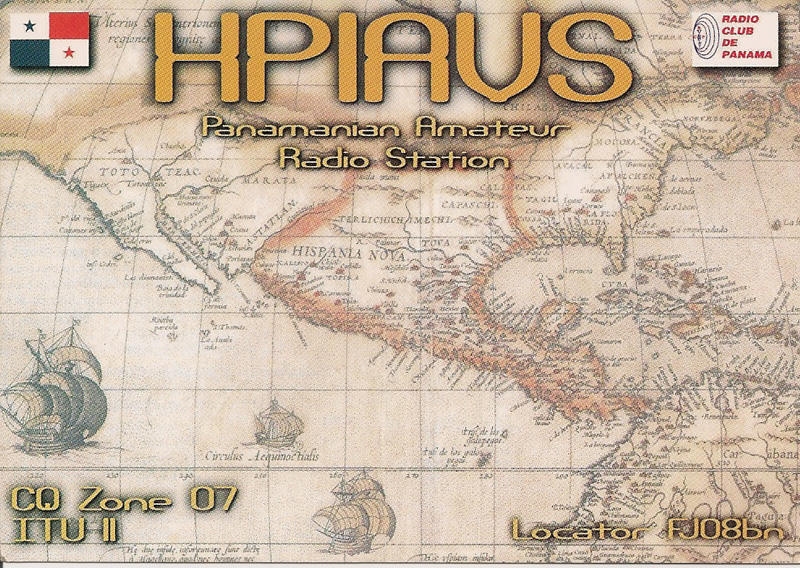 |
| QSL of HP1AVS |
I love 10 metres!

Julian Moss, G4ILO, is a regular contributor to AmateurRadio.com and writes from Cumbria, England. Contact him at [email protected].
ICQ Podcast S05 E24 – Campbell Island DXPedition (18 November 2012)
Series Five Episode Twenty-Four of the ICQ Podcast has been released. News Stories include :-
- Antenna masts and NSW planning law reform
- Amateur Radio club wants weather transmitter in Minden
- World DX Club to close down
- VooDoo in Liberia
- Successful DXpedition to Herm Island
- China name change and focus
- Mysterious Chinese signals on radio bands
- International Day of Persons with Disabilities
- Short path propagation charts from the UK
- Radio switchover delayed as listeners shun digital
listener mailbag Ed Durrant (VK2JI/VK2ARE) interviews Tommy VK2IR, DX'Pedition leader and organiser for the Campbell Island DX'Pedition plus Martin Rothwell (M0SGL) reviews the Kempton Park Rally.
Colin Butler, M6BOY, is the host of the ICQ Podcast, a weekly radio show about Amateur Radio. Contact him at [email protected].
 Ham Radio Deluxe |
 W5SWL Electronics |
 Ham Radio Prep |
 KB3IFH QSL Cards  Hip Ham Shirts  HamRadioAuctions HamRadioAuctions Reliance Antennas Reliance Antennas Enigma Shop Enigma Shop |  morseDX  Ni4L Antennas  R&L Electronics R&L Electronics antennas.us antennas.us QRV QRV |
- Matt W1MST, Managing Editor
