 |
 Some things to avoid and include in contests
 20 November 2012 | by
 Never update your contesting software the day of the contest....... "Software surprise" is not needed during a contest.
Never assume your contest station is running great just because it was last time. ..........Give the station a workout a few days before the contest.
Never update the rigs firmware just before a contest.......firmware glitches will throw your contesting off.
Never forget about the family during a contest weekend.......an hour away here or there can be a refreshing break.
Never get upset and frustrated......it's a contest have fun, know from the outset there is going to be poor op's out there.
Never think you are NOT going to get board at times.....there will be slow times have other things planned.
Never forget about non-contesters and respect mode allocations on the bands.......it's not intentional most times we just get carried away.
Always make sure the YL's "honey do" list has no outstanding promised items for that weekend.
Always understand that things never go as planned.
Always have some exercise, break times and eating times planned, a crock pot menu is a great way to have good dinners with very little work.
Always use headphones (especially CW contests) it may sound like sweet music to you but to the rest of the family (pets included) it's NOISE!!
Always have some goals for the contest.....and understand they can change.
Always make sure you are comfortable....cool in summer, warm in the winter, good chair and operating position just to mention a few things.
Always investigate if other major contests are going on the same weekend.......it can get frustrating when two stations from separate contests are giving exchanges neither can understand.
Always read and understand contest rules before the contest..........self explanatory.
Contest on!!!
P.S.....please leave your comments with more includes or avoids
Mike Weir, VE9KK, is a regular contributor to AmateurRadio.com and writes from New Brunswick, Canada. Contact him at [email protected].
The Oxford Museum of the History of Science
A couple of weekends ago, I had the opportunity to take a look around the Museum of the History of Science in Oxford. There were lots of interesting exhibits but here are a few that caught my eye.
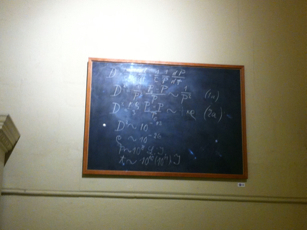
First, a blackboard. A smart scientist called Albert Einstein visited Oxford. During his lecture – he used this blackboard. I was really thrilled to see Einstein’s writing.
The formula? I’m not an expert, but I believe it shows the age of the Universe. The result of which holds up pretty well.
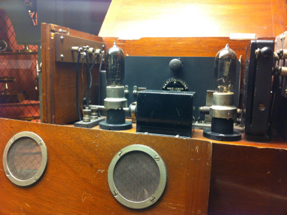
Here’s a beautiful Marconiphone receiver.
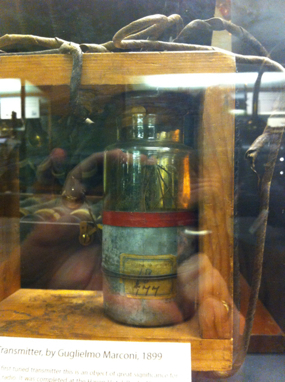
And a Marconi transmitter!
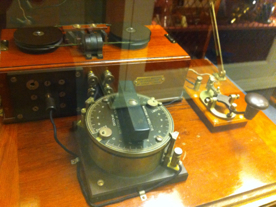
Look at this gorgeous morse key! A ‘grasshopper’ design. Never seen anything like it.
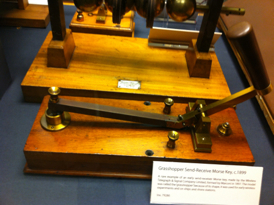
An excellent visit! Highly recommended if you’re in the Oxford area.
Tim Kirby, G4VXE, is a regular contributor to AmateurRadio.com and writes from Oxfordshire, England. Contact him at [email protected].
Beacon pages
The NCDXF beacon network may not be as popular now that WSPR has hit the mainstream but I think it still has a purpose.
For me, the benefit of programmes like Faros gives life to a receiver that wouldn’t otherwise be used. Yes, you can do the same with WSPR but because it’s a more robust system means that just because my pc can hear a station. Doesn’t mean I can work them.
Beacons,on the other hand , give you a reason to listen out. For example, if I can’t hear the Northern Ireland 2m beacon, GB3NGI on 144.482Mhz then chances are I will not be successful putting out a CQ call and expecting to get some DX (DX for me is probably a lot less in mileage terms than you might think at my QTH).
So I’ve resurrected the NCDXF beacon monitor and the results are on the Beacon pages. I hope they are still useful. Time will tell but it looks like the soundcard / rig combo isn’t working too well as its reporting 100% QSB and nowhere near as many spots as I would expect it to. I remember the software being quite precise about the signal input and I spent many hours waiting then adjusting.
Alex Hill, G7KSE, is a regular contributor to AmateurRadio.com and writes from Cumbria, UK. Contact him at [email protected].
20 November
Today my main rig has spent even more time on other things than WSPR. Besides trying to work some PSK31 DX I have also been testing a beta release of K3 firmware. This new version has an improved CW decoder that is a bit less finicky about settings. It works very well but is still beaten by the Windows program MRP40 which I regard as the gold standard for CW decoders. As Wayne N6KR says, the MRP40 algorithm is probably ten times more sophisticated and the K3 MCU doesn’t have enough code space for it.
I’ve been interested in Morse decoders since the first home computers and can remember keying in a program listing in BASIC from a QST article in the late 70s. Later I wrote a decoder in Hisoft Pascal which ran on my ZX Spectrum. It actually decoded strong, perfectly sent Morse but it was not reliable enough to be useful. More recently I tried implementing a Morse decoder in KComm but it was a total failure.
I didn’t have a lot of success with PSK31 DXing on 10m either. I only made two contacts but I heard what would have been two new South American countries: HC7AE in Ecuador and CE4BRO in Chile. I didn’t need to look up HC in a book as I remember from my teenage SWLing days hearing HCJB Quito, the Voice of the Andes!
I think band conditions were better today but they supported more propagation from Europe so there were higher QRM levels (and lower operating standards 😉 ) I moved up the band to try and get away from all the IMD products but hardly anyone was listening up there so it was a bit futile.
Someone who did hear my CQ calls was Vito IZ7DMT. He was a whopping signal but was signing IZ7DMT/QRP. He told me he was running 5 watts from an FT-817 and was rather indignant that I wouldn’t use the illegal /QRP suffix during handovers. Nice QSL though!
Here is the result of today’s WSPRing:
 |
| 10m WSPR spots @ G4ILO 20 November 2012 |

Julian Moss, G4ILO, is a regular contributor to AmateurRadio.com and writes from Cumbria, England. Contact him at [email protected].
VOAProp Repackaged
If you are a user of my program VOAProp you probably know by now that it has a problem due to NOAA having made a slight change to the format of the WWV solar data report. I cannot fix the problem in the program as I no longer have the files needed to rebuild it. Thanks to Mirek, OK1DUB a solution was found that involves changing the web address of the solar data file to download a slightly edited version from Mirek’s web site. The Troubleshooting page in the VOAProp help was updated to include this information. Unfortunately hams never read the frigging manual and so I have had to use the holiday absence message of Gmail to send a rather annoying automatic reply directing those with a question about VOAProp to the aforementioned page in order to save myself the even greater annoyance of receiving several emails a week about it. (It would be really nice if GMail’s Filters could include the option of sending an automatic reply only if an email meets certain conditions.)

It occurred to me this morning that I could fix the problem for new installations by including a configuration file containing the address of the file on Mirek’s web site. So I rebuilt the setup file including this extra file and have now uploaded it to G4ILO’s Shack. It will not help existing users if they download the new file as the installer will not overwrite their existing configuration file so as to preserve the user’s settings during an update. As emails about the issue are still coming in I will have to continue sending the automated reply to everyone who writes to me.

Julian Moss, G4ILO, is a regular contributor to AmateurRadio.com and writes from Cumbria, England. Contact him at [email protected].
New Radio Thoughts
As I mentioned in a previous post about my trip to the Aleutians, I am the owner of a new radio. The reasons for the purchase were manifold, but driven by a fundamental shift in the way I view my operating (and living) philosophy. I had long (at least 10 years) been collecting gear for a two- (or three-) tower contest station. In this philosophy, the emphasis was on collecting antennas and towers as they became available on attractive terms. It also meant keeping the inexpensive but well-performing pair of TS-930S HF transceivers for my SO2R setup and the FT-840 for my portable operations. You can imagine from those past few sentences of description alone that this consumed a non-trivial amount of space and time.
Sarah began subtly hinting that “wouldn’t it be nice if we could clean up that pile of tower on the patio so we could have people over?” My parents have been slowly migrating my junkbox from their place to ours. It became increasingly clear to me that as long as we lived in this area it would be unlikely that I would put up the towers. I started contemplating how to remedy this situation. I identified a large collection of gear (including the Rohn 45 on the patio) that 1) could be replaced by a new radio, 2) I was not using, or 3) for which I simply did not have a plan. So, I set out with the following theme to find a new rig:
Excellence in portable operation and competence at home.
I considered four radios: Ten-Tec Eagle, Kenwood TS-590S, Elecraft K2/100, Elecraft K3/100.
I was strongly considering the K2/100 initially. Its size and price seemed attractive. However, when I did the math on what configuration I wanted, it basically ended up a draw with the Kenwood and the Ten-Tec with only a small bump more to the K3/100. Plus, I’ve built enough kits to know that many of life’s most rewarding tasks tend to look better in the past than they do in the future. Personal preference, of course!
The Kenwood TS-590S is acclaimed by a number of contesters as “the poor man’s K3.” It has very similar features and performance numbers at a very attractive price. I have always enjoyed Kenwoods as well. But, the one thing that ultimately killed the TS-590S and the Ten-Tec Eagle was their lack of BCD band-data outputs. The K3 also offered the 2-meter option, IF output (for panadapters), and very easy transverter interfacing. It was really a no-brainer for me at that point since I had sold off enough gear to cover the cost entirely.
I bought the K3 kit and assembled it. Anomalies notwithstanding, it amuses me greatly when people announce to the Elecraft e-mail list that “K3 #7777 is on the air”…it’s hard to keep from responding, “Congratulations on assembling your first LEGO kit.” Unlike the K2, these “modular-kit” radios are very easy to assemble if you have a few hand tools and can follow basic directions.
My friend Oli, DJ9AO, informally asked me to compare the K3 to the TS-930S. I’ve tested (subjectively) the K3 in a couple of demanding environments and I’m pleased to say that the K3 performed well, even with essentially “factory default” settings.
The K3 wins hands-down the strong-signal handling contest, even with the Inrad roofing filter in the TS-930S. 40 meters in ARRL Sweepstakes CW is a good test for this. The FT-840 used to have severe mixing products (“beeps and bloops”). These are not common with the TS-930S, but severe AGC pumping from nearby signals often covered up weaker signals. Neither of these are problems with the K3. In fact, the K3 is so good that you can tell just exactly who has key clicks because it’s possible to find two signals of otherwise identical strength on the S-meter and one will be inaudible within a few hundred Hz and the other will continue to bleed through and pump the AGC. Well-done, Elecraft.
One thing that surprised me about the K3 was its apparently poor performance on the pileups from NA-039. With the BW cranked down to 400 Hz, the filters rang like a bell in a pileup. I have the 400-Hz 8-pole and 2.7-kHz 5-pole filters. Widening the DSP bandwidth out to 700 Hz or so (which switches to the 2.7-kHz roofing filter) alleviated the problem with occasional AGC pumping from louder signals in the pileup. In a post to the PVRC e-mail list recently, Frank, W3LPL, also confirmed that he prefers the 1-kHz 8-pole filter for CW operation. Because I had the opportunity, I recently sprung for the special-order 700-Hz roofing filter. It should arrive in March 2013. I suspect there is considerable tailoring that could be done to the AGC system but I’m not there yet. Once I realized that the bandwidth of 700 Hz was a sweet spot, the radio worked great in the pileups. I have a feeling that I’ll also end up with the 1-kHz filter eventually. But, I rarely open up beyond 700 Hz on CW so it will be interesting to see what is best.
A few other bright spots:
- CW-to-Digital: This is just plain cool. Send with the built-in keyer and the radio modulates PSK31 or RTTY for you. Decode it right on the screen.
- Multifunction knobs: The entire industrial design of the K3 is really unmatched in my opinion. It has just the right number of knobs and menus.
- Options: They are plentiful and easy to install. Keeps the initial cost low(er).
I’m extremely delighted with the K3 so far and my shack is getting more compact. It’s also nice to have a radio with a built-in keyer for once…
Ethan Miller, K8GU, is a regular contributor to AmateurRadio.com and writes from Maryland, USA. Contact him at [email protected].
CCRs Defeated Again! (A Temporary Vertical Antenna)
My “permanently installed” home HF station in my cursed covenant protected neighborhood employs a stealthy pine tree-mounted fan dipole to radiate nicely on 10m, 20m, and 40m. But I’ve been missing out on a lot of fun on some of those other higher HF bands… until recently. I’ve found another way around the CCR Nazis with a temporarily erected portable ¼ wave vertical set up in my driveway. I used it today to make contacts from Minnesota to Switzerland with 100 watts on 10m and 17m bands, but it works just as fantastically on 12m, 15m, and 20m bands. Here’s the setup.
Radiating Element: The radiating element I’m using is the MFJ-1979 stainless telescopic whip [~ $60]. It’s a pretty solid large extendable element that pulls out to 17 feet, so it’s effective down to 20m band without a tuner. It collapses down to just 27 inches, so it can also be used for everything up to 50 MHz and it stows away nicely. I tune it to a given band by simply extending or contracting it while measuring SWR with an analyzer, and I have marked the telescoping segments with permanent ink so I can zip quickly from one band extension to another without the analyzer hassle. Yes, it’s a little extra trouble compared to using a true multiband antenna or a tuner, but I can usually obtain 1.2:1 SWR or better with only a few seconds of finagling. Plus, I like to set up a station outdoors, either in the shade of the pines or just inside the garage within a few step of the well-stocked refrigerator, so it’s not too inconvenient to stroll over to the antenna to adjust it when I’m ready to switch bands.

Mounting Arrangement: The telescopic element fits into a High Sierra Jaws Antenna Mount [~ $35 ]. This is a really nicely designed antenna mount with an adjustable clamp that’ll hold firmly onto almost anything. It has a standard 3/8 – 24 thread female mount into which the MFJ-1979 fits and an SO-239 “UHF” connector on the opposite side. It also has a convenient hole drilled into the clamp body on the electrical ground side through which a screw can be used to attach ground radials. I like to have the Jaws clamp chomp down onto the wooden handle of a common dirt tamper. The tamper has a heavy, flat metal base that is more than sufficient to support the fully extended vertical element, and the Jaws clamp works nicely with the wooden handle. Plus it’s usually just hanging out in my garage and is conveniently portable. A fat stake driven into the earth will do just as well with the Jaws clamp.


Ground Radials: I constructed four bundles of ground radial wires, each bundle comprised of six wires soldered into a #10 ring terminal. Each of the four bundles spreads out into a quadrant of radials under the telescopic element, 24 radials total. The four ring terminals are stacked over the Jaws clamp hole and attached with a small stainless screw and nut. Each radial wire is about 16 feet long. I calculated the perimeter chord distance between evenly spaced radials for the 15 degree angle subtended between radials (about 49 inches), and I cut a stick to that length to make it easy to evenly space the radial wires when spreading them along the ground. Since I store the wires in coiled bundles, I use a rock or a small tent stake to keep them held straight.

Set Up & Take Down: It usually requires about 10 – 15 minutes to set up the entire antenna, with the bulk of that time dedicated to unfurling, spreading, and anchoring the ground radial wires. I route about 40 feet of coax to the radio, typically outdoors as previously noted, or through a window to a comfortable operating location on cold days. Antenna deconstruction is even quicker – kick the rocks aside, collect the quadrant ground radial bundles at the antenna and roll them up, securing each with a zip tie. I leave them attached to the Jaws clamp ready to go for next time. Scrunching up the telescopic element and detaching it from the clamp is a breeze, and it all tucks away in moments.

Results: I’ve used this antenna several times in recent weeks at my home and with a portable station for Boy Scout Jamboree On The Air (JOTA), each time with fantastic results. Today with nice F2 and sporadic E conditions I made many contacts into Europe and across North America with the 100 watts of a barefoot Yaesu FT-897D. This simple antenna gets me onto those “other bands” that I’ve been missing out on, 12m, 15m, and 17m, as well as the familiar 10m and 20m bands that my fan dipole also delivers. In particular, I have really come to enjoy 17m band’s more relaxed and gentlemanly character. Maybe I’ll catch you there sometime soon!
This antenna can well serve the ham in a CCR protected neighborhood with a quick and easy temporary installation that won’t attract a lot of attention. It also offers the convenience of portability, so it can be readily hauled to the local park, camp, forest or mountain location for relaxing outdoor operation. Look for a feature article and video about this antenna set up coming soon to HamRadioSchool.com.
Stu Turner, WØSTU, is an author and professional educator who served as a US Air Force Academy engineering professor for eight years where he honed his skills of making difficult topics easy to understand. Contact him at [email protected].
 Ham Radio Deluxe |
 W5SWL Electronics |
 Ham Radio Prep |
 KB3IFH QSL Cards  Hip Ham Shirts  HamRadioAuctions HamRadioAuctions Reliance Antennas Reliance Antennas Enigma Shop Enigma Shop |  morseDX  Ni4L Antennas  R&L Electronics R&L Electronics antennas.us antennas.us QRV QRV |
- Matt W1MST, Managing Editor
