 |
 10m 26 November 2012
 26 November 2012 | by
  |
| 10m WSPR spots @ G4ILO 26 November 2012 |
What this map doesn’t show is that all the spots are barely visible, -25 to -27dB, so propagation would not be good enough to support a regular communication mode.
Julian Moss, G4ILO, is a regular contributor to AmateurRadio.com and writes from Cumbria, England. Contact him at [email protected].
The most interesting contact in the CQ WW Contest

Sometimes looking up remote stations on QRZ.com or other sites gives a glimpse of the person behind the callsign. I did this for the Chinese station BY5CD which I contacted on 40 m during the CQ Worldwide contest this weekend.
It turned out to be a club station called “YinZhou Middle School Amateur Radio Club Station” which is located just south of Shanghai.
It is interesting to consider the age of the operators as one can see from the picture. More pictures and some information can be found on their QRZ.com website. With this many young people entering ham radio in China, maybe we will see more stations there in the future. The number of stations is unreasonably low compared to the enormous population of China.
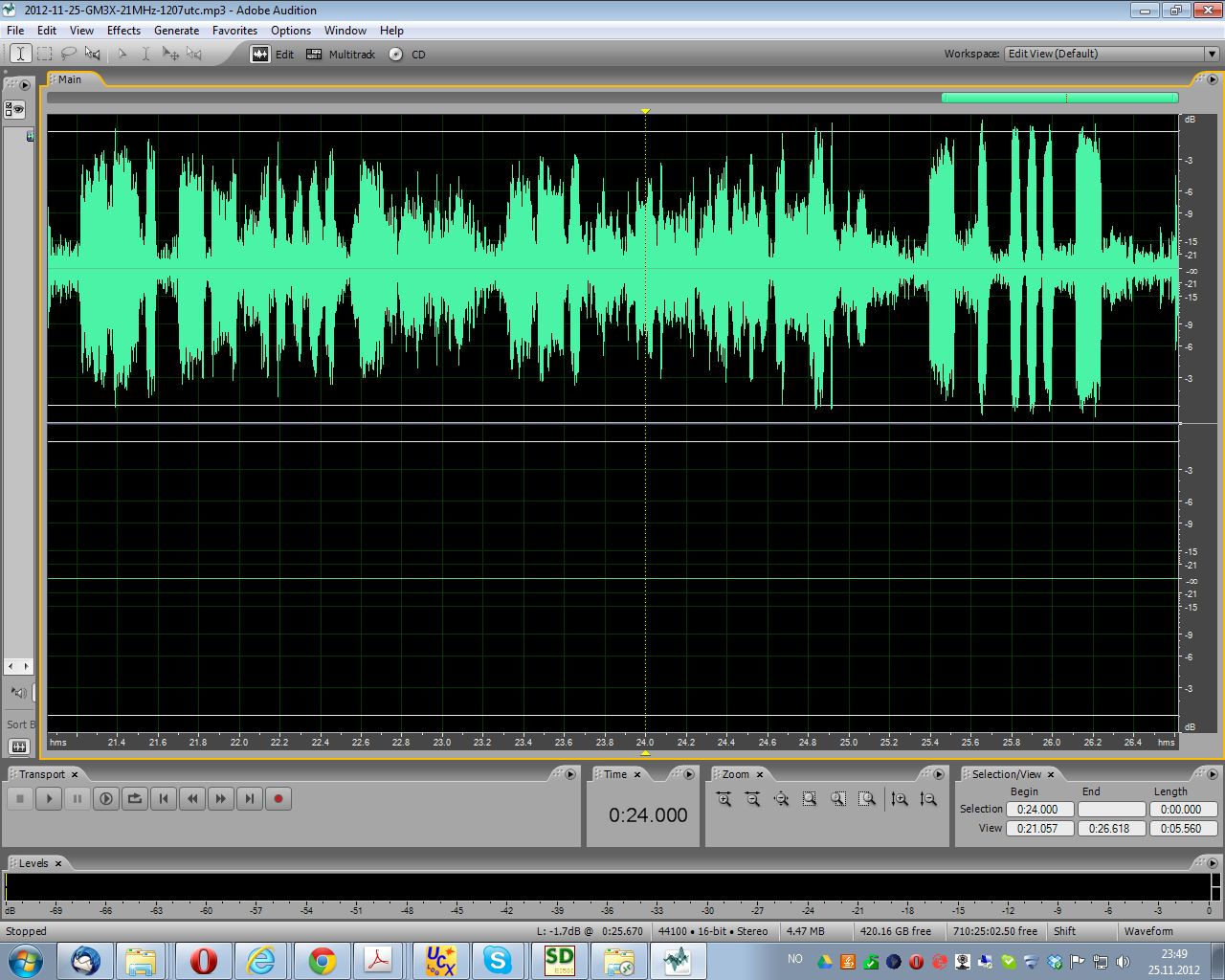 And the most interesting signal was that of GM5X on 21 MHz at 1207 UTC on 25. November. It had a distinct echo which seems to indicate that the signal travelled both on the direct path of about 800 km and the long path of about 39200 km.
The image shows “GM5X GM5X Test”. The long path signal seems to fade in and out as there is much less of it in the last part, the word “test”, than in the second “GM5X”.
Sverre Holm, LA3ZA, is a regular contributor to AmateurRadio.com and writes from Norway. Contact him at [email protected].
I have started to slow down in the CQ WW CW contest
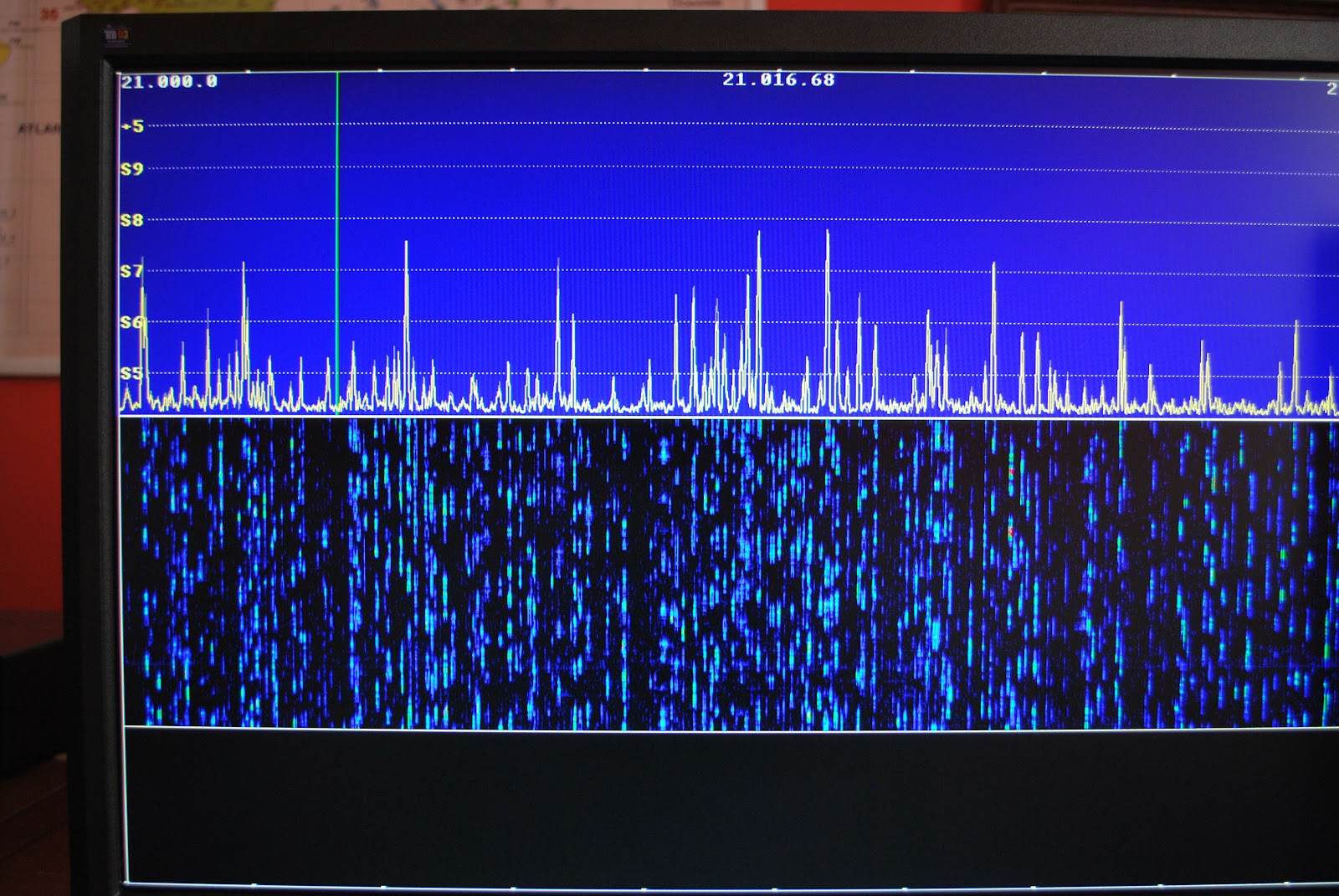 |
| The action on 15m this morning |
Contest on......well easier said than done...
Mike Weir, VE9KK, is a regular contributor to AmateurRadio.com and writes from New Brunswick, Canada. Contact him at [email protected].
The Android HT – Part 3
Bob Witte, KØNR, is a regular contributor to AmateurRadio.com and writes from Colorado, USA. Contact him at [email protected].
25 November 2012
The last day of the CQ WW DX CW contest. But nothing of interest to report. Sunday morning was one of those mornings when I didn’t seem to fully wake up. It was after 11am before I got into the shack.
My intention was to make some more contest contacts on 10m. Although I don’t compete seriously, I usually decide what category I am going to play in – single or multi-band, QRP or Low Power – and stick to it so that if I do make a decent number of contacts I can send an entry in. But this time my effort didn’t even justify sending in a check log.
I heard some interesting big gun stations such as in Africa (Gambia, Senegal) but I just could not be heard over the others calling. One Russian station seemed to be following me around and he wasn’t having much luck either. It was hard going even with the more run of the mill stations. I felt like I was running QRP. In fact, I’ve had better results when I did run QRP (such as for the CQ WW WPX back in May, when I used the KX3 ) than I was having this weekend.
It was obviously a mistake to limit myself to 10 metres. Not everyone was having such bad luck as me though. I heard a DX station who wasn’t hearing my calls working fellow blogger Tim G4VXE. So much for the magic dipole!
After I broke off for lunch I couldn’t be bothered to get back on the air again and so I spent the afternoon listening to a broadcast concert. I will draw a veil over my lamentable effort. (Those who are really interested to see the extent of my embarrassment can take a look at my contact log.)
Julian Moss, G4ILO, is a regular contributor to AmateurRadio.com and writes from Cumbria, England. Contact him at [email protected].
Homemade 2M Yagi Tape Measure
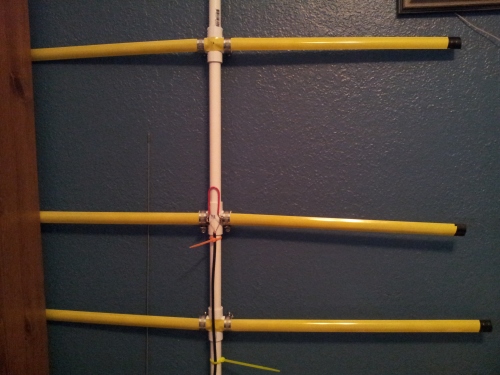
I made my first antenna. It’s a 2 meter yagi using the recipe on this web page: http://www.ccars.org/Projects/TapeYagi/index.htm
It works but not quite as well as I expected. After my first test, I found a stray strand of wire shorting the center and shield conductors where I separated them. I fixed that and am waiting to re-test. I’ll follow up with the results from that test.
After fixing my stray wire, I got much better performance and it works great!


Wayne Patton, K5UNX, is a regular contributor to AmateurRadio.com and writes from Arkansas, USA. Contact him at [email protected].
Guaranteed to work
I just finishing lofting the W3EDP antenna into the sky. I guess it is guaranteed to work, because:
A) I decided to do this on the day that a major DX contest if underway, and
B) I waited for the coldest day of Thanksgiving weekend to do it! Temperature is only 42F (5C) and the very gust winds are causing wind chill factor, making it feel like the low 30’s (closer to 0C). My fingers were freezing while tying knots in the antenna rope and untying knots (tangles) in the antenna wire.
Just to make sure that I did in fact, not waste a good portion of the afternoon, I made two quick contacts. One was a contest QSO with C6AQM on 20 Meters and the other was a short rag chew with Bob N1MFW on 30 Meters.
So the antenna works! How well will remain to be determined as I use it more and more. So currently the antenna set up is the Butternut HF9V as Antenna 1 and the Antenna 2 outlet of the K3 goes to my antenna switch, where I can pick either the W3EDP or the 88′ EDZ.
72 de Larry W2LJ
QRP – When you care to send the very least!
Larry Makoski, W2LJ, is a regular contributor to AmateurRadio.com and writes from New Jersey, USA. Contact him at [email protected].
 Ham Radio Deluxe |
 W5SWL Electronics |
 Ham Radio Prep |
 KB3IFH QSL Cards  Hip Ham Shirts  HamRadioAuctions HamRadioAuctions Reliance Antennas Reliance Antennas Enigma Shop Enigma Shop |  morseDX  Ni4L Antennas  R&L Electronics R&L Electronics antennas.us antennas.us QRV QRV |
- Matt W1MST, Managing Editor
