 |
 A week later and there is something wrong
 27 November 2012 | by
 At the back end of last week I set Faros off and running to listen into the various NCDXF beacons.
All is not well
The set up of rig, Signalink, sound card (either as a usb or internal) is inconsistent at best and not hearing anything at all at worst. After a few days of twiddling and mucking about I am at a loss. I’ve never really got the thing going with my ft817 and frankly don’t want to spend a whole heap of time trying to sort it out. Perhaps I’ll go back to it once I’ve had a chance to think about it a bit more.
Here’s what’s stumping me:
Computer – More powerful than the one it used to run off 24/. Both internal and usb sound cards have failed to get any signals. in fact the usb sound card made the software act very oddly. Audio in directly from the rig…no difference. Adjusting the volume makes no observable difference.
Rig – CAT OK, timing OK, audio out OK
The software is reporting 100% QSB which I don’t recall from the last set up so I can only surmise that it doesn’t like the two options for the sound card. Time to take a break from it.
Alex Hill, G7KSE, is a regular contributor to AmateurRadio.com and writes from Cumbria, UK. Contact him at [email protected].
LHS Episode #095: I Has the Dumb
 Richard called this one of our best efforts to date, which means there must be some kind of worthwhile contained buried in all the tomfoolery somewhere. If you can find it, you’ll be that much wiser for whatever it is we discussed. Silliness aside, we discuss some proposed FCC rule changes for the amateur radio community, the difference between hard and soft (symbolic) linking for our Linux segment, and answer questions and receive praise from several members of our audience. On the whole it turned out to be a pretty good episode, and we sure had a lot of fun doing it. Thanks to all our listeners for your support and for keeping us motivated to bring you ever more episodes of Linux in the Ham Shack.
73 de The LHS Guys
Russ Woodman, K5TUX, co-hosts the Linux in the Ham Shack podcast which is available for download in both MP3 and OGG audio format. Contact him at [email protected].
10m 26 November 2012
 |
| 10m WSPR spots @ G4ILO 26 November 2012 |
What this map doesn’t show is that all the spots are barely visible, -25 to -27dB, so propagation would not be good enough to support a regular communication mode.
Julian Moss, G4ILO, is a regular contributor to AmateurRadio.com and writes from Cumbria, England. Contact him at [email protected].
The most interesting contact in the CQ WW Contest

Sometimes looking up remote stations on QRZ.com or other sites gives a glimpse of the person behind the callsign. I did this for the Chinese station BY5CD which I contacted on 40 m during the CQ Worldwide contest this weekend.
It turned out to be a club station called “YinZhou Middle School Amateur Radio Club Station” which is located just south of Shanghai.
It is interesting to consider the age of the operators as one can see from the picture. More pictures and some information can be found on their QRZ.com website. With this many young people entering ham radio in China, maybe we will see more stations there in the future. The number of stations is unreasonably low compared to the enormous population of China.
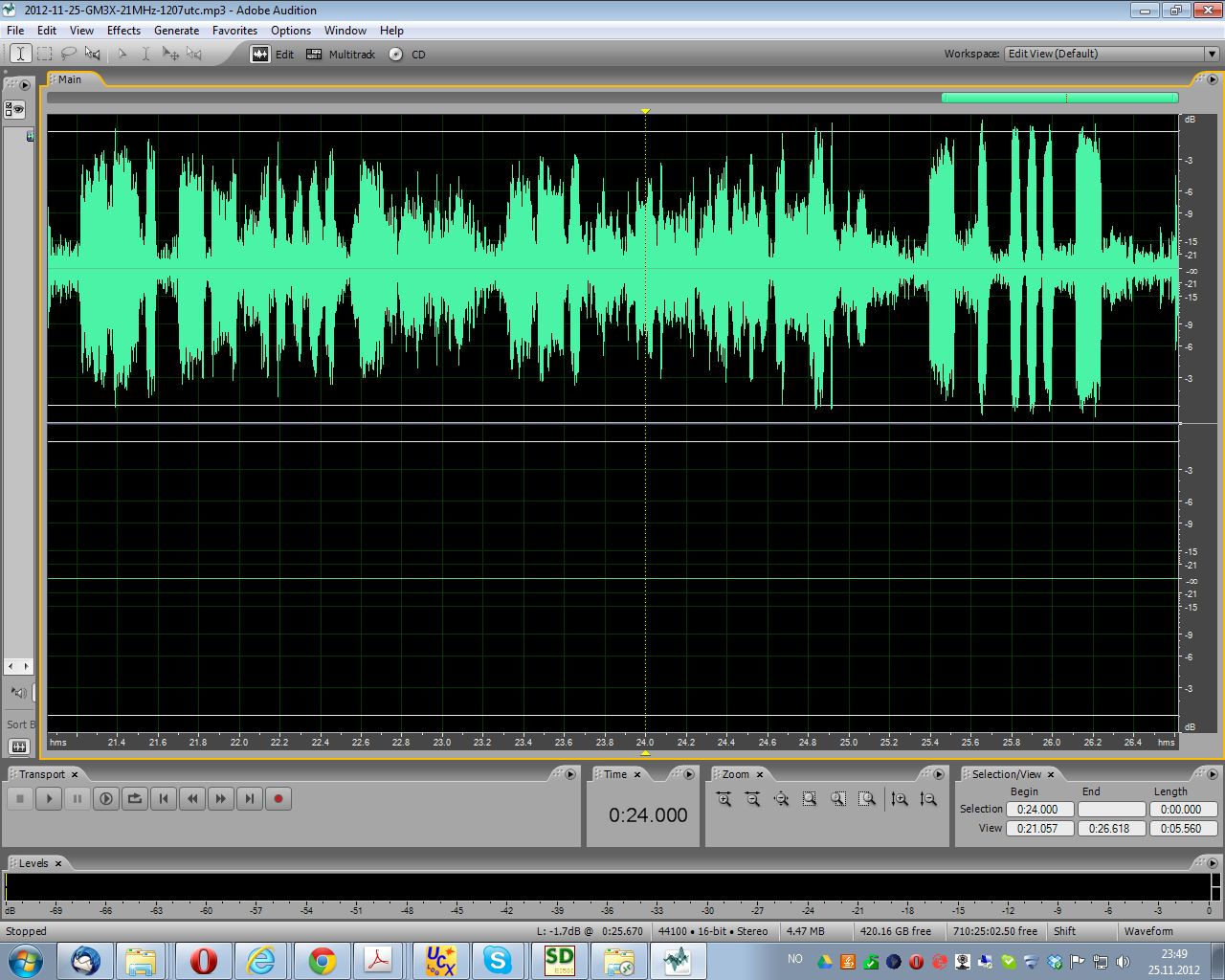 And the most interesting signal was that of GM5X on 21 MHz at 1207 UTC on 25. November. It had a distinct echo which seems to indicate that the signal travelled both on the direct path of about 800 km and the long path of about 39200 km.
The image shows “GM5X GM5X Test”. The long path signal seems to fade in and out as there is much less of it in the last part, the word “test”, than in the second “GM5X”.
Sverre Holm, LA3ZA, is a regular contributor to AmateurRadio.com and writes from Norway. Contact him at [email protected].
I have started to slow down in the CQ WW CW contest
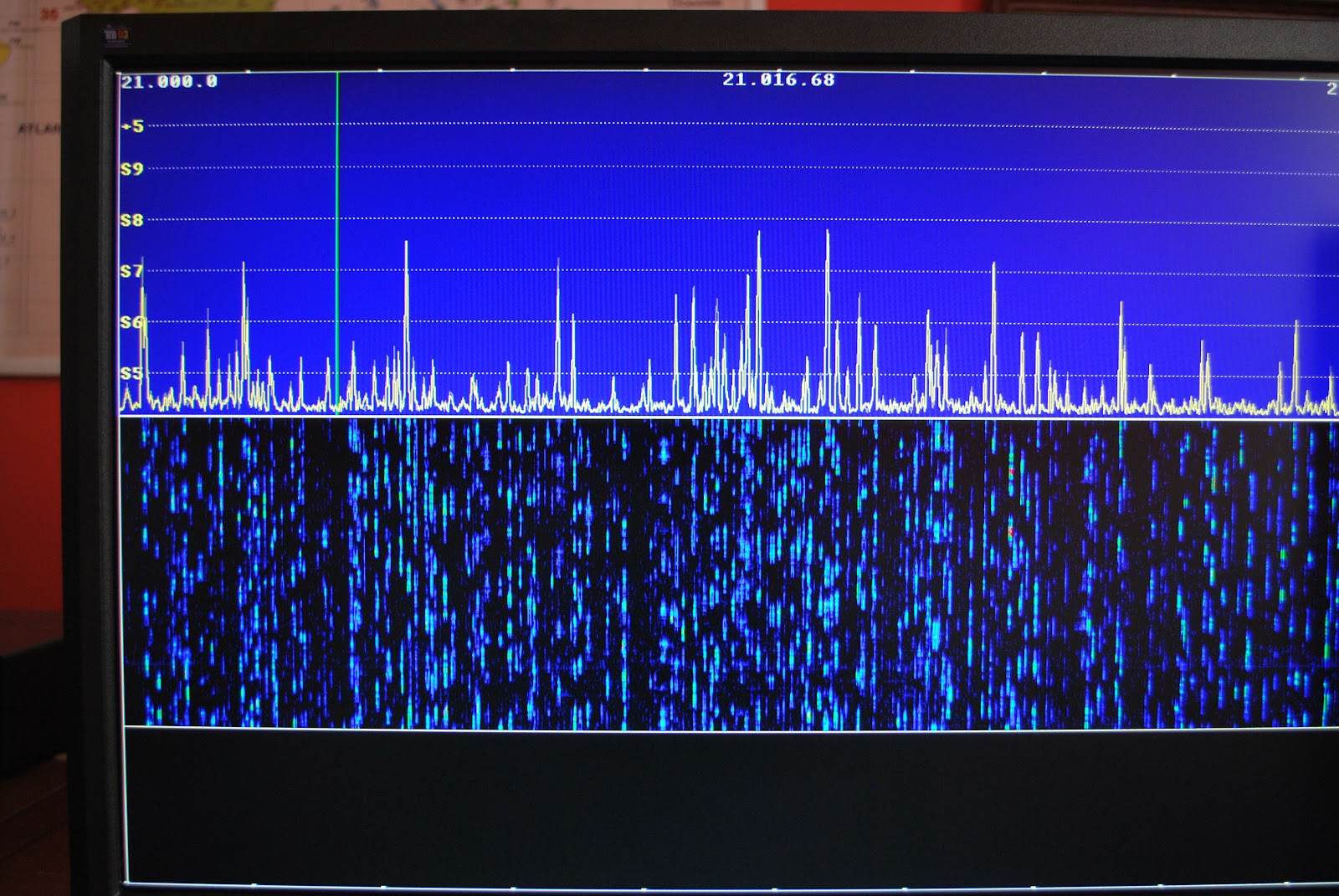 |
| The action on 15m this morning |
Contest on......well easier said than done...
Mike Weir, VE9KK, is a regular contributor to AmateurRadio.com and writes from New Brunswick, Canada. Contact him at [email protected].
The Android HT – Part 3
Bob Witte, KØNR, is a regular contributor to AmateurRadio.com and writes from Colorado, USA. Contact him at [email protected].
25 November 2012
The last day of the CQ WW DX CW contest. But nothing of interest to report. Sunday morning was one of those mornings when I didn’t seem to fully wake up. It was after 11am before I got into the shack.
My intention was to make some more contest contacts on 10m. Although I don’t compete seriously, I usually decide what category I am going to play in – single or multi-band, QRP or Low Power – and stick to it so that if I do make a decent number of contacts I can send an entry in. But this time my effort didn’t even justify sending in a check log.
I heard some interesting big gun stations such as in Africa (Gambia, Senegal) but I just could not be heard over the others calling. One Russian station seemed to be following me around and he wasn’t having much luck either. It was hard going even with the more run of the mill stations. I felt like I was running QRP. In fact, I’ve had better results when I did run QRP (such as for the CQ WW WPX back in May, when I used the KX3 ) than I was having this weekend.
It was obviously a mistake to limit myself to 10 metres. Not everyone was having such bad luck as me though. I heard a DX station who wasn’t hearing my calls working fellow blogger Tim G4VXE. So much for the magic dipole!
After I broke off for lunch I couldn’t be bothered to get back on the air again and so I spent the afternoon listening to a broadcast concert. I will draw a veil over my lamentable effort. (Those who are really interested to see the extent of my embarrassment can take a look at my contact log.)
Julian Moss, G4ILO, is a regular contributor to AmateurRadio.com and writes from Cumbria, England. Contact him at [email protected].
 Ham Radio Deluxe |
 W5SWL Electronics |
 Ham Radio Prep |
 KB3IFH QSL Cards  Hip Ham Shirts  HamRadioAuctions HamRadioAuctions Reliance Antennas Reliance Antennas Enigma Shop Enigma Shop |  morseDX  Ni4L Antennas  R&L Electronics R&L Electronics antennas.us antennas.us QRV QRV |
- Matt W1MST, Managing Editor
