 |
 Radio Mobile Online
 28 November 2012 | by
 Its probably not news to many people but whilst I was thinking about a suitable site for the UKAC 144Mhz contest next Tuesday (4th December) I remembered about a coverage prediction programme called Radio Mobile.
Now seeing as things on the internet are steadily replacing things on the desktop I had a go with comparing sites with the model outputs. As a contest novice I am entering in ‘in the spirit of’ contesting. Any site needed to be quite close to home and easily accessed / operated from.
Radio mobile confirmed what you’d expect, the site closest to home that I can get to with the car isn’t the best but its a whole load better that operating from the house. So armed with the knowledge that I’ll get some contacts at least I’ll take the plunge and aim not to be at the bottom of the pile.
The key kit will be
1. A warm coat (its 20.00UTC – 22.00 UTC) – So it’ll be chilly
2. FT817 and extra power supply – Seeing as it runs out of puff within a few minutes
3. Sotabeams 3 element yagi and fishing pole
4. A flask of tea and chocolate hobnobs
The output from a 4w Tx at the Sandwith site is below. More than enough to get a couple of contacts I hope.

We’ll have to see how I get on next week, but if you’re in earshot listen out for the weedy signal from Cumbria (rather than the stronger on from G4VFL, who has nabbed the Corney Fell site – perhaps I should tramp up Scafell Pike to out do him on height!)
Alex Hill, G7KSE, is a regular contributor to AmateurRadio.com and writes from Cumbria, UK. Contact him at [email protected].
W3EDP passes its first test
Wow – what a difference a different wire makes.
I signed on to the 40 Meter QRP Fox hunt tonight and spotted Dave AB9CA pretty much right off the bat. He was a bit on the weak side – and then I switched on over to the W3EDP from the EDZ Dave went from super weak to 569 – easy! To say I was amazed by the increase in his signal by changing wires is an understatement. I went from thinking that I might not have a chance to getting in the log.
Drew K9CW in Illinois is even tougher. No matter which antenna I switch to, this is going to be tough. I am hearing him the best on the W3EDP, though. Right now about 339 at best.
Fingers are crossed for an improvement in propagation.
Addendum – Got Drew ……… using the Butternut HF9V! Didn’t think the vertical was the best club in the bag for 40 Meters; but it did the trick. So much for conventional wisdom!
72 de Larry W2LJ
QRP – When you care to send the very least!
Larry Makoski, W2LJ, is a regular contributor to AmateurRadio.com and writes from New Jersey, USA. Contact him at [email protected].
Talk about dedication, Man !!
Another reason why Steve WGØAT is one of my Ham Radio QRP heroes …….. imagine hiking up to a mountain top in the pre-dawn darkness, just so you can activate a SOTA mountaintop as the sun rises.
That is dedication, my friends!
72 de Larry W2LJ
QRP – When you care to send the very least!
Larry Makoski, W2LJ, is a regular contributor to AmateurRadio.com and writes from New Jersey, USA. Contact him at [email protected].
A week later and there is something wrong
At the back end of last week I set Faros off and running to listen into the various NCDXF beacons.
All is not well
The set up of rig, Signalink, sound card (either as a usb or internal) is inconsistent at best and not hearing anything at all at worst. After a few days of twiddling and mucking about I am at a loss. I’ve never really got the thing going with my ft817 and frankly don’t want to spend a whole heap of time trying to sort it out. Perhaps I’ll go back to it once I’ve had a chance to think about it a bit more.
Here’s what’s stumping me:
Computer – More powerful than the one it used to run off 24/. Both internal and usb sound cards have failed to get any signals. in fact the usb sound card made the software act very oddly. Audio in directly from the rig…no difference. Adjusting the volume makes no observable difference.
Rig – CAT OK, timing OK, audio out OK
The software is reporting 100% QSB which I don’t recall from the last set up so I can only surmise that it doesn’t like the two options for the sound card. Time to take a break from it.
Alex Hill, G7KSE, is a regular contributor to AmateurRadio.com and writes from Cumbria, UK. Contact him at [email protected].
LHS Episode #095: I Has the Dumb
 Richard called this one of our best efforts to date, which means there must be some kind of worthwhile contained buried in all the tomfoolery somewhere. If you can find it, you’ll be that much wiser for whatever it is we discussed. Silliness aside, we discuss some proposed FCC rule changes for the amateur radio community, the difference between hard and soft (symbolic) linking for our Linux segment, and answer questions and receive praise from several members of our audience. On the whole it turned out to be a pretty good episode, and we sure had a lot of fun doing it. Thanks to all our listeners for your support and for keeping us motivated to bring you ever more episodes of Linux in the Ham Shack.
73 de The LHS Guys
Russ Woodman, K5TUX, co-hosts the Linux in the Ham Shack podcast which is available for download in both MP3 and OGG audio format. Contact him at [email protected].
10m 26 November 2012
 |
| 10m WSPR spots @ G4ILO 26 November 2012 |
What this map doesn’t show is that all the spots are barely visible, -25 to -27dB, so propagation would not be good enough to support a regular communication mode.
Julian Moss, G4ILO, is a regular contributor to AmateurRadio.com and writes from Cumbria, England. Contact him at [email protected].
The most interesting contact in the CQ WW Contest

Sometimes looking up remote stations on QRZ.com or other sites gives a glimpse of the person behind the callsign. I did this for the Chinese station BY5CD which I contacted on 40 m during the CQ Worldwide contest this weekend.
It turned out to be a club station called “YinZhou Middle School Amateur Radio Club Station” which is located just south of Shanghai.
It is interesting to consider the age of the operators as one can see from the picture. More pictures and some information can be found on their QRZ.com website. With this many young people entering ham radio in China, maybe we will see more stations there in the future. The number of stations is unreasonably low compared to the enormous population of China.
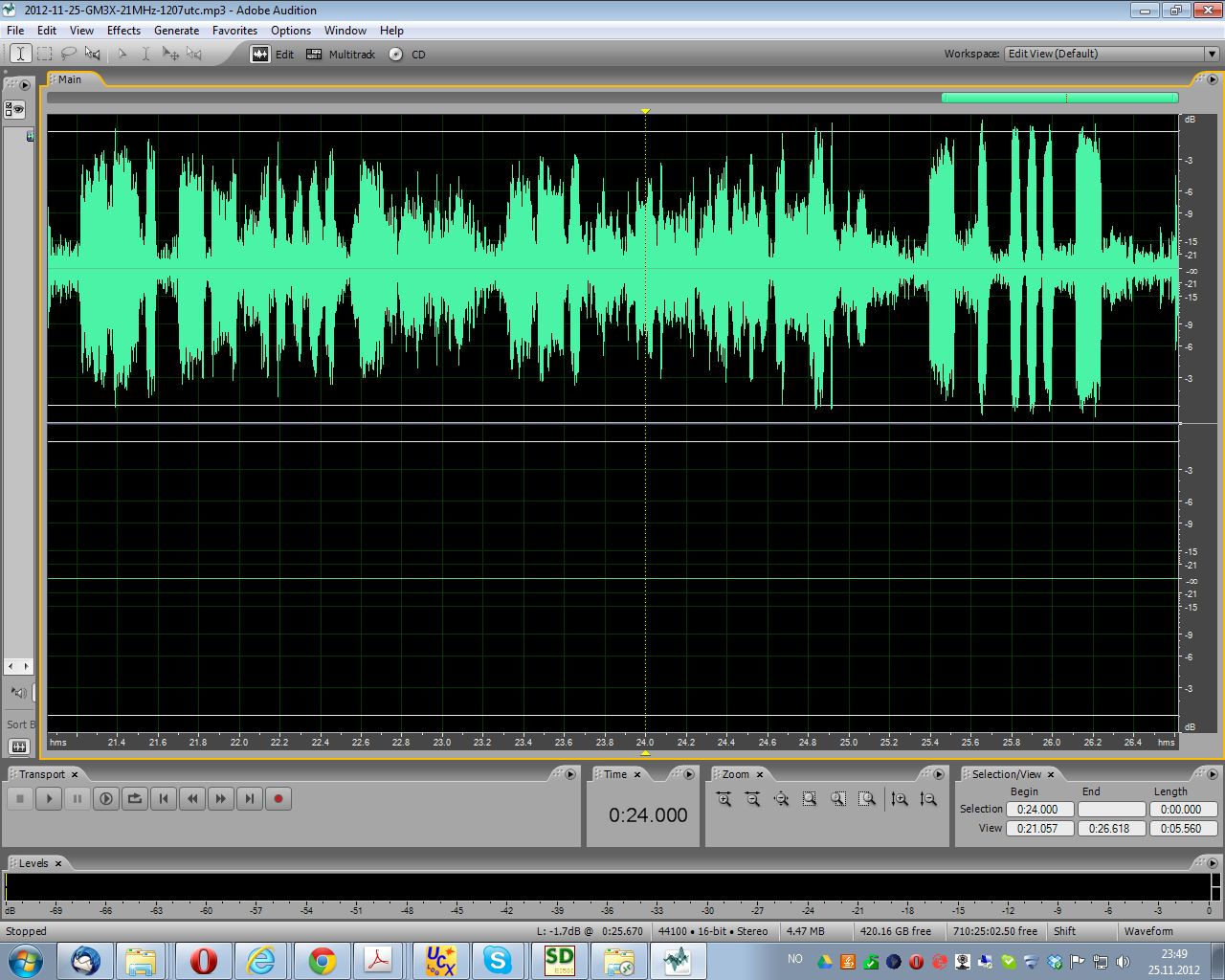 And the most interesting signal was that of GM5X on 21 MHz at 1207 UTC on 25. November. It had a distinct echo which seems to indicate that the signal travelled both on the direct path of about 800 km and the long path of about 39200 km.
The image shows “GM5X GM5X Test”. The long path signal seems to fade in and out as there is much less of it in the last part, the word “test”, than in the second “GM5X”.
Sverre Holm, LA3ZA, is a regular contributor to AmateurRadio.com and writes from Norway. Contact him at [email protected].
 Ham Radio Deluxe |
 W5SWL Electronics |
 Ham Radio Prep |
 KB3IFH QSL Cards  Hip Ham Shirts  HamRadioAuctions HamRadioAuctions Reliance Antennas Reliance Antennas Enigma Shop Enigma Shop |  morseDX  Ni4L Antennas  R&L Electronics R&L Electronics antennas.us antennas.us QRV QRV |
- Matt W1MST, Managing Editor
