 |
 Why Location Counts In RadioSport
 5 December 2012 | by
 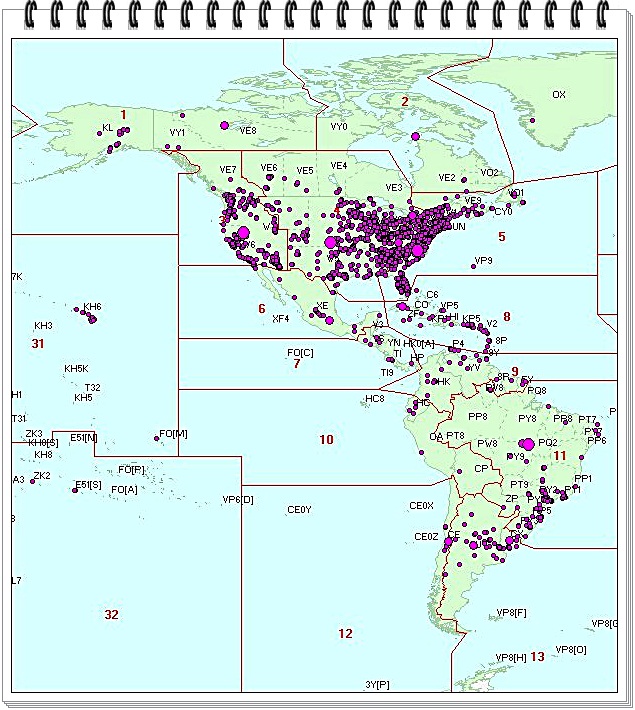 |
| Rick, ZL2HAM created 2011 CQ WW DX SSB Station Distribution Map |
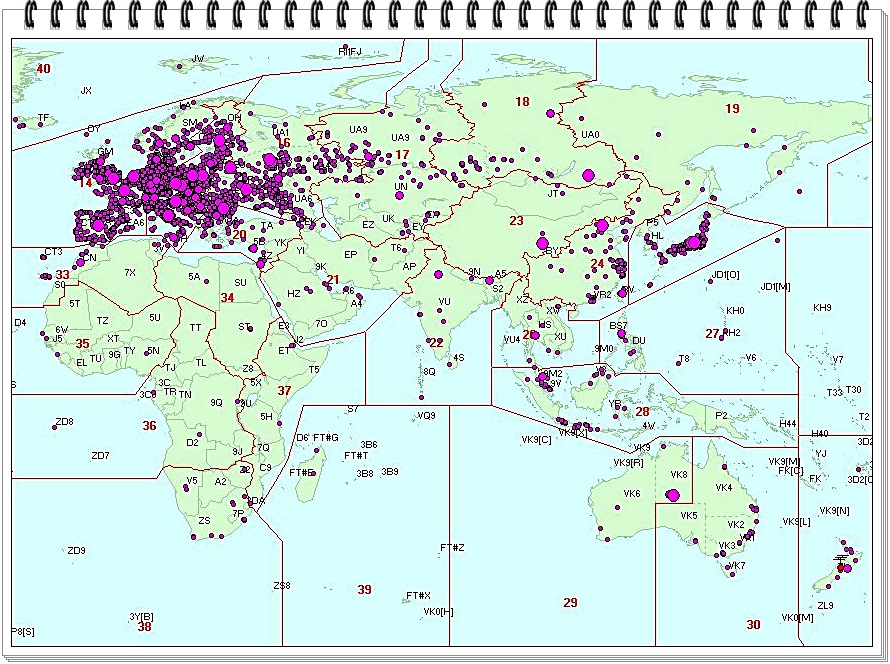 |
| ZL2HAM Station Distribution Map |
Thank you Rick, ZL2HAM for creating your visualization maps based on logs submitted from the 2011 CQ World Wide DX SSB event. I have a better understanding of why location counts in RadioSport as a result of your hard work. It did not sink in as to the challenge a West Coast station overcomes in order to achieve a DX event Box score.
Now, I can see ‘the why’ because of distance and concentration of stations. However, from the perspective of a national level event like Sweepstakes or NAQP, my location in California has an advantage.
Contest on!
Progress with the shack clock
I’ve spent a bit of time over the last day or so putting together a schematic for my Arduino / MSF60Khz shack clock. The previous iteration has been sat on my desk in breadboard form doing exactly what it should but a bit ugly.
I’ve designed the schematic on Eagle and made a bit of progress with support from the Arduino forums and think I’m nearly there. The eventual aim is for the club to have another option for those looking for a bit of soldering for the next step in their licence, or just as a simple thing for the shack.
I hadn’t appreciated how long it would take to get the spaghetti on the paper and I’m sure there’ll be more efficient ways to do it but here’s my first attempt after considerable help from the forums.

If you’re interested there are more details on the project pages which will be updated in due course.
I’m sure there are those who could do this in a few minutes, but, for the more challenged like myself it has been quite a steep curve to climb but a worthwhile one. It’ll be lovely to get something finished before the end of the month but we’ll see how well it goes. I’m struggling a bit with the PCB with little things like mounting holes and getting the correct drill size / grid.
If anyone fancies being a checker for this and the board then I’m always happy to accept guidance.

Whoever spots all the errors first wins a prize!
Alex Hill, G7KSE, is a regular contributor to AmateurRadio.com and writes from Cumbria, UK. Contact him at [email protected].
YouView or not YouView
This post is nothing to do with ham radio. However it is about radio – or rather TV – and the internet, and I’m pretty sure some of my readers know more than I do about this subject.
Here’s the thing. A few days ago TalkTalk – our telecoms and broadband provider – sent us a letter offering a free YouView box as a sop for the tariff going up. If I understand correctly, a YouView box would provide us with two things that we don’t currently get from our plain old Freesat box: the ability to record programmes (our Freesat box isn’t one with a hard drive in it) and the ability to catch up on already broadcast programmes using things like BBC iPlayer.

If we want to watch programmes after they have been broadcast then we have to use iPlayer or whatever on our computers, of which we have about six in the house already, not counting the old Toshiba laptop I run DOS on to program Motorola radios or the other slightly less old Toshiba laptop that has a whole column of dead pixels in the middle of its display. I haven’t tried connecting one of the computers to the wide screen TV in the living room and watching BBC iPlayer that way. We watch it on the computer screen if we want to. If we want to record programs for later viewing we need to buy a newer more expensive version of our Humax Freesat box.
A YouView box would cost £299 so it’s quite an attractive deal to get one free. The question is: would we be able to use it without a lot of hassle?
If I understand correctly, in order to use a YouView box we would need two things that we don’t already have: a digital terrestrial TV antenna (we get all the TV channels we need on Freesat) and an Ethernet connection to our router accessible from where the TV is (because apparently YouView doesn’t have a wi-fi adapter.) Obtaining these would entail a fair amount of extra expense on hardware (i.e. the cost of having a TV aerial installed, and some kind of wi-fi adapter or a long and ugly piece of Ethernet cable.) Nor do I know whether YouView would need the same type of TV input already being used by the Freesat box, namely the HDMI input.
So my thinking is that it’s not worth the cost and hassle. Getting stuff like this to work usually results in my tearing my hair out – and it’s only just started growing back! But then I’m not the one who cares if we miss Strictly Come Dancing because we are out or some other show that clashes with something else we’re watching. Perhaps I shouldn’t look gift YouView boxes worth £300 in the mouth. Your thoughts, multimedia experts?
Julian Moss, G4ILO, is a regular contributor to AmateurRadio.com and writes from Cumbria, England. Contact him at [email protected].
A musical interlude
If you had wondered why there have been no posts for several days, the reason is that Olga and I have been away. That is not information I want to broadcast in advance. But I’m back now and normal service will be resumed as soon as possible.
Actually it won’t as I am not doing WSPR at the moment. I’m running Faros and monitoring the IBP beacons. Unfortunately this is an activity that does not result in publishable output unless you run it 24 hours a day 7 days a week. My only suitable antenna is the multiband dipole. I can’t spare that 24/7 unless I never go on the air to make contacts so much as I’d like to restore the beacon reception reports I can’t.
The reason for my absence was that Olga and I went for a long weekend city break in Manchester. It was the first time we have been away since I became ill with the brain tumour. So it was good to be back resuming a normal life.
We went to three concerts at the Royal Northern College of Music, including the finals of the RNCM piano competition. We enjoyed them very much. I envy people who live in Manchester because the city has a full and lively cultural life. Between the RNCM, the Bridgewater Hall and the Lowry in Salford you could go to concerts every day of the week! Greater Manchester is home for several colleges and universities so there is a big student population and it is uplifting to see so many young people about. Here in Cockermouth we do have the Lake District but someone I know was not wide of the mark when he described it as “a cemetery with lights.”
We stayed at Roomzzz Aparthotel right in the centre of Manchester and we liked it very much. We had a studio apartment which was very, ahem, roomy with a huge bed and a double walk-in shower plus a kitchen with all mod cons including a dishwasher. There was a wide screen TV which was also the display for an in-room Apple Mac so I needn’t have bothered taking my Android Tablet. We thoroughly recommend this hotel and will certainly stay there again the next time we visit.
Julian Moss, G4ILO, is a regular contributor to AmateurRadio.com and writes from Cumbria, England. Contact him at [email protected].
One step forward two steps back…..
Mike Weir, VE9KK, is a regular contributor to AmateurRadio.com and writes from New Brunswick, Canada. Contact him at [email protected].
CQ VHF Magazine
Bob Witte, KØNR, is a regular contributor to AmateurRadio.com and writes from Colorado, USA. Contact him at [email protected].
3Y0IOF – Bouvet? Well…not really, but read on ! | DX-World
3Y0IOF – Bouvet? Well…not really, but read on ! | DX-World: We wish to acknowledge the value Frequency Cops bring to a Dxpedition so to recognise this we are going to specifically publicise some times when we will arrange for some operators to deliberately call us on our frequency instead of split. Frequency Cops can even register their availability with us to help us ensure these periods get maximum uptake by the Frequency Cop community. During these periods the Frequency Cops will be able to say or send “up up!” to their hearts content. (Note: we will make sure we tell the pile up to listen up and not down as the recent PT0S Dxpedition has taught us that Frequency Cops don’t know how to send “down” in CW).
Chase DX with patience and respect.
 Ham Radio Deluxe |
 W5SWL Electronics |
 Ham Radio Prep |
 KB3IFH QSL Cards  Hip Ham Shirts  HamRadioAuctions HamRadioAuctions Reliance Antennas Reliance Antennas Enigma Shop Enigma Shop |  morseDX  Ni4L Antennas  R&L Electronics R&L Electronics antennas.us antennas.us QRV QRV |
- Matt W1MST, Managing Editor
