 |
 6 December 2012 | by
  Beacon monitor back online
For the time being I have put my IBP Beacon Monitor page back online. As I mentioned in a previous post, this is really something that needs to run 24/7 to be of most value. I note that I am not the only beacon monitor who states that monitoring runs only when not otherwise using the radio and antenna. So perhaps I will manage to keep it going for a bit longer than previously.
I updated the list of other beacon monitoring stations at the bottom of the page, deleting those that did not appear to be active. The official NCDXF/IARU International Beacon Project beacon monitors page has a lot of dead links on it.
It’s interesting to take a look and see what propagation is like in other parts of the world. It’s a pity there aren’t more beacon monitors in the USA. And is propagation really that good in VK-land?
I like the additions F4CWH has made to his beacon monitor pages. I wonder if he would share with me how he has done it? I would particularly like to indicate which beacons are off the air. Three of them. including the one on the east coast of the USA (New York) are not operating at the moment.
Julian Moss, G4ILO, is a regular contributor to AmateurRadio.com and writes from Cumbria, England. Contact him at [email protected].
Handiham World for 05 December 2012
Pat Tice, WA0TDA, is the manager of HANDI-HAM and a regular contributor to AmateurRadio.com. Contact him at [email protected].
Scott, W4PA Swarm Management Suggestion
From: Scott Robbins
To: [email protected]
Subject: [CQ-Contest] Running the pile
Just returned from West Africa Toivo. Your approach works there as well. The only difference was, I had to ID every 6 or 7 QSO when pileup was really heavy. There are other methods of pileup management such as turning output power down, increase CW speed and split as the last resort. But most important the operator should be able to sustain rate of 200 + QSO per hour. If DX op is slow it irritates everybody…
Igor UA9CDC
Also on pileup management – turn the IF SHIFT or PBT control on your rig on top of the pile way off to the side of the BW filter. Once you have an effective filter BW of something close to zero you’ll hear one or two stations at a time even if the pileup is at blizzard level and don’t have to resort to the RIT. I’ve employed this many times, including last weekend’s CQ WW CW @PJ4D.
73 Scott Robbins W4PA
Why Location Counts In RadioSport
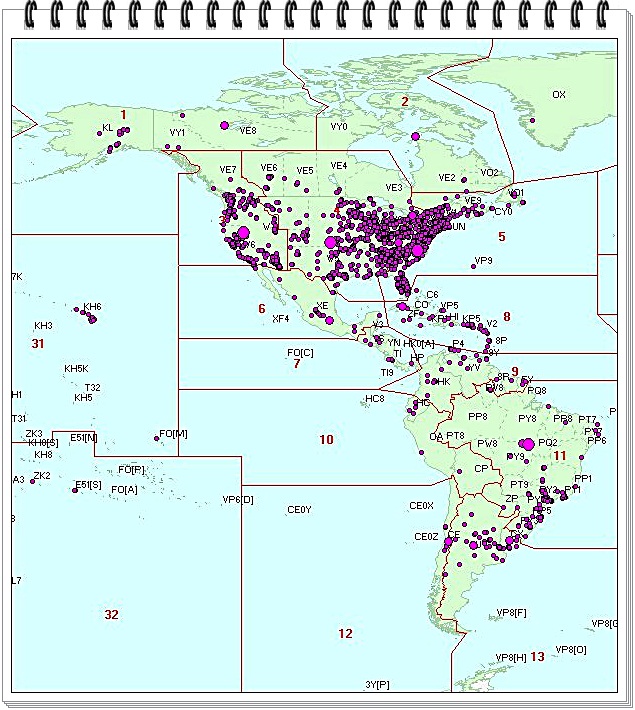 |
| Rick, ZL2HAM created 2011 CQ WW DX SSB Station Distribution Map |
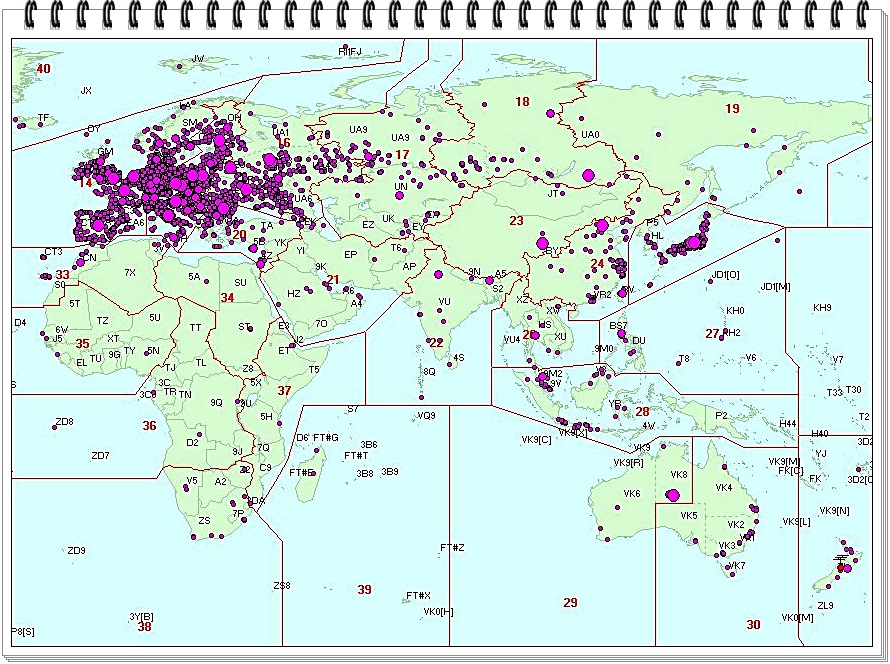 |
| ZL2HAM Station Distribution Map |
Thank you Rick, ZL2HAM for creating your visualization maps based on logs submitted from the 2011 CQ World Wide DX SSB event. I have a better understanding of why location counts in RadioSport as a result of your hard work. It did not sink in as to the challenge a West Coast station overcomes in order to achieve a DX event Box score.
Now, I can see ‘the why’ because of distance and concentration of stations. However, from the perspective of a national level event like Sweepstakes or NAQP, my location in California has an advantage.
Contest on!
Progress with the shack clock
I’ve spent a bit of time over the last day or so putting together a schematic for my Arduino / MSF60Khz shack clock. The previous iteration has been sat on my desk in breadboard form doing exactly what it should but a bit ugly.
I’ve designed the schematic on Eagle and made a bit of progress with support from the Arduino forums and think I’m nearly there. The eventual aim is for the club to have another option for those looking for a bit of soldering for the next step in their licence, or just as a simple thing for the shack.
I hadn’t appreciated how long it would take to get the spaghetti on the paper and I’m sure there’ll be more efficient ways to do it but here’s my first attempt after considerable help from the forums.

If you’re interested there are more details on the project pages which will be updated in due course.
I’m sure there are those who could do this in a few minutes, but, for the more challenged like myself it has been quite a steep curve to climb but a worthwhile one. It’ll be lovely to get something finished before the end of the month but we’ll see how well it goes. I’m struggling a bit with the PCB with little things like mounting holes and getting the correct drill size / grid.
If anyone fancies being a checker for this and the board then I’m always happy to accept guidance.

Whoever spots all the errors first wins a prize!
Alex Hill, G7KSE, is a regular contributor to AmateurRadio.com and writes from Cumbria, UK. Contact him at [email protected].
YouView or not YouView
This post is nothing to do with ham radio. However it is about radio – or rather TV – and the internet, and I’m pretty sure some of my readers know more than I do about this subject.
Here’s the thing. A few days ago TalkTalk – our telecoms and broadband provider – sent us a letter offering a free YouView box as a sop for the tariff going up. If I understand correctly, a YouView box would provide us with two things that we don’t currently get from our plain old Freesat box: the ability to record programmes (our Freesat box isn’t one with a hard drive in it) and the ability to catch up on already broadcast programmes using things like BBC iPlayer.

If we want to watch programmes after they have been broadcast then we have to use iPlayer or whatever on our computers, of which we have about six in the house already, not counting the old Toshiba laptop I run DOS on to program Motorola radios or the other slightly less old Toshiba laptop that has a whole column of dead pixels in the middle of its display. I haven’t tried connecting one of the computers to the wide screen TV in the living room and watching BBC iPlayer that way. We watch it on the computer screen if we want to. If we want to record programs for later viewing we need to buy a newer more expensive version of our Humax Freesat box.
A YouView box would cost £299 so it’s quite an attractive deal to get one free. The question is: would we be able to use it without a lot of hassle?
If I understand correctly, in order to use a YouView box we would need two things that we don’t already have: a digital terrestrial TV antenna (we get all the TV channels we need on Freesat) and an Ethernet connection to our router accessible from where the TV is (because apparently YouView doesn’t have a wi-fi adapter.) Obtaining these would entail a fair amount of extra expense on hardware (i.e. the cost of having a TV aerial installed, and some kind of wi-fi adapter or a long and ugly piece of Ethernet cable.) Nor do I know whether YouView would need the same type of TV input already being used by the Freesat box, namely the HDMI input.
So my thinking is that it’s not worth the cost and hassle. Getting stuff like this to work usually results in my tearing my hair out – and it’s only just started growing back! But then I’m not the one who cares if we miss Strictly Come Dancing because we are out or some other show that clashes with something else we’re watching. Perhaps I shouldn’t look gift YouView boxes worth £300 in the mouth. Your thoughts, multimedia experts?
Julian Moss, G4ILO, is a regular contributor to AmateurRadio.com and writes from Cumbria, England. Contact him at [email protected].
 Ham Radio Deluxe |
 W5SWL Electronics |
 Ham Radio Prep |
 KB3IFH QSL Cards  Hip Ham Shirts  HamRadioAuctions HamRadioAuctions Reliance Antennas Reliance Antennas Enigma Shop Enigma Shop |  morseDX  Ni4L Antennas  R&L Electronics R&L Electronics antennas.us antennas.us QRV QRV |
- Matt W1MST, Managing Editor
