 |
 Contest Skeeter Hunt wallpaper
 9 December 2012 | by
  |
| Just waiting to be framed and hung on the "I love me" wall |
Mike Weir, VE9KK, is a regular contributor to AmateurRadio.com and writes from New Brunswick, Canada. Contact him at [email protected].
Beacon monitor failure
After wasting most of the weekend trying to get it to work I have abandoned the idea of monitoring the IBP beacons using Faros. Although I did have it working with my Elecraft K3 I did not want to tie up this expensive transceiver on such a task. But my efforts to get my FT-817 working with this software came to nothing.
The first problem was getting Faros to control the FT-817. It uses a program called Omni-Rig to do this. The solution – no thanks to the developer who has still not replied to my plea for help – turned out to be a bad FT-817.ini file installed with Omni-Rig. I tried other programs to verify that my FT-817 CAT interface was working properly. I even ran the same developer’s CW Skimmer software which also uses Omni-Rig, and which controlled the FT-817 just fine. The idea of looking to see if there was a different FT-817.ini file was just a flash of inspiration.
Having got Faros controlling the radio the second and final problem was getting it and the Yaesu talking to the same sound card. This did work if I used the computer’s built-in sound card, but that is normally used by my K3. I have several radios in my shack, most of which are connected to the shack PC and all of the others use various USB sound devices. Whilst all of my other software – including my own program KComm – produce a drop-down list showing distinguishable names of all these devices, Faros displays a list showing three lines that all say “USB Sound Device.” I tried selecting each one of them in turn, but I could not get Faros to talk to the sound device that was actually connected to the FT-817.
If it was confusing for me trying to choose from identically named devices, it also seemed to confuse Windows, which ended up sending PSK31 audio out of the PC speaker instead of to my K3! I had to reboot the computer to get sound using the correct devices again. At this point I threw in the towel and admitted defeat. Some things just aren’t worth the hassle.
So endeth my attempt at beacon monitoring.
Julian Moss, G4ILO, is a regular contributor to AmateurRadio.com and writes from Cumbria, England. Contact him at [email protected].
So here’s the deal ……
I was sitting in the shack Thursday night, working the Fox hunt and I was looking at my K2. It looks kind of lonely, sitting there idly, while my K3 and KX3 get all the duty time. So I made a decision – my baby needs to go to a home where it will be the “star” and get the usage it deserves. This radio deserves better than “back up” status. It really, really, really kills me to do this – but unlike others, I realize there are only so many radios that I can reasonably have and put on the air at any given moment.
This is K2 – serial number 4090. It has the latest version of the main board in it. It also has the following:
K160RX – allows 160M operation.
KNB2 – Noise Blanker
KAF2 – Audio Filter
KAT2 – 20 Watt built in auto tuner.
My K2 is CW only – no SSB module and it is the QRP version, it is NOT a K2/100.
Here’s a picture:
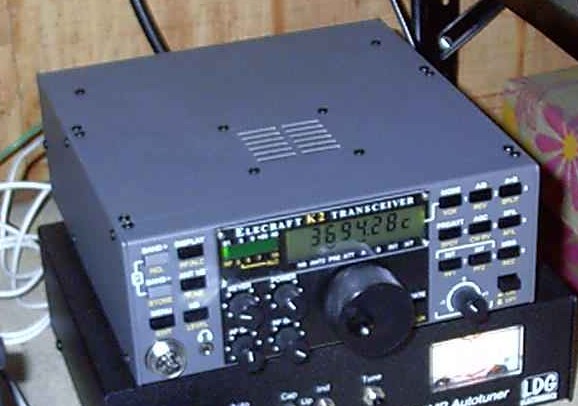
I personally built this baby and after I had built it, I had sent it to Alan Wilcox of Wilcox Engineering. He installed the KAF2 for me and perfected the settings of the filters and tweaked it for optimum output. This radio is the best!
Cosmetically, it is a 9.8 out of 10. The case is PRISTINE and the only imperfections are a few minor scuffs on the face of the main tuning knob.
If you were to purchase all the components new from Elecraft, it would cost you $1090.00, plus you’d have to build it (and there is a rumor of a price increase from Elecraft at the beginning of the new year). This radio, although used, looks and (even better) works perfectly. AND it comes from a non-smoker home. I am contemplating a price of $850.00, and I will cover the (domestic) shipping. I have the original manual and will throw in the power cord. – Note: K2 IS SOLD
In the same vein, I am also offering up my PFR3A:
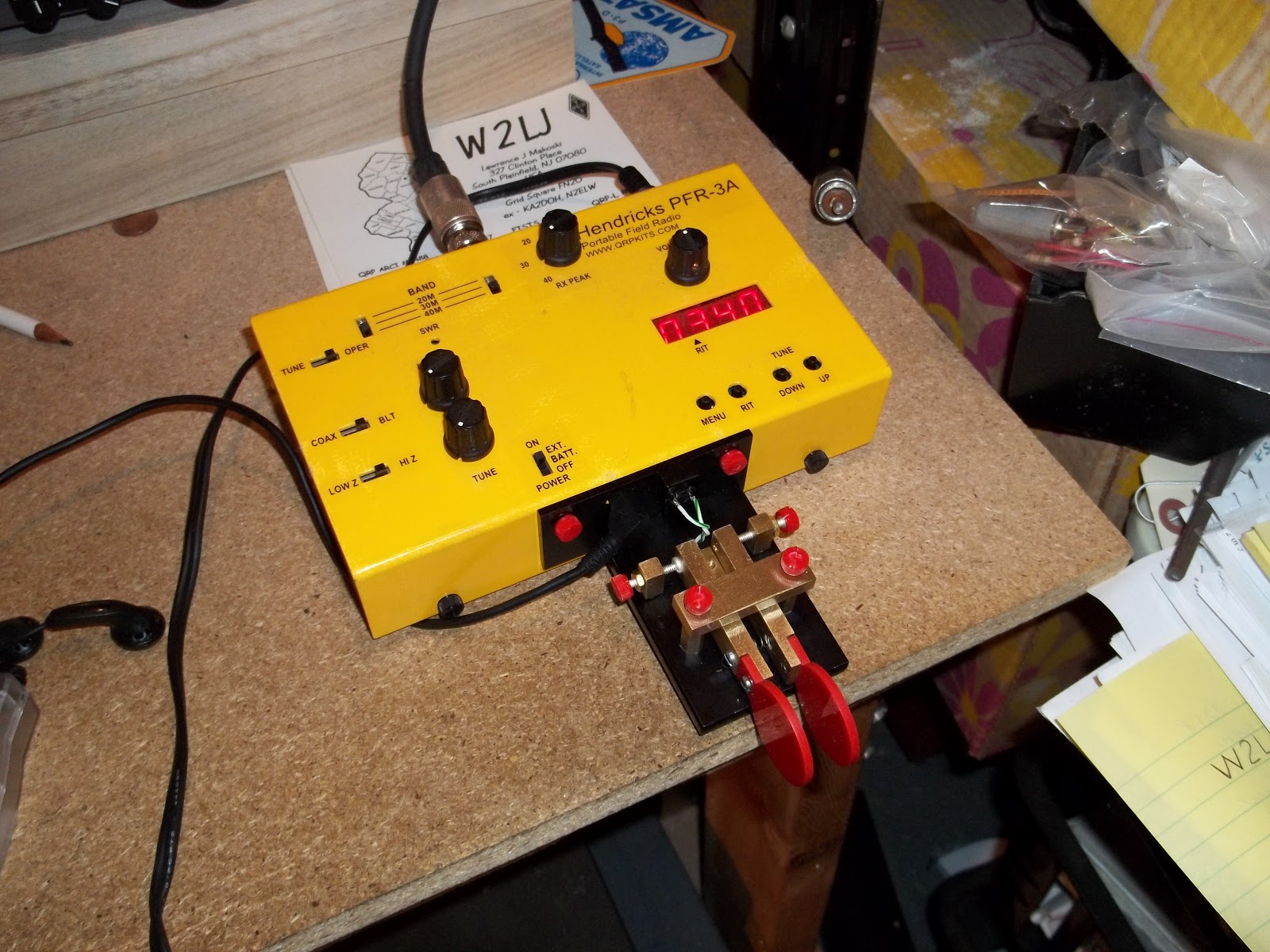
This includes the Baby Black Widow paddles. There is an issue – a cosmetic one. I clear coated the front cover of the PFR3A and it got smudged before the clear coat dried completely. I’d rate this one as an 8 out of 10. BUT ……….. I ordered a new front cover for it; but have not had the time to put the decals on it, clear coat it and install it. So this package will contain the PFR3A, new cover and decals, as well as the Baby Black Widow paddles. Brandy new from Hendricks QRPKits, the radio alone goes for – $240.00. I will let this one go with the extras described above for $200. I will also cover the (domestic) shipping costs of this one too.
I am probably going to post these to QRP-L tomorrow evening. If I get no bites there, then onto eBay probably Monday or Tuesday. I’m giving my readers first crack.
I accept PayPal or money orders – and the above prices are not carved in granite. I’m willing to consider REASONABLE offers. Please send an e-mail to [email protected] if interested. Please don’t use the comments as they have been wacky with spam and I might miss your offer as I delete spam comments.
72 de Larry W2LJ
QRP – When you care to send the very least!
Larry Makoski, W2LJ, is a regular contributor to AmateurRadio.com and writes from New Jersey, USA. Contact him at [email protected].
PZTLog – much goodness
After my initial blog about Charlie M0PZT’s PZTLog, I have been using it more and more and finding it very enjoyable to use and very good.
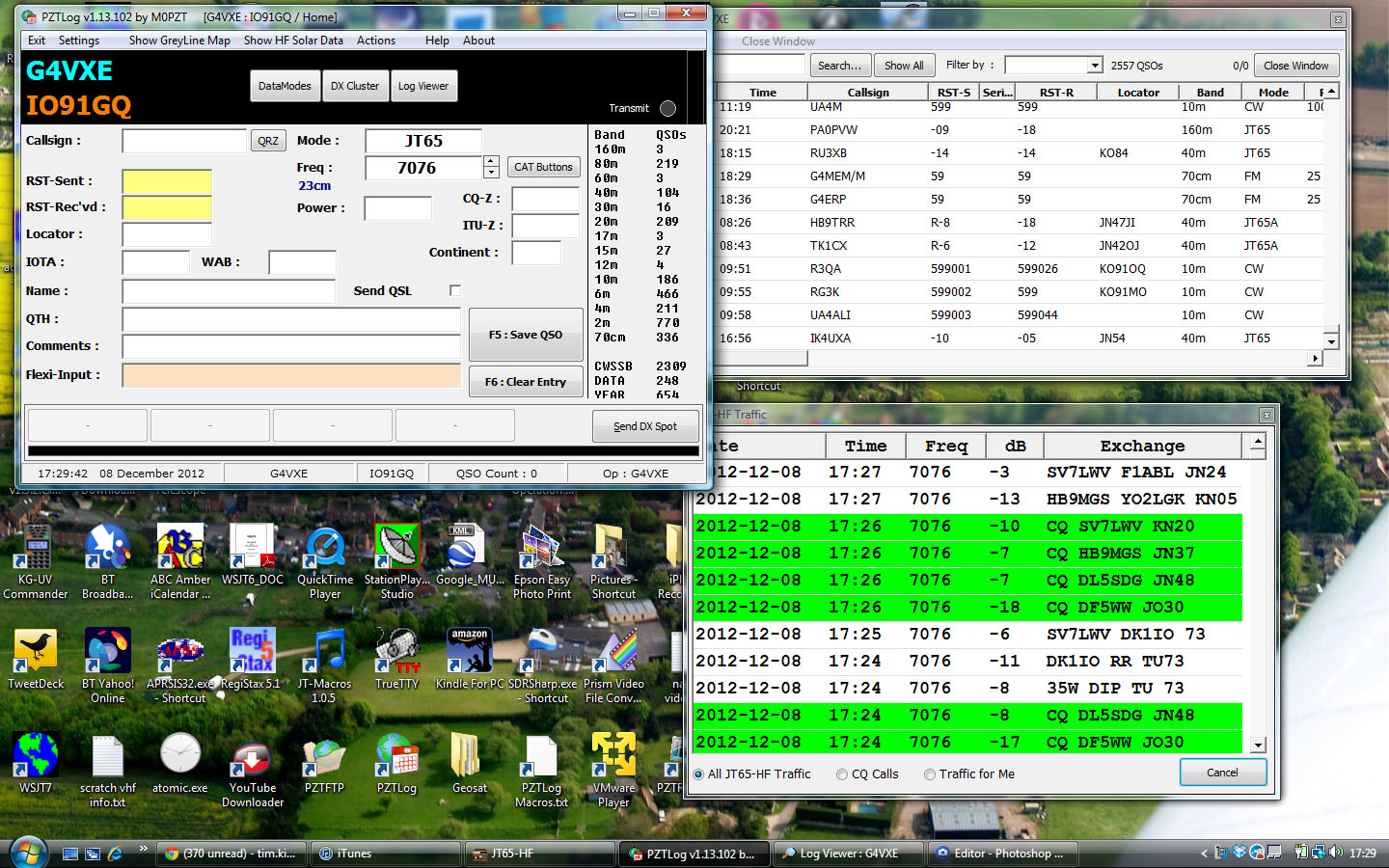
Of course I have been finding out more about the program, and Charlie has been busy adding new functionality to the software. The ADIF import now seems pretty robust and I’ve been able to import my log from Winlog32 into PZTLog.
There’s Locator Square listings, so you can see which locators you have worked on various bands – HF as well as the VHF bands – ideal if you enjoy chasing the grid squares on HF JT65A, for example. I like the integrated Grey Line Map display
Being a keen JT65-HF user, I particularly like the ability to display the JT65HF traffic within PZTLog. And best of all, double clicking on a line in the JT65 Traffic window will bring various details into PZTLog, so you don’t need to worry about doing a separate ADIF import to bring the QSOs in.
I can’t say enough nice things about Charlie’s responsiveness to questions and suggestions – updates appear very frequently- fixing issues – or adding new features.
PZTLog has become the default station logging software here at G4VXE – I’m delighted with it! Thanks for all your hard work, Charlie!
Tim Kirby, G4VXE, is a regular contributor to AmateurRadio.com and writes from Oxfordshire, England. Contact him at [email protected].
Pearl Harbor

“Getting the Message Through: A Branch History of the U.S. Army Signal Corps” by Rebecca Robbins Raines
CENTER OF MILITARY HISTORY, UNITED STATES ARMY, WASHINGTON, D.C., 1996 (pgs 242-244)
During 1940 President Roosevelt had transferred the Pacific Fleet from bases on the West Coast of the United States to Pearl Harbor on the Hawaiian island of Oahu, hoping that its presence might act as a deterrent upon Japanese ambitions. Yet the move also made the fleet more vulnerable. Despite Oahu’s strategic importance, the air warning system on the island had not become fully operational by December 1941. The Signal Corps had provided SCR-270 and 271 radar sets earlier in the year, but the construction of fixed sites had been delayed, and radar protection was limited to six mobile stations operating on a part-time basis to test the equipment and train the crews. Though aware of the dangers of war, the Army and Navy commanders on Oahu, Lt. Gen. Walter C. Short and Admiral Husband E. Kimmel, did not anticipate that Pearl Harbor would be the target; a Japanese strike against American bases in the Philippines appeared more probable. In Hawaii, sabotage and subversive acts by Japanese inhabitants seemed to pose more immediate threats, and precautions were taken. The Japanese-American population of Hawaii proved, however, to be overwhelmingly loyal to the United States.
Because the Signal Corps’ plans to modernize its strategic communications during the previous decade had been stymied, the Army had only a limited ability to communicate with the garrison in Hawaii. In 1930 the Corps had moved WAR’s transmitter to Fort Myer, Virginia, and had constructed a building to house its new, high-frequency equipment. Four years later it added a new diamond antenna, which enabled faster transmission. But in 1939, when the Corps wished to further expand its facilities at Fort Myer to include a rhombic antenna for point-to-point communication with Seattle, it ran into difficulty. The post commander, Col. George S. Patton, Jr., objected to the Signal Corps’ plans. The new antenna would encroach upon the turf he used as a polo field and the radio towers would obstruct the view. Patton held his ground and prevented the Signal Corps from installing the new equipment. At the same time, the Navy was about to abandon its Arlington radio station located adjacent to Fort Myer and offered it to the Army. Patton, wishing instead to use the Navy’s buildings to house his enlisted personnel, opposed the station’s transfer. As a result of the controversy, the Navy withdrew its offer and the Signal Corps lost the opportunity to improve its facilities.

Though a seemingly minor bureaucratic battle, the situation had serious consequences two years later. Early in the afternoon of 6 December 1941, the Signal Intelligence Service began receiving a long dispatch in fourteen parts from Tokyo addressed to the Japanese embassy in Washington. The Japanese deliberately delayed sending the final portion of the message until the next day, in which they announced that the Japanese government would sever diplomatic relations with the United States effective at one o’clock that afternoon. At that hour, it would be early morning in Pearl Harbor.
Upon receiving the decoded message on the morning of 7 December, Chief of Staff Marshall recognized its importance. Although he could have called Short directly, Marshall did not do so because the scrambler telephone was not considered secure. Instead, he decided to send a written message through the War Department Message Center. Unfortunately, the center’s radio encountered heavy static and could not get through to Honolulu. Expanded facilities at Fort Myer could perhaps have eliminated this problem. The signal officer on duty, Lt. Col. Edward F French, therefore sent the message via commercial telegraph to San Francisco, where it was relayed by radio to the RCA office in Honolulu. That office had installed a teletype connection with Fort Shafter, but the teletypewriter was not yet functional. An RCA messenger was carrying the news to Fort Shafter by motorcycle when Japanese bombs began falling; a huge traffic jam developed because of the attack, and General Short did not receive the message until that afternoon.
Scott Hedberg, NØZB, is a regular contributor to AmateurRadio.com and writes from Kansas, USA. Contact him at [email protected].
Print me an enclosure
 |
| Picture from nextdayreprap.co.uk |
Jason, NT7S has just posted an article entitled “3D Printed Enclosures” on his blog. As a ham with a drawer full of unboxed projects who has often spent hours searching for suitable enclosures for a project and only finding ones that are either a wee bit too small or miles too big, the idea of being able to make my own custom enclosures is very appealing.
I had heard about 3D printing before, but thought it was either an April Fool spoof gone wild or one of those blue sky ideas that never become reality. My (admittedly cursory) searching has so far failed to turn up any articles that explain how it works, who makes 3D printers or what they cost. (However the site from which the picture was taken, nextdayreprap.co.uk, looks like a good place to start.)
Julian Moss, G4ILO, is a regular contributor to AmateurRadio.com and writes from Cumbria, England. Contact him at [email protected].
A radio on every port
I left Faros running overnight. I needn’t have bothered: Nothing whatever was heard on the bands 14 – 28MHz from 1730 yesterday until 0730 this morning. Even now, the Finland beacon OH2B is the only one making much of a showing on the lower 3 bands, though there is a flicker of a signal from VK6RBP on 15m. I haven’t interrupted beacon monitoring to take a listen on 10m yet but prospects for the ARRL 10m contest don’t look very good.
I am going to have to interrupt beacon monitoring some time soon. I need to yank the shack computer out to install a spare 2-port RS232 board to give me two more real serial ports. I should have left it in instead of replacing it with the 4-port board whose four serial ports are now all used up (K2, K3, TM-D710 TNC for 2m APRS and TM-D710 Echolink control, since you ask.) I want to use my FT-817 for beacon monitoring as it is a bit of overkill to use my K3 for this, and the FT-817 CAT cable I have has a DB-9 for a real serial port. I could always use a USB to serial adapter of which I have three, or even make up a USB cable using a wire-ended USB-to-serial plug. But USB ports are in equally short supply, as you might imagine. Whilst the cover is off the computer I will take the opportunity to hoover out the inside which has an amazing ability to attract dust!
Being able to use the 817 for beacon monitoring won’t solve the conflict between monitoring and operating as I still have only one suitable antenna for both tasks. But it will allow me to give the K3 a rest!
Julian Moss, G4ILO, is a regular contributor to AmateurRadio.com and writes from Cumbria, England. Contact him at [email protected].
 Ham Radio Deluxe |
 W5SWL Electronics |
 Ham Radio Prep |
 KB3IFH QSL Cards  Hip Ham Shirts  HamRadioAuctions HamRadioAuctions Reliance Antennas Reliance Antennas Enigma Shop Enigma Shop |  morseDX  Ni4L Antennas  R&L Electronics R&L Electronics antennas.us antennas.us QRV QRV |
- Matt W1MST, Managing Editor
