 |
 RSGB Centenary
 12 December 2012 | by
It’s fashionable for British hams to knock the RSGB. But I have never been much influenced by fashion.
The RSGB will be 100 years old in 2013. No doubt there will be all sorts of celebrations, a special event station and so on.
To mark the occasion I will display the RSGB centenary badge on my blog and my website until the end of 2013. I think it would be a good idea if more RSGB members who have blogs and web pages did the same.
Here is a snippet of code to make it easy for you to add this to your website:

It’s an image not text so you can’t cut and paste it – Blogger kept interpreting it as HTML code so this was the only way I could find to include it!
Julian Moss, G4ILO, is a regular contributor to AmateurRadio.com and writes from Cumbria, England. Contact him at [email protected].
Courage Center Handiham World Weekly E-Letter for the week of Wednesday, 12 December 2012
Pat Tice, WA0TDA, is the manager of HANDI-HAM and a regular contributor to AmateurRadio.com. Contact him at [email protected].
China on a handheld
 |
| Wu, BG6RRN |
Today was cold and frosty. I was sitting downstairs in the warm browing through my newly-arrived January 2013 RadCom. In the shack my K3 was listening for beacons, my K2 was being a Robust Packet APRS gateway on 30m and my TM-D710 was being the local VHF APRS gateway whilst the other side of this dual band radio was running my Echolink node and logged in to the IRELAND conference (Echolink’s equivalent of D-Star’s reflectors.)
The Baofeng UV-3R+ on the table burst into life and I heard Wu, BG6RRN making a call. No-one replied to him so I called back. And so I found myself having a chat about Chinese radio equipment with a Chinese radio amateur using a Chinese handheld!
Wu spoke pretty good English – better than my Chinese anyway! He asked what I thought about Chinese radio equipment and I replied as diplomatically as possible that I liked it because it was cheap but the quality control could sometimes be better. Wu was familiar with the UV-3R+ I was using to link into my Echolink node and said that they were very popular in China as well.
Wu told me that he has had an Icom IC-7000 transceiver for a month but had so far not made any European contacts. He has never tried PSK31 so I encouraged him to try it. I hope I’ll hear him on the HF bands one day. Today’s chat may not have been a proper radio QSO but I do enjoy the opportunities Echolink provides to talk with hams with whom I would not otherwise make contact.
Julian Moss, G4ILO, is a regular contributor to AmateurRadio.com and writes from Cumbria, England. Contact him at [email protected].
2012 ARRL 10 Meter | The Stats
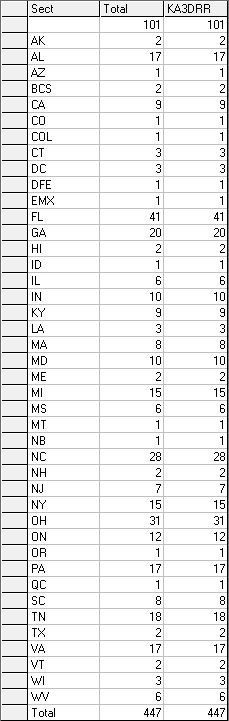 |
| N1MM Contest Logger Section Analysis |
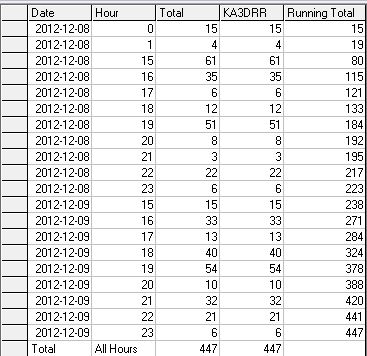 |
| N1MM Contest Logger Rate Per Hour Analysis |
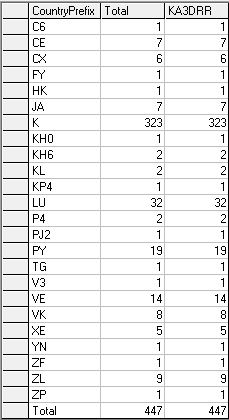 |
| N1MM Contest Logger Country Prefix Analysis |
Good afternoon from the #hamr shackadelic zone while Radio Dawg is waiting for her walking work out! Admittedly, my lower back pain is definitely associated with the lack of stretching, and yoga is my answer. I started walking breaks after long periods in the chair and it looks like stretching is a good prescription as well.
My above screens shots detail Q production from the effects of 10m propagation over the course of 20 hours. Also, after watching the news last night, I’m curious if mid-western storm systems, contributed to the radio blackout for this region? Heat. Snow. Rain. Tornadoes.
On the other hand, Florida 41 Qs, Ohio 31 Qs, and North Carolina 28 Qs, with South America stacking up like this — Lima Uniforms (Argentina) 32 Qs, Papa Yankees (Brazil) 19 Qs, Charlie Echoes (Chile) 7 Qs between two operating modes.
Ten meter propagation favored southerly latitudes perhaps related to either a positive or negative Bz with a relatively poor sunspot showing as well? There wasn’t enough ionospheric ionization to open northern latitude paths because of diminished sunspot numbers on the visible disc.
When paths were stable my rate(s) spiked — 61 Qs at 1500UTC (shortly after sunrise to East coast); 51 Qs at 1900UTC on Saturday (sun beginning descent suggesting enhancement effect); and 54 Qs at 1900UTC on Sunday much like Saturday.
I’m noting 8 Qs at 2000UTC on Saturday and 10 Qs at 2000UTC on Sunday suggesting significant path decay after 1900UTC peaks.
Is Cycle 24 peaking? Has Cycle 24 peaked?
73 from the shackadelic near the beach.
Club Log Receives $4000 Yasme Foundation Grant
“Club Log represents a unique innovation that has quickly become established in the culture of our hobby. By providing free access to features such as leagues, online QSL requests and expedition management tools, Club Log has expanded the state of the art of DXing and has grown quickly as a result. The Foundation’s grant to Club Log gives the team the means to install backup servers and keep this precious resource online for everyone to enjoy into the future. We look forward to seeing more innovations from the Club Log team.”
Rusty, W6OAT, the Yasme Foundation
LoTW Web Page Now Features Daily and Hourly Status Updates
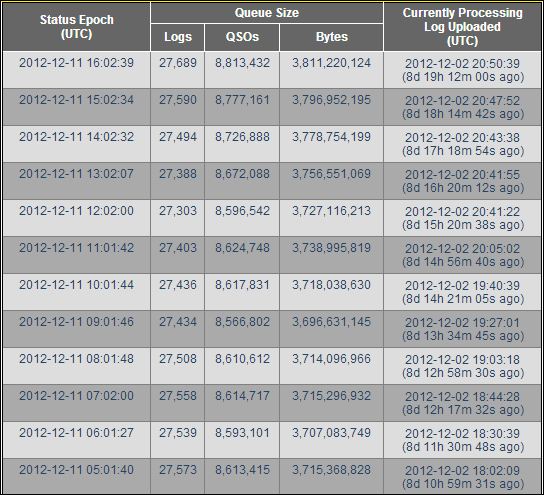
However, when LoTW either crashes or delays processing for more than a day, then, what about the viability and resilience of traditional QSL cards?
There will be something to be said about an analog backup when chasing coveted awards like DXCC, 5BDXCC, or WPX first five hundred.
Think about analog?
Logbook of The World Web Page Now Features Daily and Hourly Status Updates: The ARRL has created a new informational page to issue daily status updates and information of interest to the Logbook of The World (LoTW) user community. These updates will include planned downtime and changes that will impact LoTW operations. In addition, LoTW’s processing queue is now updated hourly, telling how many logs and QSOs have been uploaded to the LoTW system and are awaiting processing. New hardware that will improve LoTW’s throughput is on order and is expected to be running in six to eight weeks.
Rick Murphy, K1MU, and Dave Bernstein, AA6YQ, have been charged with rebooting the Trusted QSL open source project. If you have demonstrably strong C++ development skills that you’re interested in applying toward improving LoTW’s usability and efficiency, please contact Bernstein via e-mail…
A bug in KComm
Today started off with me continuing to compare the two morse decoders MRP40 and CW Skimmer in view of PC4T Paul’s insistence that the latter was the better morse decoder. When I heard someone calling CQ with no takers I took pity on them and returned their call. JY4NE and C6AKQ went into the log very quickly, in fact so quickly I was left wondering if I had actually worked them. Some people moan that all digital mode operators do is exchange macro files, but in a lot of CW QSOs you barely exchange anything!
Next I replied to a Russian station who was a bit more chatty. Unfortunately my logging program KComm locked up in mid-QSO. It was embarrassing because I was sending from the keyboard and didn’t even have a key plugged into the transceiver so I couldn’t continue. I’m sure there will be people who would add me to a blacklist for this, but these days I tend to treat CW as just another digital mode. Hence my interest in good decoder programs. 🙂
KComm has a feature where you can insert the answer to a multiple choice question into the outgoing text. It is expressed like this: %?question|answer 1|answer 2|answer3? which would cause a box to pop up saying “Question” and you click on the answer you want inserted. It was this feature that was causing the program to lock up.
After a couple of hours tracing code in the debugger I could not see what the error was, unless it was a bug in the Lazarus library software. The feature had been in KComm since many versions ago, but this current version was compiled with a new version of Lazarus, so that was a possible explanation. Eventually I managed to modify my program code to avoid the error, with the result that this afternoon there is now a version 2.02 of KComm.
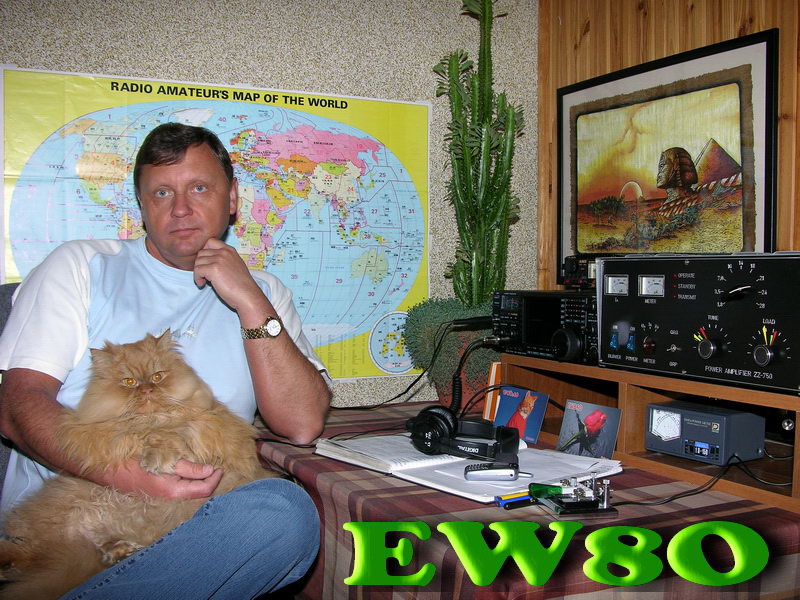
I tested the update by having a QSO with Mik EW8O in Belarus. Then I decided it was time for a rest – I find debugging code these days is mentally exhausting!
Julian Moss, G4ILO, is a regular contributor to AmateurRadio.com and writes from Cumbria, England. Contact him at [email protected].
 Ham Radio Deluxe |
 W5SWL Electronics |
 Ham Radio Prep |
 KB3IFH QSL Cards  Hip Ham Shirts  HamRadioAuctions HamRadioAuctions Reliance Antennas Reliance Antennas Enigma Shop Enigma Shop |  morseDX  Ni4L Antennas  R&L Electronics R&L Electronics antennas.us antennas.us QRV QRV |
- Matt W1MST, Managing Editor
