 |
 Series Five Episode Twenty-Seven – 2013 Radio Goals
 30 December 2012 | by
Series Five Episode Twenty-Seven of the ICQ Amateur / Ham Radio Podcast has been released. The latest news, listener mailbag and Martin sets radio goals for 2013
- Norman Woodland - Barcode inventor dies
- Transatlantic high altitude balloon bursts
- The Gathering - Irish amateur radio special event
- ILLW attracts more entries
- Limited time offer - VI4ASJ
- Ofcom thanks Radio Amateurs for Olympic support
- Potential interference sources identified
- MoD to auction off radio spectrum
- Dutch Military still insist on 915 MHz
- VK hams gain 472-479KHz band but lose 420-430MHz
- Pasta-shaped radio waves allows infinite channels
- APRS iGate built using a Raspberry Pi

Martin's Android App tip
EveryCircuit - https://play.google.com/store/apps/details?id=com.everycircuit#?t=W251bGwsMSwxLDIxMiwiY29tLmV2ZXJ5Y2lyY3VpdCJd
Colin Butler, M6BOY, is the host of the ICQ Podcast, a weekly radio show about Amateur Radio. Contact him at [email protected].
ICQ Podcast S05 E27 – 2013 Radio Goals (30 December 2012)
Series Five Episode Twenty-Seven of the ICQ Podcast has been released. News Stories include :-
- Norman Woodland - Barcode inventor dies
- Transatlantic high altitude balloon bursts
- The Gathering - Irish amateur radio special event
- ILLW attracts more entries
- Limited time offer - VI4ASJ
- Ofcom thanks Radio Amateurs for Olympic support
- Potential interference sources identified
- MoD to auction off radio spectrum
- Dutch Military still insist on 915 MHz
- VK hams gain 472-479KHz band but lose 420-430MHz
- Pasta-shaped radio waves allows infinite channels
- APRS iGate built using a Raspberry Pi
Listener mailbag and Martin sets radio goals for 2013
Colin Butler, M6BOY, is the host of the ICQ Podcast, a weekly radio show about Amateur Radio. Contact him at [email protected].
Output detected on 472khz from the IC706
I mentioned a few days ago that I had measured a couple of watts output from the IC706 on 479khz although I’d not yet detected it on a receiver.
This morning I did some better experiments and set the IC706 up on a dummy load and placed the ICF-2001 receiver close by to the dummy load. I was easily able to detect the keying on the receiver, so that was excellent news.
.JPG)
The next challenge will be to find some sort of antenna matching arrangement. I have ordered a ferrite rod from eBay (despite trawling through my junk boxes in the loft, I couldn’t find one). My first attempt at an ATU will, I think be similar to Roger G3XBM’s – although more of a bodge I expect!
However, I was speaking to Adrian G4GDR yesterday on 2m. Adrian has been one of the 500khz permit holders and mentioned that he had made a variometer out of a carpet roll and some rods. He very kindly invited me to inspect it, which I will certainly do.
I’m not sure how viable the IC706 will be for 472khz, but perhaps it will be possible to scrape a local contact or two.
Tim Kirby, G4VXE, is a regular contributor to AmateurRadio.com and writes from Oxfordshire, England. Contact him at [email protected].
Not much doing today
Today was a good day to be indoors. We had some snow today, but not nearly as much as was originally forecast. The weathermen were calling for 3 to 6 inches of the white stuff, but we ended getting around maybe an inch. Just slightly more than a dusting.
I did get on the radio for a bit after handling some house chores. But my radio efforts ended up not being fruitful at all. I called CQ for quite a while on 15, 17, 20 and 30 Meters. The Reverse Beacon Network told me that my signal was getting out just fine, but there were no answers to my calls. Perhaps every body was busy with the RAC contest.
So I entertained myself by investigating logging programs. The new version of Ham Radio Deluxe is out, but the program went from free to $80. I suppose that given the sophistication of the software that it’s worth it, but I can’t imagine spending that right now. I did sell my K2 and PFR3A recently, but those funds are earmarked for something else. So I will maintain the last free version on my computer. I also noticed that Version 6 is recommended to be run on a Windows 7 machine with dual core processors. Hardly what my netbook is set up for.
Now that computers are becoming such a fixture in our shacks, it almost seems like we are replacing them at faster rates than our radios. There are many Hams out there using boatanchors, but I would venture to guess that most everyone’s computers are not as old. Can’t get away with antiques when it comes to computing power in the shack!
Tomorrow should be less busy as far as chores go. Maybe I’ll bet to spend more time twiddling the dial.
72 de Larry W2LJ
QRP – When you care to send the very least!
Larry Makoski, W2LJ, is a regular contributor to AmateurRadio.com and writes from New Jersey, USA. Contact him at [email protected].
Beach Boys ARC | On The Edge Of A Continent
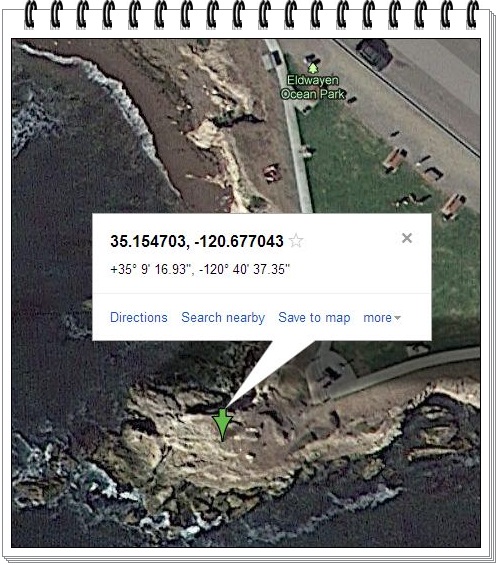 |
| Satellite perspective of our operating latitude and longitude on rocky outcropping. |
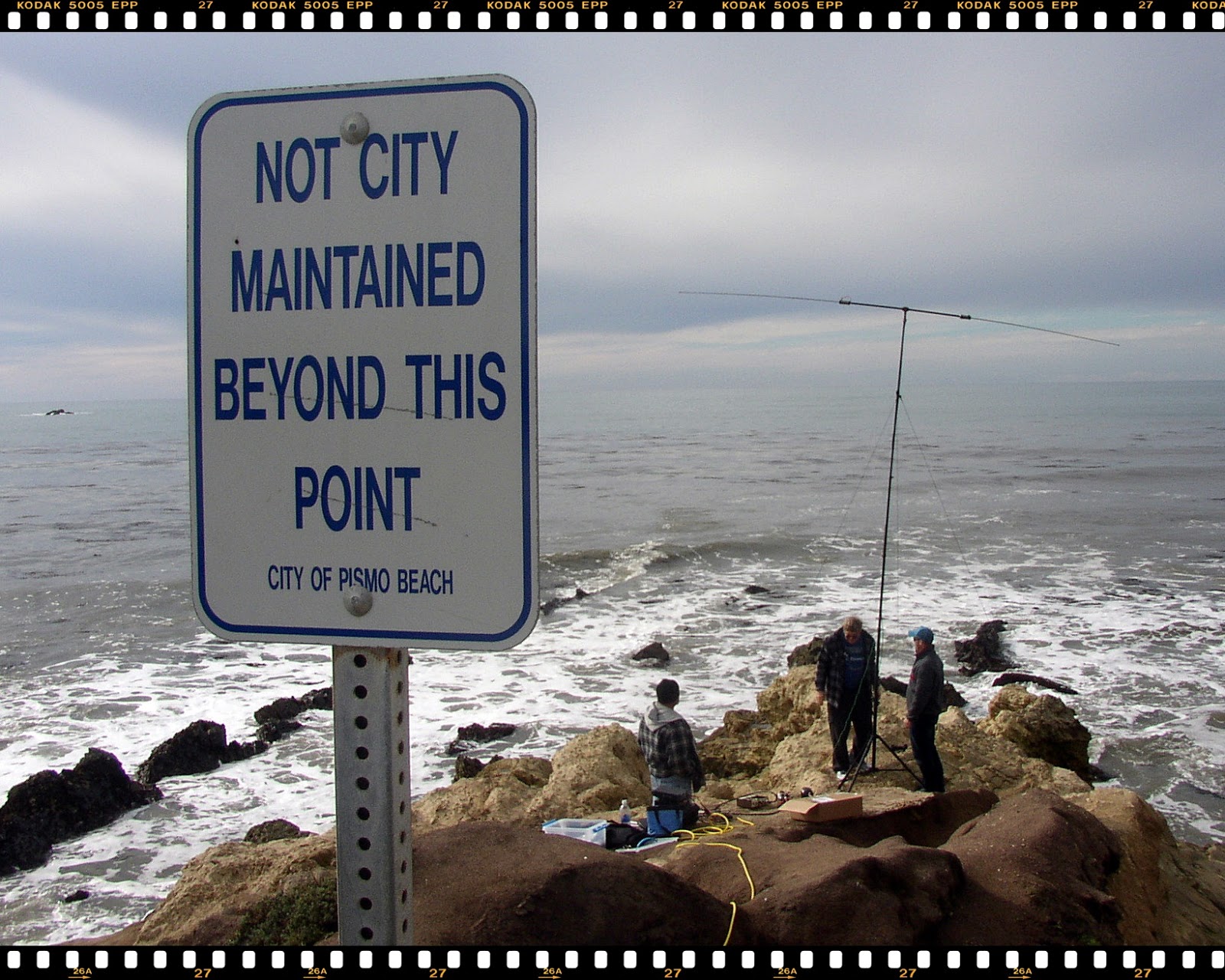 |
| The city sign amplified our ham radio experience in the great outdoors. |
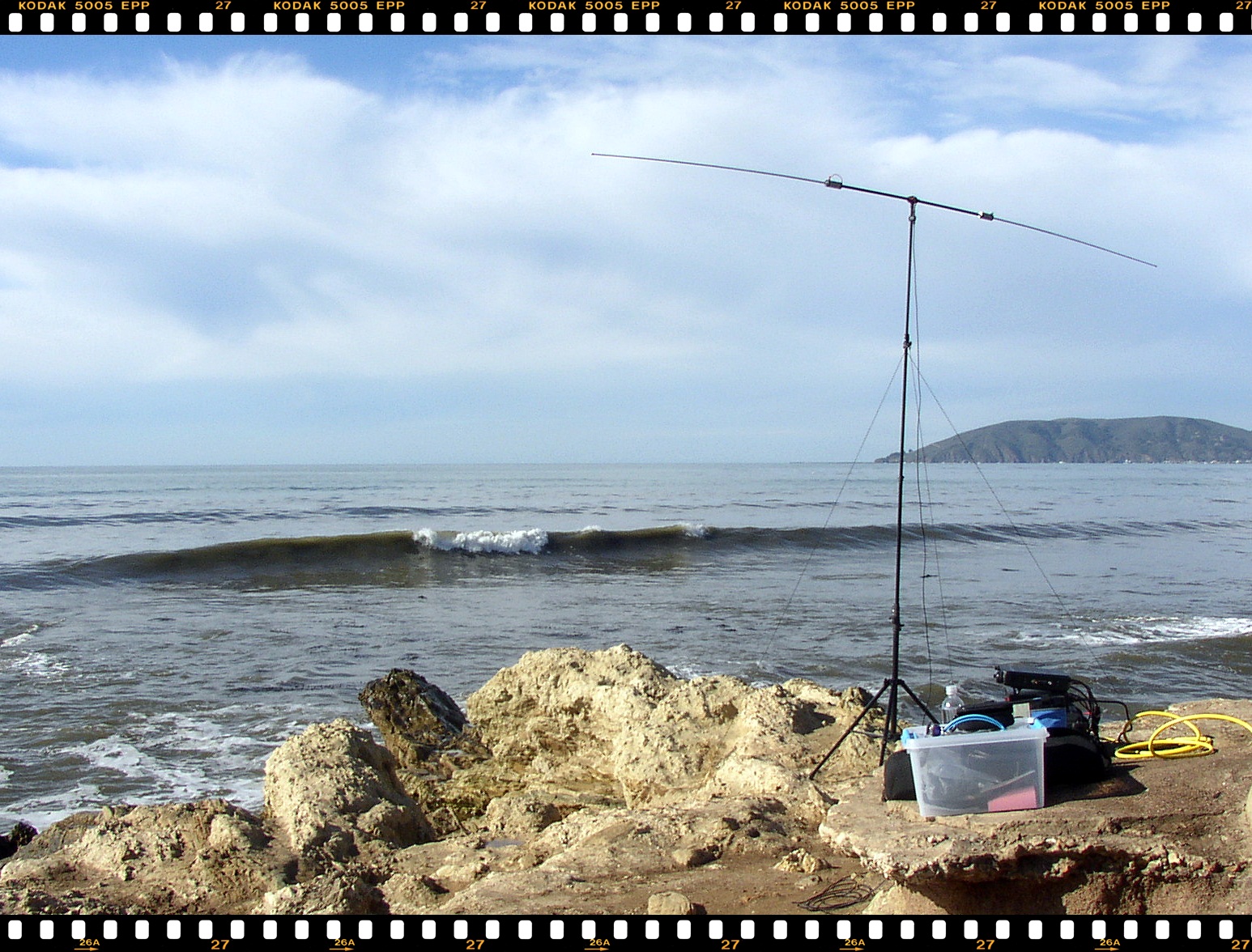 |
| Buddipole antenna system configured for 15m CW pointing north to south. |
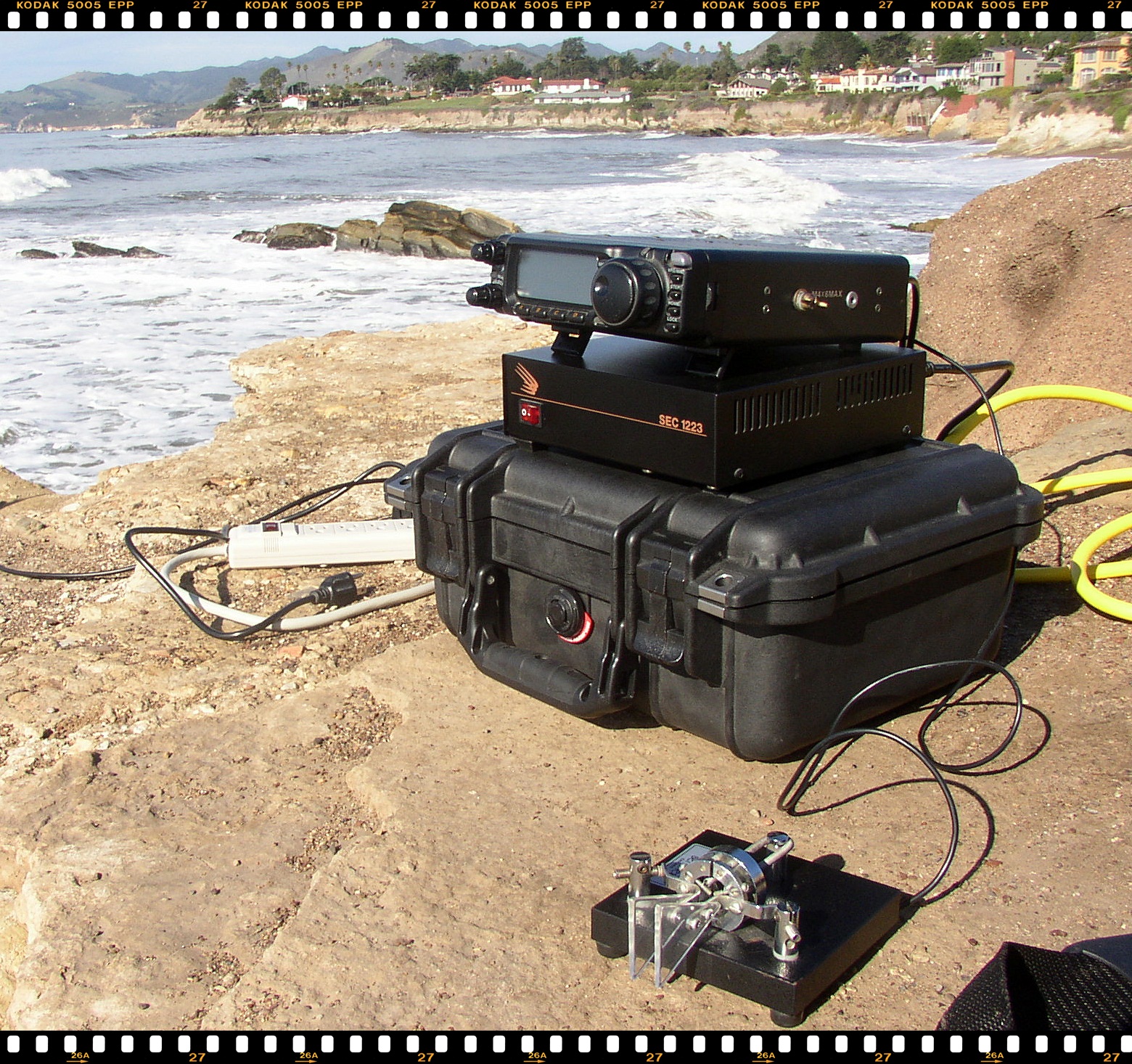 |
| Yaesu FT100 with power supply connected to Bencher Paddles almost ready to launch signal. |
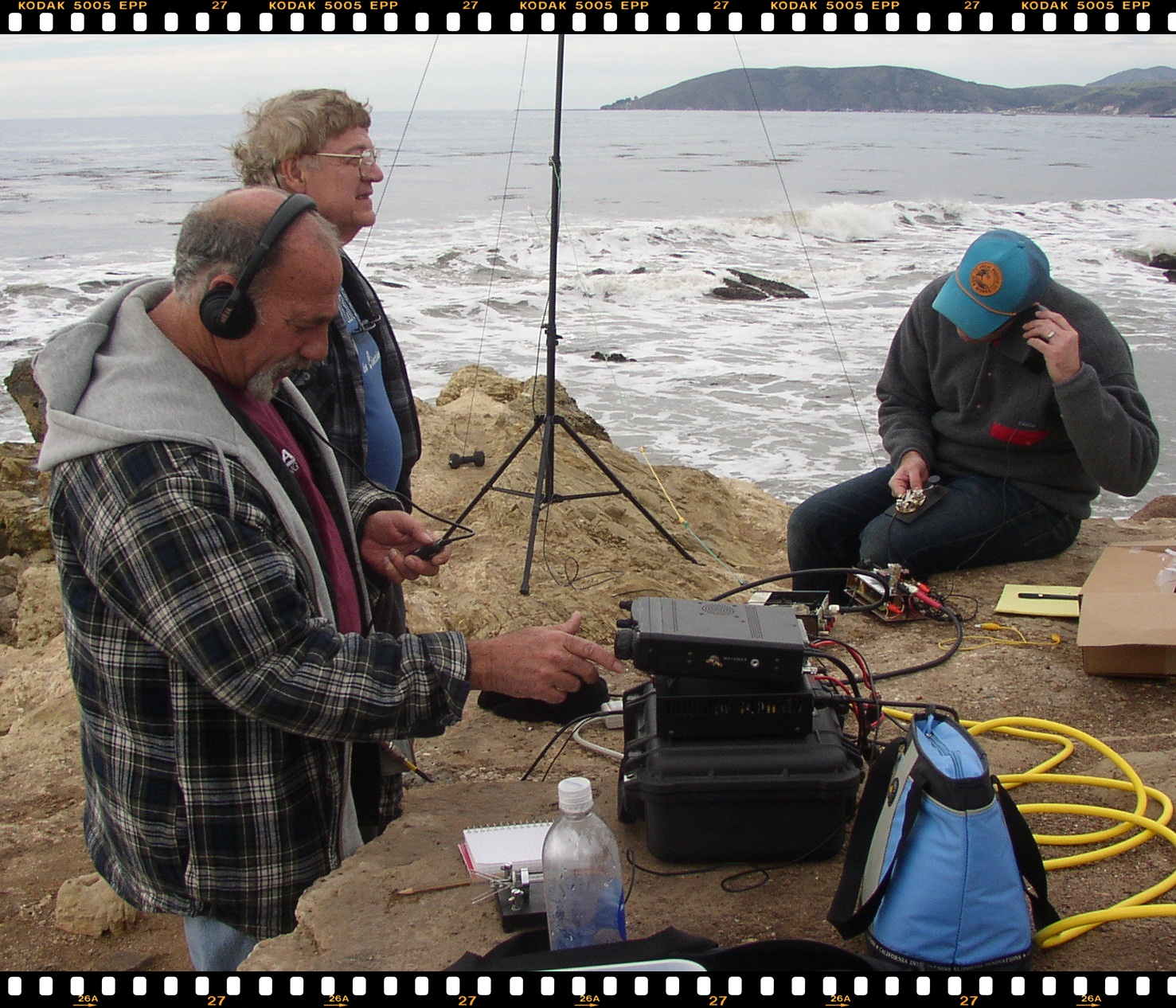 |
| Fred, KI6QDH spinning the dial on 15m SSB with Bob, K2YAZ waiting for Ryan, K6RQT to log a QRP contact. |
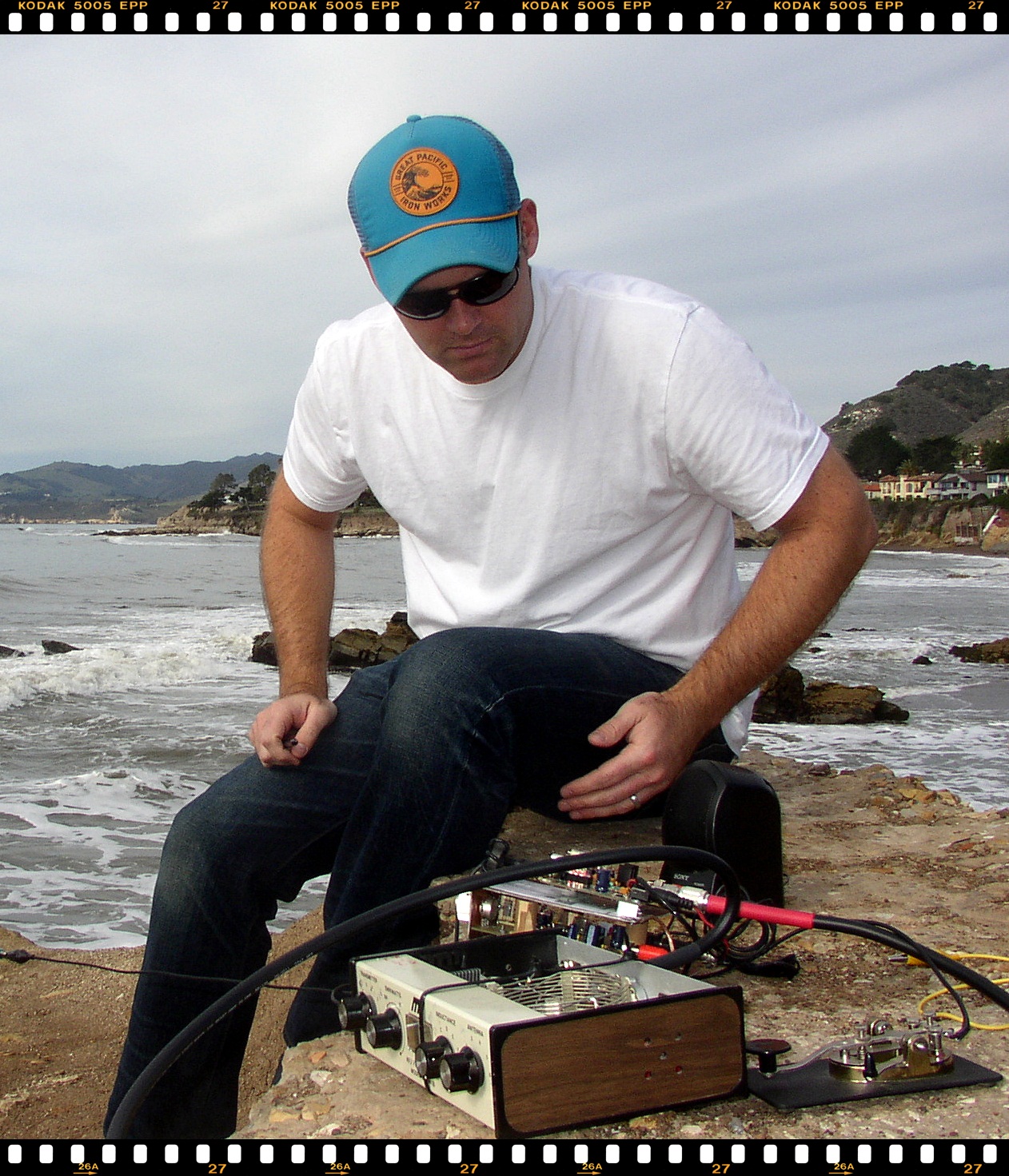 |
| Ryan, K6RQT getting ready to fire up his homebrew 1 watt, crystal controlled transceiver using matched long wire. |
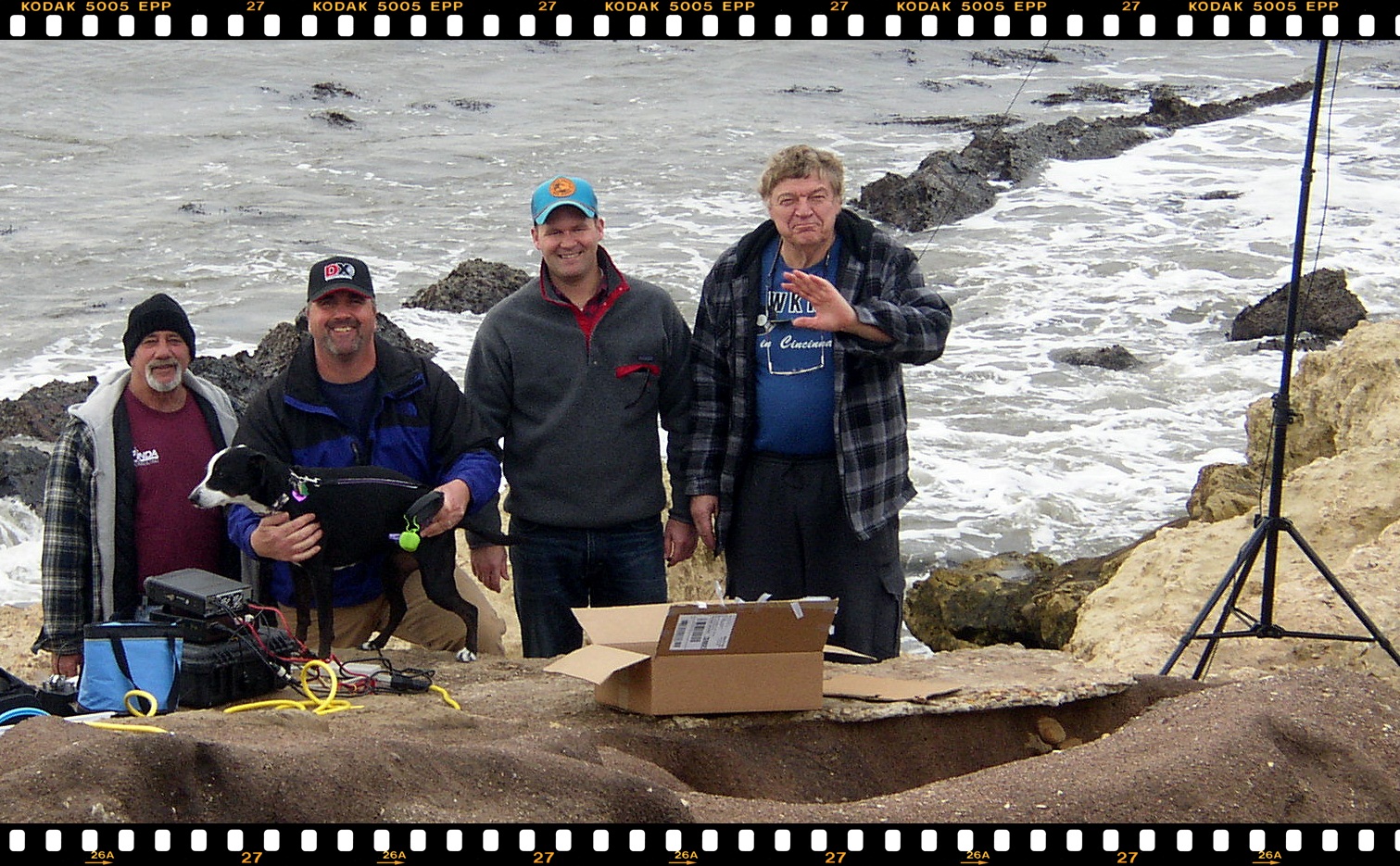 |
| Beach Boys ARC participants (L) to (R) Fred, KI6QDH, Scot KA3DRR, Radio Dawg, Ryan, K6RQT, and Bob, K2YAZ. |
We could not wish for a better day while experiencing ham radio in the great outdoors. The temperature did not rise above 60 degrees with sunny skies giving way to partly cloudy and no wind from any direction.
I packed earlier that morning wondering if the park would be full of visitors and locals? Everyone likes taking their dogs for a walk around 10 o’clock in the morning. I wasn’t disappointed. However, not only were we going to experience ham radio in the great outdoors, this was an opportunity at acquainting our general public with wireless communication as well.
Our operating location was chosen for its rugged terrain and proximity to the ocean. I would like to credit PT0S St. Peter and St. Paul Rocks DXpedition for their inspiration. We attempted to a limited degree to approximate operating conditions. I learned that ambient noise level increased substantially at high tide. The noise of breaking waves against rocks is loud making CW copy difficult without cans.
Next time, will wear cans and need to make a box for a speaker and head set jack, when operating near the ocean. It is good practice to share the experience with our general public as well.
I can only praise the performance of the Buddipole antenna system and ease of assembly in the field. Also, for transparency, I’m not sponsored by Buddipole to promote its product line on my blog. The same can be said of DX Engineering as well, however; I’m passionate about both of these companies and want them to continue succeeding into the future.
On the other hand, I’m beginning to understand why DXpeditions spend a great deal of time preparing for their operation and the impact of not being prepared. For example, I could have tweaked the FT100 side band menu settings instead of doing this in the field, lesson learned. Also, I forgot to open the vent valve on the Honda EU2000i gas tank and it stalled about an hour into operation.
Beach Boys ARC participants successfully logged two CW contacts at 100 watts into the Buddipole. We contacted Oklahoma and Florida receiving respectable signal reports from by station operators. Ryan, K6RQT and Bob, K2YAZ called CQ on several occasions without success. However, RQT’s homebrew 40m crystal controlled, one watt transceiver with matched long wire antenna will be back in the field in the near future.
In the meantime, I learned about being prepared prior to actually operating in the great outdoors and, anytime, is a good time, to take ham radio outside of the shack. Overall, Beach Boys ARC participants enjoyed a few hours under the ionosphere operating ham radio from a rocky outcropping while sharing the best hobby on the planet with the general public.
73 from the shackadelic near the beach.
Nostalgia time again: My first shortwave receiver (almost..) the Sony ICF2001
Since I seem to have engaged in nostalgia a bit, with the IC-740 post here’s another one! As I was driving back to Cheltenham with Mum this afternoon, talking about her father, Harold Iles, my Grandpa (who incidentally features in Laurie Lee’s novel, ‘Cider With Rosie’) . Harold was a great experimenter and really should have been a radio amateur. He was building radio sets when this was very cool stuff. Mum was telling me that he’d helped her build her own valve receiver. Certainly in the 1970s, he helped me build my own crystal set, which I still have! When he died in 1979, he was kind enough to leave me a little money.
By 1979, I was already very interested in amateur radio and had been shortwave listening for sometime, using a Nordmende Globetrotter broadcast bands radio which I had acquired when a dear, if distant, uncle had passed on. The Globetrotter was excellent, although the tuning was not so precise and it was hard to know exactly where you were listening – which could be tricky when sending off SWL reports!
I think I really wanted to buy myself a Trio (not Kenwood in those days) R1000, but could not really afford it and I was not working at the time, so the affordable option, which would bring me SSB reception for the amateur bands was the Sony ICF-2001D.
.JPG)
I’ve a feeling that the ICF-2001 was £199, but I’m not sure. I remember buying it from a shop on the High Street in Cheltenham, ‘Ray Electrical’ (Robber Ray, as my Dad, perhaps unkindly, referred to him!), using Grandpa’s gift.
Having digital readout and SSB was amazing! Being 1979/1980, solar conditions were good and I was able to hear lots of DX, particularly on 28MHz. With the receiver in my bedroom using the whip antenna, I listened to the USA working into the Indian Ocean (VQ9) and much more DX! I was captivated and knew that this was the hobby for me.
The ICF-2001 served as a great introduction to amateur radio for me, and I entered the SWL ladder in ‘Short Wave Magazine’ for a couple of years. By early 1983, I had taken and passed the Radio Amateurs Examination (then a City and Guilds exam) and obtained my first callsign, G6TTU. The ICF2001 formed part of my first station, being used on the Mode A satellites (145MHz up and 29MHz down) enabling me to work such DX, to a VHF only call, at least, as OX3WS in Greenland and TU2IT in the Ivory Coast.
Of course, not long after, I aimed for my Class A licence, passing the 12 wpm morse test, and by then was working, and had purchased the IC-740 so the need for the ICF2001 was lessened.
However, my Dad was always interested in short wave and I made the rig available to him. When I was off on a DXpedition somewhere, such as D68C in the Comoros, or ZF1VX in the Caymans, he would listen out for me, which was a nice feeling.
Wind the clock forward to this afternoon. I wondered if the ICF2001, which was still in Dad’s old study, would still work (not having been used since Dad’s death almost 3 years ago), so I grabbed it and brought it home.
I popped a couple of AA batteries into the ‘computer’ battery box, connected a power supply and fired it up! IT WORKS!
Fun to listen around, just on the internal antenna – just for old times’ sake, but it’s nice to know it still works, and I’m sure I can still coax some DX out of it!
Thanks, Grandpa, for getting me started…
(PS This is the first blog post written on my Raspberry Pi computer)
Tim Kirby, G4VXE, is a regular contributor to AmateurRadio.com and writes from Oxfordshire, England. Contact him at [email protected].
Grounded
I hope all of you had a very good Christmas. I was not very well a couple of days before the holiday. Nothing to do with my cancer, I’m glad to say, but possibly a result of all the treatment for it. I’m feeling a lot better now, but have got to have more tests and may have to go into hospital for removal of gallstones or kidney stones – I’m not sure which as I’ve been told I have gallstones but I have had some sharp pain in the kidney area. As a consequence of this I haven’t felt much like getting up at a reasonable hour to start the beacon monitor or HF APRS gateway.
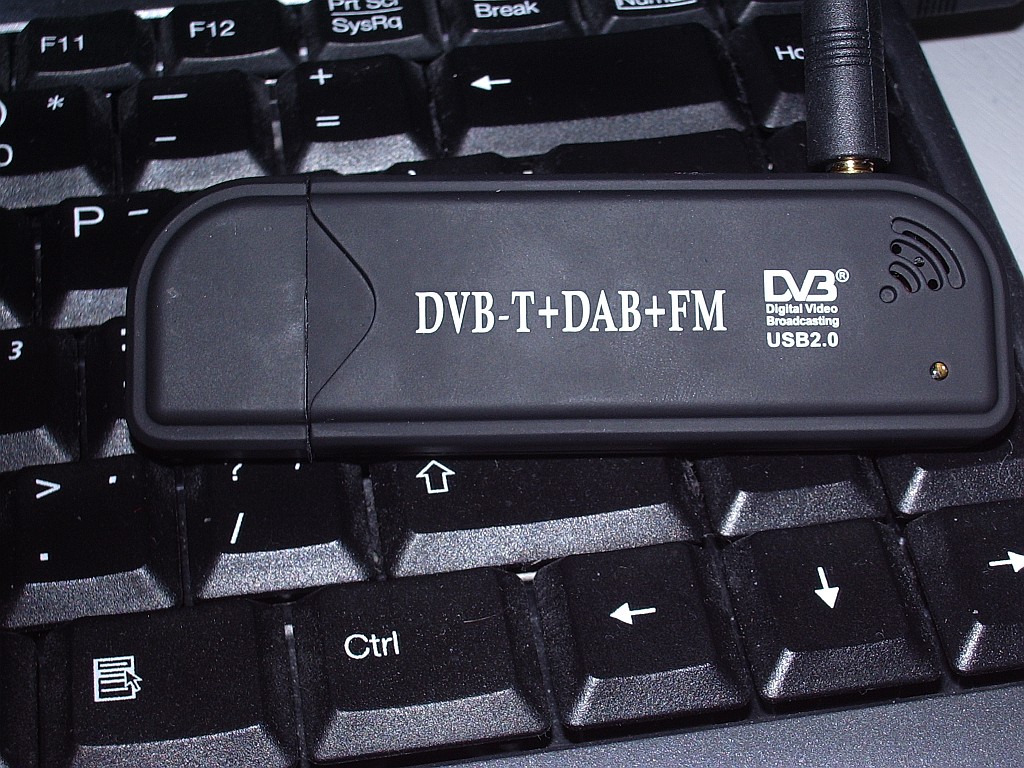 |
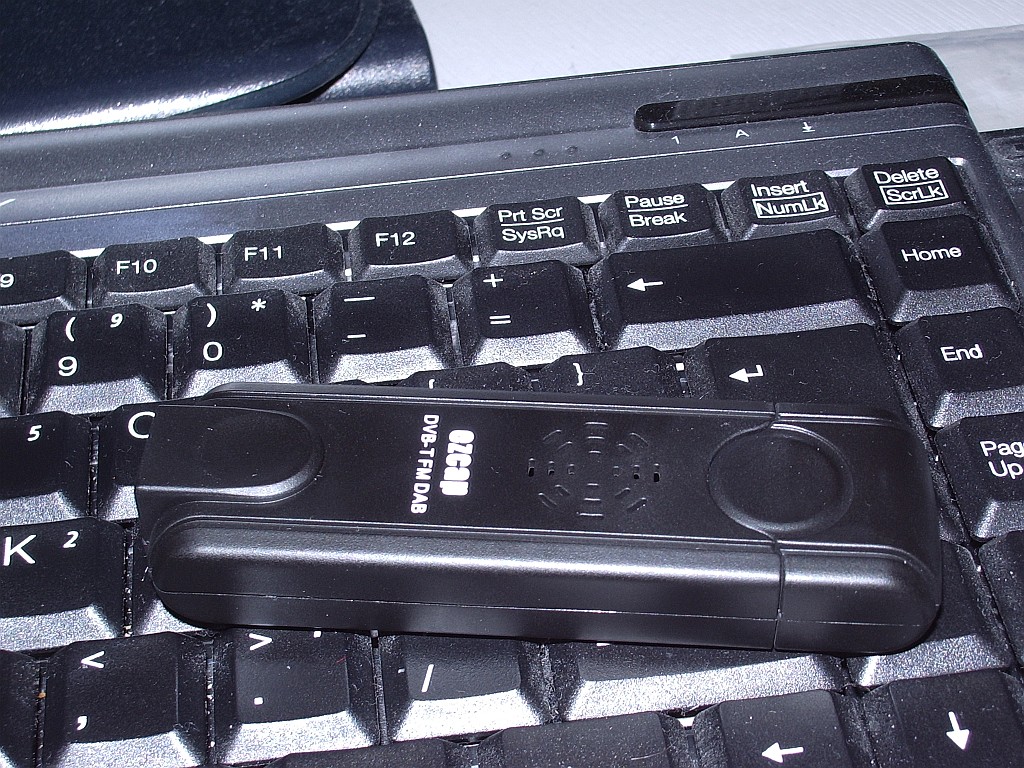
| Creative Design New FM+DAB USB DVB-T RTL2832U+R820T |
Before Christmas my interest was piqued by Tim G4VXE’s adventures using cheap digital TV dongles as receivers for, amongst other things, aircraft spotting. The first dongle I ordered was described as a Creative Design New FM+DAB USB DVB-T RTL2832U+R820T with antenna, and cost just over six quid!
 |
| EZCAP eztv645 RTL2832U / FC0013 USB DVB-T Digital TV Dongle |
After a bit more reading up on the subject I began to doubt that this would be compatible with the software everyone was using so I ordered a second one, described as an EZCAP eztv645 RTL2832U / FC0013 USB DVB-T Digital TV Dongle for WIN7 LINUX SDR which was a massive £8.68 including postage from Hong Kong.
Both arrived yesterday. I tried the ezcap first, but my shack PC didn’t like the mini-disc that came with it so I was unable to test it as a TV receiver. Following the instructions for the aircraft decoders I installed the driver using zadig_xp, then downloaded and ran rtl1090 which is a decoder for the ADSB packets. This seemed to work – no error messages appeared – but nothing else happened. To display the aircraft data that I hoped to receive I downloaded ADSBScope and installed it. I then spent a lot of time trying various options to connect ADSBScope with rtl1090 but got nowhere. I also tried SDRSharp in the hope that I could use the dongle as a VHF/UHF SDR, and ADSBSharp as an alterntive to rtl1090. But neither of them received anything.
After a while I gave up, disappointed. I then installed the Creative Design dongle and its software. A scan for channels found about 55 TV channels with its quarter wave antenna hung in the window. So it was obviously working. Just not with any of the SDR or ADSB software, as I had suspected.
This morning I tried installing the ezcap software CD that my shack PC couldn’t read on another computer. The software installed perfectly on this laptop so I plugged in the dongle and hung the antenna in the window. The software scanned for channels and found precisely nothing. I think this proves conclusively that I have a duff ezcap dongle. Ah, eBay!
Julian Moss, G4ILO, is a regular contributor to AmateurRadio.com and writes from Cumbria, England. Contact him at [email protected].
 Ham Radio Deluxe |
 W5SWL Electronics |
 Ham Radio Prep |
 KB3IFH QSL Cards  Hip Ham Shirts  HamRadioAuctions HamRadioAuctions Reliance Antennas Reliance Antennas Enigma Shop Enigma Shop |  morseDX  Ni4L Antennas  R&L Electronics R&L Electronics antennas.us antennas.us QRV QRV |
- Matt W1MST, Managing Editor
