 |
 My #hamr Weekend Update
 5 January 2013 | by
  |
| Winter Maintenance |
Good evening from the Shell Beach shack as the Kenwood TS850S listens on 20m CW through a trapped vertical between a pair of condominiums. I’ve noticed a significant uptick in activity as the weekend roller coasters into Sunday. Truly, it is good to hear signals on 15 and 20m with a bangin’ sunspot count of one hundred and sixty seven!
If this number remains stable through the night into tomorrow my plan is CW all day long.
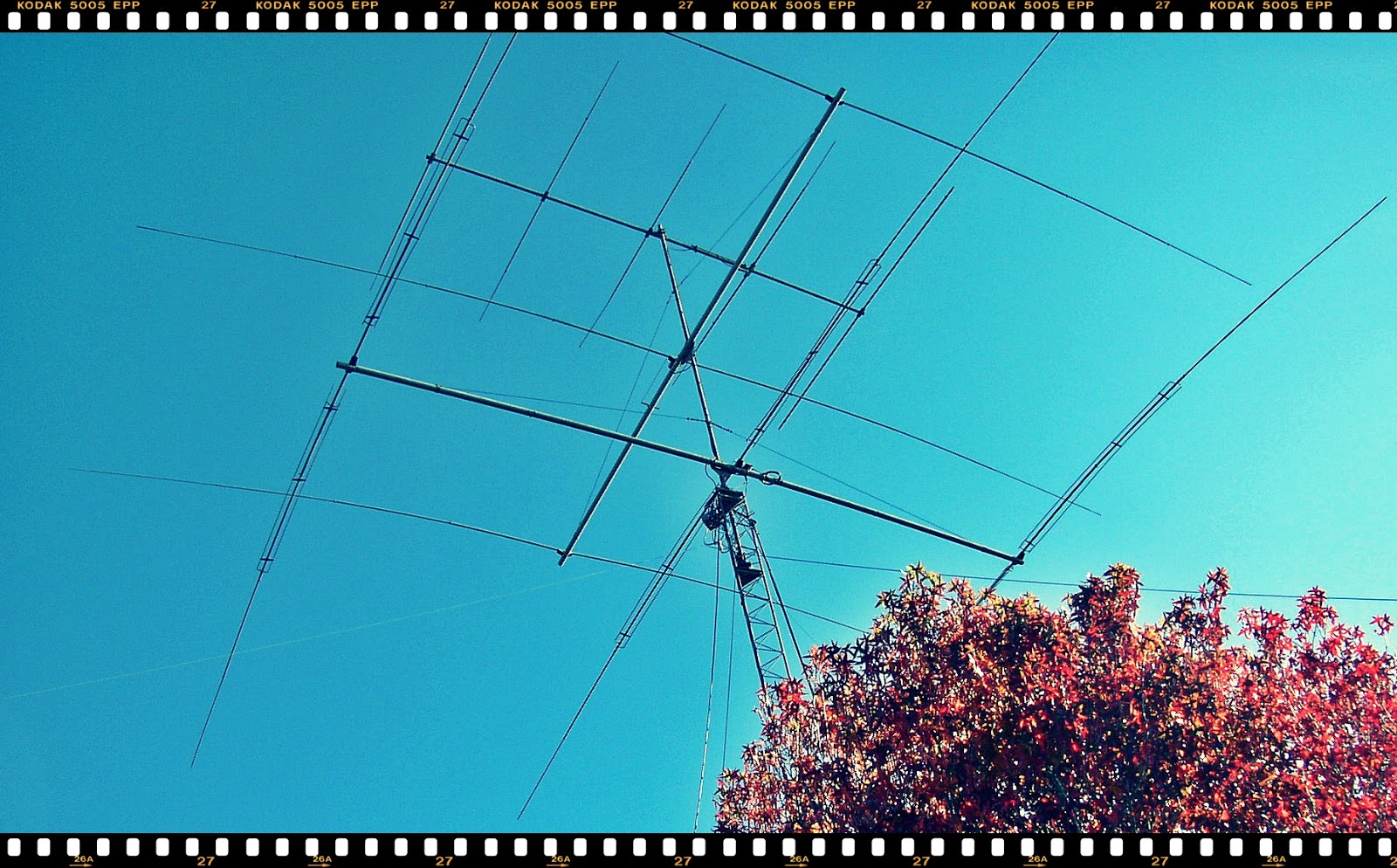
In the meantime, our break in weather has allowed time for antenna maintenance and one reflector on the KLM, 3 element 40m yagi, at SL’s antenna ranch is going through corrosion treatment. Our local marine environment is terribly corrosive and fighting it is an on going test of patience. The climbing standing wave ratio reached a point of diminishing performance.
We are taking down one element at a time instead of the entire antenna. This afternoon all the hardware on the rear reflector featured in the photograph was removed for cleaning and/or replacement. Additionally, alkaline was removed from tubing intersections and intersections were thoroughly cleaned. Likewise, linear loading hardware was removed with contact at elements given a good scrub with wire brush to remove deposits.
John is going to check intersections for continuity prior to re-installing the removed reflector.
I’m stoked to see best numbers in a long time and looking forward to tomorrow’s CW marathon session inside my Shell Beach shack.
Life is wireless.
Never too early – less than a month away!
Happy Three Kings or Epiphany – and to our Orthodox brothers and sisters, Merry Christmas!
Now that the Christmas season is approaching its end (next weekend for Roman Catholics), it’s not too early to start to think about the inaugural outdoor QRP event for 2013 ……..
Freeze Your Buns (or Butt, if you prefer) Off – which should be held the first Saturday of February – the 2nd, which is also Groundhog Day. So you can freeze your body parts off operating in the Arizona ScQRPions QRP sprint, while simultaneously keeping an eye peeled for groundhogs!
There hasn’t been any official notice of any rule changes for 2013; so if you’d like a refresher on the rules that were used last year, click here.
Last year I made 11 contacts using my PFR3A and the Buddistick on top of the car, and the temperature when I started was 45F (7C). Accuweather is predicting colder than normal temperatures for the second half of January and all of February. That would be good for a better multipler; but not so great, comfort wise.
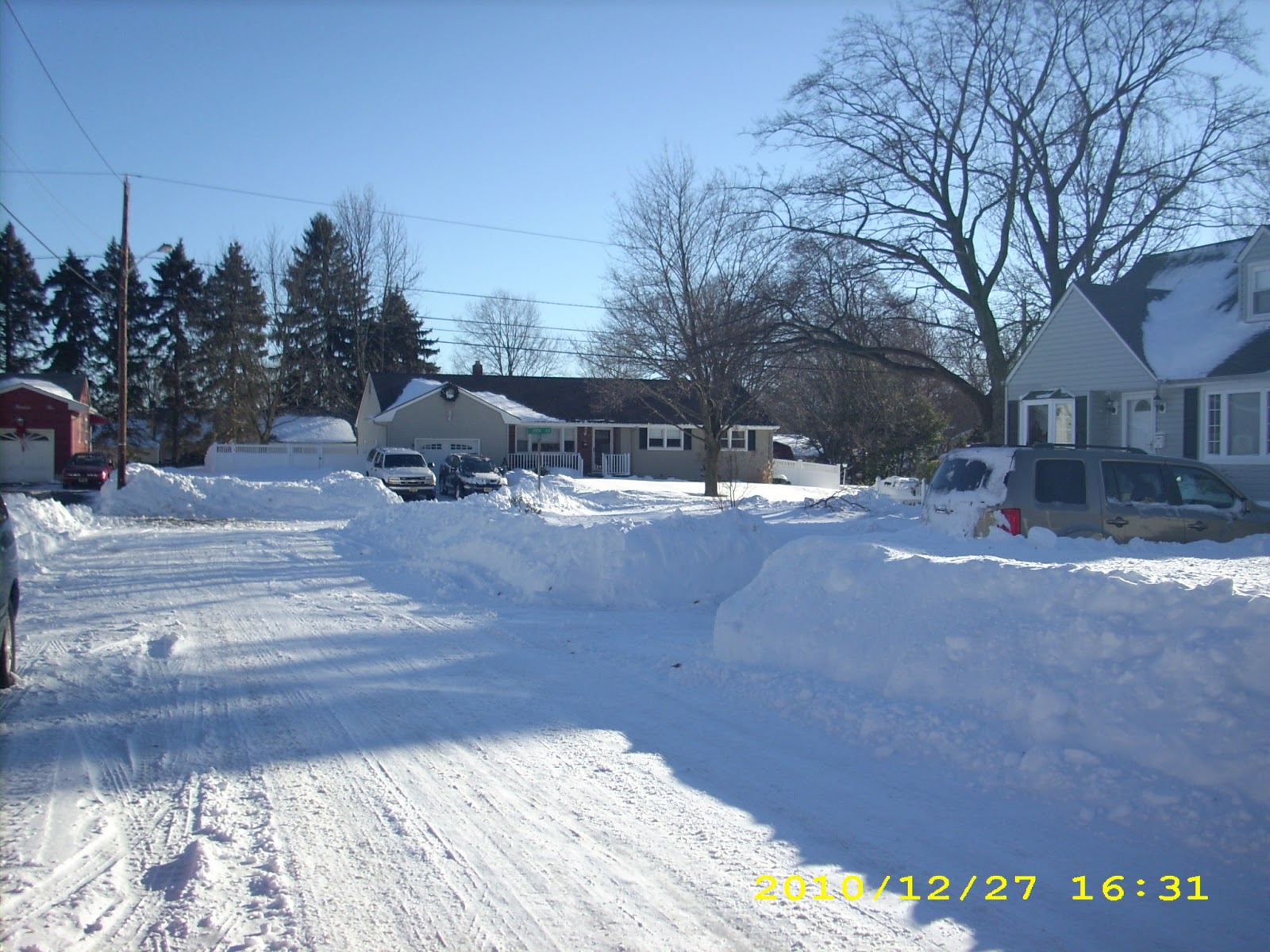
Let’s hope that it’s not like THIS, that day! Or worse yet …. like it was the day before!
72 de Larry W2LJ
QRP – When you care to send the very least!
Larry Makoski, W2LJ, is a regular contributor to AmateurRadio.com and writes from New Jersey, USA. Contact him at [email protected].
SDR-Radio and Omni-Rig
Yesterday I thought I would set up my Cross Country Wireless SDR-4+ receiver to use for IBP beacon monitoring using Faros. The purpose of this was mainly to reduce the wear and tear on my Elecraft K3 which otherise would have to be on 24 hours a day.
I established that Simon Brown’s SDR-Radio software supported external program control by emulating a Kenwood transceiver. I therefore needed to see if SDR-Radio could be controlled using Omni-Rig, the control mechanism used by Faros.
 |
| SDR-Radio supports CAT control using a virtual serial port. |
I created a linked pair of virtual serial ports, COM8 and COM9, using VSPE, a virtual serial port emulator. Using the serial ports option of SDR-Radio, I assigned the control port to COM8. Then I used a serial port emulator connected to COM9 (I use RealTerm) to verify that SDR-Radio ‘spoke’ Kenwood. It did. In fact it emulated the Kenwood protocol well enough to fool KComm into thinking it was talking to an Elecraft K2. So far so good.
Now to see if Omni-Rig could control SDR-Radio. Omni-Rig uses “rig files” to define the command set of different radios and it includes one for generic Kenwood. Unfortunately it did not work with SDR-Radio: the receiver indicator of Faros turned red to indicate a fault.
I downloaded the rig file documentation and debug tools from Omni-Rig’s site and tried hacking the Kenwood rig file to get it to work with Omni-Rig by trial and error. But no luck. Whatever I did, the program reported an error with the inscrutable message: “RIG1 Status commands already in queue”.
 |
| Error messages reported by Omni-Rig |
So it looks as if I’ve hit a brick wall. Clearly there is something in SDR-Radio’s emulation of the Kenwood protocol that Omni-Rig doesn’t like. If anyone else would like to have a go solving this problem, be my guest.
Julian Moss, G4ILO, is a regular contributor to AmateurRadio.com and writes from Cumbria, England. Contact him at [email protected].
ARRL Vintage Amateur Radio Equipment Exhibit
ARRL Vintage Amateur Radio Equipment Exhibit: While it’s important to look forward to tomorrow, it’s equally important to understand the evolution of radio equipment that was used on the Amateur Bands; from the earliest “spark days” to the dawn of digital technology. By delving into the past, one can learn to appreciate the hard work, determination and experimentation that brought us one step at a time, the technology we enjoy today.
73 from the Shell Beach shack.
So what did and didn’t happen in 2012…..
Over all it was a very good year as I and my family had good health (I did have a cancer scare but things turned out to be ok).
1.The year started out with me earning my way toward the ARRL Diamond DXCC award, I wanted to do it QRP style and well I came up short with only 83 DXCCs for the year. BUT having said that I am very very happy with the results of 83 contacts and I am sure I can snag the others this year for a DXCC award in the QRP category.
2. A new radio arrived as well the Elecraft KX3 and that sure is some radio and I have not yet been able to give it a real good workout.
3. I started out 2012 wanting to increase my CW coping speed for contests and the best way for me to do that was to get on the keyboard. My keyboard skill is find expect for the numbers and where they were without looking. I have now accomplished that goal as well. I had used various CW programs to help me out with the speed and getting the numbers and keyboarding are now in harmony.
3. I wanted to clean up the shack of unused ham gear no sense it sitting there taking up space....that was done (my beloved KX1 included). I was very surprised at the amount of money that came in from stuff that I was not using......now I am looking at my K2 along with the external Elecraft tuner and amp (100 watt) and thinking of putting in up on the auction block. I have the Elecraft K3, KX3 and ordered another K2 to build and sell over the winter months when ham radio is slow.
4. I was able to work my first split contact which to me was pretty cool.
5. I starting posting videos on Youtube up to this point I have a total of 8 videos, 22 followers and 5,638 views to date. It was rough going at first trying to figure out how to upload, edit the video and getting my Iphone to do a half decent job of recording as that is all I have as of yet.
6. During the summer months I was able to pack up and use my Elecraft K2 for some short QRP CW contests. It was nice to get out in a local park and operate the rig.
7. I descovered the art of QRPp operations and was able to top my miles per watt award
8. My kit building was strong and included Qrpometer, Hendrick attenuator, KX3 (kinda a kit), starting a new Elecraft k2, Smart charger, adding a gell cell to my K2 as well as some mod's to the Elecraft K3.
9. For some strange reason it was the first year I have not gone to any ham radio flea markets.....not sure why that is? Wait a minute I can think of one reason....lots of junk!!
Mike Weir, VE9KK, is a regular contributor to AmateurRadio.com and writes from New Brunswick, Canada. Contact him at [email protected].
More portable QRP antenna thoughts
Harry K7ZOV left this comment on AmateurRadio.com – thought I would re-post it here (for those of you who might not visit that fine site).
“I was in TX for the holidays. I brought 2 antennas. But used only one with both my TenTec Eagle and my KX3. No counterpoise. No Ground. 20 ft of coax. Worked 80-6 with the KX3 internal ATU. Worked Cuba, South America to Canada. The West coast from the far east side of Texas and lots of States.
Check out the link for more detail. Oh and the “wire” part was only a bit over 50 ft and hanging from a tree at about 30 ft at the highest point and 10 feet at the lowest point. My favorite antenna now.. LINK: http://www.earchi.org/92011endfedfiles/Endfed6_40.pdf
For a 40 meter and 20 meter only… Here is a second link:
http://www.earchi.org/proj_homebrew.html
Have fun and 73 one and all
Harry K7ZOV”
Thanks, Harry – great links to EFHW antennas that you can buy or build.
And here’s another thought – although I have never used them, I do have friends who have had great success with small magnetic loop antennas. Not only are they great for portable ops (WGØAT uses one) but they are also great for those of you who are antenna restricted. A friend of mine here in NJ thought his Hamming days were over when he moved into an apartment that was constructed from materials that in essence, created a live-in Faraday shield. He started using magnetic loops and was shortly working DX again at QRP power levels from inside the apartment! http://www.alexloop.com/
You might also want to check out the Yo-Yo-tennas that Bill WA8MEA sells – they look pretty good for taking out to the field – http://hamradiofun.com/, if you’re not inclined to “roll your own”.
72 de Larry W2LJ
QRP – When you care to send the very least!
Larry Makoski, W2LJ, is a regular contributor to AmateurRadio.com and writes from New Jersey, USA. Contact him at [email protected].
Ham Nation 79
Hosts: Bob Heil (K9EID), Gordon West (WB6NOA), and George Thomas (W5JDX).
Preparing for CES, Gordon dunks a radio in water, and how to reduce RF interference.
Guests: Don Wilbanks (AE5DW), and Cheryl Lasek (K9BIK)
Download or subscribe to this show at http://twit.tv/hn.
Submit your own video to Ham Nation! See the Video Guidelines, http://www.frozen-in-time.com/guide/
We invite you to read, add to, and amend our show notes at wiki.twit.tv.
Thanks to Joe Walsh who wrote and plays the Ham Nation theme.
Thanks to Cachefly for the bandwidth for this show.
Dr. Bob Heil, K9EID, is the founder of Heil Sound and host of TWiT.tv's Ham Nation which streams live each Tuesday at 6:00pm PT (9:00pm ET) at http://live.twit.tv. Contact him at [email protected].
 Ham Radio Deluxe |
 W5SWL Electronics |
 Ham Radio Prep |
 KB3IFH QSL Cards  Hip Ham Shirts  HamRadioAuctions HamRadioAuctions Reliance Antennas Reliance Antennas Enigma Shop Enigma Shop |  morseDX  Ni4L Antennas  R&L Electronics R&L Electronics antennas.us antennas.us QRV QRV |
- Matt W1MST, Managing Editor
