 |
 Taking stock
 31 December 2012 | by
 “It was the best of times, it was the worst of times ……”
Mr. Dickens could not have written more appropriate words to describe my 2012. I have never been a big reveler of the New Year holiday; but this year, I am quite eager and pleased to see the ushering in of a new year and with it, new beginnings and new possibilities.
2012 was not all depression, sadness and tears, however. It did have highlights, particularly with regard to Amateur Radio. The KX3, which I had so diligently saved up for, and ordered on the first night of availability in December of 2011, arrived at the end of May. For me, it has lived up to and has exceeded my expectations. I am quite happy with it and am so glad that it is an available part of the W2LJ “radio stable”. Quite unexpectedly, a K3/10 joined the ranks as well. I hadn’t dreamed of or intended purchasing one – but consider this to be my dear Mom’s last gift to me. It is an amazing radio; and I am so lucky and fortunate to have use of both of these fine pieces of gear.
The inaugural 2012 NJQRP Skeeter Hunt was an integral part of my year. Once again, so many thanks to George N2APB and Joe N2CX and the entire NJQRP Club for agreeing to sponsor this new operating event. Also thanks to Bob W3BBO who helped me ruminate and come up with some of the details for this new outdoor QRP sprint. I had such an enjoyable time assigning Skeeter numbers, actually operating in the event and then collecting and tabulating and posting the results. I am so happy that my fellow QRPers seemed to have as good a time as I did, and I eagerly look forward to the 2013 edition of the Skeeter Hunt.
I got two new antennas up in the air this year. My venerable G5RV finally made way, after a dozen or so years, for the 88’ EDZ antenna. Later in the year, post-Sandy, the W3EDP went up to join it in the W2LJ antenna garden. Too small to be a “farm”, the antenna garden consists of the Butternut HF9V and the two aforementioned wires. I pray these wires will last as long as the G5RV did. There were plenty of hurricanes and nasty winters and wind storms that the G5RV made it through – may these two new wires be as resilient.
I have to include as one of this year’s highlights, my decision to purchase the PAR END-FEDZ 10/20/40 antenna. This simple wire is a delight for portable QRP ops. It’s super easy to deploy as a sloper or inverted “L”. It tunes up with nary a problem and is neatly and easily storable in my “Go Bag”. I can’t think of any downsides to this antenna. It’s well worth the price and comes along with instructions on wire lengths to cut so that you can use it for other bands, if you so desire. This antenna, as well as my Buddistick have become my aerials of choice for portable QRP ops.
Due to all the unfortunate events which took place this year, and their aftermath, I was not able to actually get on the air nearly as much as I had intended. I actually had “a QSO a Day” going until the middle of February, when events started taking unexpected turns. From that point forward, “unexpected” became the norm for 2012, and as a result, severely curtailed my on-the-air time My major 2012 New Year’s Resolution, to complete the ARRL’s Diamond DXCC Challenge, didn’t even come close to happening. So as 2013 arrives, I am going to tempt fate once more, and will try for a QSO a Day in 2013. I am not so foolhardy as to think I will be able to pull it off, but I will do my best – hence my ever present New Year’s Resolution “To get on the air more”!
In addition to day-to-day operating, managing the Skeeter Hunt and sending out notices for The Run For The Bacon each month, this blog (which will be entering its 9th year in 2013) has become a huge part of my Amateur Radio experience. It is a most enjoyable part of Ham Radio for me, and I want to extend my deepest and most sincere thanks to all of you out there who take time out of your busy day to read this and share the Amateur Radio world with me. You are the best friends a Ham could ask for. You all have helped me to deal with what would have otherwise been a most sorrowful year. A very Happy, Blessed, Joyous and Prosperous New Year to all of you!
Lastly, I hope you all enjoy Straight Key Night tonight and tomorrow. W2LJ will be hanging out near and at the various QRP “Watering Holes” (I will spot myself on QRPSPOTS, so be sure to look out for me). I will be using my Vibroplex Original as my aging wrists just can’t stand up to a classic straight key any longer. If we have the good fortune to work each other, please excuse my less than stellar “Bug fist”. I haven’t had much practice lately!

72 de Larry W2LJ
QRP – When you care to send the very least!
Larry Makoski, W2LJ, is a regular contributor to AmateurRadio.com and writes from New Jersey, USA. Contact him at [email protected].
Today’s Red and Rover
This is a very cool comic strip, drawn by Brian Basset – about a boy and his dog, growing up together in the 60s.
http://www.gocomics.com/redandrover/2012/12/31
It has a Morse Code theme today, so be sure to visit! Since the image is copyrighted, I don’t want to post it here – but the link was meant for sharing with the blessing of the author and the comic syndicate.
72 de Larry W2LJ
QRP – When you care to send the very least!
Larry Makoski, W2LJ, is a regular contributor to AmateurRadio.com and writes from New Jersey, USA. Contact him at [email protected].
2013 #hamr GOALS

First, I want to thank you for supporting and encouraging my efforts through the years because I wouldn’t have made it this far without all of you!
Presently, I’m listening to Outlands composed by Guy-Manuel de Homem-Christo founding member of the French house music duo Daft Punk. The cut is digitally delivered from the Tron: Legacy soundtrack. It is both motivational and inspirational as a year concludes and a future of limitless possibilities opens.
Jeremy Dean wrote a 10 Step Guide for Making Your New Year’s Resolution in PsyBlog and his guide is a good schematic for realizing my goals. Dean’s first recommendation is, “for big results, think small.”
My first goal is to continue experiencing ham radio in the great outdoors. I’d like to visit several locations within our county and, now, with everything in place there are no more excuses. I’m striving for my peak experience on an island in the Santa Barbara channel for later in the new year.
My second goal is to experience at least one digital mode. The 21st Century is here and it ain’t going nowhere. My most likely mode is PSK31 or RTTY for hardware and output requirements. It is time for me to join 21st Century ham radio because digital modes continue attracting #hamr innovation.
My third goal is to complete a project started earlier in the year. I own a KLM KT34A four element tri-bander and the antenna is waiting for me like a good teacher. One of the best methods at learning is hands-on experience and I want learn inside this practical classroom. Likewise, there is a 55 foot crank up tower patiently waiting for attention.
What are my impediments? Where is the monster under the bed?
I posted the movie trailer After Earth because Will Smith said, “…[I]f we are going to survive this then you must realize that fear is not real. Do not misunderstand me. Danger is very real but fear is a choice. Do you know where we are?“
There is much more and that experience is waiting.
Going beyond the shack door and Happy New Year!
Happy New Year……………

Mike Weir, VE9KK, is a regular contributor to AmateurRadio.com and writes from New Brunswick, Canada. Contact him at [email protected].
G4VXE’s review of the year 2012
For the last couple of years, I’ve done at the post at the end of the year thinking about the highlights (and the occasional low light!) of the year from a very personal amateur radio perspective.

1. 70MHz
Four metres was a real star band for me in the summer and I found more openings than ever before. Having the new Spectrum transverter made things a lot easier and despite having only a simple aerial, I was very pleased with the results. A couple of gotaways, like SV8CS and an EA8. But there’s next year…
2. 50MHz
Lots of six metre openings too and I was particularly thrilled to make several transatlantic QSOs – no big deal you may say, but this was all on the vertical antenna.
3. Datamodes
I started to use JT65A heavily at the end of last year, but with the new G4ZLP interface that I bought at the start of the year, JT65 and the other WSJT modes have been in almost constant use here. I find the modes both extremely efficient and enjoyable to operate. CW and SSB activity has diminished quite substantially here this year.
WSPR too has been immense fun and I have devoted more time to it than before. 7 and 28MHz have been my favoured bands and it’s been fun to have reports from all the way around the world using no more than 1 Watt.
4. SDR
2012 was the year of RTLSDR and what a lot of fun I had! Although the cheap USB dongles are not the most sensitive, I have been surprised and delighted about what they can do. Probably the best use of them so far, for me, has been the Virtual Radar applications which up until now has been the preserve of the expensive, bespoke equipment.
SDR# even on a cheap USB dongle has given me a taste of what can be done and I shall look forward to trying out more advanced SDR technology in due course.
5. PZTLog
I’ve been excited to start to use Charlie M0PZT’s PZTLog program. It’s an excellent piece of software and I’ve particularly enjoyed the Datamodes and JT65 integration capability. Charlie is constantly updating the software – I even noticed a new release on Christmas Day. There’s dedication!
6. Cheap and cheerful equipment
Both the Baofeng UV-3 and UV-5 144/432MHz handhelds arrived this year and have proved a lot of fun, for a combined investment of under £50. Simply, you can’t go wrong.
7. AM
I was fascinated to listen to some 27MHz AM signals in the late summer which led me to wonder about what I would hear on 29MHz. Sure enough there were some fascinating stations to listen to and a handful of contacts. What a surprise to learn that as well as using old ‘boat anchor’ type gear, some people were using state of the art SDR rigs to generate their AM signals. Very nice they sounded too!
8. Having a message encrypted by an Enigma machine
Having the chance to have a message that I sent, encrypted by an Enigma machine in Cheltenham, sent over the air to Bletchley Park and then decrypted was quite special! Thanks to the Cheltenham ARA and Milton Keynes clubs for making this possible.
9. DSTAR: DCS reflectors
On D-STAR, the arrival of the DCS reflectors brought new resilience and quality, I felt. Some of the innovation was quickly applied across the D-STAR network resulting in less ‘black holes’ and better qualityQSOs.
10. Remote control
Although it’s as simple as using my iPad across the WiFi network at home to control the PC in the shack running the JT65-HF software – remote control has been brilliant and has resulted in a good number of QSOs in the evenings when I’ve been sat downstairs on the sofa! Highly recommended!
Tim Kirby, G4VXE, is a regular contributor to AmateurRadio.com and writes from Oxfordshire, England. Contact him at [email protected].
Airborne!
I told Tim, G4VXE, about the trouble I was having getting a USB TV dongle to work as a VHF/UHF SDR and he emailed me a couple of files. One of those was an installation script which I suspect is the same one mentioned in the article “Cheap and Easy SDR” in the January 2013 QST which a couple of people mentioned. I had read this article at least twice and then forgotten all about it, which is a shame as it would probably have saved me several hours of abortive messing about.
I ran the script once and it seemed to work but I still could not get anything out of my ezcap dongle. I then used MagiCure to turn back the clock a few days to before I started messing about, and then ran the script again. This time it worked. I ran SDR# and it appeared to be working. I set the frequency to somewhere in the FM broadcast band and within a couple of minutes I was listening to Classic FM on 99.9MHz in stereo.
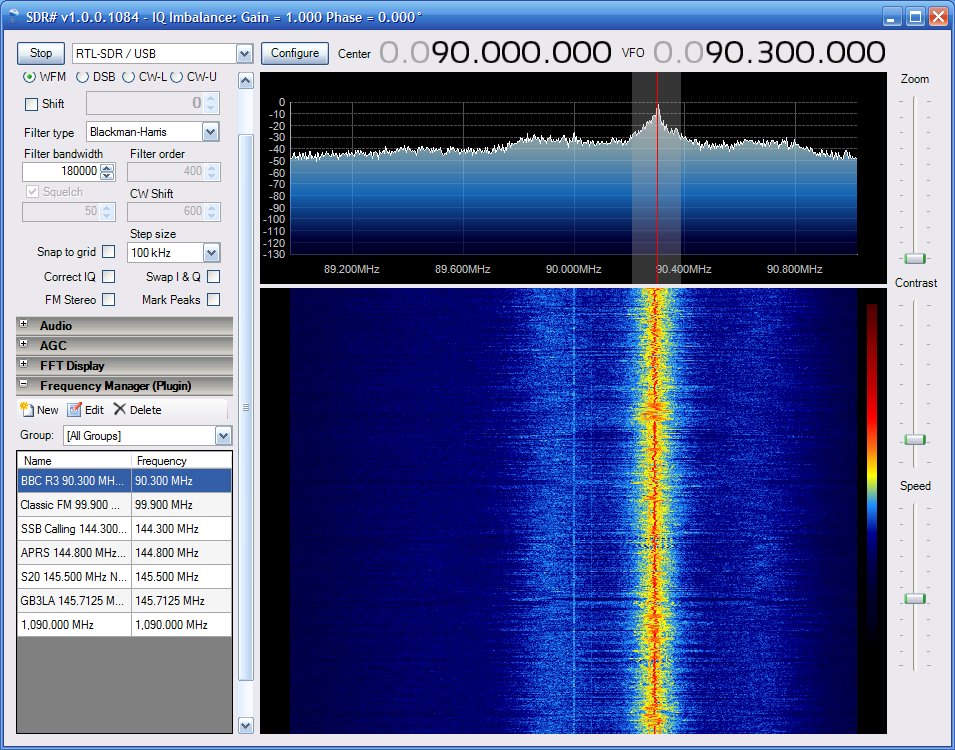 |
| SDR# receiving BBC Radio 3 in the FM broadcast band |
This was all very good, but I have any number of radios able to receive FM radio. I wanted to try receiving ADS-B aircraft beacons. But although both ADSB# and RTL1090 (ADS-B decoders) seemed to work (i.e. didn’t display any error messages) they were not decoding any data. I used SDR# to monitor 1090MHz, the ADS-B frequency, and I could not see or hear any signals, though I have no idea what they are supposed to sound like.
I decided to reinstall the second dongle which had worked as a TV receiver. Then, on a whim, I thought I would try running SDR# to see if it would connect with the other dongle. To my great surprise, it did. What’s more, it seemed much livelier (more sensitive) than the ezcap dongle. I tried both RTL1090 and ADSB#. Both worked and immediately started decoding packets! I started up ADSBScope and within a few seconds aircraft began to appear on the screen!
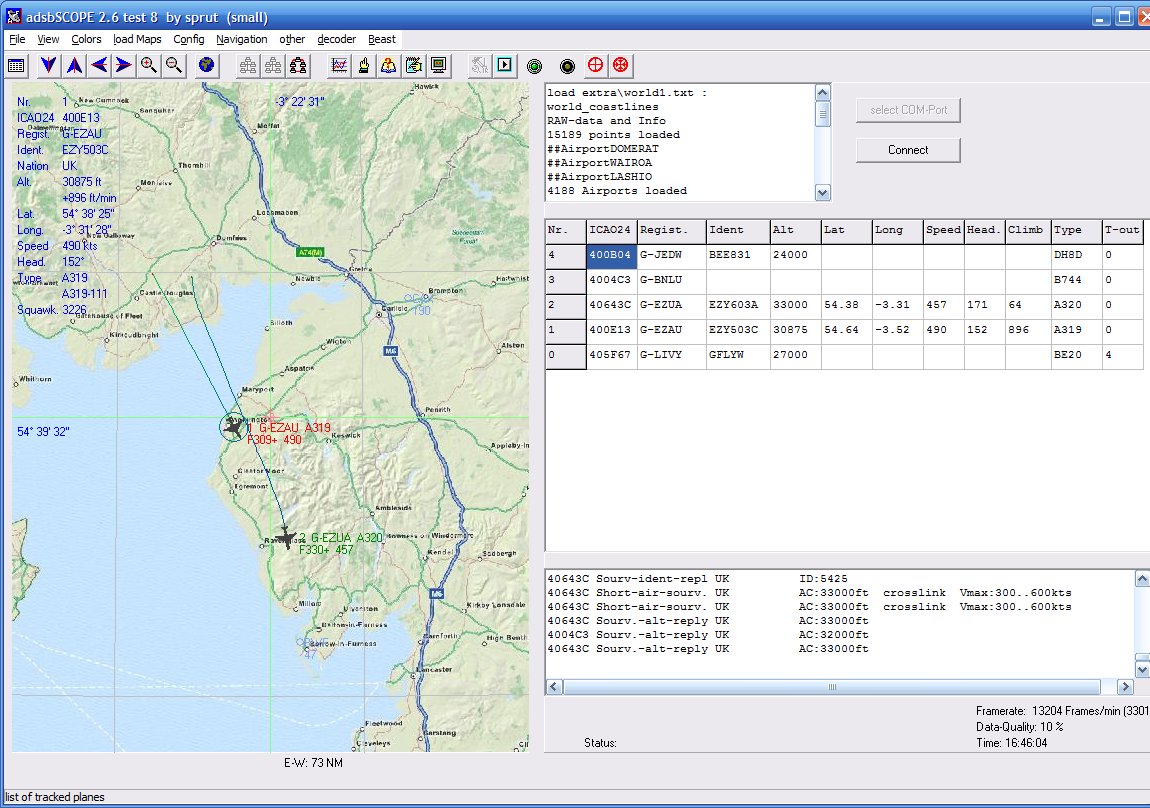 |
| ADSBScope plotting aircraft overhead at G4ILO |
After a while I got cocky and decided to see if there were any other free aircraft-plotting applications I could try, so I downloaded VirtualRadar. After a bit of trial and error I found the right settings to connect with ADSB# and I was soon seeing the aircraft passing overhead plotted on a Google map.
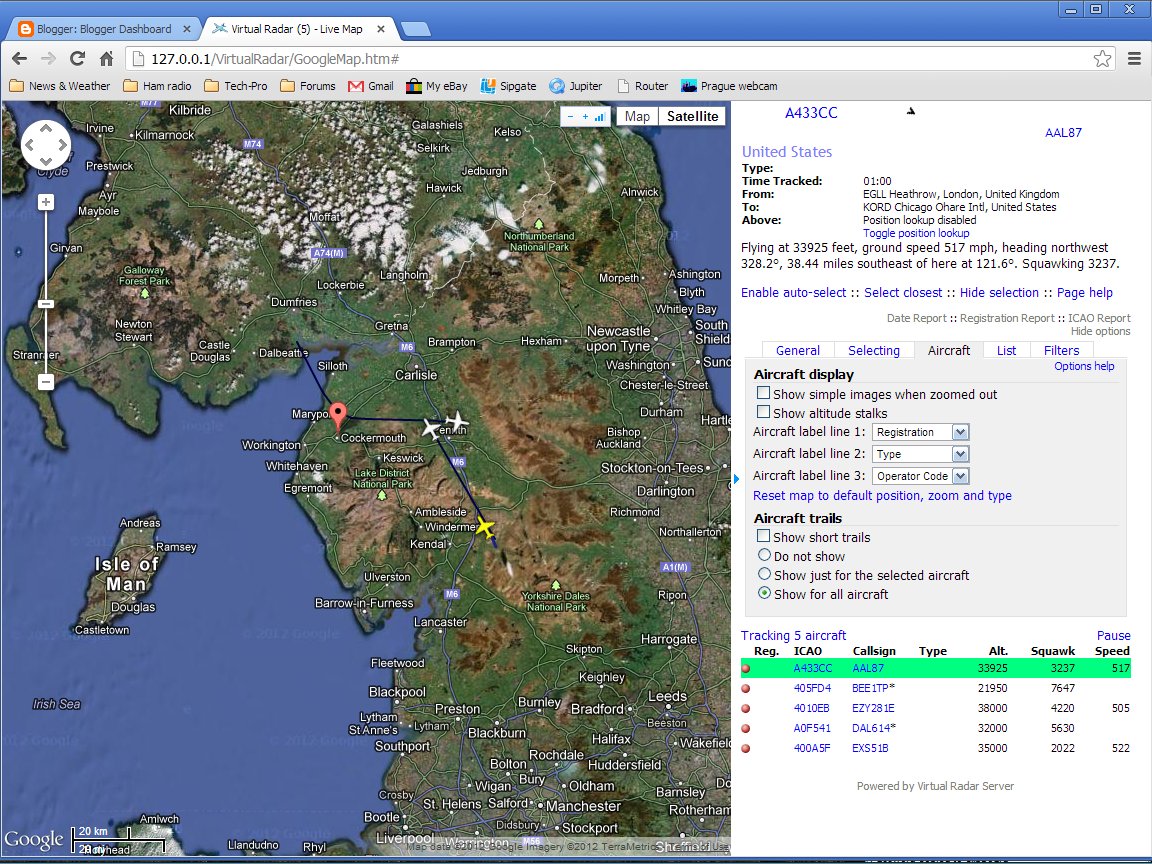 |
| VirtualRadar plotting aircraft overgead at G4ILO |
Strangely enough, both RTL1090 and ADSB# think they are talking to the ezcap dongle! Not surprising I suppose as I have not installed any other drivers. It would be nice to be able to use the equipment as a TV receiver as well but I suspect that would break everything! I should probably quit while I am still ahead.
Both ADSBScope and VirtualRadar are nice applications, and I couldn’t say one is better than the other. VirtualRadar runs as a web server and you have to point a web browser at it to see the display. It shows more information such as the starting and destination locations of many aircraft, which is interesting. But curiously VirtualRadar does not display aircraft callsigns (like G-ADSB) while ADSBScope does.
This is looking to be an academic question as this morning ADSBScope has decided to stop working. It won’t talk to either RTL1090 or ADSB# but complains repeatedly about a “comm error.” Ah well, at least VirtualRadar and SDR# are still working.
Julian Moss, G4ILO, is a regular contributor to AmateurRadio.com and writes from Cumbria, England. Contact him at [email protected].
Right place at the right time
I was able to get on the air for a bit this afternoon – I guess it would be more appropriate to say this evening, as it was getting dark. The Christmas lights in the neighborhood, or whatever, were playing havoc with my receiver tonight. It seems like there’s S9 noise no matter which band I go to and no matter which antenna I switch to.
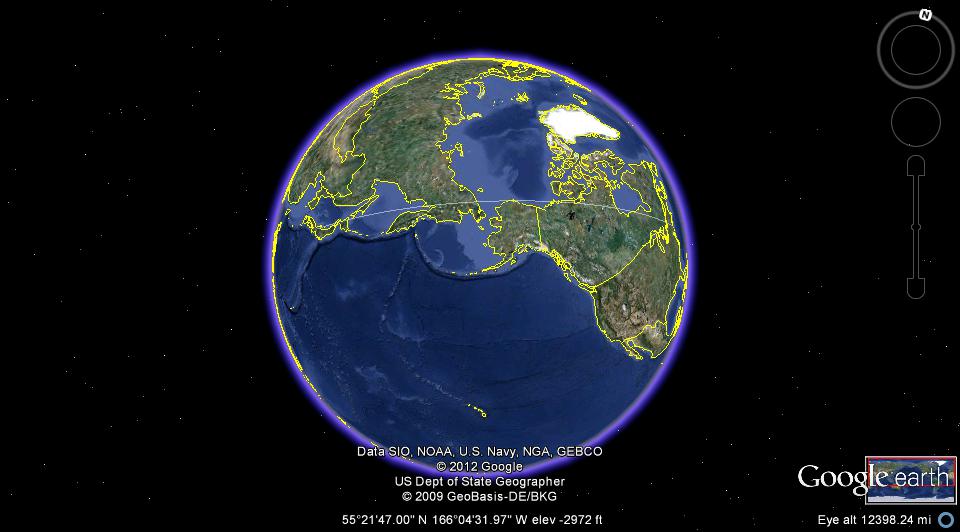
However, on 17 Meters, blasting in above the noise was JN4MMO calling CQ. Japan! I have worked Japan before, but never QRP. Japan to New Jersey is always a long hop and with 5 Watts, I really had my fingers crossed.
It took some patience to be heard and then a few repeats – but Andy finally heard me! I gave him a 599 report and got a 539 in return. It was dusk here and just a tiny bit past dawn in Japan (according to DX Atlas) so I am willing to bet that there was some grayline influence there.
No matter! I will take a QSO with a Japanese op any day of the week. Now as far as I’m concerned, that’s DX! And it just goes to show (at least in my case anyway) that you don’t always have to be good, you just need to be lucky!
I am hoping for a bit more activity on 80 Meters tonight as we get further into the darkness. I would like to get some practice in tonight with the Bug, in anticipation of Straight Key Night tomorrow evening.
As the New Year approaches, I’d like to take the opportunity to wish all of you a very Happy, Healthy and Prosperous New Year. May your days be filled with laughter and enjoyment, love and happiness. And may you always have numerous sunspots and really good propagation when you turn on your radios!
72 de Larry W2LJ
QRP – When you care to send the very least!
Larry Makoski, W2LJ, is a regular contributor to AmateurRadio.com and writes from New Jersey, USA. Contact him at [email protected].
 Ham Radio Deluxe |
 W5SWL Electronics |
 Ham Radio Prep |
 KB3IFH QSL Cards  Hip Ham Shirts  HamRadioAuctions HamRadioAuctions Reliance Antennas Reliance Antennas Enigma Shop Enigma Shop |  morseDX  Ni4L Antennas  R&L Electronics R&L Electronics antennas.us antennas.us QRV QRV |
- Matt W1MST, Managing Editor
