 |
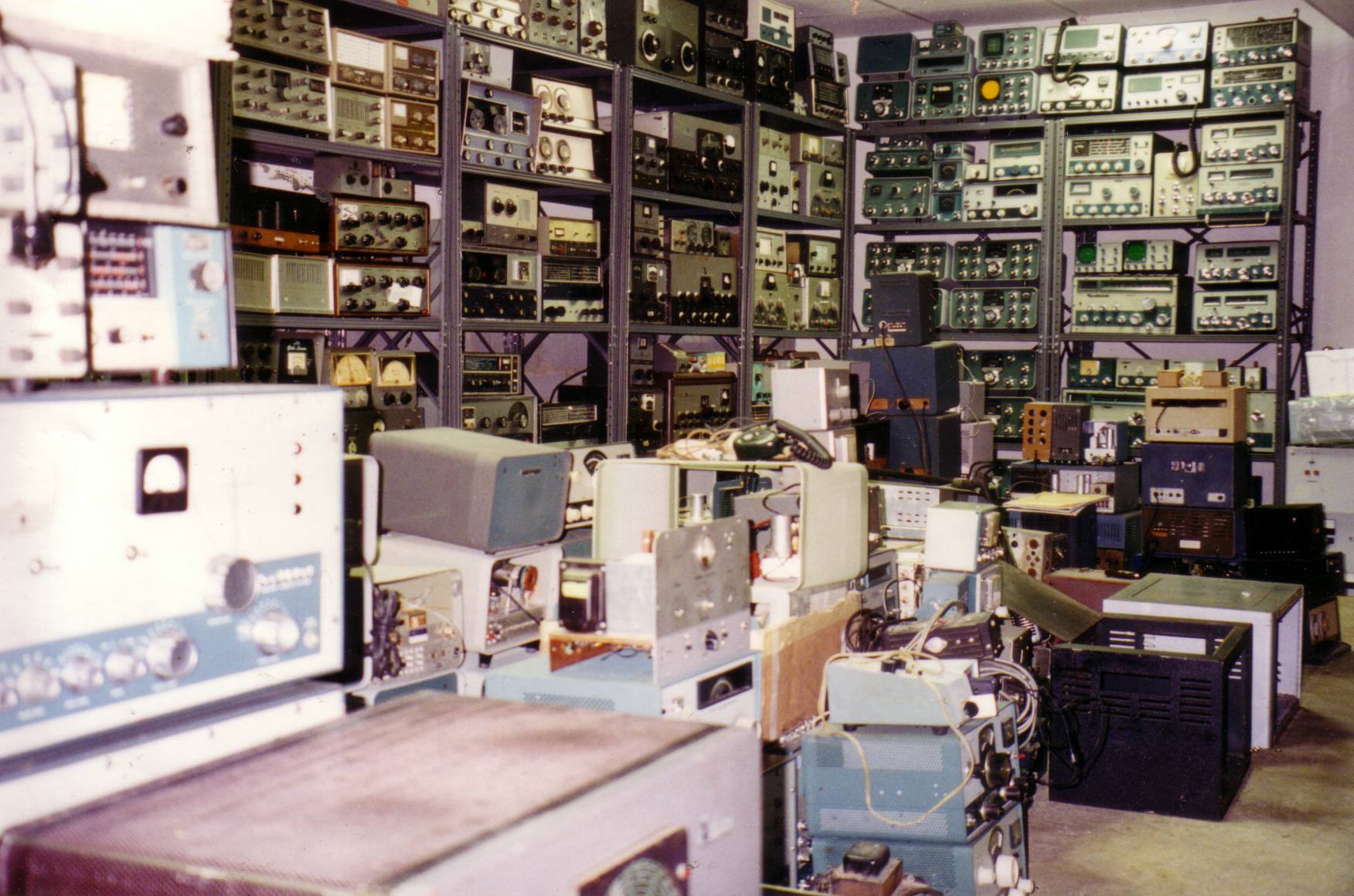
 ARRL Vintage Amateur Radio Equipment Exhibit
 4 January 2013 | by
 ARRL Vintage Amateur Radio Equipment Exhibit: While it’s important to look forward to tomorrow, it’s equally important to understand the evolution of radio equipment that was used on the Amateur Bands; from the earliest “spark days” to the dawn of digital technology. By delving into the past, one can learn to appreciate the hard work, determination and experimentation that brought us one step at a time, the technology we enjoy today.
73 from the Shell Beach shack.
So what did and didn’t happen in 2012…..
Over all it was a very good year as I and my family had good health (I did have a cancer scare but things turned out to be ok).
1.The year started out with me earning my way toward the ARRL Diamond DXCC award, I wanted to do it QRP style and well I came up short with only 83 DXCCs for the year. BUT having said that I am very very happy with the results of 83 contacts and I am sure I can snag the others this year for a DXCC award in the QRP category.
2. A new radio arrived as well the Elecraft KX3 and that sure is some radio and I have not yet been able to give it a real good workout.
3. I started out 2012 wanting to increase my CW coping speed for contests and the best way for me to do that was to get on the keyboard. My keyboard skill is find expect for the numbers and where they were without looking. I have now accomplished that goal as well. I had used various CW programs to help me out with the speed and getting the numbers and keyboarding are now in harmony.
3. I wanted to clean up the shack of unused ham gear no sense it sitting there taking up space....that was done (my beloved KX1 included). I was very surprised at the amount of money that came in from stuff that I was not using......now I am looking at my K2 along with the external Elecraft tuner and amp (100 watt) and thinking of putting in up on the auction block. I have the Elecraft K3, KX3 and ordered another K2 to build and sell over the winter months when ham radio is slow.
4. I was able to work my first split contact which to me was pretty cool.
5. I starting posting videos on Youtube up to this point I have a total of 8 videos, 22 followers and 5,638 views to date. It was rough going at first trying to figure out how to upload, edit the video and getting my Iphone to do a half decent job of recording as that is all I have as of yet.
6. During the summer months I was able to pack up and use my Elecraft K2 for some short QRP CW contests. It was nice to get out in a local park and operate the rig.
7. I descovered the art of QRPp operations and was able to top my miles per watt award
8. My kit building was strong and included Qrpometer, Hendrick attenuator, KX3 (kinda a kit), starting a new Elecraft k2, Smart charger, adding a gell cell to my K2 as well as some mod's to the Elecraft K3.
9. For some strange reason it was the first year I have not gone to any ham radio flea markets.....not sure why that is? Wait a minute I can think of one reason....lots of junk!!
Mike Weir, VE9KK, is a regular contributor to AmateurRadio.com and writes from New Brunswick, Canada. Contact him at [email protected].
More portable QRP antenna thoughts
Harry K7ZOV left this comment on AmateurRadio.com – thought I would re-post it here (for those of you who might not visit that fine site).
“I was in TX for the holidays. I brought 2 antennas. But used only one with both my TenTec Eagle and my KX3. No counterpoise. No Ground. 20 ft of coax. Worked 80-6 with the KX3 internal ATU. Worked Cuba, South America to Canada. The West coast from the far east side of Texas and lots of States.
Check out the link for more detail. Oh and the “wire” part was only a bit over 50 ft and hanging from a tree at about 30 ft at the highest point and 10 feet at the lowest point. My favorite antenna now.. LINK: http://www.earchi.org/92011endfedfiles/Endfed6_40.pdf
For a 40 meter and 20 meter only… Here is a second link:
http://www.earchi.org/proj_homebrew.html
Have fun and 73 one and all
Harry K7ZOV”
Thanks, Harry – great links to EFHW antennas that you can buy or build.
And here’s another thought – although I have never used them, I do have friends who have had great success with small magnetic loop antennas. Not only are they great for portable ops (WGØAT uses one) but they are also great for those of you who are antenna restricted. A friend of mine here in NJ thought his Hamming days were over when he moved into an apartment that was constructed from materials that in essence, created a live-in Faraday shield. He started using magnetic loops and was shortly working DX again at QRP power levels from inside the apartment! http://www.alexloop.com/
You might also want to check out the Yo-Yo-tennas that Bill WA8MEA sells – they look pretty good for taking out to the field – http://hamradiofun.com/, if you’re not inclined to “roll your own”.
72 de Larry W2LJ
QRP – When you care to send the very least!
Larry Makoski, W2LJ, is a regular contributor to AmateurRadio.com and writes from New Jersey, USA. Contact him at [email protected].
Ham Nation 79
Hosts: Bob Heil (K9EID), Gordon West (WB6NOA), and George Thomas (W5JDX).
Preparing for CES, Gordon dunks a radio in water, and how to reduce RF interference.
Guests: Don Wilbanks (AE5DW), and Cheryl Lasek (K9BIK)
Download or subscribe to this show at http://twit.tv/hn.
Submit your own video to Ham Nation! See the Video Guidelines, http://www.frozen-in-time.com/guide/
We invite you to read, add to, and amend our show notes at wiki.twit.tv.
Thanks to Joe Walsh who wrote and plays the Ham Nation theme.
Thanks to Cachefly for the bandwidth for this show.
Dr. Bob Heil, K9EID, is the founder of Heil Sound and host of TWiT.tv's Ham Nation which streams live each Tuesday at 6:00pm PT (9:00pm ET) at http://live.twit.tv. Contact him at [email protected].
RadioSport Resource | North American QSO Party Database
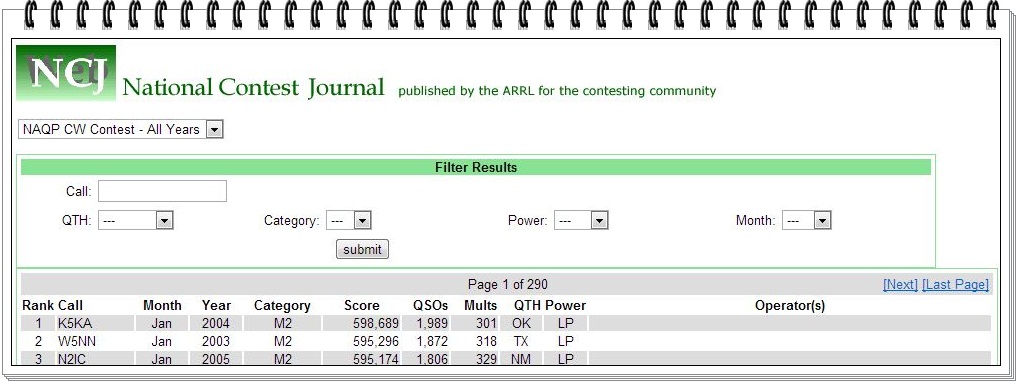 |
| Database Contributors KL7RA, K5TR, KM3T, and N5KO |
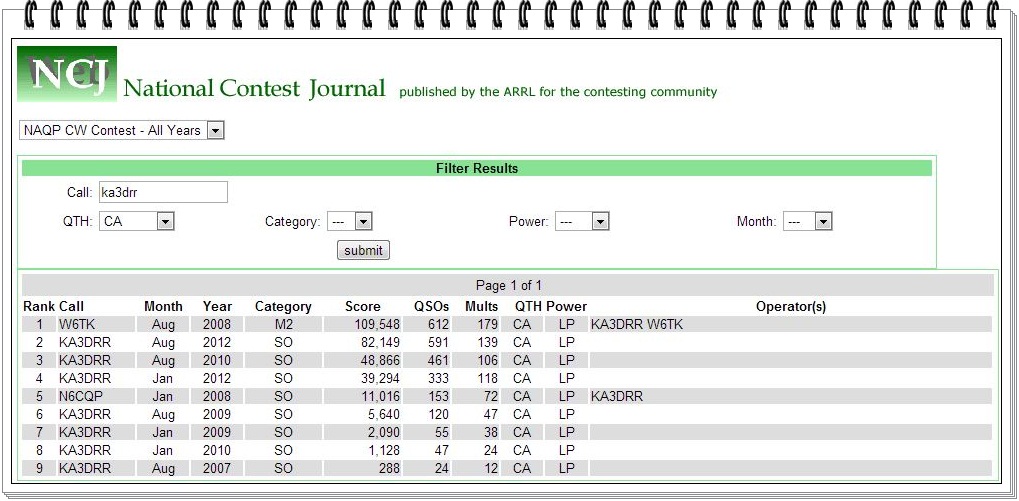 |
| Measuring Continuous Improvement With Help From W6SL |
Good morning from my Shell Beach shack with enough radiant solar energy outside to power at least one linear amplifier for a year. I was reading over at Explorersweb an article about 5 ways to get outdoors in 2013 and came across this quote, “what gets measured gets done.”
My goals are still fresh and keeping them sticky through the year is a small objective that leads to ultimate success.
In the meantime, the crew over at the National Contest Journal developed the North American QSO Party (NAQP) database and I can take a ‘big picture’ snapshot in addition to comparing month statistics.
The data suggests that my Q production is up in January and down in August. Is this related to seasonal propagation with skip going long earlier toward the East coast and with solar production on the decrease does this mean moving to the low bands earlier this winter?
Does the data further suggest activity is seasonal with an uptick in operators inside our warm shacks during the winter months in comparison to the summer?
I’ll have to answer my question next weekend when the NAQP CW swell livens up wireless wavelengths on a national scale.
73 from my Shell Beach shack.
Show Notes #097
Introduction:
- Welcome to another episode of Linux in the Hamshackedness, where the Chocolate Shake Fairy visits Richard.
Announcements:
- LHS now accepts micropayment donations via Flattr. It’s been successful for the Linux Outlaws guys, so we’re giving it a try here.
- We now have a countdown timer on the Web site that shows the time remaining until the next live recording. Of course, now that we’re recording on Wednesdays, we’ve decided to move back to Tuesdays. That will happen in January. Keep an eye on the web site for the dates. (Tuesday, January 8, 2013, as of this moment.)
- We also have a Google Community for Linux in the Ham Shack. It’s a great method for leaving feedback, show suggestions, questions, hate mail or anything else.
- The Dayton Hamvention 2013 will be coming up soon, so we’ve added the donation thermometer to the website. Please make a donation and help send LHS to Dayton again in 2013.
- Sign up for the LHS mailing list, too.
- Gnorman has a bio on the LHS About Us page.
Topics:
- Raspberry Pi in the Ham Shack
- Russ has been working on getting an Echolink node running on his Raspberry Pi.
- He’s chosen Raspbian as the operating system, which is based on Debian Wheezy.
- Installation consists of downloading the iso, using dd to copy it to a secure digital card (SD flash memory card), booting the Raspberry Pi with the SD card, and following the prompts to install.
- VK2MEV has posted instructions for configuring a Raspberry Pi as an Echolink node.
- So far, Russ has Raspbian installed, as well as svxlink and qtel, but has not yet connected it to the usb sound card or attached it to his Rascal GLX interface to control the radio. Another option would be to use the Pi’s GPIO bus to control the radio instead of a digital mode interface.
- VK2MEV also has a page describing WSPR on a Raspberry Pi. (Another page is VK2MEV’s blog on WSPRnet.)
- Ted, WA0EIR, says he thinks some folks have his PSK31LX program running on a Raspberry Pi.
- Russ mentions that there is a Slackware build for the Raspberry Pi.
Feedback:
- Cory, KD0QEA, asks if there are any “hangout” radio frequencies for LHS hosts and listeners. Well, Cory, there are none due to lack of time for the hosts to get on the radio. However, perhaps our listeners would like to establish an LHS net. Email your suggestions for bands, frequencies and times and we’ll announce them on the podcast. When Russ gets his Echolink node/Raspberry Pi running, he’ll be there more often. The node number will be 54711 (LHS11 on the telephone pad).
- Doug, N6LMX, left a voice mail about the Raspberry Pi. He has one and wonders which ham radio apps can be used on the Pi. He’s also using Raspbian as the operating system. Doug will be attempting to create a media center with his, as well as ham radio applications. Russ suggests running the Pi headless and using ssh from a smartphone or tablet to access it. That would avoid having to carry a monitor and keyboard around with the Pi. It’s likely that most of the popular Linux ham applications, such as fldigi, would work fine with the Pi, though you may need to compile them yourself. As for the media server idea, the Pi may not be quite powerful enough. Raspbmc is based on XBMC, and might be the best option. Ted, WA0EIR, has several Linux ham radio applications that should work quite well on the Pi. Richard also wonders if there are folks running APRS on the Pi, and there’s at least one. Thanks for the voice mail, Doug. We appreciate it.
- Dave, M0DCM, has been catching up on the show, and responds to episodes 95 and 96. He uses 75-ohm coax as a feedline with a 1:1 balun to horizontal and vertical dipoles, and is able to bypass his tuner on 21 and 24MHz. He goes on to describe his Linux and radio activities. Thanks, Dave.
- Thanks to everyone who sent happy birthday messages to Russ.
- Gorkon, aka Joel, says there may have been a problem with the ogg version of episode 96. Russ will take care of it if he finds the problem.
- Mike, from Sugarland, TX, has been trying to use N3FJP’s Amateur Contact Log (ACLog) program for logging, presumably under WINE, but it crashes and he wonders if anyone else has had any experience with this. If any of our listeners have tried ACLog under Linux, let us know, or respond on the Google+ LHS community. Russ suggests forcing WINE into 16-bit compatibility mode.
Contact Info:
- Contact Richard at [email protected], Russ at [email protected], or both at the same time at [email protected].
- Listen to the live stream every other Tuesday at 8:00pm Central time. Check the LHS web site for dates.
- Leave us a voice mail at 1-909-LHS-SHOW (1-909-547-7469), or record an introduction to the podcast.
- Sign up for the LHS mailing list.
- Sign up for the MAGNetcon mailing list.
- LHS merchandise is available at the Merch link on Web site. Check out the Badgerwear or buy one of the other LHS-branded items at PrintFection.com/lhs or Cafe Press. Thanks!
- Thanks to Dave from Gamma Leonis for the theme music.
Music:
- None this episode.
Russ Woodman, K5TUX, co-hosts the Linux in the Ham Shack podcast which is available for download in both MP3 and OGG audio format. Contact him at [email protected].
LHS Episode #097: Sheer Hamshackedness
 Welcome once again to the Wonderful World of Linux in the Ham Shack. As indicated in the title, this episode is full of Sheer Hamshackedness. If you’re unsure what that is, we encourage you to pour yourself a nice glass of dark beer or a 100-proof spirit of your choice, put on your headphones and immerse yourself in the pure hedonism that is LHS. And if you believe any of that, we have a large vehicular conveyance over the East River in New York City up for sale as well. Anyway, we talk a little bit about Raspberry Pi computing, APRS, WSPR, Echolink, svxlink, Qtel and a bunch of other stuff in this episode. Hope you enjoy, as always.
73 de The LHS Guys
Russ Woodman, K5TUX, co-hosts the Linux in the Ham Shack podcast which is available for download in both MP3 and OGG audio format. Contact him at [email protected].
 Ham Radio Deluxe |
 W5SWL Electronics |
 Ham Radio Prep |
 KB3IFH QSL Cards  Hip Ham Shirts  HamRadioAuctions HamRadioAuctions Reliance Antennas Reliance Antennas Enigma Shop Enigma Shop |  morseDX  Ni4L Antennas  R&L Electronics R&L Electronics antennas.us antennas.us QRV QRV |
- Matt W1MST, Managing Editor
