 |
 Amateur Radio Kit Roundup – Updated 2/18/2013
 18 February 2013 | by
The Splinter – from Breadboard Radio
Kit building appears to be on the rise again. With so many people talking about it lately I attempted to research sources for kits, only to find out that there wasn’t a single-source for Ham Radio kit suppliers.
I decided to put together a good list of sources for kits that are currently available. Many of these are for QRP operation, but a few are full-featured professional transceivers (Elecraft, DZ). On the beginners side there are a few sources that stand out: Hendricks has a great assortment of kits, including some SSB QRP equipment. QRPme offers the inexpensive, easy-to-build tuna-can products, and I would like to make special mention of the Four State QRP Group NS-40 which has the coils etched right into the PC board! What a great idea! I’ve covered trasmitters, transceivers, and some receivers here. Some accessories are mentioned in the source descriptions.
Revised 7/19/2012 Changes in Hendricks QRP Kits, YouKits, Genesis Radio, Tony Parks, and removed the coming soon designation on Heathkit. I didn’t check ALL of the prices, so don’t hold me to total accuracy in that department.
Revised 10/22/2012 Changes in Hendricks, YouKits, Tony Parks, Small Wonder Labs, Wilderness Radio, and Four State QRP Group. Removed Heathkit, Added HSC.
Revised 2/18/2013 Changes in Hendricks, YouKits, Tony Parks. Added CR KITS, and BreadBoard Radio.
Revised 2/20/2013 Added K5BCQ & K5JHF Kits
Enjoy, and feel free to add any corrections, or additions in the comments. The list can always be found at RadioKitGuide.com–Neil W2NDG
-Hendricks QRP Kits http://www.qrpkits.com/
- BitX20A/17A SSB Transceiver. The BitX20A and BitX17A are complete SSB kits with board, all parts, digital display and custom powder coated and punched case that is based on the BitX20 that was designed by Ashlan Farhan. Output is about 10 Watts. $180.00 + S&H
- PFR-3a 3-Band Portable Field Radio. Bands : 40 meters, 30 meters and 20 meters. Tuning range: Full band coverage. Mode: CW only. $240.00 + S&H
- NADC30/40 CW Transceiver. Nearly All Discrete Component CW Transceiver for either 30m or 40m. Tuning range ~ 60 kHz. Power output: 3.5 watts. Full Kit: $130.00 + S&H
- Ft Tuthill 15 Meter CW Transceiver. Two 60 KHz tuning ranges, ~ 21.000 – 21.060 and 21.075 – 21.135 MHz. Power Output: 5 Watts. Complete Kit (w/ case and digital dial) $130.00 + S&H
- Ft Tuthill 160 Meter CW Transceiver. Two 30 KHz tuning ranges, ~ 1800 – 1835 and 1830 – 1865 MHz. Power Output: 5 Watts. Complete Kit (w/ case and digital dial) $130.00 + S&H
- DCxxB Board Only Trasceiver Kit. These radios are the next generation of the popular DC40 transceiver that was also designed by Steve Weber. The kit will come with 1 crystal for the band specified. 7.040 for DC40, 10.120 for DC30, 14.060 for DC20. Board-Only kit with decals: $30.00 + S&H
- Weber Tri-Bander. The Weber Tri-Bander can be built for any three of these bands: 80, 40, 30, 20, 17, or 15. 5 Watts out on all bands at 13.8 VDC. Built in Iambic keyer with 5 to 40 wpm code speed. DDS VFO for rock steady stability with 50 Hz and 200 Hz tuning rates. Many more features! $200 + S&H
- Scout Regen Receiver. A simple 2 band regenerative radio receiver that is capable of receiving signals from 3.5 to 11 MHz. A complete kit with L shaped aluminum chassis, quality doublesided Read the rest of this post
Neil Goldstein, W2NDG, is a regular contributor to AmateurRadio.com and writes from New York, USA. Contact him at [email protected].
Like an Oasis
This last weekend was a major DX contest and I managed to stay away from the HF radio for all of it. At least until the waning minutes of the contest. The waters had been mightily churned and it seemed one cacophonous mess to the casual listener.
And then, almost magically, as the clock rolled over to 0000 of the next day, the silence was suddenly deafening.
I can just imagine there were quite a few exhausted operators and it’s likely many of them had to be grinning over putting a few news ones in the log. I’ve played in these waters before and know the feeling. But somewhere along the road to becoming a grumpy old man, I got turned off by the high-speed exchanges of button pushing keyboard jockeys staring into the glow of LCD monitors while their computers and radio equipment ran the show.
Anyway, after the contest I had the rig on and was monitoring familiar territory on 40 meters. It was just getting late enough that the band was beginning to go long. I suppose that means different things depending on your location. Here in the Hoosier Heartland 40 meters is good for 250-750 miles, give or take, while the Sun shines. Things can be a bit spooky and unpredictable right around the gray line, but as the hours pass after sunset, the workable area for me on 40 meters grows dramatically.
By 0200 it’s not strange to begin working the West coast. And as the night continues we often see a path to Hawaii and the rest of the Pacific. By 0800 signals from the VK’s and ZL’s waft over Central Indiana just begging to be snagged by anyone awake at that ungodly hour.
So last night at around 0300 I was listening to the quiet while putting together a few things for an early next-morning conference call when I heard a seven calling CQ.
And what welcome relief his signal provided, like an oasis.
Good old-fashioned CW, sent by hand, the way God and Hiram meant it to be, flowing from the desert to my front door.
My new friend was in Lake Havasu City, some 1600 miles southwest of here. After the usual opening platitudes that CW enthusiasts suffer in hopes of what might come next, conversation ensued. Real conversation. He told me about a boating trip he had planned for today and we spoke of other things besides radio and the ailments of age. It was probably the longest CW conversation I’ve enjoyed in 2013 and I would have been pleased had it gone on even longer.
But through the burps in the QSK I could hear other signals floating into the bandpass. No doubt other parched patrons of the dits and dahs anxious to get their turn in the aether now that the contest was over and the band had purified itself from its former abuse.
We signed off in the customary manner of the mode with 73 and many hopes to meet again.
After the logging, I closed station for the night. Now sleep was the one calling CQ and I was slipping into the abyss. But just before passing to the other side of consciousness, I couldn’t help but think that when radio is good, it’s very good.
Jeff Davis, KE9V, is a regular contributor to AmateurRadio.com and writes from Indiana, USA.
New records set at VE3WDM!!
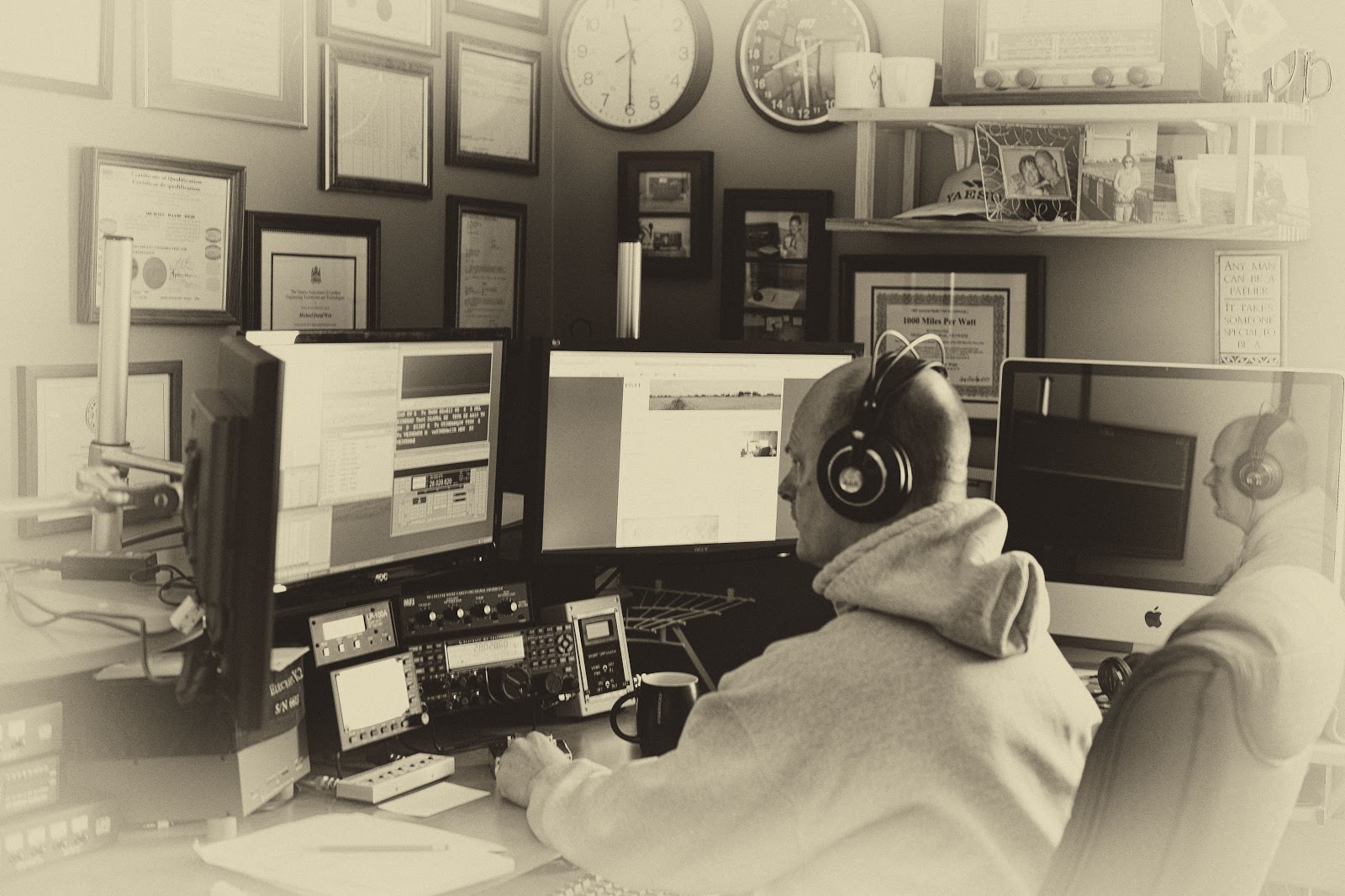 |
| Julie was out and about snapping shots!! |
 |
| At 40mW and below this is the reading |
up purchasing was MRP40 cw decoding program. Now my code is not to bad at all but during contests I have found that for some reason some stations send at the speed of sound. (not sure why as they may loose more contacts that gain as folks just move on being not able to understand the fast code) For those stations this is were MRP40 shines.
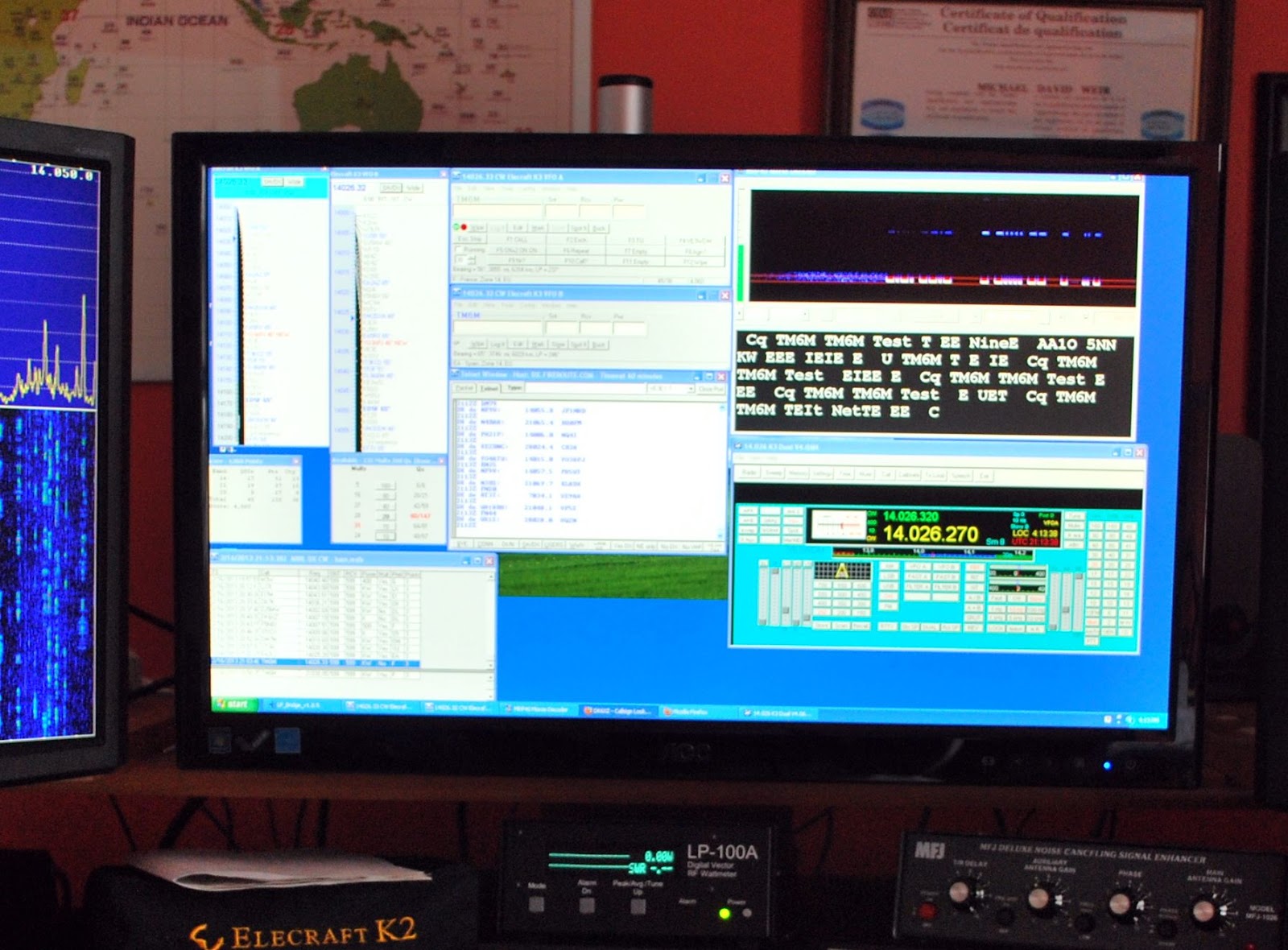 |
| Programs running during the contest |
That was the software success for the contest other great events were being able to keep my power down to 1 watt....except for 2 contacts were the power creeped up to 3 watts. Did I say the power was kept to 1 watt? That was for a total number of 6 contacts the rest of the DX contacts went into the log with power numbers varying from 10mW's to 900mW's!!
Here is how the power numbers broke down
Contacts Power
2 10mW
13 20mW
2 40mW
4 50mW
14 100mW
22 500mW
12 From above 500 to 900mW
6 1 watt
2 3 watts
77 TOTAL
I did say there was some records broken here at VE3WDM and they are
1. 69 DX contacts with under 1 watt in a contest!
2. Miles per watt bar is set higher.....CR3A with 10mW is 344,468 miles per watt
DL6FBL with 10mW is 400,126 miles per watt
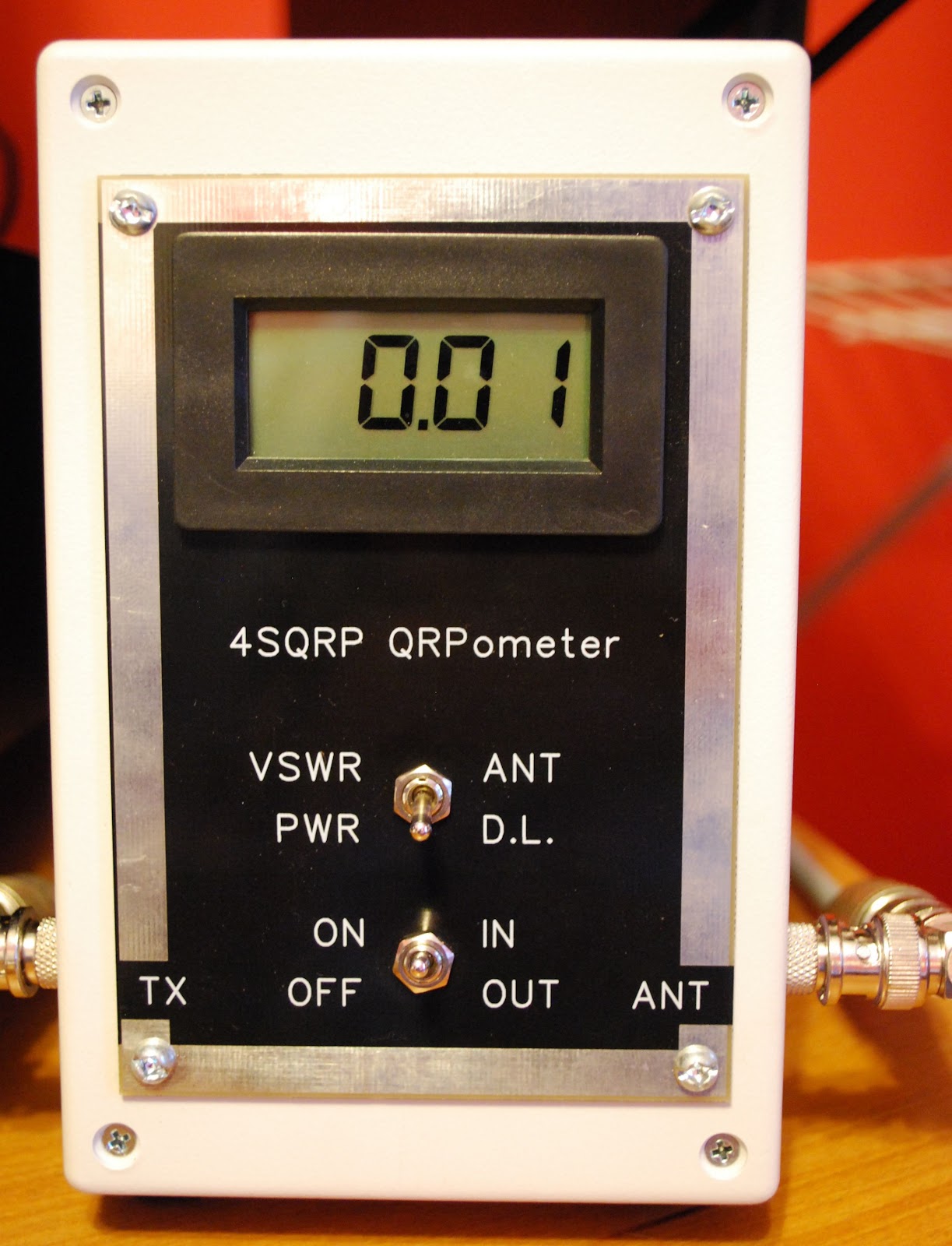 |
| 10mW on the QRPometer |
Mike Weir, VE9KK, is a regular contributor to AmateurRadio.com and writes from New Brunswick, Canada. Contact him at [email protected].
ARRL DX contest
There is still a few hours of the ARRL DX CW contest to go but I have worked all that I want to work this weekend. I only took part for fun, so no targets to beat. I did hope to work some of the rarer west coast states but conditions didn’t allow it. I only worked W/VE stations – in fact I only worked US stations, the VEs were conspicuous by their absence. I did hear one VE but I never managed to work him. So in comparison to other contests my haul of contacts was worse than normal.
I operated for a couple of hours late Saturday morning, and the same again after lunch. On Sunday morning I did another couple of hours but I almost gave up as I seemed to be hearing all the same stations I worked on Saturday. Then the jinx left and I managed to log another batch of new stations. But by Sunday afternoon I’d had enough, and it was a fine late winter day so I went for a walk by the river with Olga.
I think conditions this weekend were below average. Ten metres was all but dead; 15m was quite productive but the money band as usual was 20m. I didn’t try the lower bands as I think my attic antennas are too much of a compromise on those bands to work DX with them.
My total of 55 stations worked is nothing to write home about, but remember I was only working US stations – I ignored all the Europeans and Russians whom I would have worked in a normal contest. I worked 20 different states: CT, FL, GA, IL, MA, MD, MN, NC, NH, NJ, NY, OH, PA, RI, SC, TN, TX, VA, VT and WI. So my 100W was barely making it past the east coast. If anyone is interested in my full log the contest starts on this page.
Working in a contest is always fun. It’s not the winning, it’s the taking part that counts!
Julian Moss, G4ILO, is a regular contributor to AmateurRadio.com and writes from Cumbria, England. Contact him at [email protected].
New stations heard on 472khz WSPR
I’m finding it interesting to note how variable conditions can be on 472khz WSPR. Some days are distinctly better than others. It will be fascinating at some stage to try and correlate the various indices with improved reception/conditions.
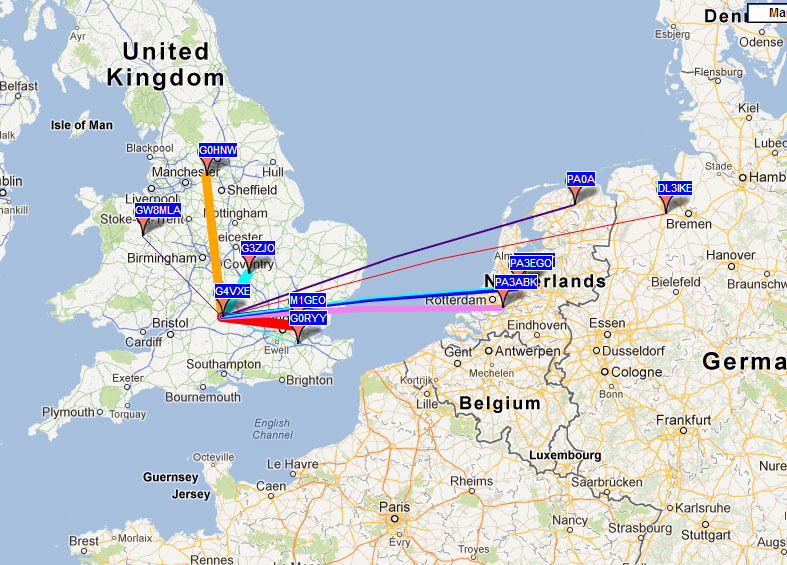
Last evening was a good one and I copied a number of new stations; PA3FNY, G0HNW, DL3IKE and PA3EGO. New to me, that is. Nice too, to hear Paul G0HNW. I’m sure it’s a coincidence, but most of the stations I have heard up to now have been on an East-West axis, so good to hear someone from the north.
Remember all this is on unmodified, untuned kit, so I hope it serves as an encouragement to anyone else who might be interested to try and hear something!
Tim Kirby, G4VXE, is a regular contributor to AmateurRadio.com and writes from Oxfordshire, England. Contact him at [email protected].
Contest goals close to 50/50
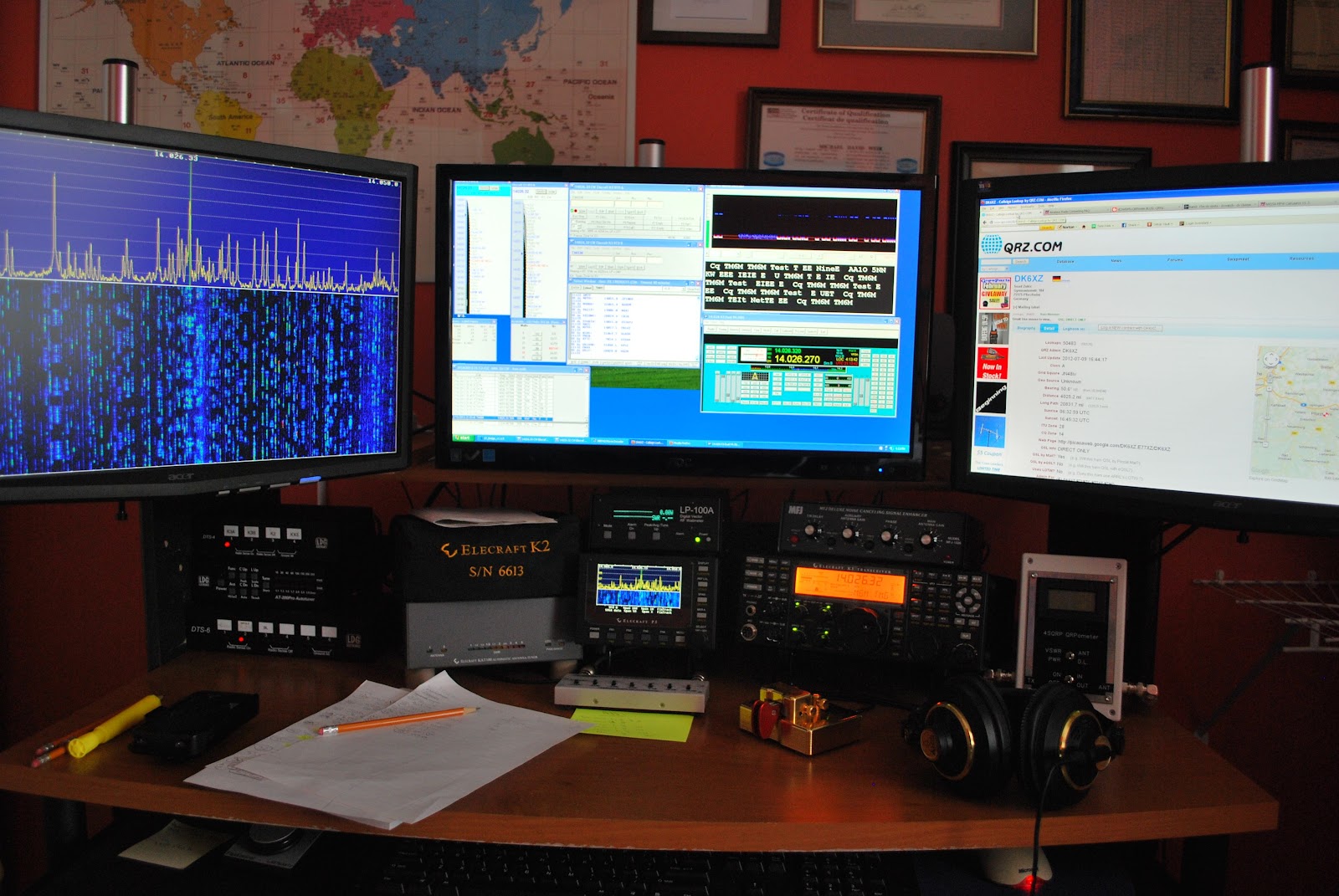 |
| In the thick of things |
1. Contacted DL6FBL with only 10mW's for a miles per watt total of 433,756 per watt an all time record for me.
2. As was already mentioned 92% of contacts are QRPp and a majority of those are at or below 500mWs.
3. There are so far 9 contacts at or below 50mWs and again all these contacts are DX and not U.S stations.
As for the rest of the goals like getting up early and racking up lots of time on the contest.........well the bed was sooooo comfee this morning it was very hard to get up and out before 8am! So that goal up to this point has not been met...but there is Sunday!! (dreams are free they say)
As for spending more time in the chair that will have to be weighted out on Sunday evening when the total time on air is looked at.
Contest on....it's off to 40m and maybe 80m as well..........will keep you posted
Mike Weir, VE9KK, is a regular contributor to AmateurRadio.com and writes from New Brunswick, Canada. Contact him at [email protected].
The Noise Blankers: Running Loose on the Interwebz
 I am always on the lookout for great ham radio information on the internet. I haven’t found any lately but I did come across The Noise Blankers radio group web site. It was difficult to tell if these guys are really serious or not but they do have an Official FCC Club Callsign (KF5TQF) so they must be legit. Who I am to disagree with this endorsement from the Federal Government?
The mission statement of the club is:
- Do radio stuff.
- Have fun doing it.
- Show people just how fun it is.
This mission statement is very much in harmony with The Universal Purpose of Amateur Radio, so that is a good sign!
I see that the club has posted cutting-edge reports about a West Virginia ham who bought his wife an Alpha amp for Valentines Day, a Michigan man that declared himself to be a new DXCC entity and the problem causing the Logbook of The World backup. Check their website frequently for more exciting ham radio news.
I have been unable to confirm the rumor that this group is a renegade element of the Lost Island DX Society (LIDS), still presumed to be missing somewhere in the Chihuahuan Desert.
73, Bob K0NR
Bob Witte, KØNR, is a regular contributor to AmateurRadio.com and writes from Colorado, USA. Contact him at [email protected].
 Ham Radio Deluxe |
 W5SWL Electronics |
 Ham Radio Prep |
 KB3IFH QSL Cards  Hip Ham Shirts  HamRadioAuctions HamRadioAuctions Reliance Antennas Reliance Antennas Enigma Shop Enigma Shop |  morseDX  Ni4L Antennas  R&L Electronics R&L Electronics antennas.us antennas.us QRV QRV |
- Matt W1MST, Managing Editor
