 |
 March CQ
 6 March 2013 | by
 If you’re not a subscriber, then you might want to go to the local news stand or book store to see of you can procure a copy. This month’s issue is devoted to QRP.
Good articles (as always) by Cam N6GA and Joe K0NEB. Cam reviews the new Argonaut VI, and Joe has his monthly, first rate article on kit building.
There are other interesting articles – one about using QRP next to saltwater and a look inside the NAQCC. And also an article with some novel and unconventional ways on how to run a 100 Watt transceiver at QRP power levels, by splitting your output power between a dummy load and an antenna
There’s also a very interesting article about the Raspberry Pi.
FYI, I’m not an employee of CQ Communications – I just appreciate the fact that they have an annual issue devoted to QRP. And in all honesty, besides this annual issue, they give QRP related items and events good coverage year ’round.
72 de Larry W2LJ
QRP – When you care to send the very least!
Larry Makoski, W2LJ, is a regular contributor to AmateurRadio.com and writes from New Jersey, USA. Contact him at [email protected].
Handiham World for 06 March 2013
Pat Tice, WA0TDA, is the manager of HANDI-HAM and a regular contributor to AmateurRadio.com. Contact him at [email protected].
Raspberry Pi APRS
I had a recent email from John, WB2OSZ regarding using the raspberry pi for APRS and he has developed an application that looks like a very slim APRS beacon and digipeater for aprs called Dire Wolf . I have yet to investigate it further but for all those with an interest head over to Johns website and take a look. Here is the address.
From what i can see the application acts as a soundcard modem and tnc for programs like Xastir and APRSIS32. I think this needs some further investigation
Alex Hill, G7KSE, is a regular contributor to AmateurRadio.com and writes from Cumbria, UK. Contact him at [email protected].
March contesting and other things
I’ve finally managed to crack open the radio again this month and get going again. I can’t believe its March already, a full 2 months into 2013 and I must admit my radio rate (a bit like work rate but far more enjoyable) has been very low. However, i see light at the end of the tunnel.
I managed to get out last night and particiapte in the UKAC 144Mhz contest. I find this to be a nice and easy going type of contest where I can operate as a portable station without too much bother. last night i managed 17 contacts from the comfort of the car with 10w and a 5 ele yagi. I am using these contests as a way to get more involved on a regular basis with vhf operating as I struggle to get out on hf as the salt air has knackered my vertical antenna.

Next off is the new outdoor antenna. I have always had a soft spot for Cobwebb antennas. My single wire one is going to a new home and I wanted to get myself building again so I will be making a more robust version for outside. I have XYL permission and will get cracking in the summer.
Also is the VHF field day. Andrew, G4VFL and I will be putting together a station to operate from Corney fell, which judging by Andrews recent results in the UKAC should give us some advantage in height.
Only work can get in the way now.
Alex Hill, G7KSE, is a regular contributor to AmateurRadio.com and writes from Cumbria, UK. Contact him at [email protected].
Radio workout
The 40 Meter Fox hunt turned out to be radio “workout”. The two Foxes for the night were Kevin W9CF in Arizona and Tom KV2X in New York.
I turned on the K3 about twenty minutes ahead of time, to hear the “D” beacon from Odessa, in the Ukraine, coming in at about 579/589. I figured right there and then, that barring some kind of propagation miracle, that KV2X was an impossibility – too close.
As it turned out, I was correct in my assumption, and I did not hear Tom all night. But Kevin W9CF was another matter. Kevin was audible, but the QSB was very bad. His signal was anywhere from ESP to 559. At peaks, he was very workable.
At about an hour into the hunt, the pack was thinning out and Kevin was calling CQ FOX with no takers. It was frustrating, and I was bouncing from antenna to antenna, trying to figure out what would work.
It wasn’t until the “four minute to go” mark, that I was able to work Kevin. And I think what worked in the end was that I changed my code speed. All evening, I was attempting to work him at about 23 WPM, which was a match for his speed. When I slowed my speed to 20 WPM, it wasn’t long until I was heard. By doing something to “stick out”, I was able to garner Kevin’s attention and get in his log.
This was a good lesson learned. I think I’ll have to remember this one and pull it out from time to time in the DX pileups. It might not work there, but it can’t hurt to try.
72 de Larry W2LJ
QRP – When you care to send the very least!
Larry Makoski, W2LJ, is a regular contributor to AmateurRadio.com and writes from New Jersey, USA. Contact him at [email protected].
QRP Tactics and XT2TT
However, as they say, there is more than one way to skin a cat, so are there many ways to work big DX-peditions QRP. I did not need XT for a new QRP country, however I did need them on 160m. (before you say I know what's coming, I did not work XT2TT on 160m QRP). So after the IOTA Bash festivities on Saturday night I went to the shack to see if the XT was up on 160m. Not only did I need them for a new one on Top Band, but a friend of mine has already worked him on that band, so I was doubly motivated. As luck would have it, they were not on 160m, but on 20m CW. So rather than fire up the QRO rig, I thought I would give the KX3 a workout to see if I could get a QRP QSO with Burkina Faso.
So I turned the beam to Africa, found the split and started calling. The Op was working primarily Russian stations that I could not hear so I had trouble knowing exactly were to call. He work several in succesion, leading me to believe that band was much louder to Eastern EU. My hopes of a QSO weren't very high. Finally he worked a W4 that I could hear, I moved the VFO to the W4's frequency and called, "AD5A/QRP" after which he came right back to me. In fact the online log has AD5A/QRP in it.
I'll admit that I was a little surprised to make the QSO, so I sat there thinking why was this relatively easy. After evaluating the scenario and remembering that the ARRL DX Phone contest was in full swing, it was a late night opening on 20m that isn't used that much, the situation made more sense. For both reasons above, the competition was much lighter and therefore a QSO was much more probable.
I guess the moral of this story is to look for QRP workable DX on a major phone contest weekend on the CW bands and I suppose the reverse would be true as well.
By the way, I managed a QRO QSO with XT2TT on 160m last night so I have a new band country in the log, but more importantly, my buddy no longer has bragging rights:-)
Mike Crownover, AD5A, is a regular contributor to AmateurRadio.com and writes from Texas, USA. Contact him at [email protected].
Who says it can’t be done?
I always like reading about what can be achieved using a stealth antenna system, so I always enjoy reading the blog of John, N8ZYA.
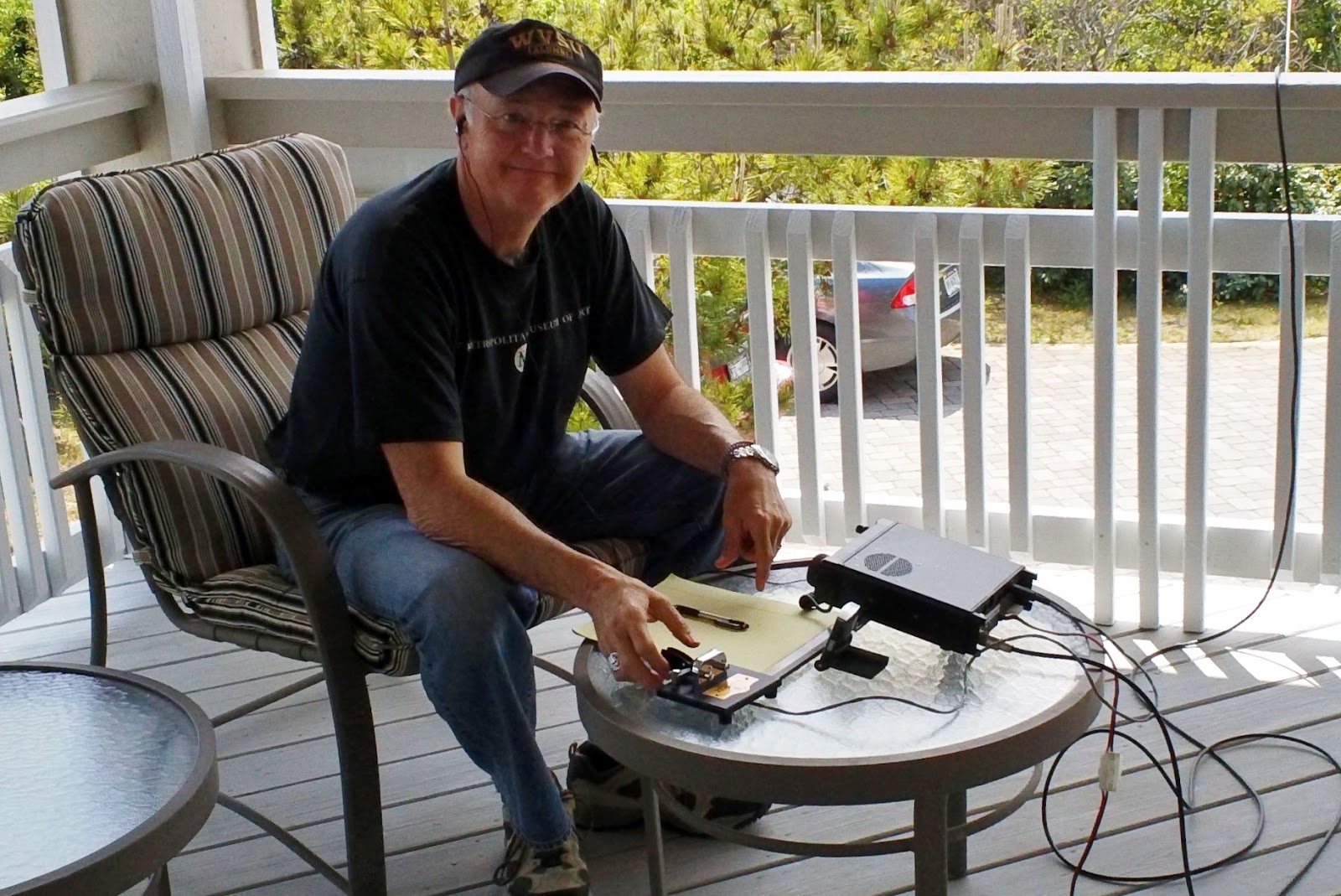
From a town house in Charleston, West Virginia using 3 watts of CW to an indoor random wire, John has made 1,830 contacts including 361 DX stations in 73 different countries. Simply amazing!
I hope you don’t mind me pinching your picture, John!
Julian Moss, G4ILO, is a regular contributor to AmateurRadio.com and writes from Cumbria, England. Contact him at [email protected].
 Ham Radio Deluxe |
 W5SWL Electronics |
 Ham Radio Prep |
 KB3IFH QSL Cards  Hip Ham Shirts  HamRadioAuctions HamRadioAuctions Reliance Antennas Reliance Antennas Enigma Shop Enigma Shop |  morseDX  Ni4L Antennas  R&L Electronics R&L Electronics antennas.us antennas.us QRV QRV |
- Matt W1MST, Managing Editor
