 |
 Series Six Episode Five – Android Tablet Amateur Radio Apps
 10 March 2013 | by
 Series Six Episode Five of the ICQ Amateur / Ham Radio Podcast has been released. The latest news, mailbag and Martin (M1MRB & W9ICQ) reviews Amateur / Ham Radio Apps for your Android Tablet.
- Pat Hawker MBE G3VA Silent Key
- Ham radio club to celebrate Legion birthday
- The VK0RTM 6m beacon on air
- Short-wave radios banned in Zimbabwe
- Beijing jamming BBC World Service
- St Patrick's Day special event
- Amateur radio association raising funds
- UK amateur radio licences fail to expire
- Review of Amateur Radio Exam Questions
- WSPR on the Raspberry PiMariana Islands

The following are a few of the 365 Ham Radio apps found in the Google Play store. Most are free, however if the app is chargeable it will cost less than £10 and will have the adverts removed.
- EveryCircuit
- 555 Calculator
- Ohms Law Calc
- ElcalcZs
- RF calculators
- RF Pad Calculator
- Resistor Color Code
- Alldatasheets
- Digi-Key
- Equivalent Resistance
- Circuit Simulator
- Capacitor Buddy
- UK Band Plan
- ISS Detector
- HF Beacon
- NCDXF Beacon
- Grid locator
- QRZDroid
- Morse Code Trainer
Colin Butler, M6BOY, is the host of the ICQ Podcast, a weekly radio show about Amateur Radio. Contact him at [email protected].
How to Get a $10,000 FCC Fine
 The ARRL web site reported on this Notice of Apparent Liability for Forfeiture from the FCC. That’s government talk for “we are fining you.”
In case you are wondering how you can get fined by the FCC, here’s the sequence of events that resulted in a $10,000 fine for this person:
- Get a Technician License and then let it expire.
- Repeatedly transmit on 14.312 MHz, interfering with licensed radio amateurs.
- Have FCC agents track the signal to your house
- When the FCC agents enter your house to inspect your radio station, leave the transmitter sitting on 14.311 MHz.
- Tell the FCC agents that you will remove the microphone from the transmitter and only use it as a receiver.
Hmmm, why does 14.312 MHz sound like a familiar frequency? 
73, Bob K0NR
Bob Witte, KØNR, is a regular contributor to AmateurRadio.com and writes from Colorado, USA. Contact him at [email protected].
JT on JT9
I had an all-day session on the JT modes today. Actually, almost all of today’s contacts were on JT65A. I did listen for JT9-1 signals a few times but most of the time I only saw stations I had already worked before.
I put out a CQ call on 15m JT9-1 and Joe Taylor K1JT came back to me. I’ve decoded Joe’s WSPR signals numerous times and I’ve exchanged several emails with him but I had never had a radio contact with him until now, so that was a nice surprise.
Then it was back to JT65A. The contrast in activity was extreme. There were so many stations active I couldn’t find a space to call CQ, so I had to wait and pounce on new stations that called.
I must say that when using JT9 I miss the infrastructure that has been built up around the JT65A mode – the reverse beacons, the auto-spotting to PSK Reporter so you can see how far your signals have got, the JT-Alerts when you decode someone you’ve worked before. I especially need the B4 alerts. My memory is so bad I can’t remember the calls of stations I’ve worked before so I have often called people who I have worked only a couple of days earlier. I guess that due to the lack of new stations they probably don’t mind too much!
Julian Moss, G4ILO, is a regular contributor to AmateurRadio.com and writes from Cumbria, England. Contact him at [email protected].
A cheap way onto 29MHz AM/FM using an Intek M60
After my posting about Sporadic E a couple of days ago, I had an interesting email from Steve G1KQH who pointed me in the direction of a simple way of getting onto 29MHz FM (and AM) using one of the Intek CB radios, the M60.
You do need to pop the cover off and remove link LK2 – this allows the rig to cover 25.610 to 30.100 in ‘PO’ mode (the rig is configured with different settings for different adminstrations’ CB allocations, but PO allows the widest coverage).
Here’s a video from Simon Parker on the modification required
Here Simon shows cycling through the various modes
I’ve not tried this, but it looks a temptingly cheap way to get on 28/29MHz AM/FM for the Es season if you don’t already have a rig.
Thanks Steve for the tipoff and thanks Simon for the video ‘how to’.
Tim Kirby, G4VXE, is a regular contributor to AmateurRadio.com and writes from Oxfordshire, England. Contact him at [email protected].
LHS Episode #101: O Sole Mio
 Welcome to the first episode of Linux in the Ham Shack that doesn’t have Richard it in, on purpose. I can personally say that I feel his absence rather heavily in this program, but overall I think the show went rather well. Harrison, VE2HKW, was kind enough to be a guest host to help me out. Episode #102 will also have a couple of guest hosts, rather likeable ones at that, and so it will go until a permanent(?) replacement is found for Richard. We can only hope he comes back one day to grace us with tales of strippers on scooters and discharging firearms indoors. Until then, I soldier on. Thanks for listening and remember, you can send feedback to [email protected], or by voice mail at 1-909-LHS-SHOW (547-7469).
73 de Russ, K5TUX
Russ Woodman, K5TUX, co-hosts the Linux in the Ham Shack podcast which is available for download in both MP3 and OGG audio format. Contact him at [email protected].
East End Peak Activation SOTA ref. W7A/MN-038
Since joining the SOTA chase, I have been looking for summits to activate, but the problem is that the closest accessible peak that counts for the program is several hundred miles away from my QTH. So, I had to look for opportunities. As I checked my business calendar I had a two day meeting in Scottsdale, AZ. Ah, there are mountains there. So I did a little research and contacted another SOTA activator from the Phoenix area, Jim Davies, K7JFD. Jim was kind enough to offer a few suggestions of both easier peaks and some good candidates that had yet to be activated. As my schedule developed I was able to have most of day free and so I planned use that time activating a summit.
Based on the results of my research, I settled on East End Peak, a summit that had not been activated. It is located in the northern region of the McDowell Mountans outside of Phoenix, AZ. It is the highest peak in the range, at 4,057 ft (1,237 m). East End is mainly covered in rocky boulders and is accessible from the Tom Thumb Trailhead in the McDowell Sonoran Conservancy. From the trailhead East End Peak is 1.82 miles, one way, and 1,405 feet vertical assent.
My wife of 37 years accompanied me on the trip and is also experienced in the mountains, so we saw this as a challenge and renewal of our love of the mountains.
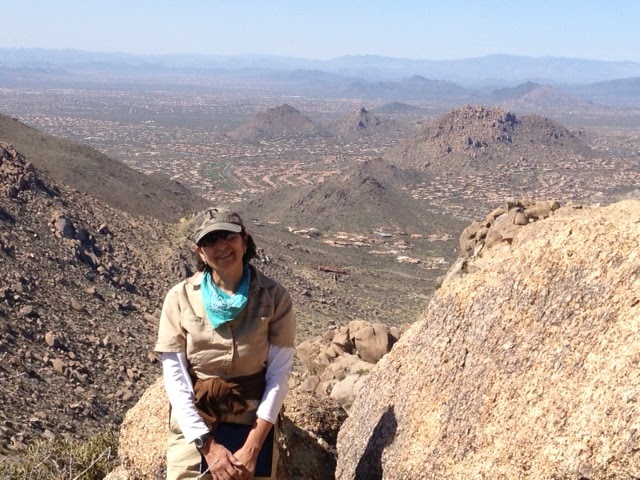 |
| My lovely wife Cris, KC5HZQ |
The packing for the trip took some thinking, but to keep this story from getting too long, my station consisted of a Buddistick vertical mounted to the top of my hiking stick, an Elecraft KX3 and a 4 amp/hour battery for my power supply. The hike up the mountain was pretty tough as the last 400 feet were without a trail. There were a lot of boulders, cactus and thorny bushes to navigate, however, we found our way to the summit to set up the station. Since this trip occurred on a Wednesday, the number of summit chasers would be limited, but I had announced the activation, so I knew there would be a few folks waiting on me.
We first set the station up a few feet below the summit and the path to the east coast was blocked by some boulders, so after I worked a few W6's and W7's we moved the station up to the absolute summit where I was able to work some of the guys on the east coast. After switching bands a few times and several unanswered CQ's I shut down and packed up. I put 18 stations in the log, coast to coast, with my QRP set up and my wife and I enjoyed a lovely day in the mountains. The calories burned per QSO was pretty high, but we had a lot of fun and we slept extremely well that night. I can't wait to do it again.
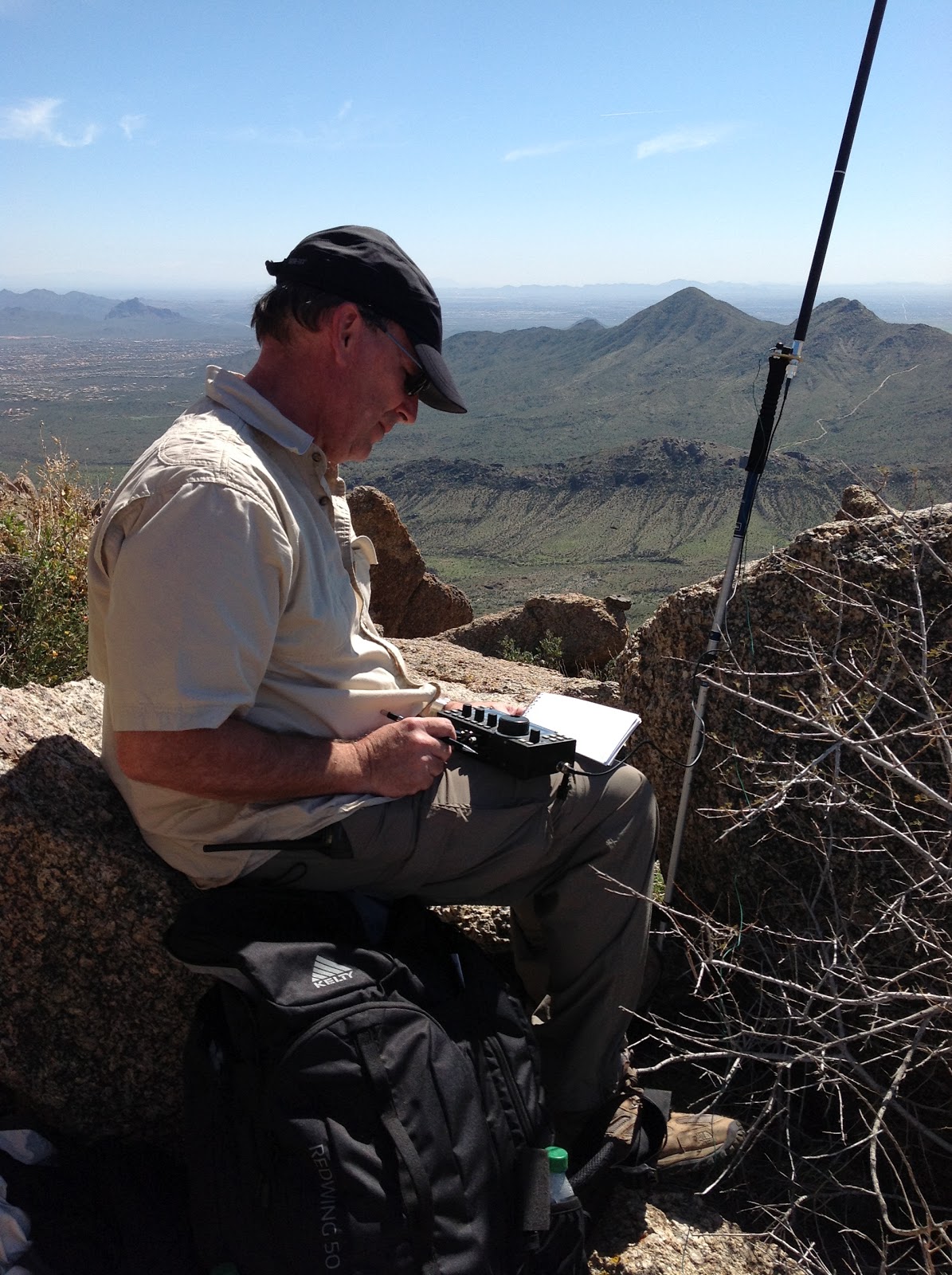 |
| Making QSO's from East End Peak in Arizona |
Mike Crownover, AD5A, is a regular contributor to AmateurRadio.com and writes from Texas, USA. Contact him at [email protected].
The good and the not so good.
Last night, while hunting in the 80 Meter woods in the QRP-L Fox hunt, I continued to work on my PigRig. I came to the part where I am winding T1, and I guess I had a case of brain flatulence, because I just couldn’t figure out from the instructions, how the center tap was supposed to be done.
Before going to bed (late), I came up here and fired off an e-mail to the Flying Pigs e-mail reflector looking for some enlightenment. When I checked my e-mail this morning, there was an e-mail from the Head Honcho himself, Diz W8DIZ. He explained to me (very patiently) what should have been as obvious as the hand in front of my face.
Thanks, Diz for excellent customer service! And also thanks for being super courteous and patient with someone who seems to have had a “Senior Moment”.
On the other hand, last night I was fortunate to work an SU9 station from Egypt on 40 Meters. I was doing the “happy dance” as this was my first QSO with Egypt – ever. So I dutifully went to QRZ to look up QSL information, only to find that LOTW is not accepted (as it’s too cumbersome and difficult to figure out), that paper QSLs are not really wanted, but if you go to PayPal and enter this particular PayPal address (along with the appropriate “donation”) that a QSL card can be had.
What ?!? I mean, really …… what?
OK, I understand that Egypt is not the most commonly found country on the air; and I’m sure that QSLing is quite the tedious chore (if not a downright pain in the butt). But isn’t that what QSL managers are for? And really, I mean even I can figure out how to use Log of the World. You know, the guy who had trouble figuring out how to wind a simple toroidal transformer? …… Yes, me – even I figured out how to use Log of the World.
I hesitate to use that hackneyed expression, but if I can figure it out – you can figure it out.
Maybe I ought to quit my job, move to a “rare and exotic” locale, get on the air, make a couple hundred QSOs a day, and start charging a few bucks per QSL card.
But then I guess I’d have to figure out how to use PayPal. (Of course, I am being facetious, I already know how to use that. Learned how just around the same time I learned how to use LOTW).
72 de Larry W2LJ
Larry Makoski, W2LJ, is a regular contributor to AmateurRadio.com and writes from New Jersey, USA. Contact him at [email protected].
 Ham Radio Deluxe |
 W5SWL Electronics |
 Ham Radio Prep |
 KB3IFH QSL Cards  Hip Ham Shirts  HamRadioAuctions HamRadioAuctions Reliance Antennas Reliance Antennas Enigma Shop Enigma Shop |  morseDX  Ni4L Antennas  R&L Electronics R&L Electronics antennas.us antennas.us QRV QRV |
- Matt W1MST, Managing Editor
