 |
 WSJT-X: Why won’t it work for me?
 17 March 2013 | by
 Over the last month or two, I’ve been watching the development of WSJT-X and the increase of activity on the mode. In fact I tried it quite early on, on 3.5MHz with Mark, M0DEV. However, although I could get it to receive and transmit, Mark couldn’t decode me.
Mark looked at my signals and there seemed to be some sort of artefact with the audio. We wondered if that was the problem. Time came and went and I didn’t have a chance to look at it properly.
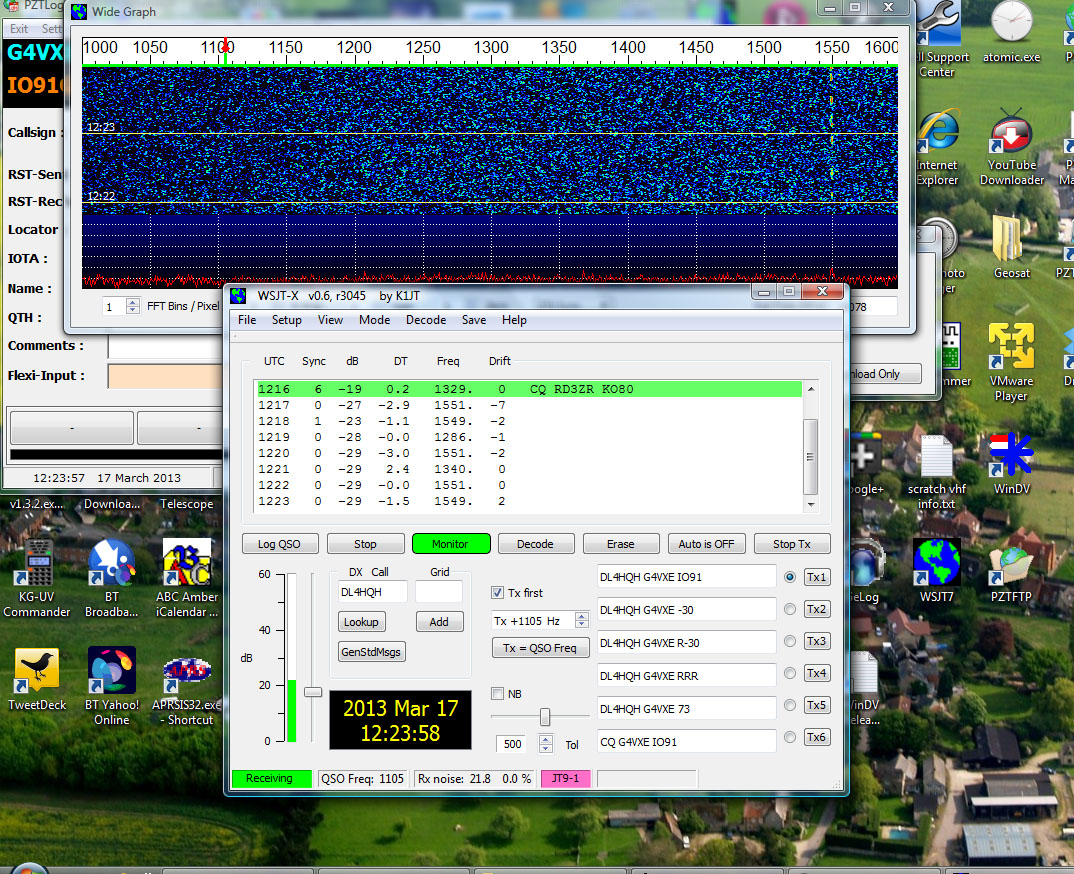
New versions of the software have come out and seeing Julian G4ILO’s post at RTTY and JT9 earlier this week, I thought it would be fun to try it again. Although this morning, I have tried two different rigs and two different interfaces, no one has yet decoded me! Of course, that could be sheer bad luck – but no decodes on PSK Reporter either.
I’ve tried reducing the audio output as much as I could in case there was anything causing an issue.No! Bear in mind that I can use exactly the same setup on JT65A and pretty much any other data mode that you care to shake a stick at. It’s all rather puzzling.
The next experiment will, I think, be to try a different USB soundcard and see if that makes a difference.
It’d be great to get it going, as it looks an interesting and a useful mode.
Tim Kirby, G4VXE, is a regular contributor to AmateurRadio.com and writes from Oxfordshire, England. Contact him at [email protected].
Decent DX Day
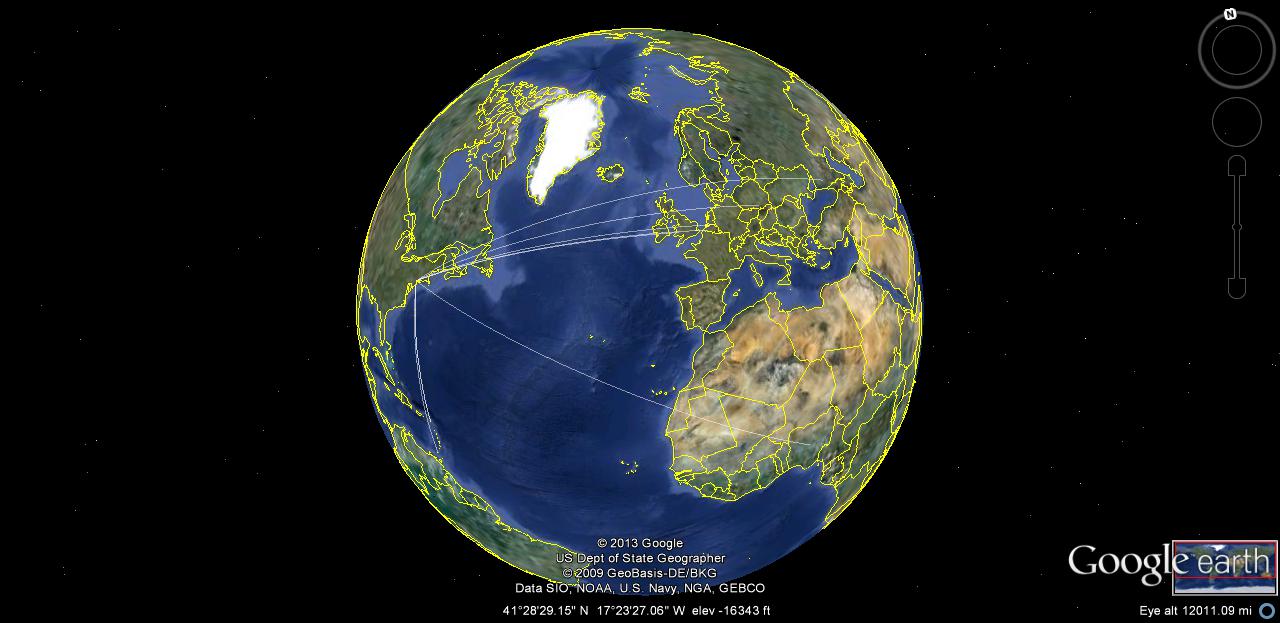
I was piddling around on the bands today. Since there were a lot of contests going on, and I did not feel like participating, I exiled myself to the WARC bands – 30, 17 and 12 Meters.
There was enough DX to be had and I worked just about all of it QRP.
On 12 Meters, I worked Andy SP9KR. There was a lot of QSB there, and I’m not 1000% that he got my call right. So at the very end, when I sent my call sign for the very last time, I bumped up my power to 55 Watts (for insurance) but I’m not sure that even then that I was heard correctly.
On 17 Meters I worked Serge R7AY in Russia. After our QSO and I got Serge’s info in my log, I heard him continue to call CQ. So I spotted him on the TelNet Cluster. Almost immediately, as he was working other stations I heard him send “W2LJ TNX SPOT”. I guess he had his computer on! I thought that was so cool. You’re very welcome Serge, I hope it brought you lots of DX!
I also worked OT4A in Belgium and GW100C in Wales. Of course the GW100C call stuck out like a sore thumb. After working him, I looked up the call on QRZ and it turns out that GW100C is one of several UK HQ team members of the RSGB. These calls, GW100C, GM100C, GD100C, G100C, GJ100C are meant to be used by the HQ members so that they get practice in learning how to handle pileups for when they are taking their turns as G100RSGB, GW100RSGB, GM100RSGB, etc – the RSGB Centennial Stations.
On 30 Meters, I was able to work PJ7/N0TG and PJ7AA, both on Sint Maarten. J34G in Grenada who has excellent ears – and as it turns out, an FOC member, so no surprise there.
The last station that I worked for the day was Ivin 5N7M in Nigeria. I ended up having to bump up the power to 85 Watts to work Ivin. I was getting nowhere with 5 Watts and it actually took a fair amount of doing to get noticed at 85 Watts. The pile up wasn’t fierce, so I have no idea what the problem was, although for this QSO, the EDZ ended up being the antenna that worked. I have worked Nigeria before with QRP power, but not on 30 Meters. Nigeria was new for me on that band.
Geez, it almost sounds like I’m starting to pay attention to 5BDXCC matters!
72 de Larry W2LJ
QRP – When you care to send the very least!
Larry Makoski, W2LJ, is a regular contributor to AmateurRadio.com and writes from New Jersey, USA. Contact him at [email protected].
Why do Norwegian callsigns end in A?
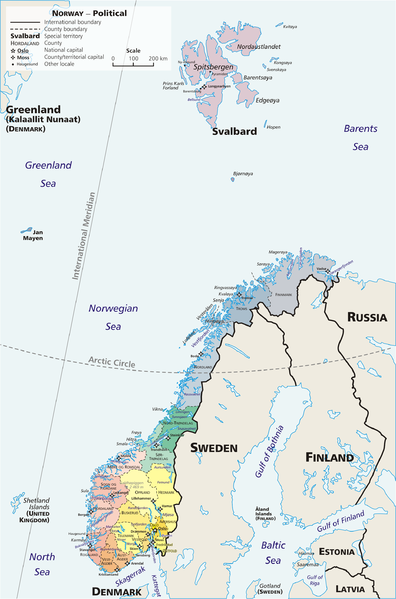
Well actually not all end in A, but almost all of the recent ones do. Amateur callsigns in Norway are not so well documented on the web, so here is a short explanation.
Norwegian callsigns are used in these territories:
- LA-LN for use in mainland Norway
- JW is used on Svalbard and close-by islands Hopen and Bjørnøya
- JX is used on Jan Mayen
- 3Y is used on Bouvet Island, Peter I Island, and in Antarctica (Queen Maud Land)
Usually the callsign starts with LA, but why do so many of the LA callsigns end in A?
The callsigns have been distributed with the last letter as the most significant letter, e.g. in this order for the two letter series: LA1AA, LA1BA, LA1CA, …, LA9ZZ. In the 80’s it was necessary to add a third letter and that series started like this: LA1AAA, LA1BAA, LA1CAA, …, LA1ABA, LA1BBA, … As an example LA9KTA was issued last year. With the ‘TA’ we are getting closer to the last one, LA9ZZA, in the series ending in ‘A’ now. Therefore in some years all new radio amateurs will get callsigns ending in B.
We also had an LC license at the same time. That was a no-code VHF/UHF-license. All those callsigns ended with -T for Technician license, e.g. LC3SAT. That series is no longer used and it is not possible to get the old LC callsign back.
There is no vanity callsign system in Norway, but club stations were allowed by the Norwegian Post and Telecommunications Authority to get one of the rare single-letter callsigns that were issued to the very first radio amateurs (up to about the time of the second world war). There are only 26*9 = 234 of these callsigns and one example is LA4O for the Oslo group. But this practice seems to have ended now. It is also possible to inherit a callsign from family as I have done.
There are also a few special callsign series:
- LD: Packet radio repeater nodes for VHF and UHF, e.g. for APRS. An example is LD3GT
- LF: License issued to a company, e.g. LF2E
- LG: Only Norwegian-Swedish station LG5LG in Morokulien
- LN: Club stations may switch to this in some of the major contests, e.g. LA8W – LN8W

Sverre Holm, LA3ZA, is a regular contributor to AmateurRadio.com and writes from Norway. Contact him at [email protected].
Little Victories
I've had a couple of little victories in the last 24 hours. The first was working KH2L on 10m CW for country #121 on QRP. I was reminded during the QSO that a QRP operators have to use all the tools at our disposal to make QSO's more probable. This time I was calling with no success and noticed on the KX3 display that I wasn't quite centered on the KH2's transmitting frequency, for those with a KX3, its the CWT display. I zero beat his signal and bingo, in the log.
My other little victory was this morning. I was chasing a SOTA peak, Gespitzer Riegal, in Austria on 17m SSB. Mike, OE4MXB, was QRP on this mountain top. I was using my QRO rig and beam for this one, as I really wanted the QSO and I'm sure that Mike wanted it also. There was a lot of QRM on adjacent frequecies and Mike was in and out. Finally, the window opened and Mike was a solid 44, heard me and we made the QSO. A little QRP rig on a mountaintop in Austria worked Texas with 5 watts and a portable antenna. Oh the joy of little victories.
Mike Crownover, AD5A, is a regular contributor to AmateurRadio.com and writes from Texas, USA. Contact him at [email protected].
A rant about RTTY
I just worked Iraq for the first time. YI1RZ on 20m using JT9-1 mode.
 |
| YI1RZ |
What was remarkable about this QSO is that I worked YI1RZ despite the presence of heavy RTTY QRM. My Elecraft K3 has great filtering but it can do nothing about a RTTY signal that is straddling the QSO frequency.
Why, in this age of DSP, do people persist in using this antiquated mode? Dating from the 1930s and the age of mechanical teleprinters and analog modems, RTTY is by any definition an outmoded mode. It requires far too much power and occupies far too much bandwidth for the data transmission rate (45 baud.) PSK31 has existed for more than a decade and is a far more efficient mode. If PSK31 is too slow then there is PSK63 which is faster than RTTY and yet still manages to occupy less bandwidth. Not to mention the plethora of other modes such as MFSK and Olivia that have been invented in the last 10 years offering far greater reliability than RTTY and, like PSK, the ability to use the entire character set not just capital letters, numbers and a few punctuation symbols. And which don’t print up garbage because a shift character wasn’t decoded.
It feels good to get that off my chest! I’d better put my asbestos suit on! It is interesting to note that as I have been typing this WSJT-X has been pulling JT9-1 out of the air in the teeth of RTTY interference so great that you cannot even see the JT9-1 signal traces. JT9 rocks! I doubt if the RTTY operators even know the JT9-1 signals are there.
Julian Moss, G4ILO, is a regular contributor to AmateurRadio.com and writes from Cumbria, England. Contact him at [email protected].
New page for JT9 modes
JT9 just got even better. Thanks to Laurie, VK3AMA, JT9 has a new page to show current activity or general chat at hamspots.net.

As far as I can tell, the spots are generated from the spots to PSK Reporter, which the latest WSJT-X program does automatically if you tick the appropriate box. So you don’t have to do anything extra for your spots to show up on this page. This is a great facility that I am sure will increase the growing popularity of the JT9 mode.
Julian Moss, G4ILO, is a regular contributor to AmateurRadio.com and writes from Cumbria, England. Contact him at [email protected].
New 6 and 10 reports
Martin Harrison, G3USF has provided another 6 and 10 report. Its a bit shorter than usual but we’re all blaming the conditions. It can be downloaded here
Alex Hill, G7KSE, is a regular contributor to AmateurRadio.com and writes from Cumbria, UK. Contact him at [email protected].
 Ham Radio Deluxe |
 W5SWL Electronics |
 Ham Radio Prep |
 KB3IFH QSL Cards  Hip Ham Shirts  HamRadioAuctions HamRadioAuctions Reliance Antennas Reliance Antennas Enigma Shop Enigma Shop |  morseDX  Ni4L Antennas  R&L Electronics R&L Electronics antennas.us antennas.us QRV QRV |
- Matt W1MST, Managing Editor
