 |
 QRP Gear: The Temptations
 19 March 2013 | by
 QRP rigs however are quite a different story. As a general rule they are more affordable and this introduces a dilemma to me. Currently I own a K1, KX1, FT-817, ATS-3, ATS-4 and a KX3. This begs the question of how many different ways do I need to cover 20m with a QRP radio? The answer to that question, at least for now, must be six!!
However, operating QRP portable is not limited to transceivers. Unlike a home station that usually has resonant antennas that are at least semi-permanent, QRP/P deals with temporary poles, various antenna configurations, tuners, batteries, backpacks, logging, raingear and on and on. Oh the combinations one can come up with to operate portable. As I have written, I am a backpacker and there is something in my genes that is attracted to the smallest, lightest and most efficient way to be functional when traveling, either with a suitcase in my hand or a pack on my back. So I am always on the lookout for lighter more efficient gear. As I process all the possiblities I find myself driven to eBay searching for any little gadget that I don't have, kit providers for a new piece of equipment and backpacking stores for lighter ways to travel. A good is example of my compulsive behavior was just the other day I was looking at the Ten-Tec QRP transceivers. To their credit, Ten-Tec had put together a nice package, to tempt people like me, that included either a 2- band or 4- band radio, with a portable mulit-band wire antenna and a very cool shoulder bag to carry it in. All of this for a reasonable price. It was almost more than I could take and just before I hit the buy button, I came to my senses and realized I didn't need a seventh radio to cover 20M with QRP. I was also looking at a cool portable tuner to add to the three portable tuners that I already have. I just received in the mail another version of the end fed dipole antenna with a 9 to 1 balun to compliment my Alex-Loop, Buddistick, center fed doublet and my End Fedz multiband antenna. Oh the shame of such excess. But, you never know what the situation will call for, right?
This QRP equipment thing is an addiction and I have to re-commit on a daily basis to be rational, the temptations are beyond calculation. But one small success is that I still don't own a Ten-Tec QRP radio, yet.
Mike Crownover, AD5A, is a regular contributor to AmateurRadio.com and writes from Texas, USA. Contact him at [email protected].
LHS Episode #102: Run, It’s George Lucas!
 Here we are, two episodes past the Richardocalypse and the calendar hasn’t run out yet! This time around, I’d like to thank Rob from MintCast for once again stepping in to be a co-host on the show, filling in the left big toe of the shoes once worn by The Richard himself. Since I barely fill a pinky toe, myself, that’s really saying something. In this episode we go a little ham nutty with Linux thrown in. Topics range from slow-scan television to licensing requirements to Rob asking, “What do I need another damned hobby for??” That question and many others answered in this fabulous installment of Linux in the Ham Shack.
73 de Russ, K5TUX
Russ Woodman, K5TUX, co-hosts the Linux in the Ham Shack podcast which is available for download in both MP3 and OGG audio format. Contact him at [email protected].
5 Foot Diameter Magnetic Loop Antenna

A bonus picture here. The one on the left is a 3 foot in diameter loop.
Note: The little box at the bottom of the small one contains an air variable capacitor for tuning.
Compare it to the 5 foot in diameter loop on the right. ‘

5 Foot Mag Loop
I made a QRP CW contact with this mag loop from right where it stands in my drive way.
 Small Loop Feeds the Big One

Home Made Capacitor Clamps.
Home made cap clamps. The clamps are soldered to keep the contact resistance low.
This is very important with High Q antennas.

5 to 150 Pfd capacitor
Russian capacitor. It is available at E-Bay for about $150

Easy to Make PVC Pipe Stand
Where would hams be without PVC pipe!
This stand is made from 2 1/2 inch sewer pipe.
This is a fun antenna to build and use. I made my first contact with W9GY this afternoon on 20 meters. I used 5 watts, he used 10. RST out was 459, RST in was 579. The antenna was in my drive way in front of the garage that you see here. And Jeff was in Indiana. What a hoot! Making contacts on a home made antenna is great fun. The parts are readily available and with a little planning and shop time you can have a Magnetic Loop antenna to play with.
This is my second Mag Loop. The first one is 3 feet in diameter and covers from 20 through 15 meters. I’m planning another for 17 meters through 10 meters. Mag Loop calculator is available at http://aa5tb.com/index.html
Yahoo has Mag Loop groups that are very helpful to get you started. http://groups.yahoo.com/group/MagLoop/
and http://groups.yahoo.com/group/MagneticLoopAntenna/
Copper foil or strapping is available at http://stormgrounding.electrical-insulators-and-copper-ground-bars.com/copper-foil-2.html
If you’d like more information about Mag Loops, please feel free to contact me. [email protected]
73 De AA1IK
Ernest Gregoire
Ernest Gregoire, AA1IK, is a regular contributor to AmateurRadio.com and writes from Florida, USA. Contact him at [email protected].
Elecraft K3 Build Continuing – Reflection Point
Ironically – Building the Elecraft K3 has let me to reflect. This K3 project is special to me and has drawn some interesting questions. I have been asked by several people including friends and coworkers and some outside my family what I did on my vacation days and when I tried to explain that I was working on building a Ham Radio – Elecraft K3 which I knew they would have no idea about the brand but I always take shot at it.
The reaction has been staggering – so you are building something that is taking days if not weeks to do that you could have purchased all put together and ready to use by someone else. On top of that you are setting up camera and blogging about it. What a waste of time seems to be the consensus.
The joy of building something – anything it doesn’t have to be a Heathkit, Elecraft or even a Lego set (which I enjoy building as well) is a primal instinct for me. I like to create, build, see a result and when I’m able to use this radio on the air knowing that I had large part in the assembling is going to make me even more proud to use it.
I am capturing this memory for me, writing about it for me and I want to share with others so maybe they will consider building something whether it is this radio or not to enhance their life. Setting up a camera, editing footage, blogging and building all takes time certainly and I know over 7000 (by my serial number) have built an Elecraft K3 before me. Maybe they have done this – maybe not – maybe they will enjoy looking back at someone else’s experience. Maybe no one will watch or read…. That’s entirely possible as well… But the project is mine ☺ I will still have the memory.
Life is short and sometimes you have to savor experiences – let them burn a memory for you that you will have for a long time. This is one for me… I know I could have bought this radio built, I know I could put it all together in a day very quickly (possibility ☺) and I know some will never understand…
Nick N1IC
To see my full build story: http://nicktoday.com/elecraft-k3-and-n1ic-my-build-page-1
Nick Palomba, N1IC, is a regular contributor to AmateurRadio.com and writes from Florida, USA. Contact him at [email protected].
A Good SOTA/DXCC Weekend
Starting Friday, UTC, time I managed to work 16 summits for a total of 94 points. Summits range in point value from 1 to 10. It would be possible to work 16 summits and get 16 points, but this weekend the activators were putting some quality summits on the air, which meant they were working extra hard to make it to these summits to activate them. To make earning the points all the more fun I worked summits in OE, DL and OK as well as across the US. So thank you activators for putting in the effort.
On the DXCC front, creating my separate QRP log paid dividends this weekend. In an earlier post I talked about my decision to create a separate QRP log on my DX4WIN logging software that would highlight needed countries on the DX Cluster. In the past I was hit and miss, having to take time to query my total log to see if I had worked a station QRP. Since there was a lot of contest activity this weekend, I decided to look around for needed QRP countries. I hit a gold mine. This weekend, thanks to my logging software I worked many relatively easy countries that I hadn't taken the time to work before. I was able to log HR, C6, J3, KP2, PJ7, KH2 (as mentioned in my previous post) for new ones and the catch of the day was 9M4SLL (1S). I worked the 9M4 on 17 CW, when no-one was calling. So my QRP DXCC count is now up to 126. I have worked 15 new DXCC countries on QRP since creating the log about 6 weeks ago.
So it was a good weekend, now back to work:-)
Mike Crownover, AD5A, is a regular contributor to AmateurRadio.com and writes from Texas, USA. Contact him at [email protected].
WSJT-X: Why won’t it work for me?
Over the last month or two, I’ve been watching the development of WSJT-X and the increase of activity on the mode. In fact I tried it quite early on, on 3.5MHz with Mark, M0DEV. However, although I could get it to receive and transmit, Mark couldn’t decode me.
Mark looked at my signals and there seemed to be some sort of artefact with the audio. We wondered if that was the problem. Time came and went and I didn’t have a chance to look at it properly.
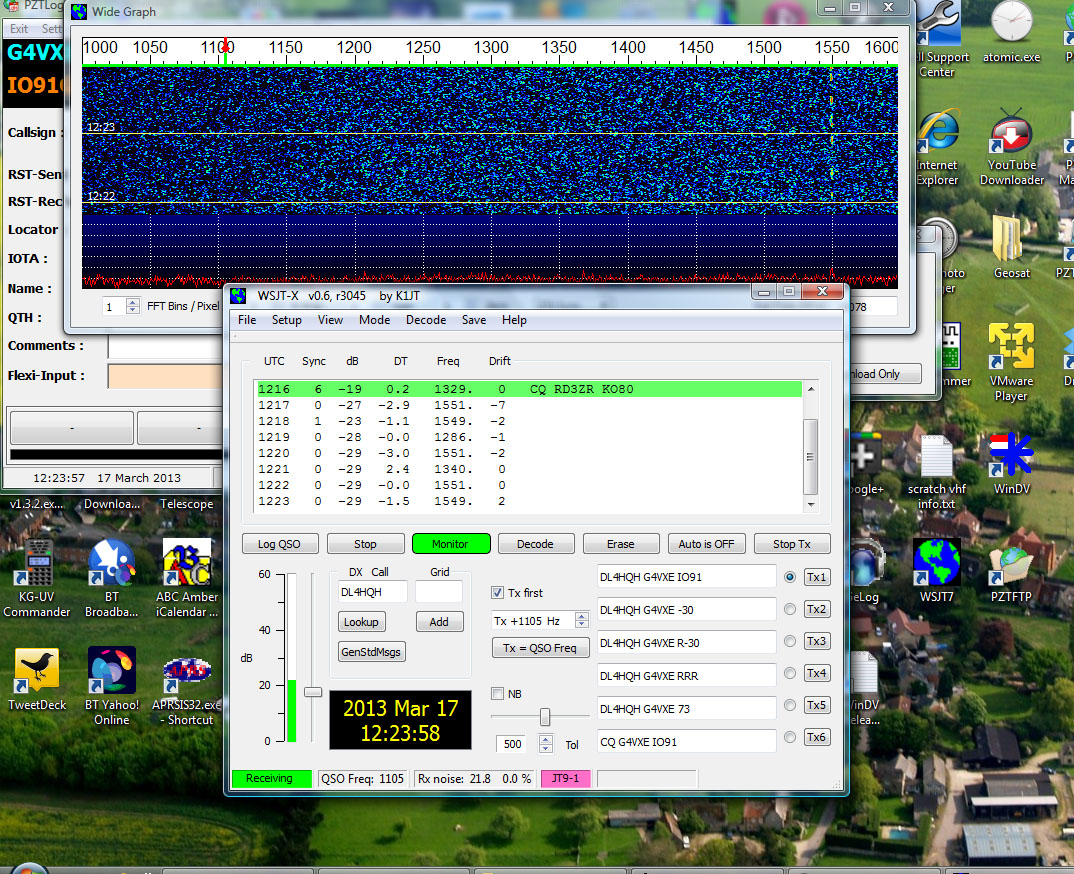
New versions of the software have come out and seeing Julian G4ILO’s post at RTTY and JT9 earlier this week, I thought it would be fun to try it again. Although this morning, I have tried two different rigs and two different interfaces, no one has yet decoded me! Of course, that could be sheer bad luck – but no decodes on PSK Reporter either.
I’ve tried reducing the audio output as much as I could in case there was anything causing an issue.No! Bear in mind that I can use exactly the same setup on JT65A and pretty much any other data mode that you care to shake a stick at. It’s all rather puzzling.
The next experiment will, I think, be to try a different USB soundcard and see if that makes a difference.
It’d be great to get it going, as it looks an interesting and a useful mode.
Tim Kirby, G4VXE, is a regular contributor to AmateurRadio.com and writes from Oxfordshire, England. Contact him at [email protected].
Decent DX Day
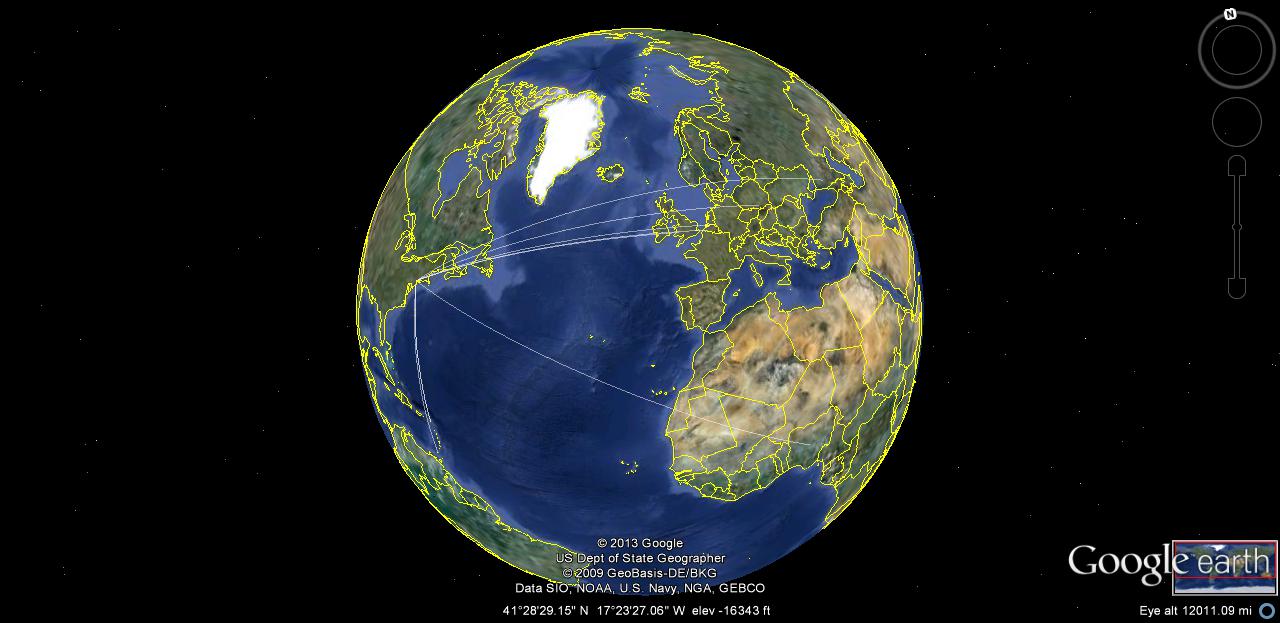
I was piddling around on the bands today. Since there were a lot of contests going on, and I did not feel like participating, I exiled myself to the WARC bands – 30, 17 and 12 Meters.
There was enough DX to be had and I worked just about all of it QRP.
On 12 Meters, I worked Andy SP9KR. There was a lot of QSB there, and I’m not 1000% that he got my call right. So at the very end, when I sent my call sign for the very last time, I bumped up my power to 55 Watts (for insurance) but I’m not sure that even then that I was heard correctly.
On 17 Meters I worked Serge R7AY in Russia. After our QSO and I got Serge’s info in my log, I heard him continue to call CQ. So I spotted him on the TelNet Cluster. Almost immediately, as he was working other stations I heard him send “W2LJ TNX SPOT”. I guess he had his computer on! I thought that was so cool. You’re very welcome Serge, I hope it brought you lots of DX!
I also worked OT4A in Belgium and GW100C in Wales. Of course the GW100C call stuck out like a sore thumb. After working him, I looked up the call on QRZ and it turns out that GW100C is one of several UK HQ team members of the RSGB. These calls, GW100C, GM100C, GD100C, G100C, GJ100C are meant to be used by the HQ members so that they get practice in learning how to handle pileups for when they are taking their turns as G100RSGB, GW100RSGB, GM100RSGB, etc – the RSGB Centennial Stations.
On 30 Meters, I was able to work PJ7/N0TG and PJ7AA, both on Sint Maarten. J34G in Grenada who has excellent ears – and as it turns out, an FOC member, so no surprise there.
The last station that I worked for the day was Ivin 5N7M in Nigeria. I ended up having to bump up the power to 85 Watts to work Ivin. I was getting nowhere with 5 Watts and it actually took a fair amount of doing to get noticed at 85 Watts. The pile up wasn’t fierce, so I have no idea what the problem was, although for this QSO, the EDZ ended up being the antenna that worked. I have worked Nigeria before with QRP power, but not on 30 Meters. Nigeria was new for me on that band.
Geez, it almost sounds like I’m starting to pay attention to 5BDXCC matters!
72 de Larry W2LJ
QRP – When you care to send the very least!
Larry Makoski, W2LJ, is a regular contributor to AmateurRadio.com and writes from New Jersey, USA. Contact him at [email protected].
 Ham Radio Deluxe |
 W5SWL Electronics |
 Ham Radio Prep |
 KB3IFH QSL Cards  Hip Ham Shirts  HamRadioAuctions HamRadioAuctions Reliance Antennas Reliance Antennas Enigma Shop Enigma Shop |  morseDX  Ni4L Antennas  R&L Electronics R&L Electronics antennas.us antennas.us QRV QRV |
- Matt W1MST, Managing Editor
