 |
 LHS Episode #104: Propagation 101 with G0KYA
 25 April 2013 | by
  We sometimes on this show attempt to bring you interesting interviews with people who are both computer literate and ham radio literate at the same time. In this case, we bring a scholar, physics buff, aerospace engineer and brilliant guy, Steve Nichols (G0KYA), to discuss the science of radio wave propagation. No need to turn the show off before it even begins. Steve makes understanding the Earth’s atmosphere, its magnetic field, and a ton of stuff about the sun simple and approachable. No mind-bending equations, no physics lectures, just some great information for anyone interested in learning how a radio signal gets from here to there. A bunch of follow-up information in the form of books and Web sites are provided as well, links to which will be in the show notes, for anyone who wants to further their education. Thank you as always to our loyal listeners. Make sure to tell a friend next time you’re out for a cold one. The more the merrier.
73 de The LHS Guys
Russ Woodman, K5TUX, co-hosts the Linux in the Ham Shack podcast which is available for download in both MP3 and OGG audio format. Contact him at [email protected].
Have you ever been listening to something that may not be there???

Mike Weir, VE9KK, is a regular contributor to AmateurRadio.com and writes from New Brunswick, Canada. Contact him at [email protected].
A few things
Two things pointed out to me by Bob W3BBO, who directed me to the “ARRL Contest Update” e-mail, which I had just kind of glossed over without reading properly:

Larry Makoski, W2LJ, is a regular contributor to AmateurRadio.com and writes from New Jersey, USA. Contact him at [email protected].
Handiham World for 24 April 2013
Pat Tice, WA0TDA, is the manager of HANDI-HAM and a regular contributor to AmateurRadio.com. Contact him at [email protected].
Multi-Band 4 Foot Magnetic Loop with Gamma Match

4 Foot Diameter Magnetic Loop In Operation
As my mag loop projects progress, I’m learning a lot about building them and using them. This antenna works on 17, 20, and 30 meters, with the best bandwidth on 20 meters. The bandwidth on 17 and 30 is quite small but usable. There is a 20 KHz bandwidth on 20 meters. I used a vacuum capacitor to build this particular loop for 100 watt operation. The air capacitors are good for QRP but will arc over using much power over QRP levels.

4 Foot Magnetic Loop Antenna with Gamma Match
This photo was taken before I trimmed the Gamma Match.
I didn’t know how long the Gamma Match should be, so I made it long enough to allow for trimming after the match to 50 Ohms was made.
This is the first mag loop that I made with a Gamma match. I like this match better than the usual Faraday feed loop that is featured in my previous mag loop antennas. Matching is easy and building the Gamma match is not difficult. I’m planning to build other smaller loops that will also feature the Gamma match. The smaller loops will target 10, 12, and 15 meters. Loop size determines which band its best suited too. Although it is possible to get more bands on one loop, the bandwidth is small and the tuning ‘dip’ is very sharp. I found it better to limit the number of bands in favor of wider bandwidth and antenna efficiency.
Please look up my previous posts for more details on parts and plans.

Here is a good close up of the clamp.
(Before Trimming)
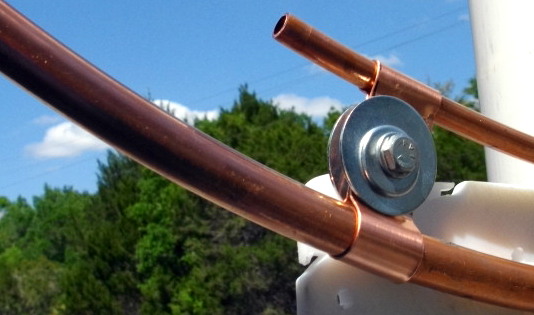
Gamma Match After Trimming. This enables a 50 Ohm Match for all three bands.

Gamma Match on the left, PL 259 in the center and, Tuning Aid Stick (PVC) pipe , on the right.
The vacuum capacitor is ‘tuned’ by twisting the PVC pipe that is attacked to it with a cotter pin.
Tuning the cap to the ‘loudest noise’ on the air will put you in the ball park for operating.
You can also use an antenna analyzer if you want to know the exact SWR, and RR of the antenna.
Tuning with a radio attached is fast and easy.

Making the clamp for the Gamma Match

Soldering The Back Plate and PL 259

Removing The Oxidation Before Soldering
The main loop is 5/8 inch, soft copper tubing.

Close Up of PL 259 to Gamma Match Joint
The center of the PL 259 had a #10 solid copper wire inserted and soldered in place.
The Gamma match is 3/8 inch soft copper tubing.
This part of the job was done with a soldering iron, the rest was done with a plumbers torch.

Handy ‘third hand’. A clamp to hold the Gamma match in place while I soldered it.
My town was going to hire a ‘Mad Scientist’ but it couldn’t afford one, so they settled for a ham radio operator instead. Me!
73 de AA1IK
Ernest Gregoire
Ernest Gregoire, AA1IK, is a regular contributor to AmateurRadio.com and writes from Florida, USA. Contact him at [email protected].
Special events
HF propagation conditions have not been great today. There was not much happening on 15m at all.
Julian Moss, G4ILO, is a regular contributor to AmateurRadio.com and writes from Cumbria, England. Contact him at [email protected].
Winlink using Robust Packet
Helge DF8LS has just published a web page showing how to send and receive email on HF using Winlink and the SCS Tracker TNC. I just sent an email to myself (isn’t this one of the signs of madness?) and it was received, so the instructions are obviously good!
 |
| A Winlink session on HF |
Mention of Winlink seems to cause strong emotions in some quarters. Personally I think using ham radio to send and receive email is rather cool, even if it is too slow to use for today’s level of email use. It’s a pity more hams don’t activate their Winlink account, which is callsign @ winlink.org .
If you use APRS then you can also send and receive email by that means using a feature called APRSlink. The trouble is, I use it so infrequently that I forget the commands. It would be wise only to use it if the APRS channel is quiet like it is here.
Julian Moss, G4ILO, is a regular contributor to AmateurRadio.com and writes from Cumbria, England. Contact him at [email protected].
 Ham Radio Deluxe |
 W5SWL Electronics |
 Ham Radio Prep |
 KB3IFH QSL Cards  Hip Ham Shirts  HamRadioAuctions HamRadioAuctions Reliance Antennas Reliance Antennas Enigma Shop Enigma Shop |  morseDX  Ni4L Antennas  R&L Electronics R&L Electronics antennas.us antennas.us QRV QRV |
- Matt W1MST, Managing Editor
