 |
 SMD Project
 6 May 2013 | by
 When Steve, KD1JV, kitted another run of his MTR (Mountain Top Rig), I wanted one. It is however an SMD kit, but I thought why not take the plunge. However when the kit arrived with its cool looking case and I looked at the components I thought maybe I should have someone else build this kit. I didn't want to ruin such a cool radio with my learning mistakes. So I outsourced that one. However, I still wanted to learn SMD construction. Somehow I felt like a QRP wimp because I couldn't build SMD projects. So, what to do?
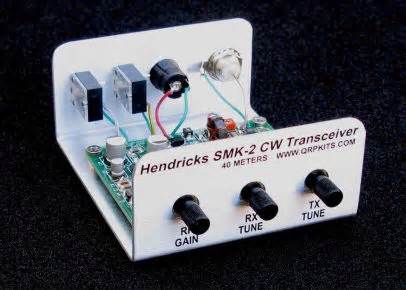
As I searched the QRP kit world, I found the perfect project. The SMK-2, a kit from Doug Hendricks, www.qrpkits.com, is a 300mw, 40m crystal controlled transceiver. It is specifically designed for SMD training. So I ordered the kit.

Mike Crownover, AD5A, is a regular contributor to AmateurRadio.com and writes from Texas, USA. Contact him at [email protected].
Alexloop on the deck calling CQ
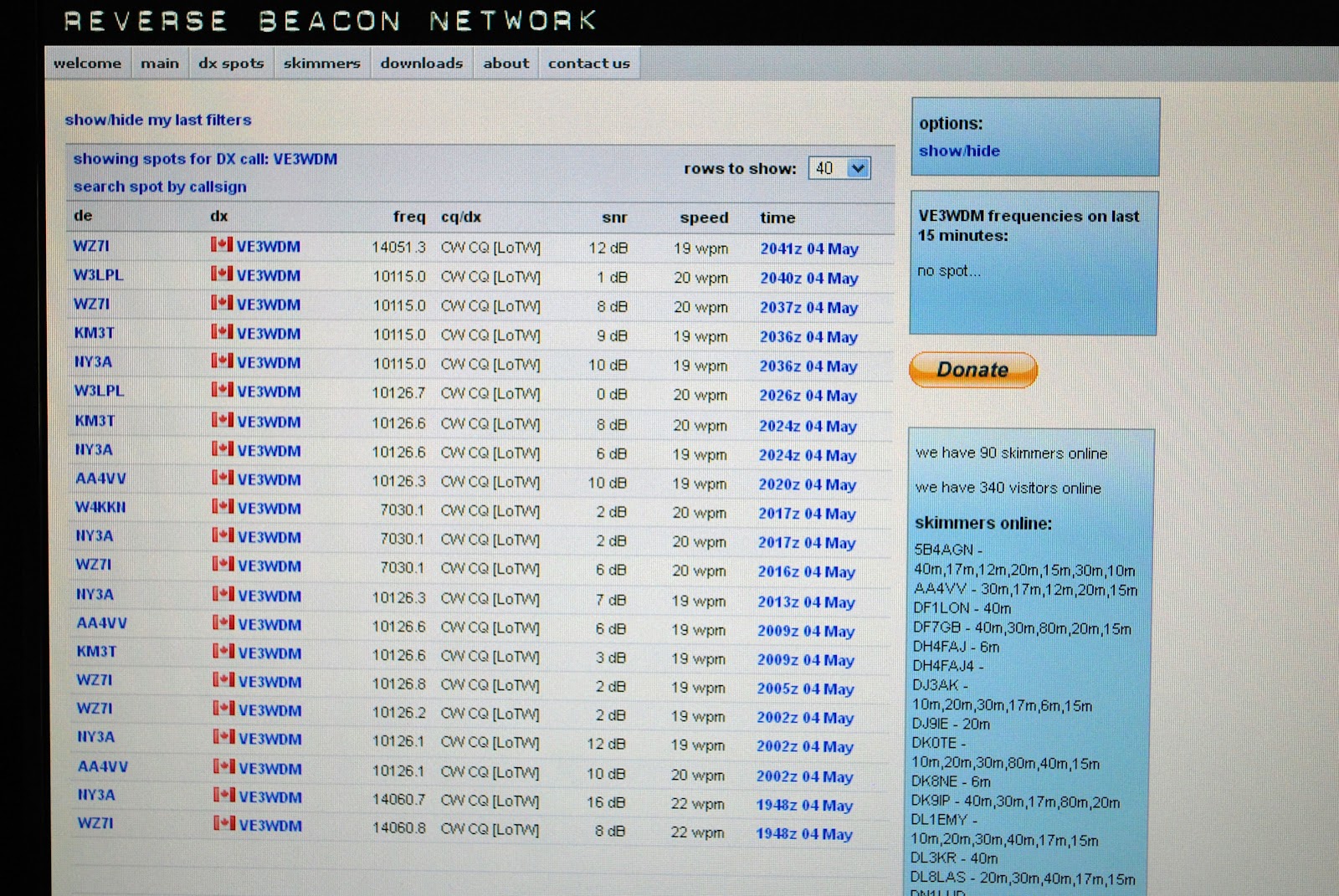 | |
| RBN spots (click to enlarge) |
Mike Weir, VE9KK, is a regular contributor to AmateurRadio.com and writes from New Brunswick, Canada. Contact him at [email protected].
ICQ Podcast S06 E09 – International Amateur / Ham Radio Beacon Project (5 May 2013)
Series Six Episode Nine of the ICQ Podcast has been released. News Stories include :-
- The P5 Project
- RILGES East Sussex Repeater Group
- New Amateur Radio Club for Bath
- New QRSS/WSPR ham radio kit
- Free WARD certificate
- South African Hams to get 472 kHz license
- ZB2TEN beacon is now fully operational
- Ham Radio 50 MHz operation in New Zealand
- MB7IDA - Danbury Echolink frequency change
- Taxi drivers fined for using GPS Jammers
- Norfolk Island
- Isle of Skye activation
- Queen's Award for Wood & Douglas
Leslie Butterfields (G0CIB) joins us to discuss International Amateur / Ham Radio Beacon Project plus Austalian report from Ed Durrant (VK2JI) and our new north American correspondent Frank Howell (K4FMH)
Colin Butler, M6BOY, is the host of the ICQ Podcast, a weekly radio show about Amateur Radio. Contact him at [email protected].
ICQ Podcast S06 E09 – International Amateur / Ham Radio Beacon Project (5 May 2013)
Series Six Episode Nine of the ICQ Podcast has been released. News Stories include :-
- The P5 Project
- RILGES East Sussex Repeater Group
- New Amateur Radio Club for Bath
- New QRSS/WSPR ham radio kit
- Free WARD certificate
- South African Hams to get 472 kHz license
- ZB2TEN beacon is now fully operational
- Ham Radio 50 MHz operation in New Zealand
- MB7IDA - Danbury Echolink frequency change
- Taxi drivers fined for using GPS Jammers
- Norfolk Island
- Isle of Skye activation
- Queen's Award for Wood & Douglas
Leslie Butterfields (G0CIB) joins us to discuss International Amateur / Ham Radio Beacon Project plus Austalian report from Ed Durrant (VK2JI) and our new north American correspondent Frank Howell (K4FMH)
Colin Butler, M6BOY, is the host of the ICQ Podcast, a weekly radio show about Amateur Radio. Contact him at [email protected].
Series Six Episode Nine – International Amateur / Ham Radio Beacon Project
Series Six Episode Nine of the ICQ Amateur / Ham Radio Podcast has been released. The latest news, Leslie Butterfields (G0CIB) joins us to discuss International Amateur / Ham Radio Beacon Project plus Austalian report from Ed Durrant (VK2JI) and our new north American correspondent Frank Howell (K4FMH)

- The P5 Project
- RILGES East Sussex Repeater Group
- New Amateur Radio Club for Bath
- New QRSS/WSPR ham radio kit
- Free WARD certificate
- South African Hams to get 472 kHz license
- ZB2TEN beacon is now fully operational
- Ham Radio 50 MHz operation in New Zealand
- MB7IDA - Danbury Echolink frequency change
- Taxi drivers fined for using GPS Jammers
- Norfolk Island
- Isle of Skye activation
- Queen's Award for Wood & Douglas

Colin Butler, M6BOY, is the host of the ICQ Podcast, a weekly radio show about Amateur Radio. Contact him at [email protected].
Busy Day
Beautiful day again here in New Jersey – but extremely busy! Lots of chores, lots of running around and I didn’t get everything accomplished that I wanted to. But even at the end of a busy day, it’s nice to step back, take a breath and spend a few minutes engaged in “The World’s Greatest Hobby”.

This was nice as it ended up being an actual QSO. As it turns out, it ended up being a K3 to K3 QSO! I was at 5 Watts and Mario was at 100 Watts. We gave each other 579 reports. I was on the Butternut while Mario was on his Hy Gain vertical – so it was a K3/vertical to K3/vertical QSO. We exchanged weather information as a matter of course; and again, I was surprised that New Jersey was just a bit warmer than Pesaro. Of course, I’m the typical American who assumes it’s always warmer on the Mediterranean than it is here!
Larry Makoski, W2LJ, is a regular contributor to AmateurRadio.com and writes from New Jersey, USA. Contact him at [email protected].
QRP TTF 2013 Contest Point Giver Report!
Last weekend was a fun one for me. I had an open day following a morning commitment, and then I was free to operate in the QRP TTF event. I had originally planned to strike out to a nearby trailhead for the extra multiplier but a hastily planned meeting nixed that plan. So I operated from the park area by Lake Fredrica in our housing development. It is my favorite spot due to the nicely spaced tall pines and open area to a sandy beach on the lake. The lake is spring fed and one of the clearest natural lakes in the area despite being surrounded by civilization. It is also a nice quiet RF location free of most appliance generated noise that is so common these days.
Being a dedicated Contest Point Giver, I set out to give some points to the serious ops among us. What a treat to casually listen, and try to improve my cw copying speed by listening to all the exchanges going on during events like this one. I love the fact that the SOTA gang was included and there were a few Florida QSO Party ops on 20m where I spend most of my time. It was also Polar Bear QRP monthly outing time and I got to Grrrrrr to several of my fellow Polar Bear ops. Thanks and an extra long Grrrr to Larry W2LJ, Perry N5PJ, Barry N1EU, and John N0EVH and hope I did not miss any other PB’s.

My view of the lake K4UPG
In the end, I had a fun day. Seems the bands were not solid, but I’ve gotten used to that in this current solar cycle. I kept hearing the same stations over and over. Now and then a new call would appear but most of the time they disappeared before I could work them with my Sierra at 2.4 watts. Even with my jumper dipole up at 45 feet I suspect my signal isn’t always loud enough to attract much attention. So I search and pounce and enjoy reading the mail and waiting to pounce. I did collect 14 different states and give myself a bit of multiplier for that fortunate turn of events.
Nothing like spending time outdoors doing something that I love. I especially appreciate my fellow QRP ops and the fun we have making QSO’s with limited power and gear.
CU on the air!
72,
Kelly K4UPG
Kelly McClelland, K4UPG, is a regular contributor to AmateurRadio.com and writes from Florida, USA. Contact him at [email protected].
 Ham Radio Deluxe |
 W5SWL Electronics |
 Ham Radio Prep |
 KB3IFH QSL Cards  Hip Ham Shirts  HamRadioAuctions HamRadioAuctions Reliance Antennas Reliance Antennas Enigma Shop Enigma Shop |  morseDX  Ni4L Antennas  R&L Electronics R&L Electronics antennas.us antennas.us QRV QRV |
- Matt W1MST, Managing Editor
