 |
 Times R a changing
 3 June 2013 | by
 |
| Back to the K2 build |
Mike Weir, VE9KK, is a regular contributor to AmateurRadio.com and writes from New Brunswick, Canada. Contact him at [email protected].
The cost of equipment
The new edition of Radcom arrived a little while ago and I had a chance to have a read through it yesterday and there was a review for the new Kenwood super rig. It certainly looked an impressive site, but what struck me the most was not the features it had but the sheer cost of the thing. It tips the scales at over £6k. The cost of my last car!
Radcom also features a section every now and again about how they are trying to attract new members and potential people into ham radio. Can I give them a little hint, start working on cheaper rigs. The evidence was even strong as I went through the pages and it showed individuals, who know doubt deservedly, won trophies and prizes for all manner of things. There wasn’t a single one in the 16-24 bracket, in fact I’m pretty sure there wasn’t a soul under 45 in there.
Can I make a suggestion?
Can we please take a look at providing cheaper gear that doesn’t need building, say a £100 rig that will get people on air. If we can produce a funcube dongle for a little more than that which seems like an amazing piece of kit, why can’t we produce a rig that is universal, cheap, useful and worth having rather than producing for the wealthy ‘person of a certain age’. That way we may be able to see talent in the younger age bracket collecting trophies.
If you’re looking for a volunteer to project manage it then just ask. If you’re looking for a technical whizzkid then you’d better look elsewhere 
Alex Hill, G7KSE, is a regular contributor to AmateurRadio.com and writes from Cumbria, UK. Contact him at [email protected].
The Cyclone
no ……. not the roller coaster at Coney Island – but a new kit from the Four States QRP Group, designed by Dave Cripes NM0S.

“The Four State QRP Group is pleased to announce the availability of the Cyclone 40 Transceiver.
This innovative and simple transceiver by NMØS is an enhanced version of Dave’s QRP ARCI’s 72 Part Challenge Design Contest entry in 2010. This is a complete kit, including the enclosure. The price is a buck a part plus shipping, $104 total, for domestic sales. Purchasing info and more details are on the kit’s home page here http://www.4sqrp.com/cyclone.php Here are some of the design features:
. All through hole parts and easy assembly. NO SMD parts
. Less than 100 components
. Superhet receiver with very good sensitivity and selectivity
. “Perfect” QSK very high speed and absolutely seamless operation.
. VFO tunes the entire 125 kHZ CW segment of the 40M band at a comfortable
tuning rate.
. Transmitter output is nominally 4W. Those built so far are running ~ 4.6W
. Frequency readout is included so you know where you are at all times.
. A very attractive PCB enclosure is included, asy to assemble, looks great.
. All parts are included, jacks, knobs, enclosure, transformers, everything.
This is a complete kit, including a black enclosure with white silkscreened
labels.
We hope you enjoy this high performance transceiver.”
Looks like the Four States Group have come up with another winner. And at the rate these guys are coming out with kits, we’re going to have to change that famous advertising slogan to: “Like a good neighbor …. Four States is there!”
On a side note, this weekend turned out to be even busier than I had first imagined. Other than my accomplishments of Friday evening, and an 8 minute QSO with Bob W3BBO on 40 Meters on Saturday afternoon to give a listen to his new HF2V antenna, I was not able to squeeze in any on air time at all. And that QSO with Bob was a bit disappointing as QSB was so deep that it made our QSO more of an adventure than either of us would have liked. Of course, now that I do have time this Sunday evening, we have thunderstorms off the horizon. So for safety’s sake, instead of getting on the air, I have disconnected the antennas. The past four days have seen 90F (32C) plus temperatures, for the first real bonafide heatwave of 2013. According to the weather folks, the coming storms will break the heatwave, but will also have the potential for a lot of lightning, heavy downpours and gusty winds.
Ahh summer, you gotta love it!
72 de Larry W2LJ
QRP – When you care to send the very least!
Larry Makoski, W2LJ, is a regular contributor to AmateurRadio.com and writes from New Jersey, USA. Contact him at [email protected].
Some more satellite experiments – and a good 70MHz day
I wanted to try out the SSB satellites today and was pleased to listen to a couple of passes of FO-29. Signals were good and there was a surprising amount of activity. With the FT817 not being full duplex, working out the Doppler is a bit interesting, but Pete 2E0SQL has given me some useful info – so I will have another try soon and see how it goes.
Another QSO on SO-50 today, none other than 2E0SQL, so I was delighted. We’re only about 12 miles apart, so it’s fun to make a contact the long way round.
A good Es day too. 50MHz has been going well off and on through the day but I felt like concentrating on 70MHz. I worked 2 Italian stations this morning and then this evening the band was open to the Czech Republic, Poland -with the best of signals from Denmark where I was pleased to make several contacts including Bo, OZ2M.
Tim Kirby, G4VXE, is a regular contributor to AmateurRadio.com and writes from Oxfordshire, England. Contact him at [email protected].
The advantage of the single-lever paddle
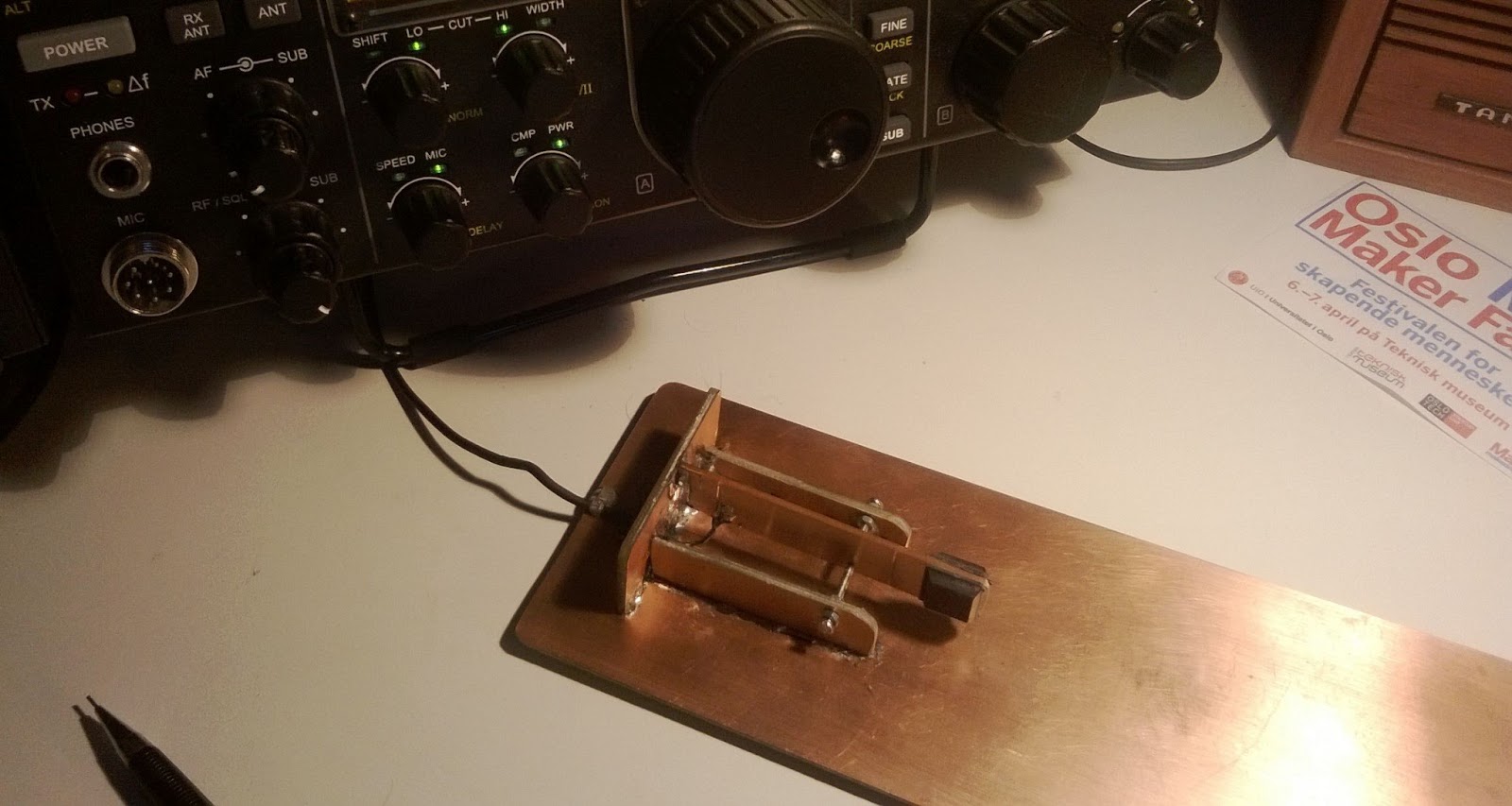 |
| My single-lever PCB keyer KI6SN/NB6M-style |
It may seem like a bad idea to downgrade from a dual-lever paddle and iambic keyer to a single-lever paddle. It must be inefficient since each individual dash and dot has to be generated by a right or left movement of the paddle. Despite this, many of the champions in the High Speed Telegraphy competitions use single-lever paddles, often home-made ones. How can that be?
K7QO, Chuck Adams, wrote “Using an Iambic Paddle” and compared the dual-lever paddle with the single-lever with respect to number of movements. If all 26 letters of the English alphabet and the numbers from 0 to 9 are sent, the single-lever paddle requires 73 strokes while a dual-lever and an iambic keyer requires 65. This is 11% less.
But when N1FN, Marshall G. Emm, wrote “Iambic Keying – Debunking the Myth” he analyzed the 7 letters that are faster to send with an iambic keyer – C, F, K, L, Y, Q, and R – and found that only one of them, the L, is among the 12 most frequent ones in English. He illustrated it this way:

Guess what’t wrong with this figure? He didn’t see the R and forgot that it is also among the most frequent letters!

So two of the faster letters are among the most frequent ones, not just one. I guess that N1FN’s estimate of only a 5% increase in efficiency when letter frequencies are taken into account is a bit too small then. In addition comes the fact that CQ, and all Q-codes use letters that are more efficient with the iambic keyer, so in radio amateur use the efficiency advantage of the iambic keyer is probably even more than 11%.
So this doesn’t explain the fact that many of the high speed champions do so well on single-lever paddles. My experience is based on learning to send Morse code at the age of 47. Somehow I feel that this was 20-30 years too late in order to master all the finer movements involved in iambic keying.
The issue must be tolerance to errors, not just efficiency. The high-speed champions value that and increasingly the producers of morse paddles are including single-lever paddles in their assortment.
A single-lever paddle is also easy to make yourself, much easier than a dual-lever paddle. I made one from printed circuit board based on the paddles of KI6SN. That design was a modified version of the miniature single-lever paddle of NB6M. I made it just to try the concept before I move on and eventually buy one. But the homemade one was surprisingly good to use, so I might stay with it for a while. The nice thing is that the single-lever couldn’t care less if your keyer is set up for iambic A og B. Neither if the keyer does the ultimatic mode which I promoted recently (Is the ultimatic Morse keyer really that efficient?)
There should be freedom in choice of paddle, so everyone should find what suits best regardless of what is the current fashion or what it is that is considered to be ‘best’. So whether you are a newcomer who struggle with learning to send properly with an iambic keyer, or an oldtimer who keep using the dual-lever as if it is a single-lever paddle, feel free to change to a single-lever paddle. I am sure you will notice a reduced error rate.
The question for me is what “real” single-lever key I should upgrade to, they all look attractive: Begali, Bencher, Bushwhacker, Hi-Mound, Kent, K8RA, N3ZN, Scheunemann, UR5CDX, Vibroplex, …
Sverre Holm, LA3ZA, is a regular contributor to AmateurRadio.com and writes from Norway. Contact him at [email protected].
ICQ Podcast S06 E11 – SlowScan TV (02 June 2013)
Series Six Episode Eleven of the ICQ Podcast has been released. News Stories include :-
- Fox-1 has a launch date!
- Israel on 5 MHz with 8 channels
- Ham Radio your free social network tool
- South African 5 MHz operation - interesting propagation paths
- ZS2X VHF beacon now covering most of South Africa
- Oklahoma storm - Radio Hams respond
- Radio News in Irish
- Combining Software Defined Radios and Smart Phones
Martin Butler (M1MRB & W9ICQ) reviews Slow Scan TV (SSTV) and a report from our north American correspondent Frank Howell (K4FMH).
Colin Butler, M6BOY, is the host of the ICQ Podcast, a weekly radio show about Amateur Radio. Contact him at [email protected].
ICQ Podcast S06 E11 – SlowScan TV (02 June 2013)
Series Six Episode Eleven of the ICQ Podcast has been released. News Stories include :-
- Fox-1 has a launch date!
- Israel on 5 MHz with 8 channels
- Ham Radio your free social network tool
- South African 5 MHz operation - interesting propagation paths
- ZS2X VHF beacon now covering most of South Africa
- Oklahoma storm - Radio Hams respond
- Radio News in Irish
- Combining Software Defined Radios and Smart Phones
Martin Butler (M1MRB & W9ICQ) reviews Slow Scan TV (SSTV) and a report from our north American correspondent Frank Howell (K4FMH).
Colin Butler, M6BOY, is the host of the ICQ Podcast, a weekly radio show about Amateur Radio. Contact him at [email protected].
 Ham Radio Deluxe |
 W5SWL Electronics |
 Ham Radio Prep |
 KB3IFH QSL Cards  Hip Ham Shirts  QRV QRV Reliance Antennas Reliance Antennas |  morseDX  Ni4L Antennas  R&L Electronics R&L Electronics antennas.us antennas.us |
- Matt W1MST, Managing Editor
