 |
 Sunny weather
 31 May 2013 | by
 I hope I don’t jinx it by writing this, but I think my weather station is now working. Everything is showing the values expected, including the rain which shows 0 mm as we haven’t had any. Trust the Cumbrian weather to not rain when you want it to.
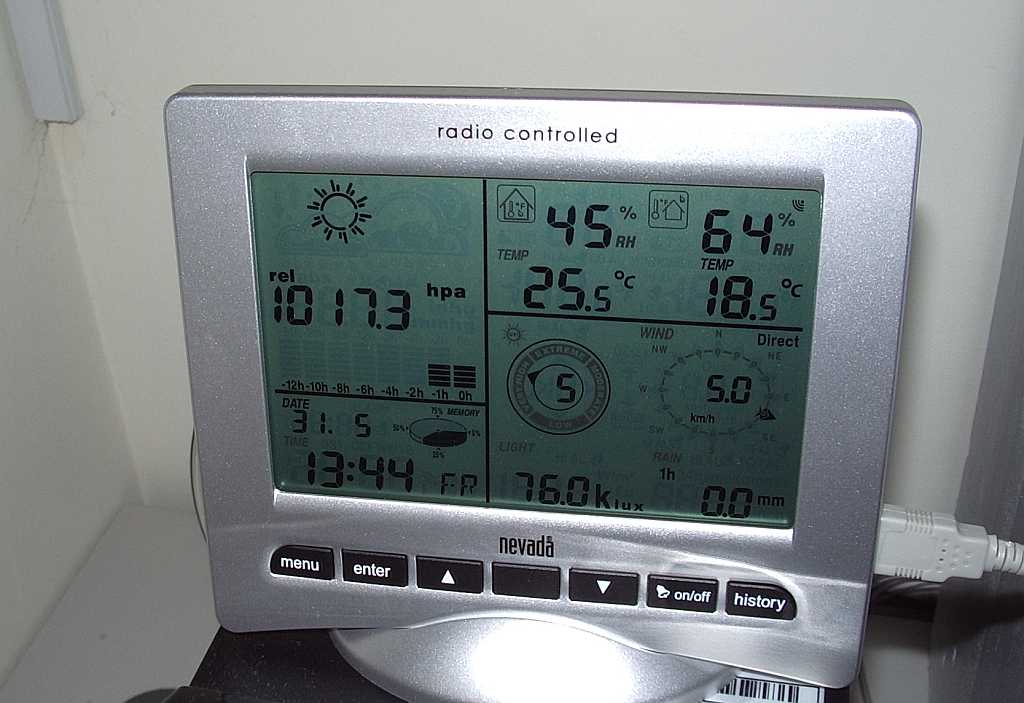
It was actually Olga who got everything working. I had lost patience with it and was all for sending it back. Olga patiently went through the manual (which she found was poorly written) and double-checked everything. She even used my test meter to check the voltage of the newly installed batteries. She found that the rechargeable alkaline batteries supplied for the sensor/transmitter unit were only giving 1.3V each. So she took them out and replaced them with some new Energizer alkaline cells. And everything including the rain sensor started working!
The manual says “Insert 2xAA 1.5V rechargeable batteries into the battery compartment of the remote sensor and immediately afterwards 3xAA alkaline batteries in the base station.” It didn’t say anything about charging them first. If I had provided my own rechargeable batteries I would obviously have charged them first. But as they came shrinkwrapped in the box I assumed they were ready to use. False assumption! It was as simple as that!
Julian Moss, G4ILO, is a regular contributor to AmateurRadio.com and writes from Cumbria, England. Contact him at [email protected].
Don’t play Ingress at Radio Observatories
A few weeks ago, the IPG got some curious email from some ABQ-ians asking if they could play Ingress at the VLA to capture some GPS-based portals. If you’ve never heard of Ingress, think of it as geocaching with a Virtual Reality spin. Check out their website here.
Ingress is played on smart devices, which require data connections to operate. These data connections are fine and dandy unless you’re at the world’s greatest radio observatory; here they aren’t so dandy.
RF-EMS
Below is a screencap of our RF-EMS (Radio Frequency-Environmental Monitoring System) which captured two WiFi access points (the darker blotches) from an RV containing a Verizon 4G hotspot and another router for something else.
 |
| Your VLA on WIFI |
In the last blog I described the 10′ dish for pinpointing RFI. We also have a (usually) 24/7 monitor that uses some pretty nifty antennas and preamps on a 50′ tower, sending it to an HP 70000 Spectrum Analyzer in a RF-shielded room from which we can record and upload plots like the one above, every day for the past 5+ years.
 |
| RF-EMS Tower and Bunker |
The biggest downfall is adequate locating of interfering transmitters. Currently, I’m designing a method which will allow the IPG to quickly and accurately pinpoint people with any kind of transmitter, be it a cell phone, hotspot, or vehicle keyfob (if we wanted to locate such things). My idea is based on multilateriation, which uses multiple receivers around the site which compare arrival times to calculate a four dimensional location. Keeping the bill of materials as low as possible, simplicity, ease-of-use and network integration (without causing RFI itself) a prime focus.
It may be overkill, but it gives me something to do in the free time.
Other Doin’s: Testing out and Debugging the 74 MHz System
When I’m not having free time, this is what I’m doing. A new feature of the Expanded-VLA is observations on the 4 meter band. The current system in place uses these simple crossed dipoles hoisted a few meters below the sub-reflector.
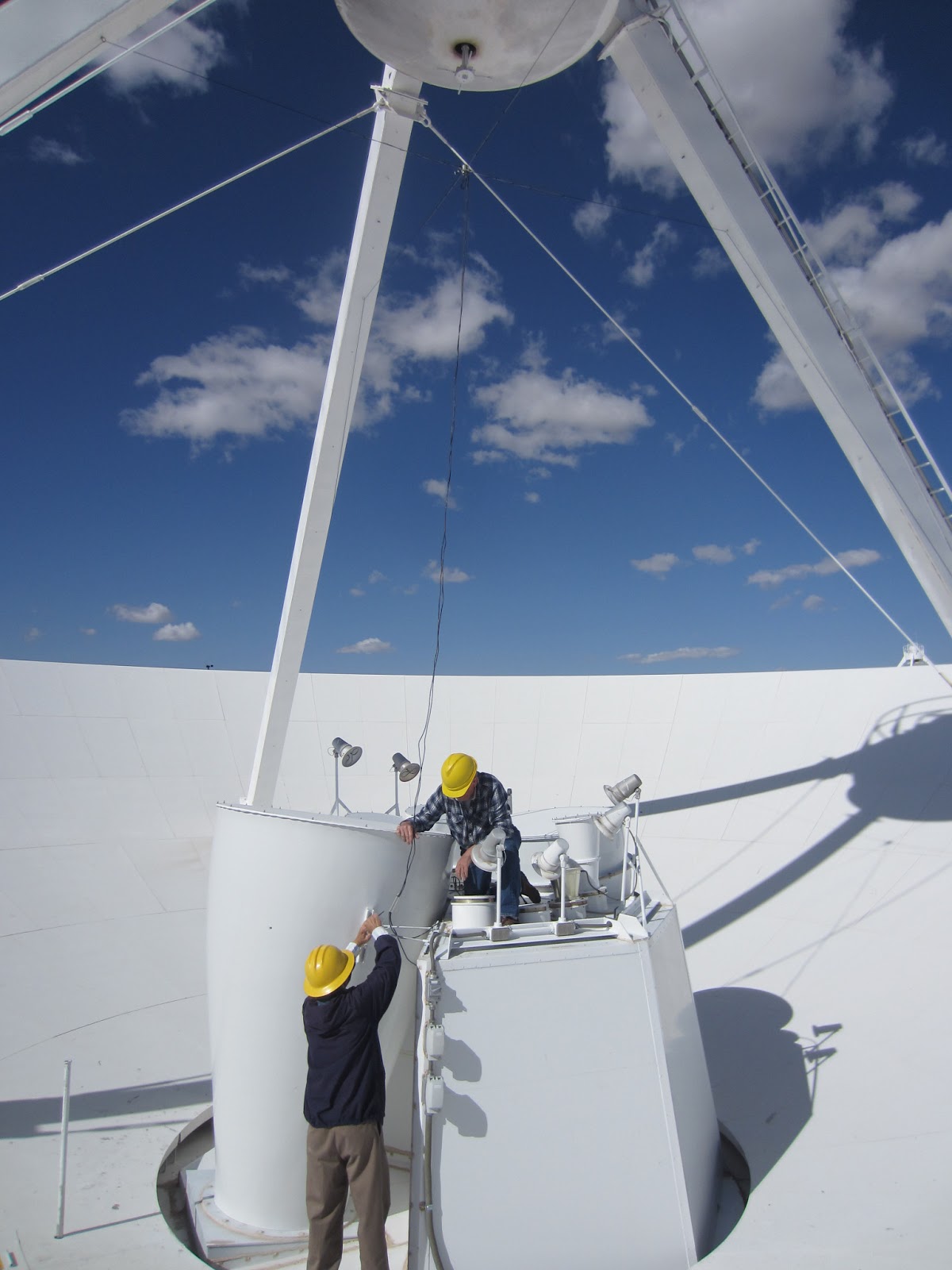
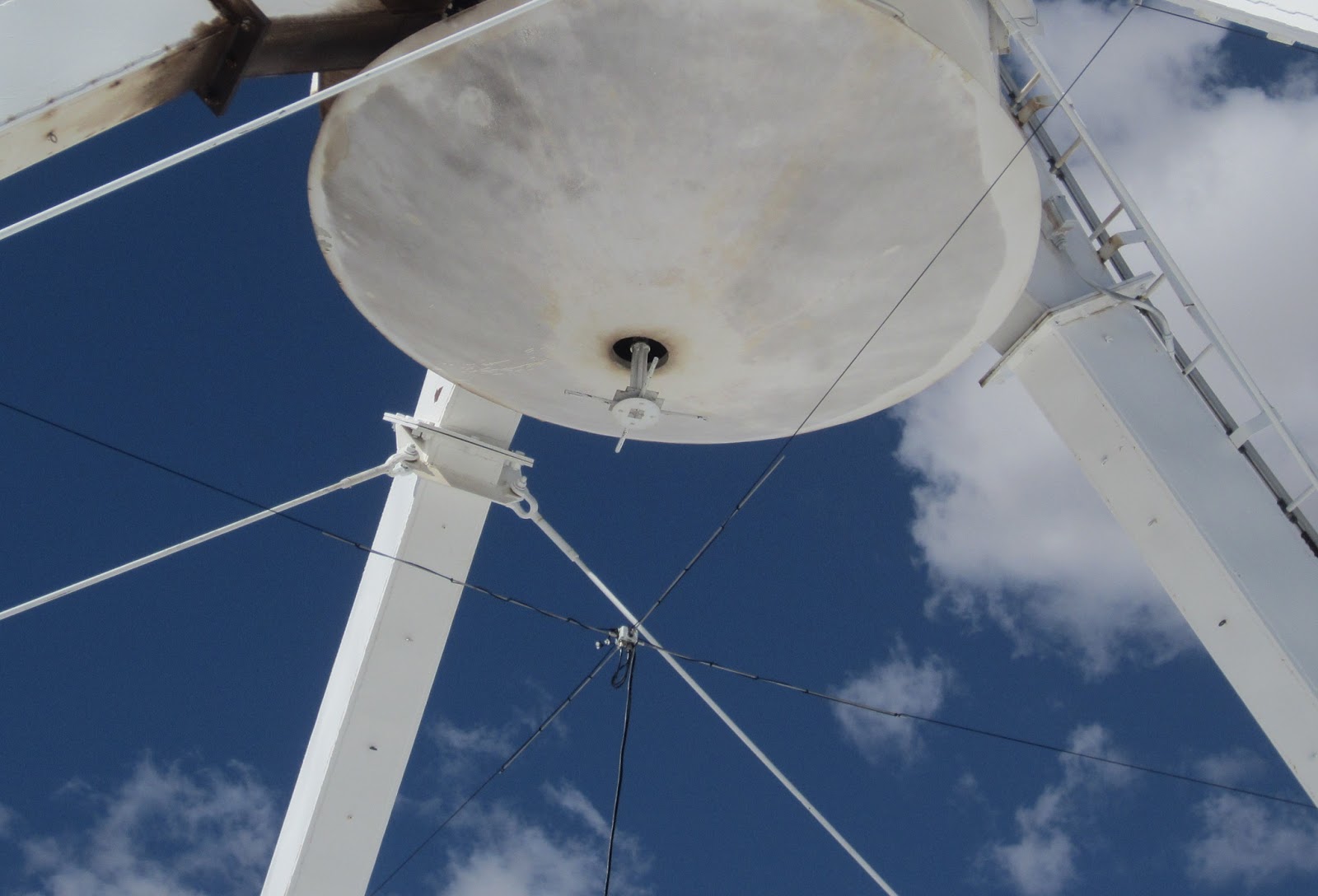
The cross dipoles connect to our receiver, which hooks up to the rack that magically digitizes the signal and turns it into pulses of light which the correlator feeds upon.
One of the problems we face are things broken that don’t have to do with our antennas and receivers. For example, the first test we do to examine the receivers performance is a band pass plot. Often times, we see something like this:
 |
| A bad bandpass plot caused by a faulty relay in the T301. |
This is ugly! What we want to see is this:
 |
| A beautiful bandpass! You can see 4 band on the left, and P-band in the middle with RFI spikes all over. |
First we go digging in the LO-IF and FE racks for a place to stick a spectrum analyzer to…
|
| Eric the BAMF next to the LOIF and FE rack. Our culprit is on the left, in the middle of the top rack of modules |

And from that we figure its’ this T301 which does the first IF up-conversion from 0-1GHz to 1-2GHz.
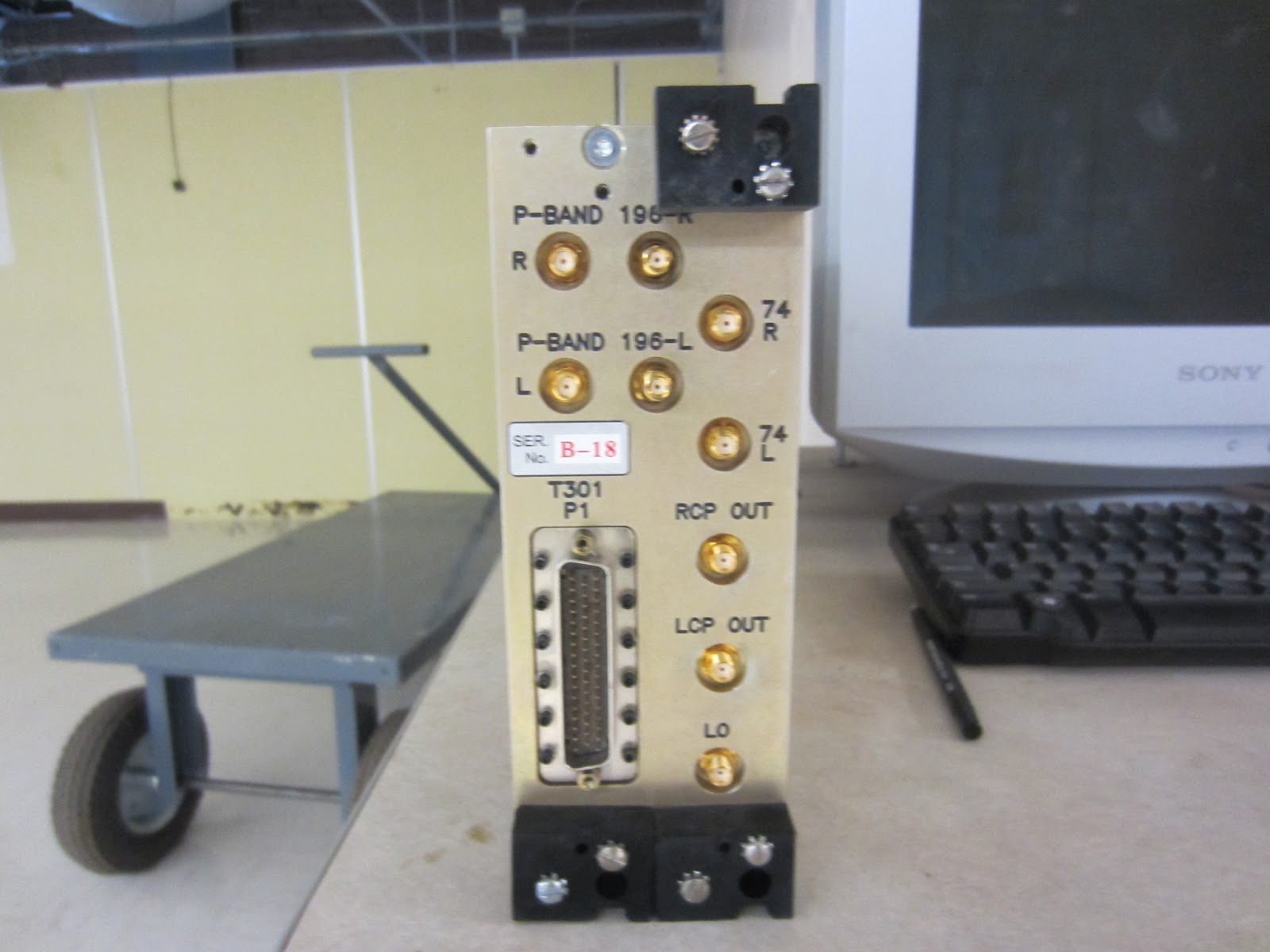
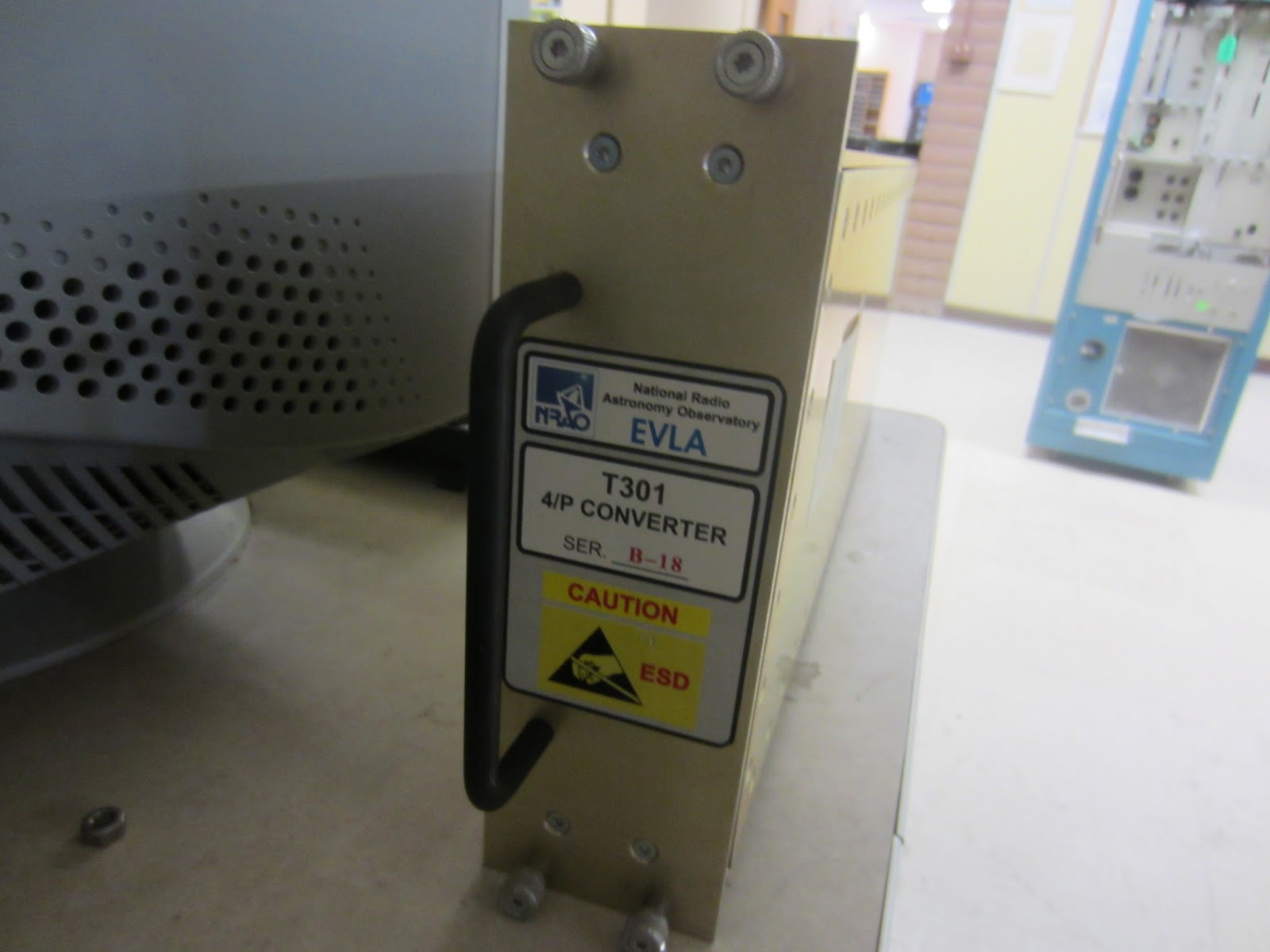
We get a new one, stick it in, turn it on and voila, it’s alive!
Sterling Coffey, NØSSC, is a regular contributor to AmateurRadio.com. He is ARRL Youth Editor and an electrical engineering student at Missouri S&T. Contact him at [email protected].
The Blue solution
 |
| My Blue solution |
Mike Weir, VE9KK, is a regular contributor to AmateurRadio.com and writes from New Brunswick, Canada. Contact him at [email protected].
Six Meter Summer

My Buddipole Antenna, Configured as a 2 Element Yagi for 6 Meters
The ribbons are to keep me from poking my eyes out on the end of the whips.
Here, I’m trying the antenna out in my driveway before I take it to the beach.

Kx3 QRP Radio
Six Meter Summer!
 This pavilion is my favorite operating spot at Hagen’s Cove.
It overlooks Dead Man’s Bay, on the Gulf of Mexico in Perry Florida.
I’m going to spend the summer playing around with my Kx3 on 6 meters. The antenna here is a Buddipole, configured as a 2 element Yagi. Its easy to assemble in the field, so I’ll take it to the beach (Hagen’s Cove) and try to make some contacts with it. I’ve been a ham for 22 years but have never done much with 6 meters. This will be a 6 meter summer for me. Join me, I’d love to have a ham radio buddy to share the adventure with.
de AA1IK, 73
Ernest Gregoire, AA1IK, is a regular contributor to AmateurRadio.com and writes from Florida, USA. Contact him at [email protected].
Reasons to be on 50MHz FM
Driving home this evening, I had the second VFO scanning through the 50 or so memories across 29/50/145 and 433MHz, with a few in between!
It doesn’t often stop on 51.51 the 50MHz FM calling frequency, but I heard a loud voice ask someone to move to 51.530. I stopped the scan and tuned there.
The station had an English accent, so I guessed it was a local or an expat. Of course, it turned out to be the latter; EA7/G0WHX. He was a great signal working a G4 I couldn’t hear. There was a little fading, but I listened to the QSO for around 15 minutes.
A great reminder to call on 51.510 a bit more often! You never know who’s listening!
Tim Kirby, G4VXE, is a regular contributor to AmateurRadio.com and writes from Oxfordshire, England. Contact him at [email protected].
Museum Ships Weekend 2013

http://www.nj2bb.org/museum/index.html
Beginning at 0000Z June 1 through 2359Z June 2, 2013 102 ships will be participating in the Museum Ships Weekend.
There will be Aircraft Carriers, Battleships, Cruisers, Destroyers, Submarines and more participating on most ham bands.
The details about the ships, frequencies, and certificate information has been listed on the Battleship New Jersey’s NJ2BB.org web site.
This looks like a lot of fun and a good opportunity to teach our kids and grandkids about our amazing maritime history!
Thanks to Ron, AA2RR, for reminding us of this fun weekend opportunity!
Matt Thomas, W1MST, is the managing editor of AmateurRadio.com. Contact him at [email protected].
Duff stuff
I don’t know why it is, but whenever I buy some piece of gear I always seem to end up with duff stuff. My weather station that I received a few days ago will not register any rain. A little voice says “why do you need a gadget to tell you if it’s raining in Cumbria?” but that’s not the point. I would really like it to work. I have sent an email to Nevada (the dealer not the US state) but have yet to receive a reply. Watch this space.
My UV-3R+ has also developed a fault, or at least its battery has. It started having a flat battery when I didn’t expect it, but irregularly enough for me to think that perhaps I forgot to switch it off. But now the battery won’t charge up. The charger works and I can measure a charging voltage on the battery pins but when I remove the battery from the charger the voltage across the two internal contacts is about 1.3V. I’ve ordered a replacement from 409Shop.
Julian Moss, G4ILO, is a regular contributor to AmateurRadio.com and writes from Cumbria, England. Contact him at [email protected].
 Ham Radio Deluxe |
 W5SWL Electronics |
 Ham Radio Prep |
 KB3IFH QSL Cards  Hip Ham Shirts  HamRadioAuctions HamRadioAuctions Reliance Antennas Reliance Antennas Enigma Shop Enigma Shop |  morseDX  Ni4L Antennas  R&L Electronics R&L Electronics antennas.us antennas.us QRV QRV |
- Matt W1MST, Managing Editor
