Archive for the ‘Uncategorized’ Category
 Broken duck
 April 7th, 2010 |
  Author:
 I went for another stroll up Tallentire Hill this afternoon with the TH-F7E. The FT-817 is tied up running my EchoLink hotspot until I can find something cheap I can dedicate to the task – I have my eye on a pair of PMR446 radios that are modifiable to 70cm.
I took along my DIY 2m rubber duck antenna and a “Black Rod” 2m 5/8 telescopic whip that I recently bought on eBay. In case you are wondering, I use an “HT Saver” SMA to BNC adapter to take the strain of the longer whip. But I am seriously considering using the TH-205E for such outings in future, if I can sort out a battery pack for it, because it has a proper BNC antenna socket and is much better suited to use with a large telescopic whip.
The 2m FM channels were not exactly buzzing with activity but I heard the GB3CS repeater 100 miles away and a GW station (Wales) in QSO. I tried swapping the two antennas for a comparison, but could hear nothing on the rubber duck at all. This surprised me, as the last time I did a comparison there was hardly any difference between it and a quarter wave telescopic, and I didn’t expect the 5/8 to make such a huge difference.
The TH-F7E is multimode on receive, so I took a listen on 2m SSB as well. I heard the GB3NGI Northern Ireland beacon much stronger than I can receive it from here. But I couldn’t hear GB3VHF from South East England at all. I haven’t heard it from home at all recently either, although it is supposed to be back on the air after a move to a new location. I guess the new location isn’t as favourable as the one it has operated from for longer than I have held a ham radio license. GB3VHF was the first amateur 2m signal I ever heard, after building my first 2m receiver, so hearing its call in Morse always causes some nostalgia.
I put out several CQ calls on 145.500 and was eventually called by Bill G3WJH in Seaton, only a few miles away by line of sight. I swapped the antennas again, and he couldn’t hear me at all on the duck. Colin, 2E0XSD then joined us, and then we were called by Richard G0IBE/P on Lord’s Seat (a SOTA and WOTA summit) so we all exchanged reports with him for chaser points. Jim G3ZPD from just south of Cockermouth then called in and worked Richard as well. By that time I was getting a bit chilly as it was a lot colder up there than it was at home, so I came back.
On my return I checked the DIY Duck on my antenna analyzer and found an infinite SWR. I pulled off the whip and the copper wire had fractured just about level with the top of the BNC adapter, which is probably the point that experiences the most bending. I guess 22SWG enamelled copper wire isn’t flexible enough to use for a helical antenna. Back to the drawing board.

Ham Radio Odyssey | XR0Y’s 21st Century Journal | Part Two
XR0Y – Rapa Nui Videoblog – part 2 from SQ8X on Vimeo.
Stan begins laying out the team’s goal and mission for Rapa Nui.
73 from the shack relaxation zone.

3830 Claimed Scores | 2010 SP DX | Low Power
Multi Single.
- YU1AAV | 156 CW | 211 SSB | 41 Mults | 10hrs | 45,141 Points [YU CC].
n = 1 score submitted in this category.
Single Operator 3 Band (SO3B) [Morse Code].
- N2WN | 35 Qs | 14 Mults | 1,470 Points [TCG].
n = 1 score submitted in this category.
SO3B [Mixed].
- OR2A (ON7YX) | 230 CW | 174 SSB | 47 Mults | 56,964 Points [RR DX].
n = 1 score submitted in this category.
Single Operator All Band [Morse Code].
- SN3C (SP3ASN) | 768 Qs | 119 Mults | 145,180 Points.
- SP3BJK | 662 Qs | 106 Mults | 92,856 Points.
n = 10 scores submitted in this category.
Contest on!

Ham Radio Odyssey | XR0Y’s 21st Century Journal | Part One
XR0Y – Rapa Nui 2009 Videoblog – part 1 [ENG] from SQ8X on Vimeo.
Unlike explorers of yesterday, Stan, SQ8X fully comprehends today’s paradigm. He has circumnavigated legacy media channels instead he delivers his narrative to a wide audience beyond that of ham radio. Fundamentally, he is shaping a future for those considering DXpeditions because SQ8X talks about his connecting experience with the local culture in addition to searching out its mysteries.
The Making Of Remarkable.
Ham radio is a subset of his personal experience, and, in broader terms, Stan creates a robust storyline that demonstrates in visual terms, the team connecting with the world using airwaves.
Stan mentioned an important piece in his previous video and it is why SQ8X stands out from the noise.
What Makes Extraordinary.
I paraphrase although I hope the point is understood when Stan mentioned in the previous video, “I did not tune into the station when listening with my Safari II receiver. I was interested instead in the odd tones, strange noises, and irregularities off of the zero beat frequency.”
Additionally, has one taken note of Stan rotating those things that are rotatable, in turn, mimicking the tuning knob of one’s radio? I was thoroughly impressed that SQ8X’s editing team created parallels between nature and technology. It is attention to creative detail mixed with imagination that makes Stan, SQ8X and his cinematographers, a cut above.
Conclusion.
I’m convinced that ham radio has received a gift in the person who is Stan, SQ8X. The kind of gift that only arrives once in a generation.
73 from the shack relaxation zone.

Ham Radio Odyssey | XR0Y The Journey Begins…
Unfolding Of An Odyssey?
A journey is an explanation of one’s imagination, perhaps Stan, SQ8X has embarked on something extraordinary that is more than a journey? His DXpedition to Rapa Nui with another planned in the distant future to a distant land is moreso reminiscent of an odyssey that is a long, eventful wandering.
Perhaps, it is not unlike Homer’s Illiad, a timeless mythological story where spirit and character is tested again, again?
Rapa Nui evoked powerful images from our distant past as well Jan Mayen a volcanic island located 950km west of Norway in the cold Atlantic tantalizes the adventuresome spirit that speaks too many of us.
His Odyssey Begins.
Take a moment, while reading the sub-titles, and imagine adventurers past and future who dared the odds. Stan’s story is compelling like many DXpeditions who risk much in the face of danger.
It is why, given SQ8X’s youth, that something extraordinary is underway, one that I believe, is an odyssey for ham radio.
Believe in your signal.

Tallentire Hill
By the time I had finished repairing the TH-205E the sky had cleared and the sun had come out so after tea I thought I should go for a bit of fresh air and exercise. Olga is still suffering from a chesty cough and didn’t want to come so I decided to drive over to Tallentire village and walk to the top of Tallentire Hill. A couple of weeks ago I had spent a couple of hours parked near the top making some contacts from my HF mobile station. But it isn’t possible to get right to the top by car unless you have a 4 wheel drive vehicle, because the track is rather stony. Even if you had a 4×4, there is nowhere to park off the road right at the top. The actual summit is in a small field and accessible through an unlocked gate from the track, but it is presumably private land so whilst walkers enjoying the view may be welcome, hams setting up a portable station would probably be accused of trespassing.
 But on a day like today it is worth going just for the view. The picture above shows the trigonometrical point (a reference point for measuring height used by the Ordnance Survey) looking south east towards the Skiddaw range. On the larger version (click on the small one to see it) you can see snow-covered mountains beyond Keswick in the background.
 The next picture shows the view south west and on the large version you can see some of the buildings of Cockermouth nestling in its valley. The big mountain on the left is Grasmoor with its steep drop towards Crummock Water. In the distance you can see the Buttermere fells.
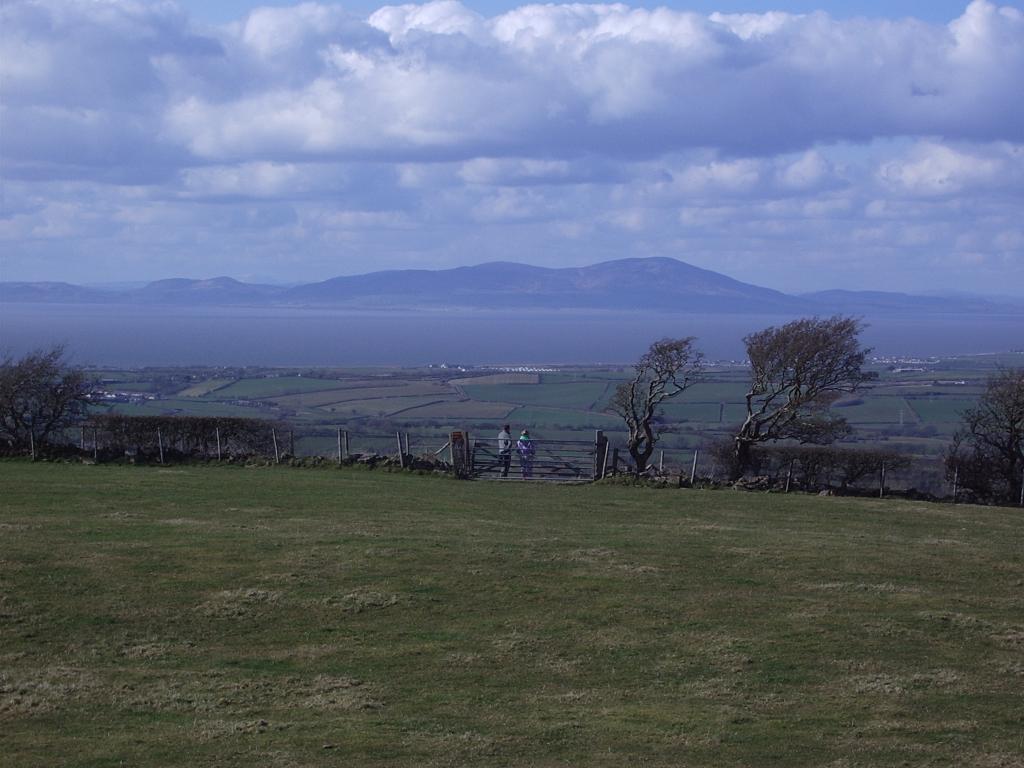 The last picture shows the view north across the Solway to Dumfries and Galloway in Scotland. I don’t know the names of the Scottish mountains.
I would love to own the field containing this summit so I could use it as a portable site whenever I wanted, even if it meant buying a 4×4 vehicle! With the take-offs shown in the pictures the site might be quite good for VHF, so I will have to take the MFD and the FT-817 up there one day when there is a 2m contest in progress.
Today I didn’t manage to raise anyone with the TH-F7E I took with me. But despite the sun it was pretty cold up there with a stiff breeze so after a few calls on 145.500 I headed back down again.

Kenwood de-gunked
It’s probably a character weakness, but I have always had a tendency to push my luck a bit too far and end up regretting it. That thought was in my mind when thinking about what to do with the Trio / Kenwood TH-205E that I got for a song on eBay. The rig worked well enough already to do what I thought I would do with it if it worked. But I was finding it hard to resist the temptation to see if I could restore it to full working order even though there was a risk that I might end up breaking it completely.
 In the end, the temptation to try to restore it won. The radio came apart quite easily – it is a big radio, and fairly easy to work on, though surprisingly for 1986 vintage equipment it uses a lot of SMT parts. The back half is a solid cast metal chassis containing the IF and RF boards, and the front half is plastic and contains the front panel with the control logic. The two halves are linked by two ribbon cables and one had been inserted a bit crooked, which led me to hope that repositioning it might solve the problem of the inoperable buttons, but that proved not to be the case, so the front panel board had to come out.
The front panel board is secured to the front panel itself with a large number of small self-tapping screws. Once they were removed and the wires to the speaker and mic unsoldered, the board came out to reveal the sight shown above. The front panel buttons were not sealed units but capacitive switches operated by contact with the rubber buttons, and they were covered by a sticky mess of gunk – presumably the same stuff I had found on the outside of the case which a couple of readers informed me was a cleaning agent used to spruce plastic items up prior to sale. This hadn’t just distributed itself over the switch area, it had even penetrated through some of the vias to reach the other side of the board. What a mess!
Olga found me a few small pieces of rag and I went to work with some white spirit from the garage. I eventually managed to clean most of it off. My fears about causing even worse damage were raised when the LCD display fell off. It didn’t seem to be attached to the board and had perhaps become stuck to it with some of the gunk. However when I reassembled the radio I just rested it in place while I fixed the PCB in place and it still worked.
There was no way I could test if the switch contacts were clean enough without reassembling so eventually I decided that it looked good enough and back it all went. I applied power with trepidation. The display lit up and I could hear hiss in the speaker. I then pressed the Offset button and was able to select repeater shift! The Scan function set the receiver scrolling slowly through the entire 2m band in 5KHz steps – very useful that! I was also able to program and recall frequencies in the three memories, although the memory buttons still need a bit of persistence to get them to work. It isn’t worth taking it all apart again just to try to improve that.
While I had the rig apart I took the opportunity to reset the power levels to give 5W on High power with a 13.8V supply and 0.5W on low power. Some previous owner had probably tweaked the power controls to give 7W out. No point in stressing the probably irreplaceable power transistor for a barely detectable 1dB or so of extra power. Then I put it all back together. Job done, and the TH-205E restored to full working order. I was feeling pretty chuffed.
As usual, there was no-one around on any of the simplex channels to do a test with but I was able to access the GB3DG repeater and even GB3LA on 145.7125 (a 12.5kHz channel) by tuning to 145.715.
I’m starting to feel a bit of affection for this big old radio now that I’ve made it as good as new. I’m thinking that it would be worth trying to resurrect the NiCad battery pack, which at the moment is showing a dead short. But there I’m really stumped, as I can’t see a way in. Clearly the plastic case is made in two halves, but sticking a screwdriver in the crack and twisting is just going to chew up the plastic. Anyone know if it’s possible?














