Archive for the ‘Uncategorized’ Category
 The most valuable ham homepage?
 August 6th, 2010 |
  Author:
 Dan, KB6NU, often claims that he has the #1 ham radio blog because it tops the Google search results for “ham radio blog”. Today he posted a review of the top ham radio blogs according to Google. I was disappointed to find that mine wasn’t even mentioned.
I ran the search myself and found that Dan’s blog came third, while G4ILO’s Shack came right after it. I guess Dan didn’t mention it because the result wasn’t a blog. Curiously, my actual blog doesn’t appear as a search result in its own right at all, at least I hadn’t seen it by the time I got bored paging through the results. Google moves in mysterious ways. I wish I understood it, especially as my entire living depends on the fact that I own a website that ranks #1 for several quite profitable key phrases. The fact that this is completely out of my control gives me sleepless nights sometimes.
While I was trying various searches to see if my blog appeared I stumbled across a site called Biznut, which values G4ILO’s Shack at £23,517.27 – considerably more than the value of the contents of my actual shack! I don’t know how Biznut comes to that conclusion, but if anyone wants to pay me that they are welcome to the site. I’ll even knock off the £17.27!

Riders On The Storm
Who rode the storm to destinations unknown? I was surprised when Cycle
24 decided to awaken its fury for benefit of some and the
consternation of a few. The coronal mass ejection was enough of a
sensation that it snatched a few brief minutes on the nightly news.
However, ham radio operators surfed some of the best VHF conditions
yet seen much like a powerful southern hemi arriving along the central
coast of California.
I called Fred, KI6QDH and he was stoked because 10m delivered point
break like surf with strong signals arriving from the midwest. VHFDX
was lit up east of the great propagation divide and why so? I wonder
what factors contribute to this difference between west and east coast
propagation? The ‘e’ MUF map intensified across the south while barely
a flicker was seen in the south west.
The storm raged above yet I could only look at the map while the magic
band went aggro for a day. It was one to remember for riders on the
storm.
73 from the anywhere, anytime shack.

Warbler now finished and working
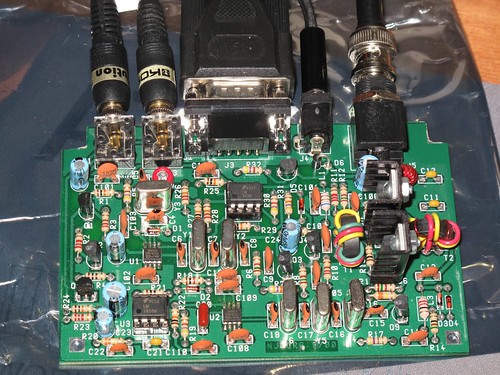
Warbler smoke test
I finally finished my Small Wonder Labs Warbler kit last night. This was started probably two years ago and then was shelved for no particular reason other than I was working on other projects. Last week I decided it was time to get it finished and so have been working on it in the evenings. It is a nice kit with a clever design based around colour burst crystals and the receiver is direct conversion. It was straight forward to build but note there are two SOIC components, the SA612 mixers (look for U1 and U2 in the photo above).
When it came to the smoke test it worked first time. I adjusted the one tuning capacitor (the only adjustment), for frequency alignment and checked power out. Alignment was done as recommended with W1AW which was coming in well (see the screenshot below). On transmit, I get 2W out on my Radio Shack power meter. It is expected that you can get 3 to 4W out of the Warbler. Given the accuracy of the meter I happy with what I measured.

Warbler working and decoding W1AW. Software is Fldigi running on Xubuntu
I have an aluminium enclosure, which is a tight fit for the board, so there is some careful drilling and filing to come. You can see in the photograph I have already cut out the corners to accommodate for the enclosure screw mounts.
Given the simplicity of the transceiver I am very pleased at how well it works. No contacts yet, so will have to see what the IMD is later. Anyone within 100 miles or so of Ottawa want to try a QSO?


New world record on 10GHz: 2696km
According to the ‘Hyperatlantica’ website a new world record has been set for a terrestrial contact on 10GHz.
On the 10th July, the team made a 10GHz QSO between the Cape Verde islands and Southern Portugal.
Take a look around the website – it’s not extensive, so if you understand a little French, you’ll be fine. If not, then Google Translate (http://translate.google.com) is your friend.
Well done Team Hyperatlantica!

2010 WRTC MP3s Are Hot
Thanks to Randy, K5ZD and his Internet team for providing the hottest
playlist in RadioSport. One receives the full range of excitement and
intensity as heard in the cans of WRTC competitors. Their rate is an
education for those who want to dare the challenge of the Box. I
downloaded the entire collection of recordings to begin the pump prior
to NAQP CW weekend.
I spent the greater portion of the weekend working my logbook and
updating my award endeavors. My inventory of traditional cards arrived
earlier in the week prompting several SASE envelopes to stateside
managers.
Six meters needs a flare because the magic band remained quiet through
the weekend. It makes the Q all that sweeter when all the elements
converge for a whole lot of ham radio fun.
73 from the anywhere, anytime shack.

Antennas, Tomatoes, and Neighbors
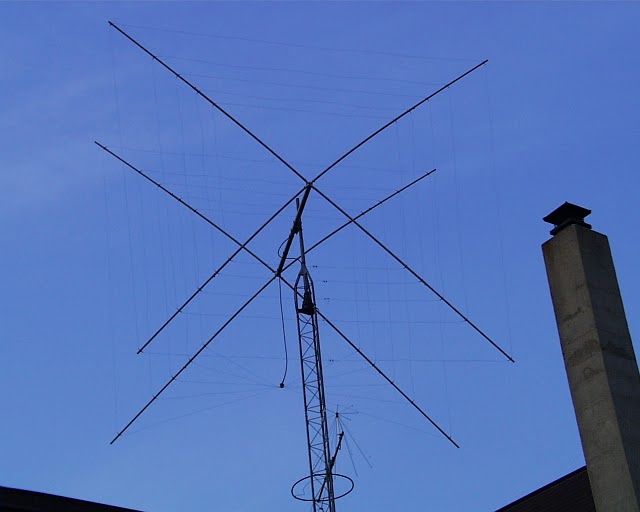
About six months later I had an antenna party and installed another ten foot of tower and a Lightning Bolt two element five band HF quad along with a Yaesu SDX-1000 rotator. The thing was a monster, a three-dimensional monstrosity measuring about 16' x 16' x 8' with a four inch diameter boom. Lightning Bolt, now a defunct company, must have been in a garage. The antenna went together well, but you could tell it was very homebrew. The element wire holders were made out of plastic brake line tubing and hose clamps. The balun was a PVC plumbing end cap with plastic poured in it. The boom end caps which held the fiberglass spreaders on to the boom were probably the most professional looking components as they were thick, welded aluminum.
I selected a quad at the time because I knew on this lot I wasn't going to be able to go much above 40'. I didn't have to get a building permit, but a township official told that the fall zone had to be within the property line, so I wasn't going to push the height issue. According my antenna modeling and articles I had read, the quad had a lower angle of radiation than a yagi at the same height. Today I know the difference is negligible but a quad requires much more maintenance than a yagi and it takes up too much vertical real estate, especially on a short tower like my 40 footer.
But the antenna was magical. Folks could have sworn my QRP signals, both phone and CW, were hundreds of watts. In contests I could really stack the multipliers on 20 meters. I got QRP DXCC in about two months after ARRL started the award. My best catch was Bhutan, netting a contact with the first call on CW running a barefoot 100 watts.
The first two weeks I had the antenna I would drive home from work and see the top of the quad peeking up out of the trees from a mile away. It made me somewhat sick seeing how big the antenna was behind my house, despite understanding its technical beauty as a radio artisan. People drove by and would rubber-neck looking at the huge antenna. I know some folks called the thing a big fly swatter. Eventually I got used to the appearance of it.
The neighbors on either side didn't seem to mind the antenna much. I was concerned about the ones behind us. It was their vacation home and they were usually there every other weekend. The antenna was almost right in the middle of their view of the lake. I would visit them maybe three or four times in the summer, bringing fresh vegetables from the garden. They were friendly couple, but I thought the antenna might change that.
The first weekend they were at their vacation home after the quad went up, I made a visit with some fresh tomatoes from the garden. We engaged in the normal conversational stuff: home projects, local news, and the weather. The man, in his mid 60s, brought up the topic of the antenna. Oh no, I thought, he's going to give me an earful about the quad.
"Does your new antenna do 40 meters?" he asked.
Slightly caught off guard I paused and said "Uh, no, it does 20, 17, 15, 12, and 10. Ummm, how do you know about 40 meters?"
"Oh, I got a novice license back when I was a teenager. I did it for a little while, but got into music and other things and let my license expire. Do people still do ham radio these days?" he inquired.
Needless to say I never had a problem with the neighbors :-)

For The Love Of Droid
I’m writing my post off my Droid keyboard this evening after
activating the mobile features at my blog. The new world of mobile
blogging has taken hold afterall the world is our shack. Mobile
wireless is the frontier of today and likely tomorrow as well.
There is much to explore with this device held in the palm of my hand.
It is the power to transform and communicate ideas from anywhere,
anytime that makes this technology so compelling.
I caught up with my bureau QSLing this morning and have a shipment
ready for the League later this week. Six meters west of the great
propagation divide was rather quiet through the day. I maybe a little
impatient at the moment.
This is a Droid test message from the anywhere, anytime shack. 73.
Has anyone noticed a lot of broken links after Newington rolled out
its new website? There are a lot of dead ends on the digital highway
leading to headquarters.














