Archive for the ‘Uncategorized’ Category
 APRSBB: APRS Client for Blackberry
 August 13th, 2010 |
  Author:
 I’m a big Blackberry fan and I was pretty excited to read G4ILO’s post a few days ago about APRSBB, a soon-to-be-released APRS client for Blackberry. I tracked down the developer, Chris Struttman KJ4HPQ of The Blue Array Network LLC, who agreed to be interviewed about what he’s been working on and what we can expect from the project:
Radio Three Four Papa
I downloaded the complete Radio Three Four Papa set at K5ZD’s website
as a learning tool. Athletes watch hours of video in order to gain an
understanding of their opponent’s skill and strategy. I lost a lot of
points last weekend when I failed to search for additional
multipliers. My Q count was sufficient however I did not log enough
mults when 15m opened to the east and midwest.
When do I shift from a calling CQ strategy to a search for multiplier strategy?
My NAQP rate was a thrill beyond 50 watts into a ground mounted
vertical. I blissfully called CQ while I heard in the corner of my
competitive mind, “Search for multipliers.”
I continued calling CQ instead of bagging a few 15m rhinos for the
long haul score. I’m listening intently to Radio Three Four Papa as
the team moves between CQ and hunting for multipliers. Rate is nearly
everything in RadioSport however an extra section or zone usually
decides a top ten finish.
73 from the anywhere, anytime shack.

Signal Corps Training film for the SCR-694
Sorry for the delay….. the hazy days of summer yield to a LOT of amateur radio and public service events!!!!
Today, we take a trip back in history to the American Signal Corps. Here is a series I recently stumbled upon with training for the SCR-694. Interesting radio (kinda like one of the early “go-boxes”. I am amazed when I see these or similar at hamfests and people just pass them by – they’re interesting. Maybe I love the history behind our beloved hobby to much…… so I couldn’t resist.
Logging assistant
When you are out in the field, especially on a windy hilltop, logging the contacts you make can be a bit difficult. One hand holding the radio or microphone leaves only one hand free to hold down the log book and write in it. If you’re using a hand-held and standing up to get the maximum height gain, it’s even more awkward.

A few weeks ago I hit on the idea of using a personal digital voice recorder. Initial researches suggested that they were a bit expensive – many models sell for around £70 or more. But diligent searching on eBay revealed that it was possible to buy them for much less than this.
The one I got is an Olympus VN-100 Digital Voice Recorder and cost £15.99 including free postage. It was described as “refurbished to new condition by Olympus.” This might be an indicator of a product that tends to fail and has a high number of warranty returns. However, this particular one was indistinguishable from new, works fine and is simple to use. It isn’t the colour I’d have picked if I had a choice, but price and functionality were the principal considerations.
I don’t know what the differences are between the VN-100 and the more expensive models apart from colour, probably storage capacity. However this model has capacity for more than 13 hours of recording – more than adequate for my purposes.
I find the VN-100 easy to operate with the hand that isn’t holding the radio. You just press one button to start recording and another to stop. A bar meter shows the level of the audio input. You can either say the callsign, time and whatever else you are interested in logging, or just point the device at the radio and make an off-air recording. At home it could be a handy shack tool for recording unusual DX contacts.
The only problem I found is that the voice recorder is just as sensitive to wind noise as the microphone in the radio. More than once I have returned home to find a recording was unintelligible. However, mishaps like this can probably be avoided with practise.
I’m finding my digital voice recorder to be an indispensable companion on portable outings. It’s also handy for jotting down ideas for blog posts that occur whilst you’re out and about!

August 2010 Prize Drawing
 We are very pleased to announce the winner of
1,000 full-color photo QSL cards
from KB3IFH QSL Cards!
Thanks to Randy at KB3IFH QSL Cards for sponsoring this month’s drawing.
We had over 750 entries!
We’re giving away another great prize in September.
Stay tuned and get ready to enter.
OK, on to what you’ve all been waiting for!
The winner of our August 2010 prize giveaway is…
An iPhone4, iBCNU and APRS
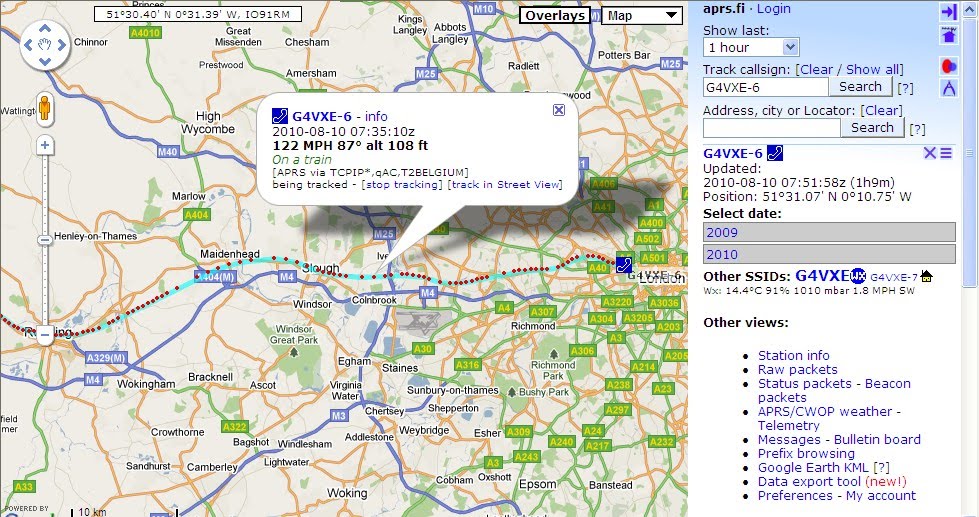
I picked up an iPhone4 when I got back from Madrid. I’ve been pleased with it. The much mentioned ‘antenna issue’ can be reproduced easily, but a case solves it easily and it doesn’t cause me any issues in day to day operation.
If you’ve been reading this blog for a while, you’ll have seen me mention iBCNU an APRS client for the iPhone. I hadn’t really tried it on the iPhone4 before today, other than swapping some quick messages at home.
The GPS in the iPhone4 seems to lock up on a position much quicker and I found that in conjunction with iBCNU it worked really well from the train in tracking my position and displaying the speed. Top speed on the way in this morning was 125MPH (200KPH), just to the east of Slough. You can see the track on http://aprs.fi – just search for G4VXE-6 – or I did a screengrab a bit earlier.

New digital mode for LF
A new narrow band digital mode optimized for MF and LF (160m and down) has just been released. Developed by Con, ZL2AFP the new mode is called CMSK.

CMSK uses Minimum Shift Keying (MSK). This is similar to Phase Shift Keying (PSK) but the frequency is shifted smoothly, achieving a 180 degree phase shift within one bit period, with the result that no amplitude variations occur, so the transmit amplifier need not be linear.
The mode has been designed specifically for use on the lower frequencies which provide good phase stability on received signals and low Doppler shift but can suffer from a high level of impulse interference. Four variants are available, ranging from CMSK8 which has a 12.5Hz bandwidth and supports a typing speed of 3.75wpm to CMSK125 which requires 200Hz and gives a typing speed of 60wpm. The default mode is CMSK63 which uses a 100Hz bandwidth and supports typing at up to 30wpm.
The software can be downloaded from Murray Greenman ZL1BPU’s website.














