Archive for the ‘Uncategorized’ Category
 Ham Forums Becoming Passé?
 August 31st, 2010 |
  Author:
GB7ML 2m D-STAR node: great coverage
I noticed a D-STAR buzz on 145.6375 the other day when I was testing an analog set and a quick ‘Google’ showed that the GB7ML 2m D-STAR node was now operational from Tring. The coverage map at ukrepeater.net looks really impressive and showed potential hand-held coverage around our village here.
Sure enough, when I took the IC-E92 along the footpath this morning, I could just about get into GB7ML!
This should prove a great D-STAR resource for increasing activity around the Home Counties and beyond.

Screenshots and copyright
Yesterday I received a comment in the site guestbook from Murray Greenman, ZL1BPU, which says: “While I appreciate your ad-hoc publicity for ZL2AFP CMSK, it would have been much better if you had asked permission to use my screen-shot on your blog site! While web pictures and text are widely plagiarized, that doesn’t make it right to do so. Copyright still applies and the image is still mine.” I have removed the image and inserted a comment directing the reader to this posting in its place.
Since I am on holiday at the moment and did not intend making any blog postings I will leave it to readers of the blog to lead the discussion on this issue. But I would just like to say that part of my career has been made publicizing software. I have always found software authors to be glad of the publicity and have never, until today, received a complaint about using their own images to this end. It is not always possible to take your own screenshots. In this case, I was unable to try the software on the air because of its insistence on using the default soundcard and I thought that it was more interesting to readers to see the live screenshot made by ZL1BPU than a blank one made by me.
As to the question of whether I should have asked permission first, I wonder if ZL1BPU understands what blogging is about? Part of the motivation for writing about some new development in a blog is to be one of the first, and if you have got to write an email asking permission and wait for a reply then it’s likely that others will pip you to the post. It’s not like writing an article, which may take several days to prepare and where time is not of the essence. Blogging is a bit like tweeting, but more verbose.
Finally I would argue that a screenshot is not an original work of art. I’m not depriving anyone of earned revenue by using it. Anyone can install the software and obtain one that is pretty similar. So why make an issue out of copying someone’s screenshot, particularly when the purpose of doing so is to give publicity to the software not to use it with any adverse intent?
I shall certainly think twice about giving publicity to any more new ham radio programs in my blog in future. Perhaps all of you bloggers who happily copy people’s QSL cards and shack photos to illustrate your stories about contacts should pause for thought as well. Ought this not to count as “reasonable use” – the clause in copyright laws that allows you to quote part of an article when referring to it?

Spiderbeam, USA
 Congratulations from the low power, low profile shack to Scott Robbins, W4PA who acquired SpiderBeam, USA according to a recent email from the company. Scott also owns Vibroplex as well. One might say there is something fascinating going on in Knoxville, Tennessee and a ham radio entrepreneur is leading the way.
I want to send all the best success to Scott, W4PA as he leads the way into ham radio’s future.
73 from the shack relaxation zone.

Broadcaster Praises Amateur Radio, Decries CB

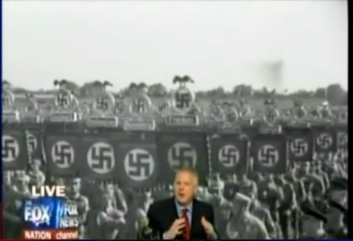
Beck went on to contrast CB radio with ham radio, calling CB a "failed big goverment experiment in socialism". President Carter, who raised taxes, gave away radio spectrum to all citizens, hence the name citizen's band. Hams on the other hand have to pay for their callsigns. Beck said the government should take the spectrum and auction it off to broadcasters in the free market, estimating that the frequencies could create as many as 2,000 new radio stations in the US (40 channels times 50 states), and the proceeds could support a tax cut which would reduce the deficit and big government. But this won't happen as it threatens liberal mainstream radio media, potentially increasing the number of conservative talk radio stations beyond its current 91% level. Beck ended the segment by calling CB "Communist Band" and pointing out that both "Carter" and "Communism" start with the letter C.
This is a parody. I only go to target practice once or twice before the big game hunting seasons start, everyday is a "freedom rally" here in the US, and I don't need to go to a seminar to understand the Constitution. Glenn Beck didn't say any of the above, though it's conceivable he would if he was involved in amateur radio. This is a hypothetical example of the fact-twisted, selective history supported, pseudo-intellectual punditry that is considered "edutainment" by some and unbiased news and information by others in the US . Unfortunately AM radio in the US is now dominated by this sort of programming, and it's become some of the most popular programming on TV. It's dividing our nation.
How about we restore honor to broadcasting?

Broadcaster Praises Amateur Radio, Decries CB

First Podcast – A conversation with Youkits
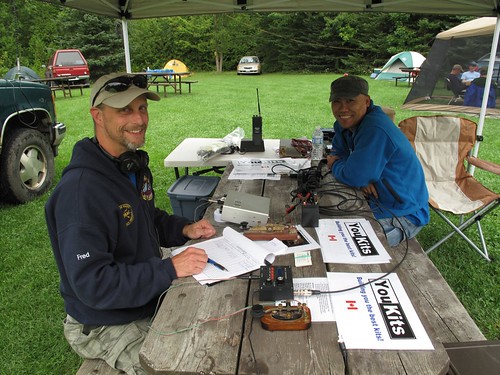
Fred and Yimin of Youkits
When I attended Maplecon I recorded at conversation I had with Yimin and Fred, VE3FAL, of Youkits. I have turned that recording into the first VA3STL podcast. I am making it only available here for the time being. If I make any more audio podcasts I will think about putting them on iTunes. Please click on the link that follows.
VA3STL Podcast#1 Conversation with Youkits
As the podcast is something new to me and an experiment, I would appreciate any feedback via a comment, or direct e-mail.
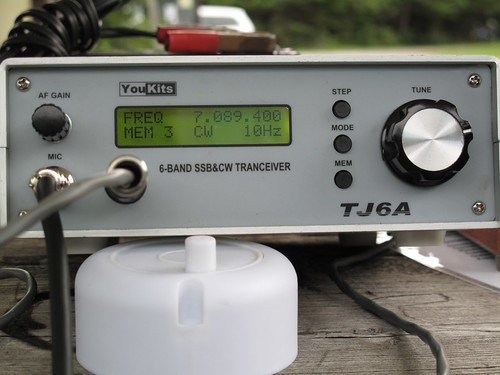
Youkits TJ6A transceiver
















