Archive for the ‘Uncategorized’ Category
 VHF/UHF QSOs of the week
 November 22nd, 2010 |
  Author:
 Continuing my idea of plotting up what I hear on VHF/UHF from the car, here’s the map from last week. Nice to get back on GB3FX (Farnham 50MHz) for a couple of QSOs with Roger, G4HZA who I used to work often in the mornings. I was also pleased to work M1ELK/M on Beacon Hill near Newbury on 145MHz simplex (those simplex contacts are gold-dust) and interested to hear a mobile on the hills near Bromsgrove in Worcestershire, which is a good haul from here
View Heard this week 19/11 in a larger map
Not shown on the map are D-STAR QSOs made from home, of course. But I had a particularly enjoyable QSO on Wednesday evening with Keith, WD8AFB in Orlando. I’ve spoken to Keith a couple of times before and we share an interest in low power HF portable operating which it’s always fun to talk about. Keith had just got an FT817 and was trying to find the optimum antenna to use from hotel rooms when he’s out on the road.

WOTA day
What a day it has been for activity in the Lake District fells! Although the day isn’t over the light is beginning to fade as I write this and I’m guessing there won’t be any more activations today. But a quick count of the spots on the Wainwrights On The Air website shows there have been a total of 22 different fells activated by 6 different people which is probably a Wainwrights record.

At times the spots were coming so thick and fast that there was a danger of missing someone because you spent too long calling another station. And the fell-top stations had a hard job finding a clear frequency. Many had to QSY two or three times from their original chosen frequency because they landed on top of someone else’s contact. Perhaps we need to consider moving to 70cm for WOTA?
I myself made 16 contacts and added 7 new summits to my chaser total. I wish I could have been out on the fells myself to gain a bit of elevation and work some of the more distant ones. But this has still been my most productive day of WOTA chasing. Thanks to Phil G4OBK, Geoff GM4WHA, Phil M0AYB, Richard G1JTD and Colin G4UXH for the contacts. Visit Phil G4OBK’s Wainwrights blog where he will no doubt be posting an account of today’s activity with pictures shortly.

A little RF goes a long way
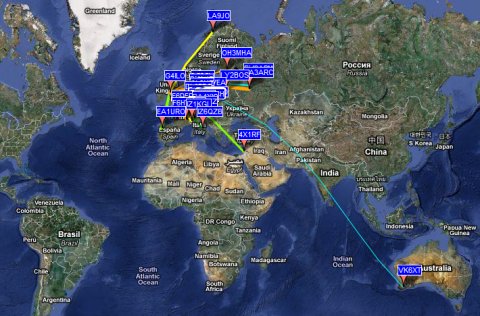
In this case, 5W of WSPR on 40m to a bent attic dipole. Not, perhaps, as impressive as M0XPD’s results with 50mW on 30m. But it’s still nice to be heard on the other side of the planet.

A weekend WSPR
I should share with you that after my blog post about the Marconi Memorial CW contest last weekend, I had an e-mail from a friend who will remain nameless, who said ‘Nice to see you doing some real radio for a change’. I replied that it was nice to keep the ‘Wireless Preservation Society’ in business…
So this weekend I thought it would be nice to play around with some digital modes on HF. I didn’t know, but apparently it was the WAE RTTY contest taking place. I tuned across the digi bands and there was RTTY everywhere. Somehow, I didn’t fancy doing that, though I decoded a few for fun, using MMTTY. I’d read some things about the PSK Reporter network in the week, so I thought it might be fun to play some PSK. I set up Digital Master (DM780)’s Superbrowser, so I could sit my receiver on 14.070 and the Superbrowser would decode the streams of all the different QSOs going on. Quite interesting – but didn’t grab me as far as transmitting was concerned!
I decided I was more interested in playing with WSPR again. I had the software on my laptop from the last time I used it at the end of last year. I quickly set it going on 7.038MHz (this was mid afternoon) and was soon logging other WSPR users across the country, across Europe and as far away as UA3ARC (KO85). I couldn’t get it to transmit though. When it was time to transmit, the speaker emitted a click and that was it.
I couldn’t understand what was up – and frankly gave up for a while and just ran it on receive, as that was interesting enough anyway. But of course, curiosity got the better of me (must be the cats’ influence) and I tinkered around a bit, without success. I googled around and found that someone had similar issues solved by a reinstall of WSPR.
I removed the program directory, deleted all the files and reinstalled WSPR 2.11. It worked! I could hear tones on transmit! No idea why this had happened, but glad to be QRV again.
By the time all this had happened, 7MHz was starting to be swamped by the WAE contest stations, so a mere watt or so of WSPR wasn’t going to go far was it? To my surprise, my 1W signal was heard by a number of German stations as well as in northern Italy. Later on, I set the transmitter going for a period or two and was heard in Serbia at around 2000km.
With the contest out the way, I might try and run the 1W WSPR signal in the evenings this week and see how I get on. It ought to go a reasonable way…

Still Fine Tuning…
My apologies for the hideously long load times for this blog. I’ve been informed that the number of RSS feeds on the right is making the page take a long time to load. I’ve been trying to build something similar to the blogroll you get at Blogger, but unfortunately WordPress.com doesn’t offer a blogroll widget that sorts by last post date and shows the title of the last post. It’s either a full blown RSS feed for each blog you want to keep up with or a list of static links. So, most of the RSS feeds are deactivated for now until I can figure out another solution.
I consider blogrolls an important part of amateur radio blogademia. If you have me in your blogroll, thank you. I hope to get your blog back in mine soon….
(If anyone reading this has better WordPress fu than me, please give me some pointers!)
73
Goody


Heard on VHF/UHF from the mobile this week
Last week’s map of what I’d heard from the mobile seemed to cause a little interest (thank you!), so I thought I’d keep a mental note of what I heard over the week and put a map together. It gives an idea of what conditions have been like, which I hope you find of interest
View Heard this week 12/11/10 in a larger map
A couple of ‘spots’ that I didn’t hear last week. GB3LW in Central London came through on 433.150 (same as GB3DI near Didcot) a couple of times, with good signals. GB3SN on 145.725 was weak but audible this morning and GB3WR was consistent through the week, but a little louder than usual this morning.
Something as yet unidentified is coming through weakly on 145.750. I will keep an eye on this one and see what it turns out to be.
Most active repeater in the morning when I’m listening seems to be the GB3FN Farnham box with a good number on their commuter net. Rob, G4XUT and I do our best on GB3TD!

Switched capacitive audio filter projects
 With W1AW practically in my back yard, I get to play with some expensive toys. I volunteer there from time to time….. and really get to play with some toys! One thing I’ve learned (and try to teach new hams in my classes) is….. spend more time listening than transmitting!
So, on all my non homebrewed rigs, I have spent tons of time learning how to use, or installing filters and figuring out not only how they work, but how they truly help me on the air. Software defined radio has also shown me some really neat things that can be done just playing with bandwidth and CW (especially trying to work a DXpedition!).
To that end, I finally got to play with a few switched capacitive audio filters that really had me thinking, why do I not have one!
Today I’m going to show you a few projects that can get you going. First, the image on the right is from the NEQRP Club and their NESCAF project. The theory of operation, I’ll quote from their website: http://newenglandqrp.org/nescaf
The integrated circuit at the heart of the NESCaf is made up of two CMOS active filters. These filters are extremely configurable (low pass, band pass, notch etc).
We have chosen to set up both filters as Butterworth band pass filters and to cascade the filters. Butterworth filters have the characteristic of constant amplitude in the band pass region, while the cutoff knee is not be as sharp as if the filter were configured as a Chebychev. We considered this an acceptable tradeoff, wanting constant volume out regardless of the bandwidth or center frequency setting of the filter.
There are two on-board trimmer pots. One is used to “calibrate” the center frequency pot. This allows you to adjust the frequency at which the center detent occurs. If you are using a rig with a transmit offset and sidetone of say, 700 Hz, you can use this trimmer to make that the center-detent frequency. The other on-board trimmer adjusts the audio level into the filters output amp. Using this pot, you can set the overall gain of the filter. This can be used to set the filter for unity gain, if desired. This way, the filter could be switched in and out, and still maintain a comparable volume level in the headphones.
Pretty neat! This is a relatively simple kit that the club has been offering for quite awhile. Out of stock now, but will be available again soon and priced really inexpensively – under $35.00. If you want, all the information is available int he schematic and documentation if you want to “roll your own”.
There are some commercial offerings as well, many we have seen advertised like the one from Idiom Press (http://www.idiompress.com/scaf-1.html). This one works VERY well, and comes as a complete kit with an enclosure. There is some good information on the Idiom Press site that shows the response curve as well as why the filter doesn’t use DSP. This kit is a bit more, but has an extremely high quality/professional looking enclosure and sells for $89.95. I can’t afford one now, but when I can, I plan to build one and post details here with audio files (there is an audio file that can be played on their website to demonstrate the audio characteristics).
Here is a great video of NG9D’s build of the SCAF-1:
But, I don’t want to make this just a CW project…… how about AM?
Stewart (“Stu”) Personick, AB2EZ is a ham that wanted to work a bit on his transmitted and received audio. He took the SCAF-1 and modified it in true ham spirit. From his online writeup of the project:
My original objective was to demonstrate, to the AM community, the use of a switched capacitor filter for “brick-wall” bandlimiting of the output of an AM audio chain… in order to limit the bandwidth of the r.f. output signal produced by a vintage high-level-modulated vacuum tube transmitter, or a modern FET-based “Class E” transmitter.
What’s really neat, is this is a relatively easy mod to build in and expand the already excellent capabilities of a great kit/filter! You can find full details of this modification at: http://mysite.verizon.net/sdp2/id14.html I think the Idiom Press site has copied this info on their site as well.
 A little more research on the topic led me to “An Adjustable Audio Filter System for the Receiver” by Lloyd Butler VK5BR (Originally Published in Amateur Radio, March 1995).
This is also a “roll your own” project, but gives some detail on the use of the filter in CW, RTTY, voice and other narrow bands. This article was originally published 15 years ago and is still VERY relevant today.
I took a look at the schematic and it’s not entirely too difficult to build this in an evening or two and looks like a very useful and educational shack accessory.
You can find the article and schematic at: http://www.qsl.net/vk5br/SwCapFilter.htm
Hopefully this will whet your appetite and make you want to fire up your soldering iron and build a useful filter for your operating needs. I know after using a few of these filters I’m left to wonder, “how did I NOT learn about switched capacitive audio filters!”.













