Archive for the ‘Uncategorized’ Category
 December 2010 Giveaway Winner
 December 8th, 2010 |
  Author:
We are very pleased to announce the winner of
1,000 Photo QSL Cards
from KB3IFH
Thanks to Randy for sponsoring this month’s drawing.
We had over 700 entries!
We’re giving away more great prizes soon.
Stay tuned and get ready to enter.
OK, onto what you’ve all been waiting for!
The winner of our December 2010 prize giveaway is…
Yet Another Digital Mode
Windows PC users now have the option to try yet another weak signal digital mode. Called V4, it is described as “a robust, easy to use, keyboard sound card mode that would fit into the narrow digital segments of our HF bands.” The mode is 200Hz wide and capable of sending text at 40 – 60 words per minute.

Do we need yet another keyboard digital mode? Although PSK31 is very popular and very narrow, performance deteriorates under conditions of multipath reception (such as in NVIS propagation) or when the ionosphere is disturbed (polar paths during periods of auroral activity) while RTTY, though also popular, is archaic, inefficient and successful only by brute force methods (a big amplifier and a beam.) More robust FSK modes such as MFSK, Olivia, Thor and DominoEX perform better but are much wider which can be a barrier to use. V4 uses the same robust modulation scheme as WINMOR but has been optimized for use as a keyboard chat mode. A detailed protocol description can be found here and the software can be obtained after joining the V4 Protocol Yahoo Group.
I have only just been admitted to the group so I have some reading to catch up on and it will be a few days before I can find the time to try V4 for myself. However I am quite interested in this mode which seems to have been developed by licensed hams keeping in mind the need for responsible band use (so no 2.2kHz wide signals!) and with all the details being published and open. The software modem has been implemented as a standalone TNC that can be interfaced with other applications such as my own program KComm which is also interesting to me. So I think you can expect to hear more about the V4 Protocol in this blog in the weeks to come.

Beacon monitoring with Faros
Alex, G7KSE wrote recently about monitoring the International Beacon Project beacons on 20, 17, 15, 12 and 10 metres, which gave me the idea to try it again for myself. I did try the Faros beacon monitoring software by VE3NEA a few years ago but being a tightwad I never registered it so the trial came to an end after 30 days. I was also less than enthusiastic about leaving the computer and radio running every day 24/7. Work out the power consumption and it can add a significant amount to the quarterly bill which is unlikely to go unnoticed by the chancellor of the exchequer (the XYL.)
These days the computer is usually running from when I get up (or after breakfast) until when I go to bed in order to run my HF and VHF APRS gateways so it is no extra trouble to do some beacon monitoring as well. I don’t have a spare radio or antenna so I will have to use my main radio (my K3) and antenna for the beacon monitor. This means that if I want to go on the air the beacon monitoring will stop. Currently my enthusiasm for actually making contacts is at a very low ebb so this is not much of a problem. I shall still shut down at night and restart in the morning, at least during the winter months when there is no night time propagation on 20m and up. Apart from the pointless waste of joules, the loud click from the K3 each time Faros changes bands will be a disturbance as the shack is only just across the landing from our bedroom.
The antenna I am using is the short multiband 80plus2 dipole bent to fit into the roof space, with additional 10m and 6m elements. It works fine on 20, 15, 12 and 10m. On 17m I can get a good SWR with the aid of the K3’s built-in tuner (which is the source of the loud clicks) but performance is noticeably down on the magnetic loop. However, the magnetic loop is used by my K2 for the HF APRS gateway so it is not available.
VE3SUN has written a very good article explaining how to set up a system to display the beacon reception charts created by Faros on a web page. It looked easy so I went ahead and set up an IBP Beacon Reception page on G4ILO’s Shack. I found that the WinSCP software that VE3SUN recommends to automate the uploading of the reception charts to the website popped up annoying windows whenever it updates so I used SyncBack SE instead. Unlike WinSCP it isn’t free, but I had purchased a license a few years ago and the code still worked with the latest version.
I converted the JavaScript in VE3SUN’s example page to PHP. This means that I can test for the existence of the beacon monitor graphics and display a friendly message rather than have the browser display a “missing picture” graphic if the monitor has not been running and that day’s GIF image doesn’t exist.
I have added to the page a short list of currently active beacon monitors to make it easy to compare my reception reports with other people’s. It would be nice if, instead of each beacon monitor having his own results on his own web site, there was a central site that collated all the IBP reception reports and displayed them on a map, like WSPR does. Perhaps that would rejuvenate interest in the IBP which seems to have been overshadowed in recent years by WSPR and reverse beacons.

Back on 70MHz FM
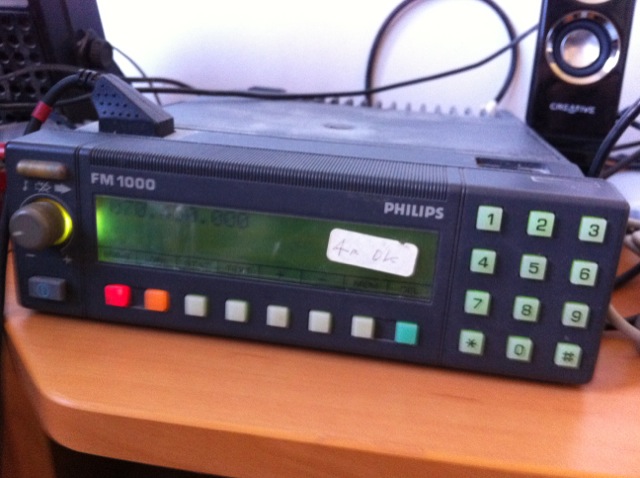
With the Es season just a distant memory, I’ve moved the 70MHz antenna from the FT847 onto the 70MHz FM rig, which is a converted Philips FM1000 PMR set. It seems to be working, though there are no QSOs to report just yet. I can hear the MB7UW packet node on 70.4875 some miles away and the GB3RAL beacon on 70.050 is loud! Test transmissions from the Wouxun handheld within the shack are loud too. So, hopefully there will be a QSO before long.
There’s a net in Swindon on a Friday night now, 2000z, run by John, G4SRE – starting off on 70.450 and moving to 70.475 – so should be able to work some of those guys, and there’s also some activity from Reading on, I think, a Tuesday night.

Ottawa D-STAR symposium resources online
Earlier in the week, I noticed from Alan, VA3STL’s blog that the proceedings of the Ottawa D-STAR symposium were on-line.
Alsn did a nice write up on his blog and it’s great to see that the slides from many of the presentations are online too.
I’ve not really had a chance to look at the presentations fully yet, but at a first glance they look great – I’ve learned plenty in the few slides I’ve looked at so far.
Thanks to Alan, VA3STL and also to the Ottawa Amateur Radio D-STAR group for this interesting resource.

Propagation: one of the fascinations of amateur radio
For me, and I’m sure I’ve said this before, one of the fascinations of radio is how how signals travel from one place to another; how signals can be strong one day and almost inaudible another. I find this true at both VHF and HF.
One of the pleasures I find on HF is to listen to a band that you think should be closed and see what’s coming through. That’s what happened the other night. I’d had a quick spin around 28MHz which wasn’t doing anything at all (it was well after sunset) so I went down onto the bottom end of 14MHz.
The band was pretty quiet – but the great thing was that the only signals coming through were from several thousand miles away. First heard was a chirpy weak one, which turned out to be from Honduras, working into the USA. I listened to him for a while and tuned up and down the band a bit, only to find a Venezuelan station at good strength. He was also working into the USA.
Though I didn’t get a chance to call, I’ll bet a contact would have been possible and it’s often fun to surprise people with a call from far away.
Even when you think the band is closed – have a listen!

Defeated by Microsoft
I have never understood why Microsoft has become the most successful software company in the world. When compared to similar products the underlying design of their software, to me, seems unnecessarily complex. And the company couldn’t care less about backward compatibility and breaking something when bringing out a new version. Microsoft software development tools, compared to third party products like Delphi or Lazarus, are far more difficult to use in my opinion. Visual Basic long ago ceased to be a “basic” programming language for amateurs like myself.
I had an idea for a program to run on my HTC Touch Pro smartphone that needed to access the phone’s internal GPS. A couple of months ago I actually got a good way towards implementing it for the Android platform (even though I’d never programmed in Java before) just by downloading the source code of someone else’s GPS application and modifying it using the free development tools. But because my phone was running an unofficial port of Android on which not all features worked I could only run it in an emulator, not transfer the app to the phone. In any case, the XD Android port was unstable and ate battery power even worse than Windows Mobile did, so I had to go back using WM 6.1 despite the fact that under Android it was a much nicer phone.
So I thought I’d have a go at writing my program for Windows Mobile. I had a copy of Visual Studio 2005 sitting on the shelf. So as before, I started Googling for example programs for accessing a GPS.
If I am writing a program for Windows desktop using Lazarus / Free Pascal I can Google for what I am trying to do and nearly always find code I can use. Even if it was written for Borland Delphi in 1996 it usually still works. The problem with the Windows smartphone / PDA platform is that it has been through many incompatible incarnations in less time than that. There is Windows CE, Pocket PC, Windows Mobile versions 4, 5, 6 and 6.1, Windows Smartphone, Windows Phone 7, Compact Net Framework 1.0, Compact Net Framework 2.0 and Compact Net Framework 3.5. If you do manage to find a relevant example there is no guarantee that it is actually compatible with the development tools and SDKs you have installed on your PC, or with your mobile device.
The first program I tried that actually did anything came with two DLLs, one for serial port access and one to decode the GPS data. That would print out a few NMEA strings and then fail with an exception. None of the other examples I tried would do anything at all. The problem with the first program appeared to be in the serial port DLL, so I tried to upgrade it to version 2.0 of the .Net Compact Framework which had built-in serial port support. I copied examples of serial port access code but although the program didn’t crash it never received anything from the GPS at all, even though I knew it was working (e.g. by running APRSISCE.) Unfortunately when run from Visual Studio the Net CF 2.0 programs would display an error on the phone that “this device has a newer version of the Compact Framework installed that must be uninstalled first.” I wasn’t about to do that since who knows what it would break. So much for backward compatibility.
One of the reasons implementing my idea was so easy on the Android platform is that Google had provided a GPS object that gave you ready to use data. On Windows Mobile you have to listen to the GPS via a serial port and then parse the NMEA data that comes out. So, having failed to find a GPS example that would run for more than a couple of seconds I decided to look for serial port examples. None of those would receive any data from the GPS either. I even found a free GPS test application. That would receive several lines of data from the GPS then disappear without trace.
At this point I started to wonder if there was a problem with the internal GPS of my HTC Touch Pro. I did some more Googling and found that users of some GPS apps on HTC smartphones with internal GPS had found these apps did not recognize the internal GPS or timed out while waiting to get data from it. Presumably these apps had been written based on the same code examples I had been trying. One user had found the only way to get the GPS data into the program was to use a program called GPSGate. But this was a commercial program, costing money, which I had no wish to spend just to see if this worked when everything else hadn’t.
After a couple of days of fruitless effort my interest in continuing with this project had evaporated completely so I gave up. At least, unlike with abortive hardware projects, no components were wasted. I restored the PC back to a couple of days earlier to remove all the hundreds of megabytes of APIs, SDKs and examples I’d installed. And I have gained a new respect for people who actually manage to develop software using Microsoft tools.














