Archive for the ‘Uncategorized’ Category
 Don Keith: You might be a real ham radio operator if…
 May 24th, 2011 |
  Author:
  Recent comments on some of the amateur radio web forums have attempted to posit the point that someone is not a “REAL HAM” unless he or she meets certain arbitrary criteria. Those include such requirements as passing a code test to get licensed, using equipment with tubes in it, or being able to build a transceiver from scratch, using only a pie tin, a set of shoe laces, and a handful of grab-bag parts from a swap meet.
With apologizes to a certain comedian who has made a gazillion dollars with his “You might be a redneck if…” shtick, here goes my feeble attempt at a similar definition of a “REAL HAM:”
- If you have a ham band antenna on all four fenders of your car, the roof, in the trunk lip, and another one clamped to the trailer hitch with an alligator clip and duct tape…you might be a “REAL HAM!”
- If your wife…sorry, “XYL”…asks you to help bring in the groceries while you are chasing a rare one and you yell back, “QRX! QRX!”…you might be a “REAL HAM!”
- If you can recite the numbers of every driver, modulator, and final amplifier tube in every Heathkit, Drake or Collins transmitter or amplifier ever made, and name the best idling grid current for 90% of them…you might be a “REAL HAM!”
- If when you were a teenager, you tore open the cases of your little brother’s “Flash Gordon” walkie-talkies just to see if you could modify them to work on 10 meters or used the pans from your sister’s Easy-Bake oven to breadboard a code-practice oscillator…you might be a “REAL HAM!”
- If you have ever tried to ker-chunk the repeater while riding in a funeral procession…you might be a “REAL HAM!”
- If your kids…sorry, “harmonics”…know your call sign, your grid square, and your 10-10 number, but not your middle name…you might be a “REAL HAM!”
- If you have at least a half-dozen different sets of hilarious (at least to you and the guys on your 75-meter roundtable) phonetics for your call letters…you might be a “REAL HAM!”
- If you have more countries confirmed than you have dollars in your 401-K and more bucks invested in your tower, rotor and tri-bander than you have in your retirement annuity…you might be a “REAL HAM!”
- If you have ever taken an HT to church or a scanner to the courthouse while on jury duty…you might be a “REAL HAM!”
- If you painted the walls of the new playroom downstairs in the colors of the resistor color code…you might be a “REAL HAM!”
- If you ever chopped up your wife’s…sorry, XYL’s…patio furniture to build a Yagi for 15…you might be a “REAL HAM!”
- If you have ever attempted to use a gutter downspout, the hubcap from a ’93 Buick, your dog’s food dish, your neighbor’s rose trellis, the vent hose from a clothes dryer, a wicket from your mom’s croquet set, or a one-quart metal Thermos bottle (with or without coffee) as an antenna…you might be a “REAL HAM!”
- If you read the ARRL “Repeater Directory” or the latest catalog from one of the big “candy stores” while taking your daily “constitutional” …you might be a “REAL HAM!”
- If you know the formulae for Ohm’s Law and Kirchoff’s Law and can read a Smith Chart from 100 feet but have no idea who Paris Hilton is…you might be a “REAL HAM!”
- If you typically go to hamfests wearing your “Hams do it with frequency” tee-shirt, a “KNOW CODE” belt buckle, at least two HTs clipped to your belt and an earpiece for each in each ear, a pith helmet with a 440 ground plane sticking out the top, and a blinking-LED button with your callsign on it…you might be a “REAL HAM!”
- If you know the prefixes for every DXCC entity as well as their beam headings but you don’t know your oldest kid’s…sorry, “first harmonic’s”…birthday…you might be a “REAL HAM!”
- If you ever flagged down a local utility bucket truck and tried to bribe the guy to hang some ropes and pulleys in the trees in the backyard…you might be a “REAL HAM!”
- If you ever tried to convince your fiancé that Dayton, Ohio, has replaced Niagara Falls as the Honeymoon Capitol of the World and that the first part of May is absolutely the best time for a wedding…you might be a “REAL HAM!”
- Of course, if you MET your fiancé in the flea market at Dayton when she tried to jaw you down on the price of a Hallicrafters HT-37 with a bad power transformer…you might be a “REAL HAM!”
Finally, if you call beers “807s,” money “green stamps,” your house your “home QTH,” your car your “moe-byle,” your base station your “shack,” the FCC “the friendly candy company,” anything a salesman tells you “Bravo Sierra,” the big brouhaha at the last club meeting “a Charlie Foxtrot,” your wife your “XYL,” and your kids “harmonics” …you might be a “REAL HAM!”
Ain’t it fun?
Just when you convinced your wife that your friends were normal…
Just when you convinced your wife that your friends were normal…
You take your wife to Dayton! 🙂 (Ok it’s been about 15 years since I did that and I can’t get my wife to come back even still!)
- Dayton 2011: Saturday– the BIG day!
Except for the toilets (sewer line) exploding in the afternoon in the flea market… it was a picture perfect Hamvention. Nothing like it ever before for me.
But it looks like driving back it will be “tornado alley”.. I’ll keep my fingers crossed…No Hail… No Hail…
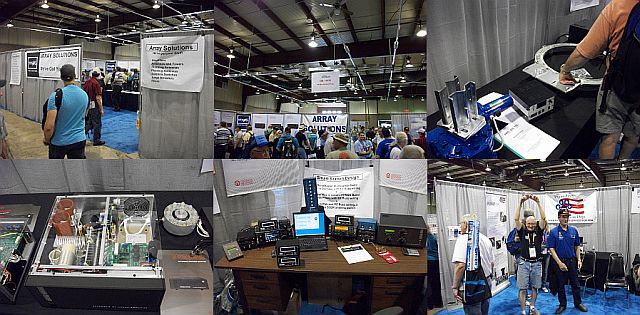
Here’s the day in pictures:




Who is that crazy looking dude with the Astronaut?!?
Well.. it was all fun and games this year.. it’s a wrap for me and the Eastern Iowa DX Association.. I’m praying that the weather isn’t as severe on the way back as predicted.
It was a blast meeting everyone I met at Dayton this year.. I had great fun.. the City of Dayton looks a lot better than it did in 2004, and the weather was beautiful. I had some of the best eyeball QSOs that I’ve had anywhere.
Hopefully it won’t be 7 years before I make the pilgrimage again… catch you all on the bands, eh?
Dayton 2011 – Friday
Well.. you knew this was coming.
Here is the detail.. the smells were not all that bad this year, I ignored the so-called food, the crowd was thinner than I remember — there were less outdoor vendors than I remember — but more indoor ones. Chinese HT’s were dirt cheap, and I did have a lot of fun. I was sad that Max-Gain doesn’t come with fiberglass anymore.
The weather was as beautiful as possible, Yaesu seriously cheaped out on hats… And except for one old bag who ran over me, from behind where I couldn’t have possible seen her or heard her, with her “hover round” right when I got into the inside exhibits and then yelled at me for stopping to take a picture..(don’t worry.. I responded even more rudely) everyone.. well seemed nicer than in previous years. (Maybe losing 160 lbs helped with that?!?)
But what can I say. Except for a SERIOUS lust for a Kenwood TS-590 and an impulse buy of a Peet Bros weather station (which I’ve been considering doing for years).. I didn’t do that much or buy that much. Probably the neatest thing is the Argent USB Data APRS Tracker and the cable for my TYT .. I’ll be geeking on the way back.. track me on:
My 1st gen TYT is now going for $89+tax now instead of the $99+tax I paid for it at Des Moines.. thanks Radio City.. no.. I still love you guys but you owe me a small deal in the future! Wouxuns dual banders from wouxun.us were selling for $90 with tax…. If I didn’t live in Cedar Rapids with only one 222 MHz repeater I would have bought the 144/220 version just to have 220.. (I almost did anyway) but it’s pointless at my QTH…
But here it is.. commentary aside:

Beautiful day for a Hamvention...Yup that

What an eclectic bunch of stuff.. Yaesu=Cheap no hats-- Kenwood much better freebies!!

Obligitory Mendelsohn's shot.. also DEMI and other goodies

ARRL and international radio societies inside

AMSAT, WB4APR's "Mean Green Machine" and other oddities...
More Fun and probably lame coverage tomorrow night.. same Bat Channel
A K3 in your pocket


Jeff Davis KE9V was among the first to post pictures from Dayton of Elecraft’s latest announcement, a portable all mode HF to 50MHz transceiver – almost literally “a K3 in your pocket.”
Weight: 1.5 lbs
Size: 1.7×3.5×7.4″
KX1 form-factor
internal battery pack & charger
internal wide-range ATU
new adjustable, attached keyer paddle
…and a K3-like front panel, including the same LCD.
I want one!

Tuning in before tuning up
 No, CW doesn’t make bad amateur operators. But tuning over somebody does. Is there a connection between the two? [hint: probably not]
I started thinking about this a few weeks ago when, prior to a net on HF, a few members we’re ragchewing for a bit beforehand. As seems to be all too common, somebody started to tune on top of them. Then came a comment from one of the operators who mentioned how he wished they had never done away with making CW a requirement to get your Amateur Radio license. He connected the two: no CW and bad tuning practice. I was at a loss — thankfully I wasn’t talking then, just listening.
I fail to see how the two are connected. I am grateful that CW is no longer required. Even if I had to, I couldn’t make out any code with the exception of S.O.S. But that doesn’t make me any less of an operator than one who knows code does it?
Does my lack of CW skill/knowledge mean I will disregard common courtesy — and FCC rules — regarding tuning my antenna? Again the answer here is no. Sadly I know many who know CW yet do that very thing. Some of them tune at full legal power.
Common courtesy would be to pre-tune at low power prior to making the final adjustments at the power level you will use for the QSO. Sadly, there’s a large number of Amateur Radio operators out there who disregard that courtesy.
An ideal solution is for all of us to play by the rules. Unfortunately that probably won’t happen. So what can we do? For starters, listen before tuning. Pre-tune. When someone starts overpowering you by tuning, wait for a lull and politely remind the tuner that it isn’t OK to interfere with another operator’s signal. Another thing we can do is keep talking about this problem, and any other problems on the bands. We’re supposed to ‘police’ ourselves. We have a nice code of ethics yet we don’t talk about them much.
Another idea, and this is one that I can’t do, is to find a new way to tune. There are lots of very smart, savvy engineers in our hobby evidenced by the many different modes and protocols, more being added almost daily it seems. What if some of those programmers were to work on a better way to tune?
Maybe a subaudible tone? I’m sure that someone out there could come up with a solution. I’m asking on behalf of all of us on HF who get annoyed by tuners who lack courtesy. Will you help us?
The Defense of 440
Lately there’s been more saber-rattling and calls to arms over HR 607 here in the US. This is the bill that places several UHF bands on the auction block for commercial wireless service and public safety. The item of concern to amateur radio is the listing of the 440 band which amateur radio has a secondary allocation.
There are some “inconvenient truths” about 440 and its potential reallocation:
1. Amateur radio usage of the 440 band is abysmal. (Dead repeaters don’t count as usage.)
2. What usage there is of 440 is inefficient when compared with 3G and 4G technologies that could use the band.
3. Millions could benefit for 440 rather than a few thousand who use it today.
4. Amateur radio’s 440 band is a secondary allocation, not primary.
BPL was a major threat to amateur radio and I adamantly opposed it. Millions could have benefited from BPL as well so opposition of BPL may seem hypocritical, but there is key difference. BPL didn’t actually use the spectrum, it polluted it. If BPL would have made actual use of the spectrum for transmission of data, we may have seen a de facto reallocation of amateur radio HF spectrum. But ultimately physics and market forces killed BPL.
When it comes to the reallocation of 440, I’m neutral about it and almost leaning towards letting the chips fall where they may. However, I feel like I’m selling out amateur radio. It’s been ingrained in our minds that we have to reflexively defend amateur radio against any and all threats.
The comments I see from amateurs regarding HR 607 seem to reflect a lack of understanding of the real world today, technology, and amateur radio’s place in the world. Perhaps I’m reading and hearing the wrong comments, undoubtedly from venues that cater to those who speak before thinking. But I digress.
Amateur radio has little to no political pull today. Any semblance of political power is merely momentary photo opportunity politics. We lack the numbers to give politicians appreciable benefits from sticking their necks out for us. The post 9/11 homeland security “importance bump” we received is winding down and arguably so will the war on terrorism. The next war is going to be a war of limited resources and debt, areas where amateur radio is politically irrelevant and potentially a roadblock.
We can’t expect to hold on to valuable spectrum forever with 1960s technology when faced with 21st century technology that can make use of a limited resource that would result in a benefit several orders of magnitude greater than what amateur radio is doing today. In recent years in American society it’s become common for vocal citizens to complain about entitlements, programs, and hand outs under the guise of reigning in the national debt, thinly veiled in patriotism, protecting the American Way and all that is good. But when it comes to cutting entitlements, programs, and hand outs from which they receive benefits, the conversation abruptly ends and out come the protest signs and 16th century costumes. It’s much the same with amateur radio bands. Our wise and aging licensees are deathly afraid of the coming debtpocalypse, but “you can pry my barely used UHF spectrum from my cold, dead fingers.” I see retorts to HR 607 like “why do they need more spectrum; public safety/cellular has X MHz” or “why don’t they reallocate FRS/TV/WIFI/Cellular!?!” I just have to do a face-palm. It’s painful to read.
Ultimately I doubt 440 will be reallocated as a result of HR 607. Amateur radio is a secondary allocation, the primary being the military. All the boilerplate letter mailing campaigns and phone calls to poor overworked congressional staffers won’t have an effect. If the military throws in the towel on the 440 band, the amateur radio 440 allocation is going down for the count, regardless. Much like the situation with BPL, it’s mostly out of our control.
Rather than just totally blocking the reallocation of this band, “we’re the radio guys who will save the world, end-of-story”, we need come up with some reasonable compromise options that gives something to the public and justifies what spectrum we hold on to for decades to come. Perhaps this means offering up 10 or 20 Mhz and keeping the remain part for satellites and data modes. As I mentioned in a previous article, we need to develop a digital protocol and network to utilize this spectrum at a respectable level with applications beyond ragchewing and exchanging grid squares. We certainly can’t forever defend holding on to this band with analog repeaters and point-to-point links linking vegetating two meter repeaters.













