Archive for the ‘Uncategorized’ Category
 DigiLite Update and Soapbox
 November 6th, 2011 |
  Author:
 Again, this is going to be a shorter version of my blogger ‘blog at http://w0fms.blogspot.com where I intend on having more random thoughts and technical detail than I post here! 🙂
I’ve purchased parts (in the US– all from Mouser for lowest overall cost except for the Analog Devices AD8346ARUZ Modulator IC– which they don’t carry) for the British Amateur Radio Club’s DigiLite “poor man’s” DVB-S SCPC modulator unit.

Almost complete BATC DigiLite DVB-S modulator board. All that is still needed is a MMIC amplifier be added after the QPSK modulator is properly adjusted with the external PLL Oscillator I am still awaiting from Israel.
The unit, as you may remember from my last post, uses an older analog Hauppage PVR-150, 250, 350, 500 and/or probably PVR-USB2 MPEG2 hardware encoder to set fixed constant bit rate (CBR) video and MP2 type CBR audio in a program stream format. This is translated to Transport Stream (TS) format for over the air transmission, Channel, EPG, and other needed DVB-S specific information is also multiplexed by the BATC software which is then sent to a DSPic33 that optionally adds the FEC (particularly at rate 1/2) and randomizes (to take out DC components because RF is inherently AC coupled!) the data– and then forms I/Q data with some pre-distortion with some tricks.. it’s filtered in a atypical way through an ANALOG LC Nyquist filter.. otherwise unfiltered PSK has infinite bandwidth! In commercial products a DSP typically would do this with a digital filter and a DAC. Finally the AD8346 does the I/Q phase shifting and that is the directly at frequency modulated DVB-S.
The LO is generated by a good e-bay find– a PLL L-band Oscillator that you can get from Ultram Tech in Israel custom programmed to one frequency. (I intend on reprogramming the unit with an Arduino [AVR ATMEGA part] board in the future– the chip’s dividers are programmed with SPI.) I have not received the board yet and didn’t want to disassemble and hack the 1152 MHz oscillator I previously bought about two years ago from Israel.
What the software and serializer firmware doesn’t do, thankfully, is care about the type of video that is in the MPEG-2 stream. I verified that tonight. The designers in the UK thought that NTSC would be fine.. and it seems to be.
Here is a video of the DigiLite “doing it’s thing” with rate 2222K video and 128K audio at a bandwidth of 3 MHz- 3MSym/S at 1/2 FEC QPSK. The video was set at NTSC D1 720×480 4:3 and I toyed with the settings until we were absolutely maxed out and were at close to zero null packets. Over the air, about 100K slower video might be a better choice. At 2112K, the null packets averaged 4.5%.. so somewhere in between these settings is about right for NTSC at 3MSym/s QPSK. This proves the digital part of the system out! We are close!
YouTube video of the BATC DigiLite running NTSC!
This is cool.. 1/2 the bandwidth and better quality than most Amateur TV. You’d think it was a no brainer for 70cm to replace 6-8 MHz AM TV? Well it is.. but in my not so humble opinion it’s not legal to run.
—SOAPBOX—
Part 97 defines that a digital phone or image (important definition) signal is legal if it uses the same or less bandwidth than the equivalent analog signal.
DVB-S and other digital standards definitely do. Unfortunately, from commercial license grants researched, I note that ATSC is C7W emission type and DVB-S/S2/C/T is G7W. Image is defined to EXCLUDE “7W” emissions. C7W and G7W are specifically defined as “multiplexed data” in another part of the rules– actually in reference to RTTY in the typical early 1980’s wording of those rules. So because DVB-S is “data” by part 97 definition, the 56K baud/100KHz BW rule applies at 70cm. In my not-so-humble-opinion it is not legal to run DVB-S nor ATSC (?!?) at 70cm because of these antiquated and wrong rules. But it is legal at 33cm and above as wideband data.
There are several who disagree with me on this. But for their definition to be valid technically by the Part 97 rules as they stand ATSC and or DVB-S would have to be G2F (DVB-S) or C2F (ATSC). By the Emissions Designator system that would also imply no audio channel. F2F is what SSTV is and I believe the “image” definition for FM/PM/PSK was specifically written with HF SSTV in mind! NO COMMERCIAL license grant (I found) has it defined that way! I can’t run 70cm DVB-S because I interpret the rules as above. Anyone who disagrees with me and wants to run it is fine with me. Wish you the best and I’m all for you! Likely the FCC nor the ARRL would do a thing to you as they shouldn’t!
What this really means is that the digital rules in US ham radio need fixing in a big way! We need to get rid of all the protectionist crap and realize that for many modes, the handwriting is on the wall for analog. The way the current rules are written in Part 97 makes most new digital modes second-class citizens on the bands. Bogus and Sad IMHO in almost-2012.
— /SOAPBOX —
The start of the contest season
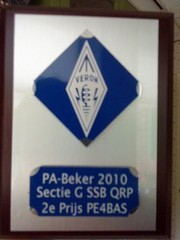 |
| Plaque I received yesterday |
The CQWW SSB is as always the beginning of the small contest season for me. I did a lot of contests in the past but since family life keeps me busy I choose to participate only the important ones. Some of those are only important for me as a Dutchman like the PA-beker contest, Friese elfstedentocht contest and the PACC. I placed myself 2nd in the PA-beker and 4th in the Friese 11 steden last year and this month I’ll try to improve myself, I guess it’s going to get difficult. Next thing to do is to set up the horizontal loop again, after that I will see if there is time and room for any improvements on the station. Anyway, one thing is for shure I really want to have fun that’s the most important thing. First contest coming now is the PA-beker contest which is purely a contest inside the Netherlands, I will participate again in the QRP section with my FT-817. Only this time I will use N1MM as contestlogger instead of the PA0FLE contestlogger I used in the past. Hopefully it will help to beat my score of last year.
Last years declare:
Place / Call / Region / QSO / Multiplier / Score
1 | PA1AT | 19 | 118 | 61 | 7198 |
2 | PE4BAS | 19 | 73 | 48 | 3504 |
3 | PA3DAT | 49 | 69 | 47 | 3243 |
That means if I want to be at first place I need approx 120 QSO and 60 multipliers. Looks easy, but I can tell you it’s difficult to make so much QSOs in 2,5 hours especially when QRP.
CQWW SSB 2011 wishlist
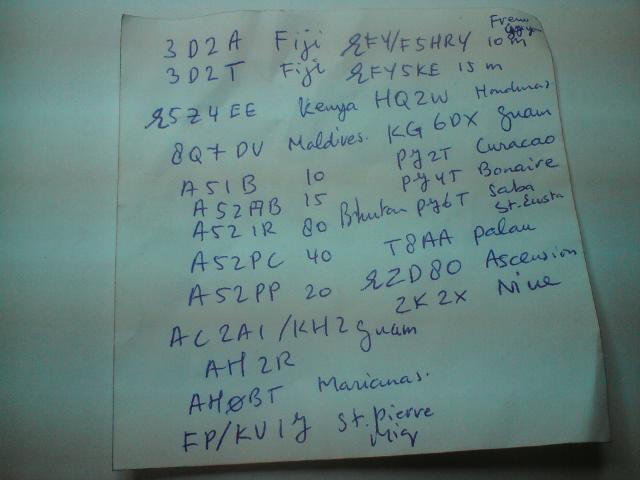
Incredible! Worked 20 !!! new band DXCC on 10m in the CQWW contest last weekend. That’s a lot. Propagation was very good especially on the 10m band. I actually made a wishlist before the contest with the help of the announced DX operations list of NG3K. Did not work everything fom the list as for example the PJ and A52 stations were constantly in a pile-up and I didn’t want to waste time with so many nice DXCC to work. But at last I did QSO with a few of the list. I even made a incredible QSO over the northpole to Alaska on 10m another first on that band. And no, I don’t work with a large beam but with a simple vertical made partially from Aluminium foil! I don’t have a lineair amplifier as well and did make all QSOs with 100W. I was not on the radio the whole weekend, so I missed opening to Oceania. I was simply not able to be on the radio on the right time as family duty calls. But after all I cannot complain I made 450 QSO’s, 200 of them were made on the 10m band. And I was almost jumping in the air….I made my first QSO with XE zone 6 after years of trying on various bands.
Some highlights on 10m, of course I made some QSOs on other bands too:
10m: JH4UTP (Japan), ST2UOK (Sudan), JT5DX (Mongolia), A92GR (Bahrain), BX100 (Taiwan), BD3NCK (China), VU2PAI (India), JY4NE (Jordan), C5A (Gambia), PZ5MM (Surinam), HI3TEJ (Dominican Rep.), P40W (Aruba), 8R1EA (Guyana), A73A (Quatar), A61BM (UAE), AA4V/VP9 (Bermuda), XE1CQ (Mexico), YV5NEA (Venezuela), HR2DX (Honduras), VP2MDG (Montserrat), WL7E (Alaska), 5H3EE (Tanzania), 7Z1SJ (Saudi Arabia), FY/F5HRY (Fr.Guyana)
I didn’t mention the countless northern American stations I worked on 10m. Imagine what would have happen if I used a beam, I think I would have doubled this list !!!
If you don’t use it….then lose it.
 |
| Random shack with random goodies. |

Welcome HamSphere, our newest sponsor

I wanted to take a quick moment to welcome AmateurRadio.com’s newest sponsor, HamSphere.
For those who may not be familiar, HamSphere is a virtual ham radio “simulator.” It doesn’t use RF — instead, hams communicate over the Internet with simulated interference, propagation, and more.
You can download software for PC, Mac, or Linux and try out the service free for a limited time.
Thanks for checking them out and remember that it’s the generosity of sponsors like HamSphere that helps pay for our hosting and bandwidth and, ultimately, keeps AmateurRadio.com “on the air.”
Have you tried HamSphere? Share your thoughts….
QRN a year ago…T32C? not here…
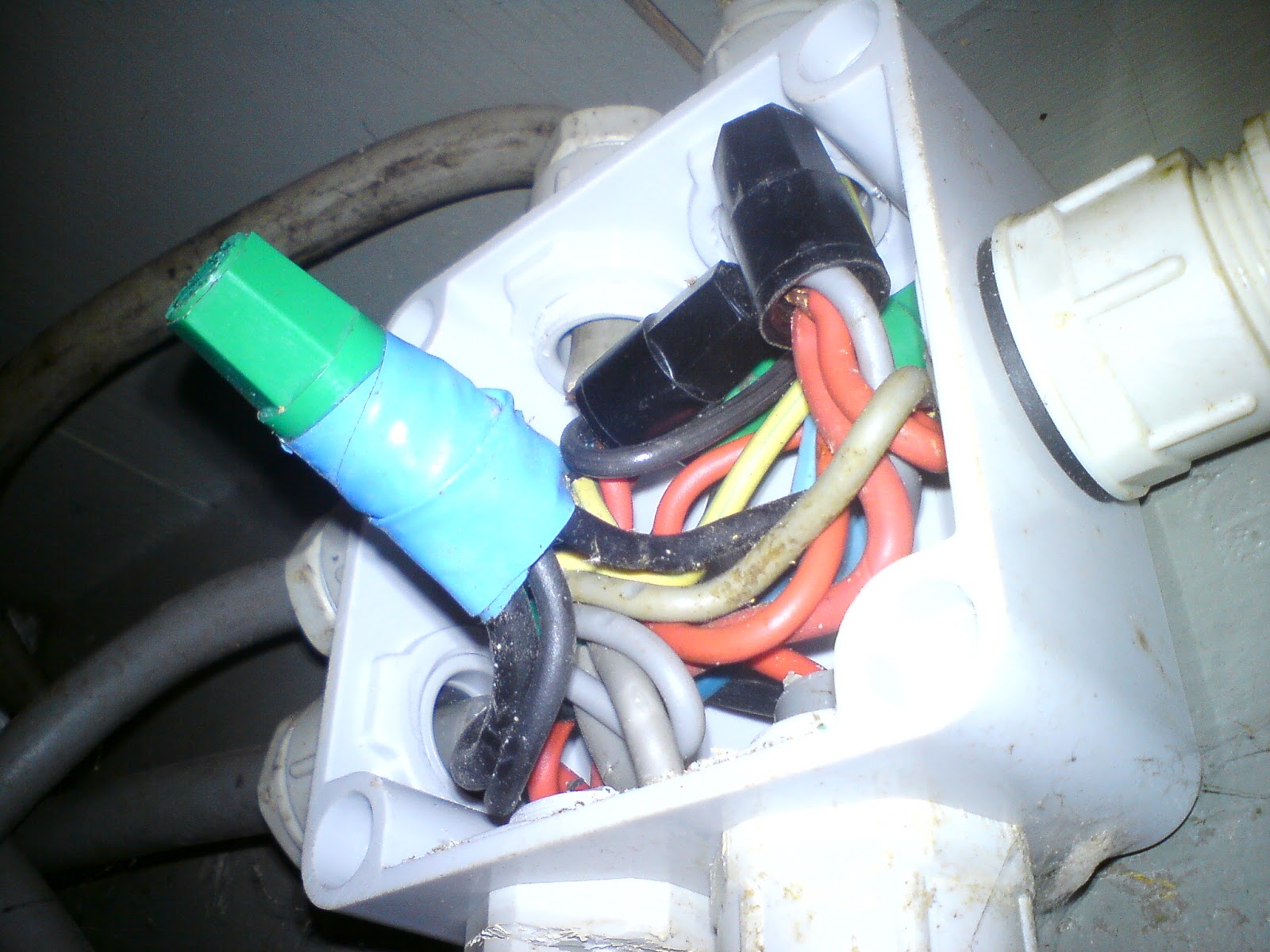
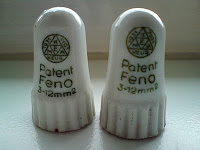
Remember that QRN I had a year ago. It suddenly disappeared after a few days. I never found the real troublemaker but suspected it came from the house or from nearby. Now since we are going to build a new bathroom next week, I had to rebuilt part of the house and wiring I came accross some mains wiring above the ceiling that probabely caused this QRN. When I opened a junction box and touched the wire nuts lights went on and off. Actually all connections were very poor made and the last owner of the house apparently tried to stick everything together with tape, besides that he probabely was colorblind. I removed all nuts and made new connections with new connectors no nuts again. As a result of that blindness wires were switched, I noticed a short circuit at first after reconnecting I thought. But in the end it seems the safety earth was used as switch wire, so it became a life wire as well. That was a 2 weeks ago, in the mean time I did a rebuilt and rewiring, that junction box has been removed together with a lot of other junk. I already made some preparations for the new radioshack and of course for the new bathroom and finally switched over to the new wiring last Sunday. Unfortenately I think other wiring in the house is just the same mess as this, although that wiring is from a earlier date I think around 1950-1960. I already removed parts of it when building the baby room last year and found some nice porcelain wire nuts at one of the old junction boxes. They are originally from the first mains wiring when the house was built, great to find such items in our 1935 house. Well despite a lack of time I’ve tried some radio as well looking for T32C in the evening, reading other blogs it seems they are easy to work from North America. But although I saw a lot of dx cluster spots on 20, 15, 12 and 10m from stations in Europe and even from the Netherlands I could not even hear a whisper from them. So I guess to work them you really need a beam from this part of the world, or I’m just not lucky? If time allows I’ll try again next few days till the DXpedition is over.
Poll: Best used HF rig for the money?

I’m planning on buying a small multi-mode HF rig for a relative who has recently become a ham. It’s been a very, very long time since I’ve bought a radio (used or otherwise). I’m polling the readership for opinions of the very best choice.
Ah, what do I mean by “best”?
Here are my criteria:
- Affordable
Browsing eBay and the other ham classified sites, there is quite a range of prices for used HF gear. I don’t really have a price in mind, but I am looking for a good value. As I can buy a new radio for about $600, I would say that the cost would have to be under $500 in the used market. - Reliable
The radio should probably be solid-state. - Portable
Should be able to be taken “backpack portable”
I would love to be in a position to spring for an Icom IC-7000, IC-718 or an Yaesu FT-817. They’re beautiful rigs, but I just don’t have the cash to spring for one.
What do you recommend? What’s the best value for your money?













