Archive for the ‘Uncategorized’ Category
 Ham Radio Aboard the Disney Wonder Cruise Ship
 July 11th, 2012 |
  Author: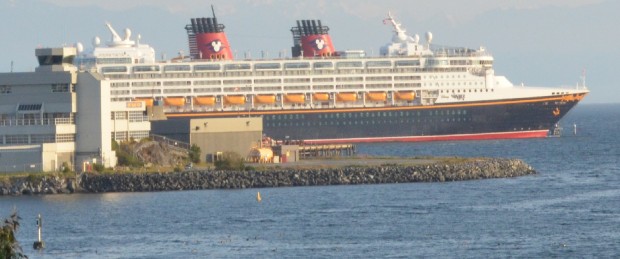
As a new ham (got my Technician and General last February), I am excited to try out all areas of amateur radio. Being eighteen years old, I’m also willing to schlep my rig wherever I can. This past week, I went on an Alaskan cruise with Disney Cruise Lines and I decided to try HF while on the Disney Wonder.
I began investigating cruise ship operation via Google, where I found mixed reports of success. It seems a lot of cruise lines don’t allow ham radio use onboard. I found a story from one ham who had success with Disney, so I started by simply sending an email to Disney Cruise Lines. I wrote:
I am a licensed amateur radio operator and I was wondering if I am allowed to operate my radio while I am on my cruise this summer in Alaska. I have heard other people have gotten permission in the past to do this, I would really appreciate the opportunity to. Thank you for your time!
A day or two later, I got a response stating that “Ham Radios may be brought onboard; however, there is no guarantee that they will function.” A little vague, the reply was enough to make me to continue on in my ventures.
Disney’s ships are registered in the Bahamas so I needed a reciprocal license to operate. Of course, I did all of this research way too late. However, I emailed the Utilities Regulation & Competition Authority, which is the responsible party for amateur radio in the Bahamas. To my surprise, they were extremely helpful and said while it using takes nearly a month, if I scanned and emailed the necessary forms, a copy of my passport ID page, a copy of my FCC license, and pay the $35 fee via credit card, I would get approved in time. Still a little unsure, I proceeded.
I still needed permission from the master of the ship, and I thought it would be impossible to prior to the cruise. I decided to write a nice letter and send it to the Disney Cruise offices in Florida as well as the port in Seattle where the cruise left from. On both, I simply addressed it to the “Disney Wonder Captain.”
I was pleased to receive a nice reply from the Florida offices on an official letterhead stating it was no problem as long as I did not cause any interference. About a week later, I received an email from the captain’s assistant stating Captain Thord Haugen “enjoyed reading my letter and has no problem with you operating your radio onboard.”
Now I was really excited! My license officially came via email the day before I left. I packed up my Yaesu FT450D, MFJ manual tuner (thanks to N8PZD, Clark for lending it to me!), and a 15m, 20m, and 40m Hamstick. Once onboard, I set up, mounted the Hamstick on my veranda and grounded it to the ship’s hull. Stupidly, I didn’t take any photos of my setup, but it was pretty simple. I fired up the rig and made a QSO as we left Seattle.
However, that is where my HF experience ended. I turned off the rig, came back later and found my radio wasn’t working. Unfortunately, I couldn’t do anything else on HF. Right now, my rig is on its way back to Yaesu for a warranty claim. All wasn’t lost as I brought my FT60R too and listened to all the port operations. I also worked 2 meters FM in various ports including Skagway, Alaska where the mountain repeater system got me to Whitehorse, Canada (about 100 miles).
In the end, it was quite an experience – both Alaska itself and ham radio. While I was really disappointed my rig died after all the pre-cruise work, I hope some others can benefit from my experience. Plus, I’m sure I’ll try it on another cruise in the future. It was pretty cool to be able to say “Maritime Mobile aboard the Disney Wonder Cruise Ship off the coast of Alaska” and I would recommend at least investigating if you are going on a cruise. I’ve heard Holland America has a written policy allowing ham radios, and they are probably your best bet if looking for a “ham radio cruise.” If you have any questions, feel free to email me. 73!
Tony, KD8RTT
TWiT’s HAM Nation Schedule Change
If you’re a big fan of TWiT’s weekly amateur radio broadcast, HAM Nation, then you’ll want to note that the program is now on WEDNESDAY evenings at 8pm Central Time (GMT -5:00).
Ask The Audience: Mobile Antenna Mount?

A longtime reader, Chris K9ROC (Blog | Twitter), wrote me looking for some advice. Please take a moment to leave your great ideas, friendly suggestions, or dire warnings in the post comments. I know Chris will appreciate them!
2M/ 440 antenna mounts for a 2009 Dodge Grand Caravan? …
For many months I had a 1/4 wave 2m mag-mount antenna on the roof of the minivan and it worked very well with respect to both transmitting and receiving.
But I took it off for a couple reasons. First, a whip on the roof of the minivan hit everything in the parking garage at work. Second, the coax went through the rear of the van, the large door. Every time my wife opened the rear door it was grinding at the coax. And of course the mag-mount itself wasn’t great for the roof. 😉
I’ve been told to install an NMO mount on the roof with a hole (I have a great elmer experienced with this). But when I mentioned the idea to my wife I realized that discussion was a non-starter. 😉
Soooo … what other options do I have? Through-the-glass on a side window? I’ve read that that’s not a good idea with modern auto glass.
What about something that would clip-on to the front fender? At the last couple RARA events I saw a lot of cars that appeared to have some kind of fender mount.
Or should I really let myself get talked into the NMO?
Thanks very much in advance,
Chris K9ROC
Where did I find those other 60 hours a week?
So I finally pulled the plug on the day job six weeks ago. For the first time since I was 18 years old, I don’t have a regular pay check coming in. Unless you count that Social Security thing, which is hardly enough to call a “paycheck.” I had big plans for all the new spare time I was going to have in retirement, including actually getting on the air more, seeking out long, rambling ragchews, working more PSK31 and RTTY, doing some QRP, maybe even building a kit or two and trying out an antenna idea I’ve been contemplating. Contemplating for a dozen years.
Truth is, I only retired from one of my several jobs. For some reason, I quit the only one that actually paid me a regular wage, which automatically brings my sanity into question. But like a gas occupying a vacuum, the other things I do quickly expanded to take up all my available time, including what the day job once took. I have no idea how I was able to work those sixty hours a week at the old vocation!
Some of you may be aware that I am a writer, too, and just published my 24th book. I’ve also finally gotten around to putting one of my novels–my second book, published way back in 1997–up on Amazon.com as an eBook. (I hope it finds a bigger audience this time because it is near to my heart, the story of a young man who falls in love with the magic of radio, goes on to a career in broadcasting as a deejay, and eventually his best friend, who just happens to be a ham, saves his bacon…using a trick many of you will recognize. It’s titled WIZARD OF THE WIND and, yes, there is a lot of me in that story!)
I’m also finishing up an amateur radio book, one that has been in the works for a while, too. It will include some of the articles and short stories I’ve put up on eHam.net and more. I want it to not only entice those who develop an interest in ham radio to go ahead and take the plunge but to also encourage those already in the hobby to explore other aspects and become true evangelists for it.
When I was writing WIZARD OF THE WIND, I actually took a weekend job at an oldies radio station for a year, working a weekend deejay shift, just to get that old feeling back. It really helped me put it into words as I worked on the novel. Maybe now is the time that I should be getting on the ham bands more, broadening my own horizons so I can capture the magic of the hobby as I work on the new book.
I think I just talked myself into getting off this blog and seeing what the DX clusters are saying. Or watching the waterfall for a bit on 20M PSK31. Time’s wasting!
Don Keith N4KC
(A blog about rapid technological change and its
effect on society, media, and ham radio)
Wouxun Dual-Band Mobile Update

Just received this from Ed at Import Communications:
fyi… KG-UV920R
Wouxun has released a limited number of the mobile radio to dealers. These samples are not FCC Certified yet and do not have the required 2.5 kHz tuning step required for 2013 regulations. SO THE RADIO DOES EXIST.
If no major problems are found when testing these samples, hopefully full production will begin in July.
The costs of these samples are higher than I expected but hopefully the costs will come down when the radio goes into full production.
If you have your name on the reserve list at www.wouxun.us, you will be notified by email when the radio is available to order.
Maine High Altitude Balloon Launch

I received a QSL card in the mail the other day for a contact I made with N1ME though a high altitude balloon repeater launched during the Pine State Amateur Radio hamfest near Bangor, Maine. I made the contact while camping with my family in a state park on the Maine coast with a Wouxun HT (stock antenna). The repeater signal was amazingly quiet from my operating position atop a picnic table.
The picture above, taken by the balloon, is at approximately 95,000 ft. I heard contacts being made from as far away as Long Island, New York which is about 450 miles away. For quite a few minutes, the repeater was covering an area well over 600,000 square miles. Very cool stuff!
While my kids found it quite entertaining, sometimes I worry that growing up in the “Skype” generation — where everyone in the world is a mere free video phone call away — has raised the bar when it comes to impressing them. I feel that it’s my responsibility to make this stuff fun and show them that they can be creators of technology and not just consumers. I suppose every “nerd” dad shares this frustration.
http://www.youtube.com/watch?v=qzAspyuQYWI
Kudos to University of Maine Associate Professor Dr. Rick Eason, AA1PJ, and his team of students at UMaine’s High Altitude Ballooning project. This is truly great stuff! It’s fantastic to see folks in higher education reaching down to the high school level to show them how exciting — and relevant — this kind of thing can be.
Field Day 2012… Vicariously
Field Day 2012 is upon us and many of you are out enjoying the day. For those who are working or can’t make their local Field Day event, there is always the option of living vicariously through those who are able.
Here is a live feed from Kings County Repeater Association (KC2RA) in Brooklyn, New York:
Or you can follow the Northwest Arkansas team of K5PO, WB0RUR, K5KVN, and K5OY here:
How is your Field Day 2012 going?













