Archive for the ‘Uncategorized’ Category
 Whisper it!
 August 23rd, 2012 |
  Author:
 I was at home but too busy to play radio, so I did the WSPR thing on 10 MHz all day. Here is a screenshot of the local morning session. As you can see I am right in the middle between JA2GRC, DU1MGA and W8TOD in Beijing. W8TOD in Beijing??? There must be something wrong with his set up of WSPR! But there isn’t. On the QRZ.com page of Warren you can read the following:
I live in Beijing, China currently and am operating under the “less than one watt” and the “it’s legal if you don’t get caught” rules.
There you go! Stay under the radar, mingle in the crowd and you can get your radio fix, even if it is not allowed. The radio situation in Asia is messy, so turn it into your advantage.
Mind you, I wouldn’t do what Warren does and as I wrote yesterday, I am very careful in my actions, because I want to enjoy my hobby for a long time. So I do my best to play by the rules, but I will bend them if necessary.
I’m fixed!
I finally have an official fixed amateur radio station! Isn’t it great! I’m tickled pink. (Calm down Hans, don’t get too excited here).
Yesterday two people from the NCC (our local version of the FCC) came to inspect my station for the official fixed station licence. An hour late, but we’re in Taiwan, so get used to it. There were two guys and one started off with a strange question: if I had any questions about the radio regulations? Ehh…no! I passed the exam, so I know what they are. And then again, I ignore them when I feel like it, because that is what we do in Taiwan, right? But the guy asking the question was Mr. Liu and he wasn’t so bad at all. In fact, he was interested in the examination procedure in the Netherlands and he wanted my e-mail address so he could consult me on changes in the examination question pool, which is going to be changed in November. He is also the man who put together the statistics I mentioned in my last post here on AmateurRadio.com.

In the mean time the other guy tested my TS-440S. He hooked it up to a Bird clone and a spectrum analyser, fed into a dummy load. On 80 and 40 meters my harmonics suppression was only just 40 dB, but on the other bands around 50 dB: good enough. The power output was measured at around 80 Watts, but I saw that the SWR of the whole set up was 1:1.5, so then it’s no surprise that the rig didn’t show its full potential. They looked at my antenna, which is on the balcony, but other than that they weren’t interested in anything. After an hour they left and the licence will be coming in the mail.

You would have thought that inspecting a radio station would be more thorough: electrical safety, structural safety of antenna’s, equipment that can only transmit on designated frequencies, etc. My TS-440S can transmit on any HF frequency, but they didn’t even check or notice. So what is this farce about? Unfortunately us hams in Taiwan know more about amateur radio than anyone working for the NCC. But there need to be rules and regulations, thought up by people high up in the chain of command, who want to be listened to (just like the Emperor, a hundred years ago. Really, little has changed). It doesn’t matter if they are right or wrong, propose something realistic or not, you just have to obey them. But once you have shown that you have played by the rules then there is a solution: ignore them. You know that you will never be bothered by them again, so you make your own rules.
Example: the Ministry of Transportation and Communication devises a national frequency allocation table. The NCC (which is a subdivision of the MOTC) extracts the amateur radio frequencies, allocates them according to type of licence and puts it in the official rules and regulations which we are to obey. Now the MOTC frequency allocation table is already inaccurate due to contradictions within the MOTC. The NCC uses an old version of the FOT and the MOTC doesn’t bother to let the NCC know of the updates. The result: most hams in Taiwan use the IARU region 3 frequency allocation table for HF. The NCC knows that Class 2 and 1 amateurs are serious people and we are never checked apart from the time you set up a station, so live and let live. On VHF and UHF there is a little tighter control because of the great number of sausages and inexperienced Class 3 amateurs. So, do what you want on HF and be a bit careful on V/UHF. That’s the way we do it in Taiwan.
I am careful by nature and I want to enjoy the hobby for as long as I can, so no worries about me. Besides, amateur radio is more about listening than transmitting, not? So after the NCC folk were gone the TS-440S was still on 10 meters and I tuned that band for a bit. Heard beacons from DU1EV/B on @28195 (very weak) and HS0BBD/B on 28205.9 (in OK03, strong at times). The DU1EV beacon is in testing phase, running 1 Watt into a Yagi pointed to Japan. Eddie hopes to relocate it to a better spot, with a GP antenna instead of a Yagi. Stay tuned.
Eye-ball QSO
If you haven’t noticed it yet then I will confess myself: I am a little bit of an oddball! I don’t like ham fests, field days, working mobile, going QRP in the park, ARES or hanging out at other people’s shack. My own shack is where I feel the best. My soldering iron to the left, my radios to the right, the key in front of it. Nobody who can bother me, but the world is coming to me via my set.
Unfortunately this has its limitations, because everybody needs help at some point. And as I am not a recluse I do enjoy some company, every now and then, with people who are like minded. So when I learned about the weekly meeting at the shack of BX3AA I decided to check it out. The Taiwanese hams I had met up till now were okay, but not really like minded. Well, that has changed. Sam (BX3AA) has a little ham shop in down-town Taoyuan. When you go in you are being welcomed by a very friendly 45 year old guy, some jazz music in the background and a cup of Taiwanese tea. And on Saturday afternoon hams from around Taoyuan join him for a cuppa. There is some talk, but you don’t have to say much. Sometimes every one is quiet so to better enjoy the tea and the music. Talking about like-mindedness! I think I finally found my posse!
 Unfortunately Taoyuan is a very busy city and my car was parked in a wrong spot and thus towed away. A bummer after such an enjoyable afternoon, but BV3FQ (not in the photo, he had already gone home) made me forget it all a couple of days later. I had asked him where I could buy aluminium tubes and rods (trust me, not easy to find in Taiwan) and phoned me up and said he had already bought what I needed. Well, isn’t that a great way to get help!
Sunday !!!
There’s still time to get a number for the Skeeter Hunt, if you are so inclined. I will honor any request e-mailed to me by 0400 UTC Sunday (12:00 Midnight Saturday).
The weather here in Central NJ is supposed to be sunny with a high of around 87F. Hope you all get a chance to participate – and even more so ….. hope you all have fun and enjoy the event!
Remember, if you’re going to claim credit for the homebrew key bonus, you have to send me a photo of your key along with your entry.
72 de Larry W2LJ
QRP – When you care to send the very least!

Statistics
Just before our trip to the Netherlands I got an e-mail from Deborah of the NCC (the Taiwanese version of the FCC). “Why I hadn’t come in for my my fixed station licence yet?” Good question! The answer: because I was ignoring the matter, hoping that it would go away. But there is no going around it, rules are rules. So on Tuesday I went there and got the papers in order. I needed a copy of my landlady’s ID and house ownership certificate, but luckily she was very cooperative. We share the same Chinese family name, maybe that is why.
In Taiwan – like a number of other East Asian countries – you can’t set up a station right away. First you pass the operators exam and get a licence to operate a station. Then you apply for a station licence, which comes in two forms, a portable and a fixed one. The portable licence is easy because it covers any HT or other equipment below 50 Watts. You bring your transceiver to the NCC office, they test it, you get a laminated card in return. The fixed station licence is more troublesome. Unless you own your house you need permission and signatures from anyone and everyone living around you. That is, unless you put your antenna on the balcony of your apartment, then it is easy. Unless the HOA of your gated community or apartment building objects, then you’re in big trouble. Confused already? Welcome to Taiwan. Whatever situation, once you get it done it will cost you US$50 for a five year licence, but then you can legally transmit from your home.
With this background information the following statistics are now easier to understand. They are fresh from the NCC and go up to June 2012.
Amateur Radio Operator ——-> Number of Licenses
Class 1 —————————–> 871
Class 2 —————————–> 73
Class 3 —————————–> 42,330
First up the number of licensed amateur radio operators. Class 3 operators (VHF/UHF only) are in a large majority. That comes as no surprise as most are ex-CBers (or “ex-sausages”) who now use 2 meters as their Chicken Band together together with the remainder of the sausages who can’t memorize 360 questions and answers – and score 25 of them right – and thus occupy 2 meters illegally.
I am one of the 73 Class 2 operators and there are 871 Class 1 operators. So there are only 944 Taiwanese operators (with either a BU, BV or BX prefix) who you can potentially meet on HF. That is not a lot considering there are 21 million people in Taiwan. But together with the Class 3 operators there are a whopping 43.274 hams in Taiwan and that is a quite considerable number.
But not everyone has set up a station. Here are those statistics:
Fixed Amateur Station ——-> Total Number of Licenses
Class 1 —————————-> 586
Class 2 —————————-> 4
Class 3 —————————-> 1,924
Mobile Amateur Station 23,876
So out of the 43.274 hams in Taiwan, only 26,390 have bothered to set up a station, either fixed or portable, or both. So your chances of running into a Taiwanese ham on HF are actually reduced to a little less than 600 and my estimate is that probably only around 100 of them are active.
If you wonder why so many people with an operating licence haven’t set up a station then there is an easy explanation. At a lot of tech colleges you can score credit points if you take the the Class 3 operators exam. It’s easy enough if you memorise the answers and the Taiwanese are good at this. After five years the licence expires automatically, so one less operator in the statistics. It’s not a bad way to gain new hams, though. While I was at the NCC some time ago there was a group of six students taking the exam. Five were just bored with it and passed with the minimum score. The sixth student had genuinely studied the material and was interested in things like call signs, Q-codes, etc. He passed with flying colours. There is no guarantee, but I do hope he pursued in getting a station on air.
An old friend returns, and arrives with a mystery item

Sony ICF-2010
I’ve owned many of the classic shortwave receivers throughout the roughly 40 years that I have been a SWL. Most of these I passed on to friends and relatives, while others were sold at hamfests, and on eBay. I know that my beloved Panasonic RF-2200, is still used by my sister-in-law Alice. My late brother Paul kept it prominently displayed on the counter for years. My Sony ICF-6500 lives in Wisconsin, in the hands of a good friend that wanted to get in to shortwave listening. Others, I’m not so sure as to the whereabouts, but hopefully they are still in use (with exception given to my National HRO-60 which I know was lost in a flood).
Of all of these, the one I frequently regret selling was my Sony ICF-2010. The 2010 is still considered to be one of the best portable shortwave receivers around, and rivals many tabletops. I sold mine on eBay during what we’ll call a dark time in my life a number of years back. I purchased the 2010 new at Gilfer Shortwave in NJ, in-person. Now, as I see working examples sell for upwards of $350 on eBay, I have relegated the replacement of this radio to a status of someday, along with several other things that I want but do not need at the moment. It would be a nice addition to my collection though, considering it is a great receiver. It has a synchronous detector, separate USB/LSB modes, and 100Hz resolution, and portability.
Last week while watching new postings on eBay I saw one come up. This example was listed as for parts or not working. Upon reading the description, I noticed that the seller indicated the radio to be completely dead. Now, in the world of radio repair, completely dead is usually better than many other states of being. Especially in the case of the 2010, which is known to have battery compartment issues. Anyway, I grabbed the radio immediately for a VERY reasonable price. It arrived last night, and as I suspected, the problem was battery compartment related. The 2010 runs on 3 D-cells, and 2 AA-cells. The AA cells are listed as the computer batteries. One thing about the 2010: If you want to run it on AC power alone, you still HAVE TO have the AA-cells in place. One of the plastic supports for the AA battery contacts had broken from the housing. It is still held in place with a ribbon-
sized piece of plastic though, causing it to tilt at an angle back and forth like a loose tooth. I temporarily fixed it with a piece of compressed foam and some plastic tubing. The radio works great! Better I think than my early example from years ago. I have a couple of questions for the radio community though.First of all, what should I glue the AA-cell support back in place with? I would try crazy-glue (or any generic cyanoacrylate), but I know that it will sometimes react with some commercial plastics, making the problem even worse. I was thinking of using Gorilla Glue, but I would need to devise a clamping method. I know some of you out there have dealt with such things before. What do you use?
Second, the radio arrived with a loop antenna of some kind. I have put pictures below. It is approximately 21 inches long, made from PVC pipe with two endcaps. On one end is an F connector and on the other end, an eye-hook. I scrounged in my adapters and was able to hook it up. It definitely improved reception on a few bands. Has anyone seen one of these before? Is it a commercial product, or homebrew? What is the bandwidth? And, if no one knows, what is the best method for determining its properties? Feel free to answer in the comments.


OK, OK! I Will Write that Ham Radio Book!
Ever since I began writing articles about my hobby of choice–amateur or “ham” radio–for my ham radio web site and several others, people have been asking me when I was going to do an amateur radio book. The truth is, I have just been too darn busy to even think of such a thing. And I also knew, in my heart of hearts, that it be would difficult indeed to get any kind of decent book contract for such a niche book. I presented my idea of a half-fiction/half-nonfiction book to the ARRL and they passed, so that confirmed my feelings. If they had no interest, I doubted anyone else who published books would either.
Fast-forward to July 2012. Things have changed, both in my personal life and in the wild and woolly world of big-time book publishing.
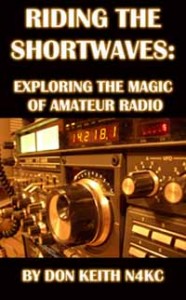
Don Keith N4KC has just published his new book of short stories, articles, advice, and more about ham radio.
First, I retired from my 60-hour-a-week day job back in May. And as I shuffled through the articles I had in the can, several more I was working on, and a few still in my head, I realized I was closer to a book than I had thought. And I truly believed I had something that would be different and could find a readership.
Secondly, as I investigated Kindle Direct Publishing at Amazon.com for the re-issue of a couple of my previous now-out-of-print books, I realized that I should absolutely pull the ham radio book together for that outlet–Kindle and some other e-book readers–at least. Amazon has become a real threat to traditional publishing companies–especially when it comes to e-books–as the old-line publishing houses struggle to figure this newfangled thing out. At the very least, it gives me the opportunity to make my book available at a very reasonable price to those interested in amateur radio. No, I don’t make much money at the price I set, even if I actually sell some downloads of the book, but that is not really the object anyway. As I have said many times, and not totally facetiously, if I wanted to make a fortune writing books, I would write pornography (See FIFTY SHADES OF GREY).
Then, as I considered other options, I realized that Amazon offers a truly unique opportunity for works like this one that allows me to offer the book in a traditional paperback format with minimal investment up front. Remember, I’m retired, on a fixed income these days! Amazon’s is a print-on-demand deal, but they seem to have it down to a science. I ordered some copies as soon as I got the book and cover uploaded and accepted for publication. The very next day I got the email that they were being shipped that day. Wow!
Again, this was with very little upfront cost and minimal hassle. Now, the paperback will be available not only via Amazon.com, but through major distributors, for order by libraries, and even in many European markets. We will see how good the print job is, but believe me on this: the major houses don’t necessarily produce the highest quality book any more either. They have to cut where they can to make a profit and printing, binding, and warehousing is a big drain on them.
Talk about rapid technological change and its effect on society and the media! Broadcast radio, TV, the Internet and telephone communications are not the only things evolving at a dizzying pace. Include the anachronistic business of book publishing in that mix, too!
Realistically, will tons of booksellers and all the Barnes & Noble stores order a box full of the books each? Or will hundreds of thousands of libraries order up a couple dozen copies each? Of course not. The big publishers do have sales staff to encourage that sort of thing. But a) no big publishing house was going to do a contract for RIDING THE SHORTWAVES: EXPLORING THE MAGIC OF AMATEUR RADIO and b) even if they did, it would be somewhere near the bottom of the sales staff’s sample case, so c) Amazon’s various self-publishing options are perfect for this kind of book.
By the way, if you have any interest in the dynamic and rapidly growing hobby of ham radio–believe me, it ain’t your weird uncle’s past-time any more!–then you may want to stop by Amazon.com and take a look “Inside the Book,” read the description, and maybe buy a copy or two…for yourself or someone you know and want to spark the interest in our amazing hobby.
See, right there in that last sentence, I did more publicity for RIDING THE SHORTWAVES than the big publishers do for most of the books they print up and ship out!
73,
Don Keith N4KC
www.donkeith.com www.n4kc.com













