Archive for the ‘Uncategorized’ Category
 Cut short
 April 24th, 2014 |
  Author:
 Every now and then, my lunch time QRP sessions are cut short by a work crisis. Such was the case today. Not hearing many strong signals during my initial tune through, I decided to call CQ for a while and then go back to search and pounce. I managed to call CQ alright, but never got to the search and pounce portion of the plan. My cell phone buzzed in my pocket and demanded a quick return to my desk to handle “a situation”.
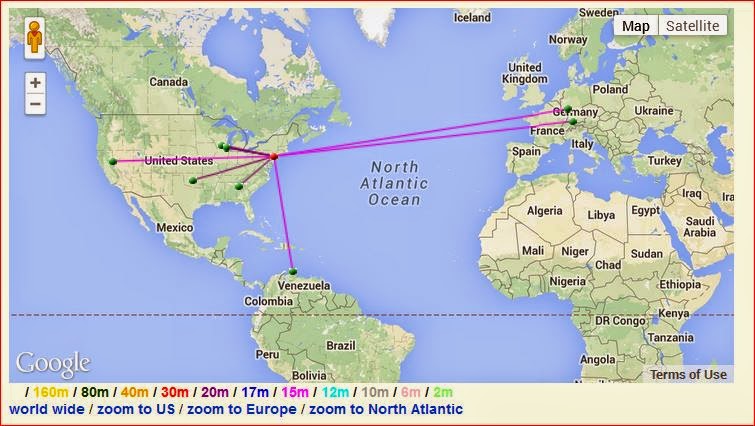
The bright side is that my CQs, although unanswered, were at least heard:
72 de Larry W2LJ
QRP – When you care to send the very least!
Doing the math
I’ve been doing some investigating with my computerized logbook. In the over 11,000 entries that I have in it, I took the time to tally the numbers for CW QSOs vs. Non-CW (Digital, Phone) QSOs. CW makes up for 98.7% of my operating.
Speaking of computerized logbooks, I am playing around more and more with Log4OM and am taking a liking to it. It may soon become my full time computer logging software. I still have a few issues to work out – such as why the distances displayed are in kilometers even though I have the “display distances in miles” checkbox checked. Also, I have to get the program to hook up with LoTW and eQSL. I think those are minor issues, especially after watching the YouTube videos on the subject by Terry G4POP.
Additionally, Ham Radio Deluxe has developed a glitch which has me puzzled. When I have the Cluster display open, if I click on a DX station that is on a band other than what I am currently on, the KX3 will go to that station and then immediately back to where I am/was.
Let’s say I just worked W1AW/1 on 7.038 MHz, and I see on the Cluster that EM7XX is on 14.004 MHz. If I use my mouse to click on EM7XX, the KX3 will go to 14.004 MHz, but then will immediately go back to 7.038 MHz. It never used to do that. In the past, it would have gone to 14.004 MHz and would have stayed there. I have de-installed and re-installed HRD, but for whatever reason, it doesn’t want to behave properly anymore. And while I’m trying to save up for the PX3, I really don’t want to pop a hundred bucks for the new version of HRD. Log4OM is not behaving that way, it’s acting like it should and it’s free, so …………… I think you can see where I’m headed.
I have played around with the DX Lab Suite and for some reason it would not import about a 1,000 of my QSOs via ADIF import. The same thing happened with Logger32. Log4OM imported every single QSO that I had in HRD. I was looking at nGenLog and kind of liked it, but for some reason after the initial session, it hangs up and freezes my computer when trying start up the next session. It’s so bad that I have to hit CTRL-ALT-DELETE to access the Task Manager in order to stop the program and get the computer running again.
Maybe it’s also time for a new computing platform in the shack.
72 de Larry W2LJ
QRP – When you care to send the very least!
Spring Peepers on Johnson Road
I heard spring peepers for the first time this year. I hiked in an old field off Johnson Road and worked Russia, Panama and a couple of stations in the Michigan QSO Party.

I hiked about a quarter of a mile on a trail from the road and turned south skirting the edge of the field when I heard the peepers. I know where they are! There’s a vernal pool down a horse path through a large and prickly raspberry patch. I look through the woods and onto the small pond. Every time one of these tiny frogs sings, his body trembles enough to send circular ripples into the pond. They are, of course, calling CQ. It is a clear sign of spring and I am overjoyed.

I wandered through this overgrown field for a while. I was searching for a warm spot out of the wind. It’s only about 45F with a stiff breeze and a bit chilly. I pass the telltale signs of a long winter… tiny holes in the grass where mice and voles have sought cover while enduring the bitter cold.
I set up under a tall pine tree on a little hillside facing the sun.

I heave my wire over a branch and tune the KX3 on 20 meters. Stations are strong, but they don’t hear me well. I work UA2FL who is operating the Mineira DX Contest from Russia. Then I work two stations in the Michigan QSO party… N8KS and K8BZ. I switch to 12 meters. HO100CANAL is calling CQ and he answers right away. This is a special event station in Panama celebrating the opening of the canal 100 years ago.
With this I pack up and head back to the car. I check for ticks (usually out
by now) but thankfully, I don’t find any. Maybe the hard winter has reduced
their numbers.
Ham Radio Helping Communities
I was asked to write a final paper for my University of Phoenix Class on a topic that I was passionate about. I thought that how Ham Radio helps communities would be a good paper as wells help others understand a little more about what makes Ham’s so passionate about the topic. I received an A on the paper and in the class and thought I would share with the community. The interesting part of the paper is that two of the people in the class were doing some disaster planning as they lived on the West Coast and they are getting more and more worried about earthquakes. My teacher is now going to get his license and I send the other person more information about the process. Add a Ham a year is my goal.
Here is the full post:
http://nicktoday.com/ham-radio-helping-communities/
Old Hill Village is Flooded
Tim W3ATB and I hiked down to Old Hill Village today. The Pemigewasset River is up more than 20 feet and the area is inaccessible. We set up in a small field and worked the Czech Republic, the Netherlands, Belgium and Alabama. We had a grand time.

We hike into the Corps of Engineers flood control area along Needle Shop Brook. We detour and clamber down a steep hill to get near the brook. It’s exhilarating to see the water racing through the narrow channel, filling the air with mist.
As we get closer to the flood plain the road disappears. The river has become a huge lake of more than 1000 acres and millions of gallons of water held back by the Franklin Falls Dam perhaps 8 miles downstream.
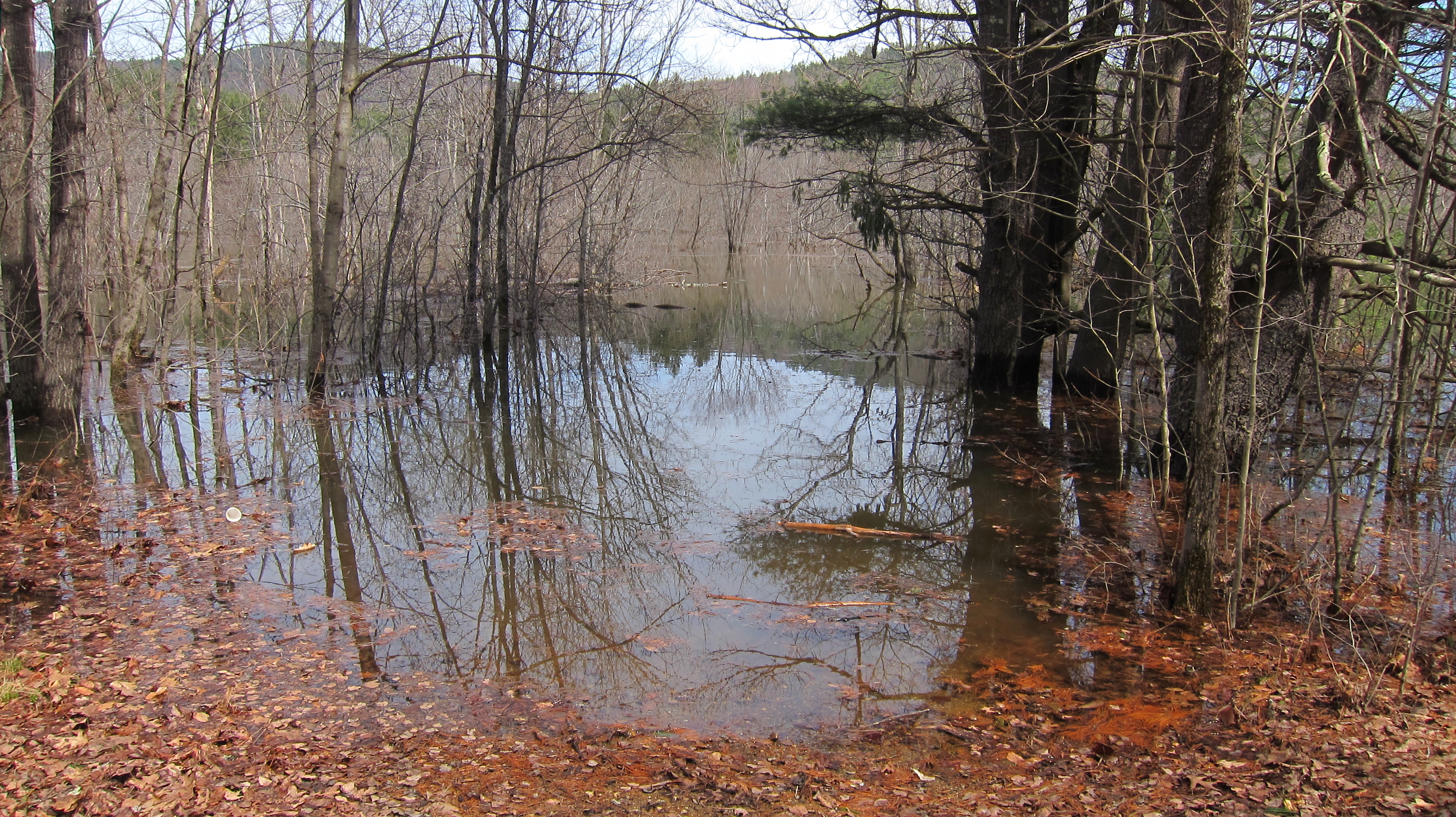
Melting snow and recent rains have left their mark. Three miles upstream a man drowned a couple of days ago in the Smith River. Search teams have been called back because it’s too dangerous.
Tim and I find a safe operating position in an overgrown field above the water’s edge. We toss a line over the branch of a small maple tree and pull up a sloper. I am using the KX3 and the internal tuner. I hear OK2PDY calling CQ on 15 meters and complete a quick exchange. He gives me a 559 and he is 579. In just a minute I work Frank PA1FP in the Netherlands. I am only 539 and he is 589.

We’ve brought our jackets because the temperatures dipped into the 30s the last couple of days. But my thermometer reads 60 in warm spring sun. I hand the key to Tim and he answers N4RAY who is calling CQ from Alabama. Rodney gives us a 579. He is QRP but is a strong 599.
Before calling it quits, I snag one more QSO… this time with a special event station in Belgium. OS16M is celebrating Morse Heritage Day. We exchange quick 599s and pack up. Unless we get more rain the water will recede in a few days and dry out within a week.
We’ll be back soon with bicycles to explore some of the most beautiful countryside in New Hampshire.
Thanks to W3ATB for the photos.
PA2BX again!
Never say that protesting doesn’t help. After Agentschap Telecom withdrew the registration of my Dutch call sign – and some 200 other Dutch hams living abroad – the two biggest Dutch amateur radio organisations wrote a letter to the AT in protest. Not only that, but many of the affected hams also wrote in to appeal the decision. The reasoning of the AT for their action was quite valid, because every database needs to be cleaned up every now and then. Their execution wasn’t and yesterday they admitted to that.
All the affected hams will be re-registered, with their old call signs given back to them. All previously issued registration papers will remain valid. We are being asked by AT to cancel our registration voluntarily in case we indeed never use the Dutch radio space. Re-registration is always possible, because the results of the test to pass the radio amateur exam will stay on record.
All’s well that ends well. 73 from PA2BX a.k.a. BX2ABT
Wouxun KG-UV8D: Hands-on review

I had the opportunity this afternoon to be one of the very first people to go hands-on with the new dual-band Wouxun KG-UV8D HT courtesy of Danny at BuyTwoWayRadios.com. What’s the verdict? I’m impressed!
VHF/VHF dual receive — for the win! This is a great feature and, at least for me, one of the most compelling reasons to upgrade to this radio. It mixes the audio from the two frequencies so you won’t miss anything. Great feature for EmComm, especially. I personally don’t have a great need for cross-band repeat, but that’s just icing on the cake.
-

- Speaker/mic jacks are well protected
-

- PTT and various function buttons are easy to tell apart by feel
-

- Standard Wouxun keyboard layout
The text on the color screen is so much easier to read than on previous Wouxuns. There’s about twice the screen real estate and it makes the radio much more usable. Although I didn’t get a chance to play with every feature of the KG-UV8D, I can honestly say that this radio seems to be much easier to program from the keypad. I think that larger screen helps a lot. For the first time, I feel that I could field program one of these without the manual. Trust me, that’s saying something!

The radio seems slightly narrower and thinner than previous versions. This is a definite step up and it improves the ergonomics of the radio. The PTT button is large and segmented in a way that makes it hard to mistake it for a function button as with the KG-UV3D. The programmable buttons under the PTT are also cool. You can program it to activate the FM radio or to start scanning, for example. Very easy to customize.
-

- I like the recessed battery eject button
-

- Slim profile battery
-

- Chassis backplate
The battery is different which is a little disappointing for those of us who have a collection of older Wouxun batteries, but I like the changes they’ve made to the way it slides on and off the chassis.
The rubber ducky antenna they include is OK, but for me a Smiley 270A would replace it in short order. And speaking of antennas, why can’t Wouxun figure out if they want to use SMA-male or SMA-female on these radios? I think we can all agree that they should just standardize on one or the other. This radio has a SMA-female connector while my KG-UV3D is SMA-male.
I’ve fallen in love with this little radio and I’ve only had it a few hours. When they begin shipping in a couple weeks, I will definitely be ordering one. While there aren’t really any must-have new features (except dual-receive), the radio just feels much more refined than other radios I’ve used that are anywhere near this price point.
Whether you’re a brand new ham looking for your first rig or you’ve been at this game for decades, you can’t go wrong with this $139 radio.
Update 4/28/2014:
If you click through to BuyTwoWayRadios.com, you will notice that the final price of this radio is now $159. If you order this radio, don’t forget to use the coupon code 139UV8D to get the original $139 price! Not sure how long this coupon code will remain active. Your mileage may vary.













