Archive for the ‘Uncategorized’ Category
 Feeling “Fox-ish”
 July 31st, 2014 |
  Author:
 Tonight is my turn to serve as one of the two Foxes in the 20 Meter QRP Fox hunt. If you have absolutely no idea what I’m talking about – they say a picture is worth a thousand words:
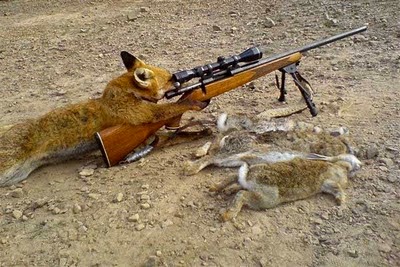

The USA vs Europe
Disclaimer – this is meant to be a bit of humor – let’s not all get offended!
There are many differences between the USA and Europe:

First off, Europe would fit inside the USA.
You call it petrol, we call it gasoline.
You call them chips (or whatever), we call them fries.
You use the metric system, we’re still on standard.
You use Celsius, we use Fahrenheit.
You call it the cinema, we call it the movies.
And so on, and so on, and so on ……….
But as a Ham, I’ve noticed a big difference in the way we approach special event stations. Here in the US, for the most part but not always, we apply to the FCC through the ARRL for special 1X1 call signs. For instance, when the Piscataway Amateur Radio Club celebrated the tri-centennial of the founding of Piscataway, we applied for and used W2P.
The 13 Colonies special event used call signs such as K2I for New Jersey, K2E for Delaware and so on. The special event station that just celebrated the 45th Anniversary of Apollo 11? W4A.
But in Europe, you guys take the opposite route! Special event stations from European nations can be a mouthful. DM200TSV, SF2014ECC, E72NATO, 3E2000PC, LZ1437MGS and my all time favorite, SV2013ATGM.
What I like about these European call signs is that they try to bear some significance towards the event they are commemorating – SV2013ATGM was about Alexander the Great, E72NATO celebrated membership in NATO and so on. A lot more descriptive than 1X1 call signs, that’s for sure.
I’m just waiting to hear one some day that has all the numbers 0 through 9 and all 26 letters of the alphabet. THAT would be a special, special event call sign – a bear to copy, but special, nonetheless!
72 de Larry W2LJ
QRP – When you care to send the very least!
Same callsigns?
One of the drawbacks of WSPR (currently) is you tend to get spotted, or spot, the same stations over and over again. I am even seeing the same stations being spotted on 10m and on 6m.
It would be very nice if there were a lot more active stations, so spots came from a variety of stations. I am even seeing this on JT65 and JT9-1.
Perhaps people think these “new fangled” digital modes are hard and so only a limited number of people (currently) use them. Let me say, if even I can use these modes then anyone can! All these modes are great with low power and have really opened my eyes as to how far very low powered signal can be detected.
 |
| 10m unique WSPR spots this afternoon (duplicates not shown) |

Overpriced KX3 options
Steve G1KQH has spotted the price of “after-market” mics on eBay. Under £5.
“The price of a Microphone:Someone is having a good laugh at stitching folk up with those KX3 Mics. The whole KX3 price is through the roof but there are plenty on the bands?”

Near miss – 11742km on 10m JT65
This evening CA3SOC (Chile) was calling CQ on 10m JT65. I called and called him – he called CQ about 14 times – but I was unable to raise him. At the start he was -16dB S/N but in the end was down to -22dB S/N. I was copied in Sweden at the same time, but that was no compensation.
Earlier in the afternoon I worked an E74 on PSK63, my first ever QSO on PSK at that speed. I am finding real-time keyboard operating in PSK modes quite “challenging”. Whenever I use the keyboard e.g to write this blog, I make lots of errors that need correcting. This is hard on PSK31 and PSK63 in real time. JT65 and JT9-1 are a lot easier. Currently I am using Digipan software which is simple and basic for PSK modes. I am using WSJTX V1.3 r3673 for JT65 and JT9-1.

FOBB 2014
I ended up staying home, working from the shack and forgoing my bumblebee number. The weather was partly a factor as one minute it was sunny and five minutes later it looked like it was going to downpour.
The real issue was my back. I woke up this morning with a stiff lower back. Nothing incapacitating, but sore enough that hiking to my FOBB destination while carrying all my gear, and then setting up would have been no fun. Added to that was the fact that my sore back has also slowed me down somewhat, so if I would have had to dismantle the station in a hurry, it would have been a problem.
Even from home, on the good antennas, band conditions seemed to stink. I didn’t hear a lot of FOBB’ers, and those I did hear were pretty weak. Giving out a 559 was generous today. I managed to work 15 stations.
I sure hope band and weather conditions and my back are better for the Skeeter Hunt!
72 de Larry W2LJ
QRP – When you care to send the very least!
Continuing JT65/JT9 today
When we get back from shopping I shall return to JT65-HF and JT9-1 modes hoping to work more stations. Yesterday, staying on 20m, I worked 4 Europeans running 2.5 or 5W. JT65-HF is very intuitive and works well. Althought I have had JT9-1 QSOs on 10m in the past, I suspect the rig stability is “challenging” and JT65-HF gives me a better chance. JT65-HF is some 4dB worse than WSPR but the TX period is only 48 secs (1 minute TX period but actual TX is less) so may be better with QSB? JT9-1 is a narrower bandwidth mode than JT65-HF and is about 2dB worse than WSPR. Of course, JT65 and JT9 are proper QSO modes.
Sunspot count today is 76 (decent) and 20-30MHz conditions are supposed to be “normal” so there could well be some F2 (as well as Es) on 10m today. JT65-HF and JT9-1 on 10m are calling I think.
The great advantage of WSPR is you can set the rig running and monitor things in another room. JT65 and JT9 seem to require “hands on” operation, which is fine.














