Archive for the ‘radio’ Category
 SOS Radio Week
 January 17th, 2012 |
  Author:
 This year Workington and District are joining up with Barrow in Furness club to extend the amount of stations we activate. We are operating from Silloth GB1LBC, Workington GB2LBC, St Bess GB4LBC and Barrow GB5LBC lifeboat stations from the 21st to the 29th January in a relaxed style. hopefully making htis years SOS radio week a bigger event locally.
The purpose of our time on the air as special event stations is to promote the RNLI as a charity, something that costs £300,000 a day to run!
St Bees will only be running at the weekends and We are looking to be on mainly 40m and 80m but the Cobwebb is coming with me so there is a possibility of something on the higher bands but it really depends on the weather as high winds will certainly destroy it.
I hope to work as many as possible in between cups of tea and choccy biccies and if you would like to make a donation then it would be really appreciated. Keep an eye out on the status monitors to see when we’re up and running.
JT65HF problems
There re just a ton of data modes you can play with and this morning was the turn of JT65-HF to be on my screen. I’d installed it quite a while ago and not used it for some months but I thought I could do with giving it a quick run through to remind myself of the protocols in case we use it on the SOS radio week operations (as GB4LBC for St Bees lifeboat station).
Time is very important with JT65 and a few other modes and I’ve never been a big fan of windows time setting utility. It never seems to be right and there is always a problem with either this or that. I use Dimension 4 on XP machines and it works very well. Under Windows 7 you have to remember to run it as an administrator so I suspect the same will be true for Vista. there seemed to be a bit of a conflict going on on my puny little computer so I had to reinstall JT65-HF and only then did it start to decode the received signals.
I took the opportunity to use my stealth antenna (A Watson 80 plus 2 dipole – which is really only good for 20m here) and immediately got a contact with DG8RW & W3PV with 15 watts.  I had a bit of trouble with the first contact as he couldn’t copy my signal report for a while and I had to resend it quite a few times before he got it. Eventually we got a QSO together and that was pretty pleasing.
So I’ve got my hands dirty again with JT65 and whilst its not the most interactive of modes it reinforces the fact that SSB is inefficient in comparison as I doubt I’d have got where I did with 15 watts and a loft mounted antenna. Still, it was a nice distraction from what I should have been doing. That was to be revising for an exam on Tuesday. Nothing exciting, a professional exam and much less enjoyable that playing with radios.
7-bit Barker Code and Matched Filter

Teaching Evan the basics of radar signal processing with this baby-block 7-bit Barker code and its matched filter.
The Spam Report
First of all, Happy New Year, loyal readers. I have been exhorted by several enthusiasts of the blog to write more. The months of November and December are busy around the Miller household with the CQ WWs, ARRL Sweepstakes, Thanksgiving, Christmas, and an annual professional conference on the West Coast between Thanksgiving and Christmas. So, this is a drought time of year for writing. A number of projects around the station have been started or completed and those will be written up as time allows. Travel and potential DX operation is on the horizon, etc, etc. However, today’s topic is WordPress comment spam.
I hadn’t checked the moderation queue on the blog comments for about six weeks until recently. There were some 1500 comments pending. Exactly two of them were from real commenters. (Thanks, by the way!) I could subscribe to a service (like Akismet) to stem the flow of spam, but I’m a cheapskate and skimming the spam is a bit like reading the police blotter in your local newspaper—a guilty pleasure.
The Internet democratizes the sale of nearly everything, legal or not, by providing a low-cost storefront for a business that can be based anywhere in the world, plus (semi-)anonymous payment. This is great for obtaining otherwise unobtanium surplus electronics and parts. But, it’s also great for anyone selling anything else that is high-risk (for vendor or purchaser) or low-volume in a standard retail setting. The difficulty for everyone is getting your business noticed. Enter search-engine optimization (SEO): techniques that game search engine algorithms to increase your visibility in a search. Google’s PageRank, for example considers the number of links to a site as a measure of its popularity. So, blasting every blog’s comment boxes with links to your site is a brute-force way to game that system (except the smart engineers at Google have weighted PageRank with the “quality” of the linking page and a whole host of other trade-secrets). Some SEO schemes appear also to develop trees of “link farms” to improve “quality.” But, this is just an arm-chair assessment.
Anyhow, the upshot is that there are a lot of keywords and links embedded in SEO spam. The keywords generally reflect what’s offered for sale and they seem to reflect typical black and gray market goods—counterfeit designer clothing (Ugg boots are the informal favorite in my spam tin, with sports jerseys a distant second), pornography, and dubious medical products and home remedies (“tattoo removal creams” was a recent example). Today, the bit bucket found a dozen or so messages such as these:

All point to the same site and contain keywords about amateur radio topics (except the SEO one at top). So, I can infer that one of several things happened: 1. The site owner’s site got hacked and the SEO scumbags wove their material into it to make the SEO look somehow more “legitimate.” 2. The site owner acted (paid…*shudder*) on one of those spam e-mails every domain owner receives that offer to “increase traffic to your site.” 3. The site owner is an SEO scumbag himself.
I’m leaning toward explanation #2, since the site itself makes him sound like the Homer Simpson line, “Oh, they have the Internet on computers now?!” Whatever the case, this is inappropriate behavior and I refuse to mention the site owner by name, callsign, or link, lest the action be successful. It’s the equivalent of splattering up and down the band on SSB when running high power to a good antenna. You’re a lid.
Ok, I feel better now.
SoftRock Ensemble RXTX IF modification
This is a pretty simple modification that converts a SoftRock Ensemble RXTX SDR RF interface board from “common-IF” (RX and TX share the same antenna port) to “split-IF” (RX and TX have separate ports). Split-IF is the standard for high-performance transverters on the 50-, (70-), 144-, 222-, and 432-MHz amateur bands.
So, I had a look at the RXTX schematics (here, here, and here) and considered the following options for where to break the RX and TX portions of radio:
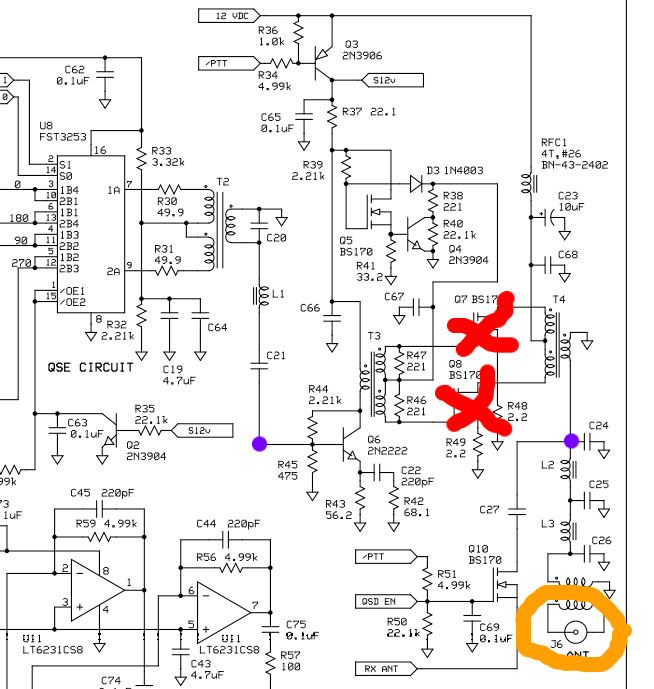
The purple dots were the first option. Unfortunately, these locations on the actual printed circuit board were not easily accessible to miniature coax and this process would involve significant surgery to perform and restore the modification. The second alternative I considered was the red Xs…jumpering over the BS170 PA transistors. By this time, I was looking for a way to avoid butchering the original circuit too much. So, I elected for option three, which was to install a second T/R switch at the antenna jack (golden circle). This had at least two advantages, the first of which was being minimally invasive. The big advantage, though, is that the radio could be operated at its design output and run through a fixed or step attenuator on the TX side to the transverter. This meant that I would be assured of having a reasonably clean signal to work with if I configured the radio correctly. It also meant that I could operate the radio as designed if I simply disabled the the second T/R switch and connected the antenna to the default port.
So, here is the modification that I came up with using parts I had in my junk box. KB9YIG ships the Ensemble RXTX with a couple of spare BS170 FETs that can be used in place of the 2N7000. I just had a lot of 2N7000s and thought I’d save the BS170s in case I ever burnt one in the RXTX.
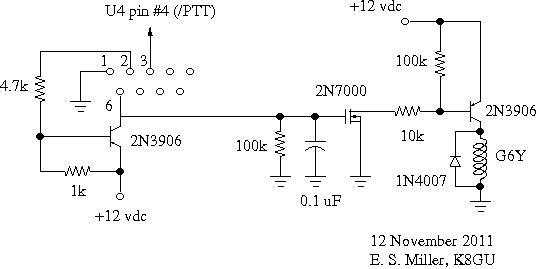
The interface to the transverter is through a DB9 connector. PTT for this transverter is +12 volts (as done with the TS-930S) on pin 6. Pin 1 is ground. Pins 2 and 3 are shorted together in the transverter cable connector to enable the modification in the SoftRock. The right portion of the schematic with the relay driver and Omron G6Y relay is based on the T/R switch from W1GHZ’s “Multiband Transverters for the Rover” that I decided not use on the microwaves when I found a cheap source of SMA coaxial relays. An I2C decoder would be great to put band data on the other pins to select a transverter (or transverter cascade for the microwaves).
The whole mess works great from a switching standpoint. When I key the PTT on Rocky or PowerSDR, it switches the TX line and keys the transverter. I’m a little ambivalent about the quality of transmitted signal that’s actually coming out. I think it’s good enough if you live in a sparsely-populated area, but I have a lot of VHF neighbors that I’d rather not upset. So, I need to do some more testing on this—a lot of it is getting the RXTX and PowerSDR configured correctly. It appears that the I/Q channels are flipped on my sound card (Audigy 2 ZS) between transmit and receive. I don’t know if that’s a wiring error in my breakout box or whether it’s normal. Spectra to come at some point…
SoftRock Ensemble RXTX
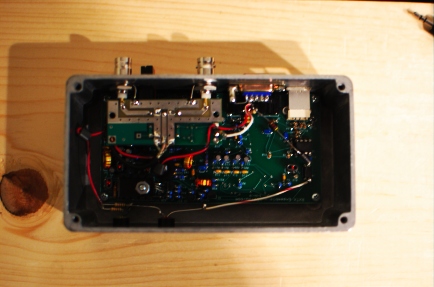
A few photographs of my latest tinkering—a SoftRock Ensemble RXTX. This unit provides all of the hardware necessary to have a software-defined radio (SDR) transceiver that uses a computer soundcard for ADC and DAC. It is available here as a kit. They are kitted in batches of 20-100 every few weeks and usually sell out within 24-48 hours.
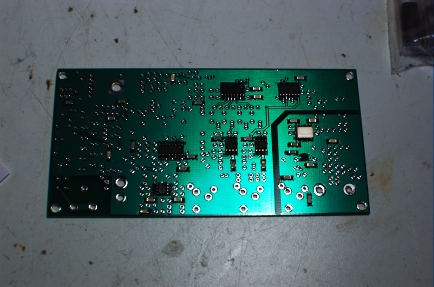
I originally had little interest in doing a full SDR transceiver (preferring receivers only) until it occurred to me that I could modify the RXTX as an IF strip for VHF/UHF transverters like many have done with the FlexRadio Systems rigs. So, I have developed a modification that is minimally invasive to the operation of the RXTX. At build time, you choose a nearly octave-wide “super band” for operation. This one was built for the 20-30 MHz band, covering the 15-, 12-, and 10-meter Amateur bands, as well as the 25-28 MHz IFs that I (will) use with present and planned transverters for the 6-, 2-, 1.25-, and 0.70-meter bands.
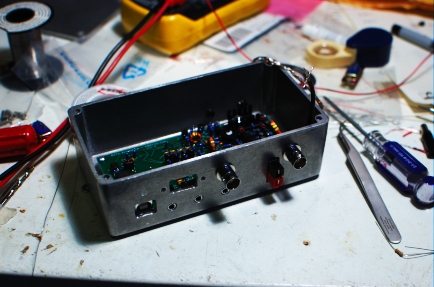
I’m not sure I have the enthusiasm to build another SoftRock. There are a lot of trifilar transformers to wind. The final result looks pretty good and seems to work. I’m going to put it on the spectrum analyzer soon to see how clean the output is and how I should balance the drive for the transverters. Then, I will also include a write-up of how the modifications are done. (I promise that writeup is the same place as the control circuit schematic for the 50-MHz transverter!)
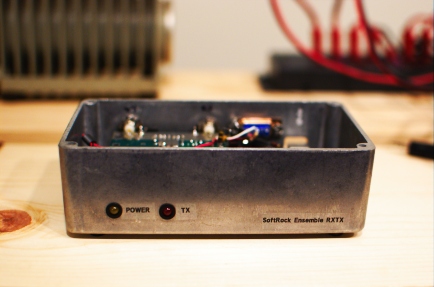
Here, you can see the W1GHZ relay board for doing split-IF T/R switching. If the transverter control cable (DB-9) is disconnected, the SoftRock switches to common-RF for regular 15-/12-/10-meter operation.
(No?) Nonsense Radio
The November 2011 issue of QST contains an Op-Ed that really left me shaking my head more than normal. The author bemoans the complexity and feature sets of newer handheld radios and pines for the days of his IC-02AT. He goes on at length about the “unnecessary” receive capabilities (NOAA weather broadcasts, AM/FM radio, etc) and how he has to search for the manual every time he wants to program a repeater offset.
Well, as someone who recently upgraded from a radio just slightly newer than the IC-02AT to a “modern” HT, he’s wrong on nearly every account (except the micro-/mini-USB port, which I would wholeheartedly support for charging purposes).
- Eliminate extraneous features. Too bad we all have different definitions of this. I think scanning is a worthless feature, but like NOAA/NWS weather broadcasts. In fact, my wife is delighted that we now have a battery-powered AM/FM+NOAA/NWS radio again that I will always be able to find and will guarantee that it works. Did you hear that, guys? My non-ham wife actually likes my HT and uses it to listen to FM radio!
- Eliminate multilevel menu trees. I’m just dying to replace my cell-phone-sized VX-3r with a knob-covered brick. I’m sure you are too. It’ll look great in my shirt pocket.
- Eliminate the proprietary programming cables. Maybe I’m not a typical ham, but I only have about ten memory channels programmed into my VHF/UHF FM radios and they took about 10 minutes to program through the front panel (my bad, menus). The mini-/micro-USB port is a good idea for charging, though.
- Allow for a battery pack that uses disposable batteries. Last time I checked, most radios have this option. Did I miss something?
- Create an inter-vendor standard for user interface. What if they standardize on Icom?!?! The last Icom VHF/UHF FM radio I used received a “grade of S, for ‘stupid’” from its owner. That was in 1993. All of the Japanese manufacturers will be put out of business by the factory owned by the Chinese military that produces their products before this happens.
He should buy another IC-02AT if he liked them so much. I bet for a Jackson or two, you could have a nice one…complete with the 6x AA battery holder. Heck, buy two or three for spare parts. I think I have the Service Manual around here somewhere if I didn’t already sell it.
On a more serious note, there are lots of no-frills radios available out there, even brand new ones with factory warranties. Until recently, at least, the money in VHF FM radios was in two-way, government, and public safety, not amateur. There are a lot of amateur rigs at the “low end” of the market that share a lot in common with their commercial counterparts. And, of course, you can always buy used Motorola gear on eBay if you desire ultimate performance and ruggedness.













