Archive for the ‘radio’ Category
 The runners up….
 January 23rd, 2012 |
  Author:
 These are the QSL card designs that didn’t make the final cut:


… it was kind of tough not going with the Delorean.
Spam, spam, egg and spam
Oh joy, my email seems to have been hacked into.
Apologies to anyone who has received any helpful advice they didn’t really want from my account.
I’ve spent the best part of an hour changing passwords and resetting things and this site hold no ‘email-able’ information so there shouldn’t be any coming through but if you’ve been got then I apologise and I’d like to say it’ll never happen again but you know how it is.
It happened at 8.37am today and the password was changed by 9am so it was the best I could do.
Very annoyed about it!
GB4LBC Special Event Station
It been a real pleasure to be operating the GB4LBC special event station for SOS radio week today. With just a long wire and 100w we had our own little pile up which lasted pretty much all day.
The station will be up and running again tomorrow on 40m and hopefully will be just as popular. The Workington and district club (MX0WRC) is operating 3 of the 4 stations in Cumbria
GB1LBC – Silloth
GB2LBC – Workington
GB4LBC – St Bees
GB5LBC – Barrow in Furness
GB5LBC is operated by our friends at Furness ARS and we managed to have a quick QSO during the pile up
Hellschreiber and microprocessors – Bridging more than 80 years
ZL1HIT (Bryan Rentoul) has bridged a gap of more than 80 years by combining the text transmission system developed by Rudolf Hell in the late 1920’s with current microprocessor technology.
 |
| A sample of received Hellschreiber test from Bryan’s beacon |
Hellschreiber sends a line of text as a series of vertical columns. Each column is broken down vertically into a series of pixels, normally using a 7 by 7 pixel grid to represent characters. The data for a line is then sent as a series of on-off signals to the receiver, using a variety of formats depending on the medium, but normally at a rate of 112.5 baud.
This process was historically accomplished with mechanical equipment but there are very few examples of this equipment still in operation and it is now sent and received by computer. Hellschreiber is very tolerant of noise and interference and requires only simple transmitters and receivers to work effectively.
 |
| German Hellschreiber unit in operation |
With a microprocessor generating the digital on-off signals a simple crystal oscillator transmitter can be used to form a beacon station, one that transmits a call sign and perhaps some other information over and over. Changing the transmitted message is as simple as reprogramming the microprocessor or having it respond to a connected input, for Eg. A thermometer, light sensor, switch, etc.
Receiving the signal and decoding requires a radio receiver capable of CW reception and a computer running any of several free software packages like FLdigi or Digital Master 780.
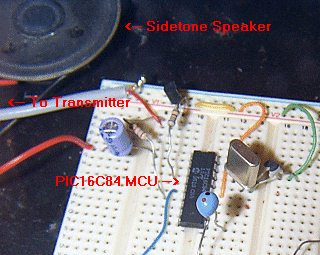 |
| The ZL1HIT beacon using a PIC microprocessor and a simple crystal oscillator transmitter. |
For more information and the PIC microprocessor source code please visit the web page of Bryan Rentoul here : ZL1HIT Hellschreiber / PIC Beacon
SOS Radio Week
This year Workington and District are joining up with Barrow in Furness club to extend the amount of stations we activate. We are operating from Silloth GB1LBC, Workington GB2LBC, St Bess GB4LBC and Barrow GB5LBC lifeboat stations from the 21st to the 29th January in a relaxed style. hopefully making htis years SOS radio week a bigger event locally.
The purpose of our time on the air as special event stations is to promote the RNLI as a charity, something that costs £300,000 a day to run!
St Bees will only be running at the weekends and We are looking to be on mainly 40m and 80m but the Cobwebb is coming with me so there is a possibility of something on the higher bands but it really depends on the weather as high winds will certainly destroy it.
I hope to work as many as possible in between cups of tea and choccy biccies and if you would like to make a donation then it would be really appreciated. Keep an eye out on the status monitors to see when we’re up and running.
JT65HF problems
There re just a ton of data modes you can play with and this morning was the turn of JT65-HF to be on my screen. I’d installed it quite a while ago and not used it for some months but I thought I could do with giving it a quick run through to remind myself of the protocols in case we use it on the SOS radio week operations (as GB4LBC for St Bees lifeboat station).
Time is very important with JT65 and a few other modes and I’ve never been a big fan of windows time setting utility. It never seems to be right and there is always a problem with either this or that. I use Dimension 4 on XP machines and it works very well. Under Windows 7 you have to remember to run it as an administrator so I suspect the same will be true for Vista. there seemed to be a bit of a conflict going on on my puny little computer so I had to reinstall JT65-HF and only then did it start to decode the received signals.
I took the opportunity to use my stealth antenna (A Watson 80 plus 2 dipole – which is really only good for 20m here) and immediately got a contact with DG8RW & W3PV with 15 watts.  I had a bit of trouble with the first contact as he couldn’t copy my signal report for a while and I had to resend it quite a few times before he got it. Eventually we got a QSO together and that was pretty pleasing.
So I’ve got my hands dirty again with JT65 and whilst its not the most interactive of modes it reinforces the fact that SSB is inefficient in comparison as I doubt I’d have got where I did with 15 watts and a loft mounted antenna. Still, it was a nice distraction from what I should have been doing. That was to be revising for an exam on Tuesday. Nothing exciting, a professional exam and much less enjoyable that playing with radios.
7-bit Barker Code and Matched Filter

Teaching Evan the basics of radar signal processing with this baby-block 7-bit Barker code and its matched filter.













