Archive for the ‘radio’ Category
 Big Gun
 May 15th, 2012 |
  Author:
 It’s not often I hit some DX but WSPR helps me out quite a lot. Here’s a screenshot from my latest 1w big gun escapade

1w into Hustler 6-BTV
Whilst some might say that lifes too short for QRP. Newly licenced hams take note. 1w into a lossy vertical in a bad location doesn’t mean you’re stuck with QSO’s as far as the end of the street.
All this was achieved with a modest transceiver (IC-7000) and a modest antenna (Hustler 6-BTV with a few radials). The lesson here is that DX isn’t just for those with limitless pockets of cash, elevated QTH’s and antenna systems that can rival your nearest broadcaster. You just might not be talking to the other station!
Armed Forces Day Crossband Test
 I had a fairly successful day participating in the Armed Forces Day Crossband Test. To recap, I am currently at Fort McCoy, Wisconsin for a brief period of time supporting a National Guard exercise. Normally when I go around to different Army units and assist in their exercises I fly. But I decided to take my Toyota Tundra on this trip and re-installed my HF rig. I have never preiously particpated in the Armed Forces Day Crossband Test and have always wanted to…. this was my chance.
The AFD Crossband Test has two components to it. The first is to receive a message from the Secretary of Defense which is transmitted in various digital modes from different military stations during the day. The second part of the Test is to make contact with the military stations with the military stations operating in their band and the amateurs in their band (hence the term “Crossband”).
For the Secretary of Defense message I hooked my Rigblaster Plug & Play to my IC-706MKIIG and brought my laptop into the truck (which has fldigi installed). The Rigblaster worked like a charm and I was able to copy the SECDEF’s message from WAR (at The Pentagon), AAZ (Fort Huachuca, AZ), and AIR-2 (New York). All these transmissions were in RTTY, which fldigi was able to read without issue. Now I need to print out copies of the messages I copied (which are the same, except the header information which reflects what station was transmitting the message) and send them in to the corresponding station. In return, I believe, I’ll receive a certificate from the SECDEF (suitable for framing, I’m sure).
The crossband contacts caused me to take a crash course in split frequency operations for my IC-706MKIIG. Fortunately I had my Nifty “Cliff Notes” version of the manual and was able to figure it out pretty quick. Although the actual execution took a bit of time to get down. First, obviously, I had to hear the station calling. MARS HQ publishes ahead of time a list of each station and the frequency that they will transmit from. I built a spreadsheet that allowed me to sort by frequency which made it easier to search for the transmitting station. The searching was done in the IC-706MKIIG’s VFO A. Once I found the station, I had to listen for them to announce the amateur frequency they were listening to… which most stations did periodically. Once I got their listening frequency, I flipped over to VFO B, dialed up the frequency, tuned the Tarheel screwdriver antenna, flipped back to VFO A, then hit the Split function, and waited for a chance to call. In the end, I was successful in contacting five different stations: WAR (at The Pentagon), NWKJ (located on the USS Yorktown, Charleston, SC), NMN0CQQ (located on the USS Midway, San Diego, CA), AAZ (good ol’ Fort Huachuca, AZ), and NWVC (a Navy MARS station in Indiana). For these contacts I get to send in my QSL card and hope for a response.
None of this was exotic DX but it was fun and exciting… and a bit challenging trying to do it all from inside my Toyota Tundra. I hope I am able to particpate again next year.
$3 AIR-2 AIR-2 MESSAGE FOLLOWS
RYRYRYRYRYRYRYRYRYRYRYRYRYRY
RYRYRYRYRYRYRYRYRYRYRYRYRYRYDE AIR-2 AIR-2 MESSAGE FOLLOWS
SECRETARY OF DEFENSE
ARMED FORCES DAY 2012 MESSAGE
TO AMATEUR RADIO AND
MILITARY AUXILIARY RADIO SYSTEM
OPERATORSQUOTE
FOR THE PAST SIXTY-THREE YEARS, OUR NATION HAS RECOGNIZED
THE DISTINGUISHED GLOBAL SERVICE OF OUR UNITED STATES
MILITARY DURING THE ANNUAL ARMED FORCES DAY CELEBRATION.AMATEUR RADIO AND MILITARY AUXILIARY RADIO SYSTEM OPERATORS
PROVIDE ESSENTIAL CONTINGENCY COMMUNICATIONS TO RELIABLY SUPPORT
OUR NATIONS MILITARY AND GOVERNMENT AGENCIES. YOUR SUPPORT OF
COMMUNICATIONS BETWEEN DEPLOYED SOLDIERS, SAILORS, AIRMEN,
MARINES, SUPPORTING CIVILIANS, AND THEIR FAMILIES IS DEEPLY
APPRECIATED.ON BEHALF OF ALL UNIFORMED SERVICES, I EXTEND MY SINCEREST
APPRECIATIMN FOR YOUR HARD WORK, SELFLESS DEDICATION, AND
VITAL SERVICE TO OUR GREAT NATION. WELL DONE!/S/ LEON E. PANETTA
SECRETARY OF DEFENSE
UNQUOTE
APPROVED FOR TRANSMISSION,
DE AIR-2 AIR-2
SK
On The Road Again
When I left for Korea, I had to pull out the HF installation on my truck… as the truck was staying in Kansas and I was not. Pulling out the rig and tuner was easy. The Tarheel antenna was also fairly simple. A disconnect at the base and then I coiled up the feedline and the cable that powers the screwdriver so they would be mostly out of the elements.
I returned back to Kansas last June but did not reinstall my HF setup in the truck. My only real modification was swapping out my VHF/UHF antenna with a fold-over. The new house afords me the opportunity to park in the garage(!) but rather than unscrewing the antenna every time I enter the garage, now I just have to pull it down. Works great.
My assignment here in Kansas has me traveling quite a bit and this week I am headed up to Wisconsin. I have only driven through Wisconsin once so instead of flying, I am going to make the 9 hour drive. This had me thinking that if I am on the road for 9 hours, I need my HF rig. So today I put the radio back in and reattached the Tarheel antenna.
Everything was set – I fired up the rig and heard the Turbo Tunner beep that it was on and ready. I hit the 706′s tuner button but the screwdriver failed to turn. Troubleshooting time. I took the base of the antenna down to the bench. Then I dug out the original rocker switch that came with the Tarheel. I hooked it up to the bench power supply and then hit the switch. Nothing. After a bit of jiggeling and wiggeling, the screwdriver engaged. I guess the almost two year siesta had taken a bit of a toll.
After a test drive today, it appears as if the mobile HF rig is working FB!… one QSO with North Carolina and another with Massachusetts. So look for me (AD7MI-9) as I make my way to Fort McCoy, Wisconsin and maybe I will catch you on 20M.
Bad day
For quite a while now I’ve not been able to get into the shack. Not because its stacked to the rafters with new gear but because I’ve had too much on to even think about it. Yesterday I managed to squeeze some time in and quite frankly I wish I hadn’t bothered.
My FT817 lives in a padded bag when its not in use along with its charger and an old Miracle whip. Now the Miracle whip no longer has a whip courtesy of my youngest who managed to snap it in half. Whilst it isn’t the finest antenna it was extremely useful for travelling. Now I need a replacement telescopic whip and I’m guessing they’re either hard to get hold of or unnecessarily expensive.
The other doom was the CI-V controller (mine is a G4ZLP USB digimater pro+) which has given some sterling service over the last couple of years but now has decided to read the frequency but not PTT or supply audio. Several wasted hours later the status quo remains. Reliability of kit in my shack isn’t that great at the best of times and this just confirms that a law based on expense and reliability. ‘No matter what it costs the chances are that it’ll stop working for no apparent reason’.
At this rate I’ll have nothing left either as a result of a 3 year old or its own suicidal components..
W5IG Cool Transmitter
A very creative way to add an important addition to your station. I would argue this may be essential for any radio amateur who find themselves in the hamshack for long periods.
Allow me to introduce myself
Hello AmateurRadio.com readers! I am Neil, W2NDG, a resident of the North Shore of Long Island in New York. I am a recent ham (August 2011), but a life-long techie and a shortwave listener since 1973. I will be posting from time-to-time here and wanted you to know a little about me first. I write mostly on my own sites, which can all be reached through the landing page at neilgoldstein.com.
I will be taking a look at the hobby from a newcomer’s point of view, but also covering the areas where computers and amateur radio cross over. I intend to learn code and build some QRP equipment by the end of the summer, so follow along, and we’ll have some fun with all of this. I also have some interesting plans involving SDR that I hope to be able to share in the months to come. I want to try to appeal to those of you out there on a limited budget, and help you find what you need without breaking the bank. These are tough times for many of us, but it shouldn’t keep us from having a great time with amateur radio. I also have 3 (possibly more) family members currently studying for their Technician licenses, which should make things interesting. My first post is a research piece I did for my club (LIMARC) here on Long Island about kit sources for amateur radio. So, 73s for now. See everyone soon.
Neil, W2NDG
QST Digital Edition beta
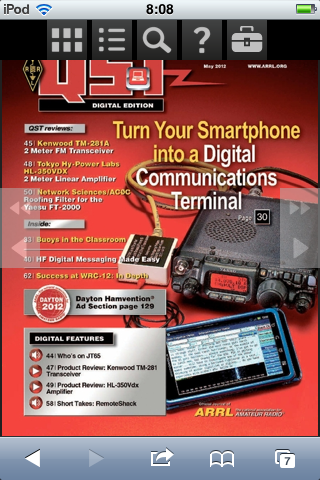
The other day I received, like some unknown number of others, an invitation to try the QST Digital Edition beta for the May 2012 issue. I am not a hard-core mobile/digital media user. But, Sarah is a librarian who has specialized in management and procurement of electronic journals and books. So, she gave me the low-down on what to look for. And, over the years, I’ve given her what-for about eBooks because, as I like to say, “I am willing to risk a single print copy of something by taking it places I wouldn’t risk taking an electronic reader.” That sums up the perspective I took when reviewing e-QST.
You can read about the Digital Edition on ARRL’s FAQ here. The desktop version requires Flash to use in-browser or Adobe Air and an enormous download to go stand-alone, neither of which really warmed my heart. But, it does work in the web browser of a mobile device. I have a 2nd generation iPod Touch running iOS 4 and it worked great in Safari. I now have a bit of insight as to why people might love their iPads (which I have always viewed as a more-expensive, less-convenient version of the iPod Touch or iPhone). There appear to be only two levels of zoom: fit page width and zoomed-in. No matter how good your eyesight, you need to be zoomed in to read because the characters don’t render legibly otherwise. I think iPad’s larger screen might make reading it easier.
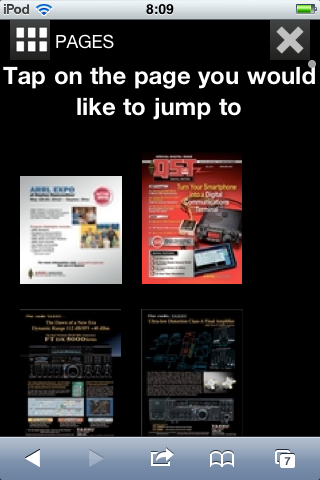
Browsing page thumbnails was OK, but it’s difficult to actually know what you’re looking at before you select the page. It also would be nice if the pages were numbered in thumbnail view.
One of the big advantages of the Digital Edition is that you can do things you can’t do with the print version, like including audio of JT65. Granted, I think almost anyone who’s active on HF CW or digital knows what JT65 sounds like, but it’s a basic demonstration of the kinds of things that will be possible in the new format.
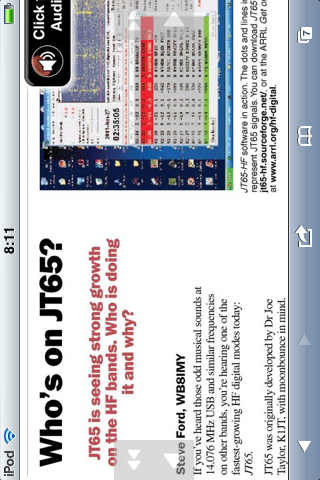
Given that I’m usually done with one month’s issue by the time the next one comes out, the Digital Edition is alright for basic browsing and reading. It’s much faster to skim the print issue, at least with my barebones 768 kbps DSL connection and the higher visual bandwidth of print (read Tufte’s essay The Cognitive Style of PowerPoint for more on this and other interesting reasons to hate slide decks). The mobile version also requires you to be connected to the Internet to browse. It turns out that an entire issue is on the order of 350 MB to download stand-alone on a computer. This makes it difficult to take places where I often want to read QST (on airplanes, for instance)… It is possible to print from the desktop version (I tried it using 32-bit Windows XP and Firefox), although it seems to be slower than the mobile version (not entirely unexpected).
Another thing that’s a bit different is that if you download the offline content to your desktop, you still need to authenticate to open it. It’s not clear whether this continues if you drop your ARRL membership. It is a bit different than owning boxes of back issues…even if you drop your membership, you still have the magazines. I don’t think this is a huge concern for most hams, who probably wouldn’t be interested in old QSTs if they dropped the membership.
In summary, I like the concept of the Digital Edition, but I wish I could carry off-line issues around on my mobile device. ARRL hints at this in the FAQ, so I am hopeful.