Archive for the ‘radio’ Category
 Digital SWR meter final adjustments
 September 15th, 2012 |
  Author:
Here’s the finished digital SWR and power meter kit from Radio Kits that is being used by the Workington Amateur Radio Club as a bit of soldering and coil winding practice. Not the poor lining up of the LCD screen. Shame really as the soldering was one of my better bits and that’s going to be covered up. All in all a nice kit to put together, I’m no soldering super star and I took my time so instead of it bring an ‘evening’ kit it I’d more like a ‘weekender’.
Deep breath….and relax
2 months to supply a switch, 2 months!
My PSU has a faulty switch (as diagnosed by a telephone conversation with a the suppliers service dept). Ah ha a replacement should fix that sir. Great, well I can live with the mark up if it turns up quickly and I can get back on the air.
A completely different switch was supplied. Several conversations and apologies later a second one was despatched, second class. Again different and again returned. This so far has taken 2 months and a lot of chasing on my part.
I felt a ‘snot-o-gram’ was needed, one was crafted and sent yesterday evening. Today I received a phone call and more apologies after then being passed around 3 people the last person told me to de-solder the one they are going to send to me and re-solder the wires on the switch of mine that they have. Good quality British customer service.
Would it not have been easier to say this 2 months ago?
I will now be taking some deep breaths.
The case of the ……
Well Dr Watson, its wobbly metal.
Enough of the Tom Foolery and down to the serious business of an issue that must be fairly common. Drilling larger diameter holes in flexible metal sheet generally found on hobby cases. Just in case you were wondering though Tom Fool (aka Tom Skelton) is apparently a ghost of a Jester at our local castle, Muncaster so here’s hoping he’s had plenty of opportunity to wander round the house and grounds with odd shaped holes in his thin sheet metal parts.
A lot of trouble I have with when its time to put a project in a case is that the 16mm hole needed for an SO239 for example causes me no end of trouble. I have tried a number of different ways to make the holes without giving a figure of 8 or elongated hole. Step drills tend to give slightly better results that piloting and increasing the bit size. I have found that the latter can easily end up with a poor hole if any vibration is imparted into the case.
So what’s the answer, well, I just don’t know. Punching would seem to be a better solution as would routing the holes but in the case of pre folded sheet I’m sure this isn’t too practical. I’m wondering if people have had better results with other ways of making these holes.
The Birthplace of the Wind
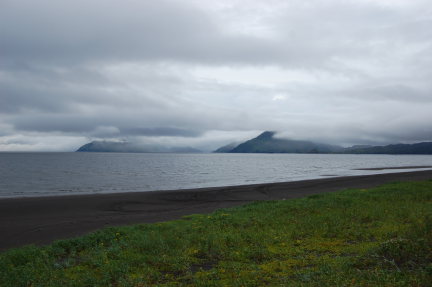
I recently had the good fortune (Sarah and some Alaskan friends might question the use of the adjective “good”) to spend about 10 days on the Aleutian island of Adak for work. In the midst of preparing for the trip, I learned that my fellow travelers Kevin, KJ4OAP, and Nathaniel, W2NAF, were planning to bring ham gear. Of course, I was as well, so we ended up with quite the merry bunch of hams on Adak. I don’t collect IOTAs, but I know it’s popular. So, I checked out Adak Island in the IOTA directory—NA-039, Andreanof Group. Fewer than 20% had claimed it, so it’s not super-rare, but not super-common, either. I was assured by at least one friend that we would be very popular, especially in Europe.
One of the first things you notice about Adak when you get off the plane is the wind. In fact, the locals call Adak “the Birthplace of the Wind.” It’s actually quite poetic considering that the winds are so strong that you don’t leave furniture outside and that the houses shudder with typical gusts. I experienced 75-mph gusts and 60-mph sustained winds during my short visit alone.
Adak is probably best known as the forward base from which the U.S. conducted its counteroffensive against the Japanese invasion of Attu and Siska during World War II. It also played an important role during the Cold War and although the military left some 10 years ago, it retains much of the infrastructure including heavy machinery, a port, and a large airport. The population shrank rapidly from a peak of just over 6000 in the 1990s to around 150 today. Just before the military (principally Navy) pulled out, they were in the process of building new base housing. The housing was completed nevertheless and so there are literally dozens if not a hundred homes that have never been occupied! Some of the others have been converted into a small hotel (this is where we stayed).
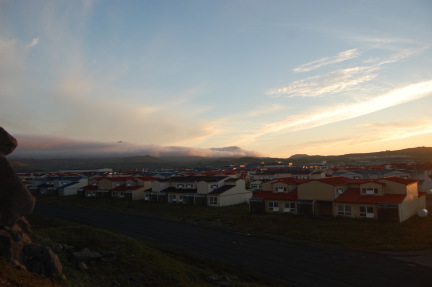
The economy is heavily dependent on fishing and fish canning right now. However, the locals are excited about the possibility of becoming a logistics hub for oil and gas work in the Bering Sea. In fact, the aircraft I came out on (An Alaska Airlines 737-400) had an unprecedented 60+ passengers on it because executives from an oil company were coming to check the place out.
Alaska Airlines operates “regular” flights twice per week.
Due to a fiction of time zones, Adak is only one hour behind Anchorage, despite being some 27 degrees west. So, sunrise and sunset are both very late in local time. It is also very far south, about the same latitude as Vancouver. Although I arrived at 6:30 pm, it was still light out for almost another four hours. So, I quickly put up the vertical on 20 meters just before sunset.
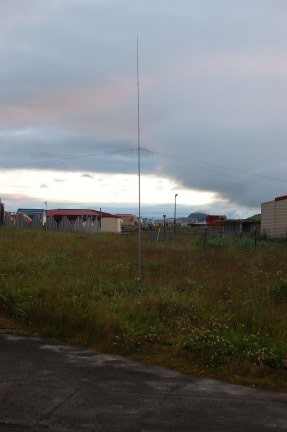
While we were putting up the vertical, Nathaniel met Jeff, KL2HD, who happened to have flown in on the same flight as us and who also happened to have his office and station across the street from my apartment. Neat. He works for U.S. Fish and Wildlife Service and they have field sites throughout the Aleutians. They use HF to communicate with their camps. So, he just plugs into a well-installed folded dipole to do his hamming. Have you ever seen a folded dipole installed between two (yes, two) Rohn 45 towers? Intense. Wind.
Due to our work schedule (8-10 hours per day plus meals), I often did not manage to get on until 0500 UT at the earliest, and sometimes even later. But, when I did, I was greeted with a roaring pileup of the “deserving.” This elicited a little bit of mail from my East Coast friends about getting on the air earlier. It turns out, however, that for most of the trip, 20 and 17 meters were open to the entire U.S. until 0630 UT. Both the skimmers and the QSOs bear this out.
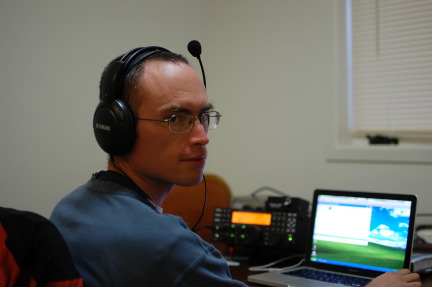
Why yes, I did get a new radio to replace the FT-840. More on this in the future.
It was pretty apparent that I had a lot of callers who couldn’t (for a variety of reasons) copy me. European friends reported a total lidfest on their end the first night I was on the air, although I learned a lot about pileup control on this trip. I have great respect for the “real” DXpeditioners who do this from the rarest locations. This was tremendous fun, though, and I enjoyed working each and every one. Thank you for calling!
There was one night on 17 meters that I CQed dead air for almost a half hour, making just two QSOs with stateside stations. And like a switch, the Europeans came in over the pole. It was incredible: I made 300 QSOs in 2.5 hours that night…mostly Europeans and Japanese.
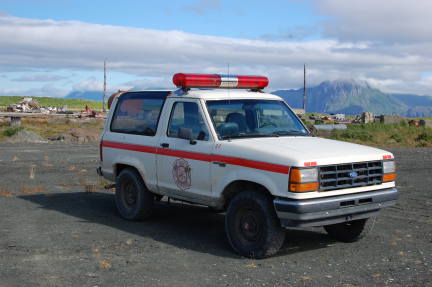
Oh, one more photo…this is one of our rental vehicles on Adak. No, your ARES group cannot buy it. The siren and lights don’t work anyway.
So, I got home on Monday and Sarah is amused by the amount of fan mail (QSL cards) the trip generated. Speaking of QSLing, the log has been uploaded to LoTW and has already generated about a 25% return rate. If you worked KL7/K8GU, you can get a nice photo card by sending an SASE or SAE+green stamp to my callbook address. I also use the bureau. To this point, Kevin and Nathaniel and I have been planning to share a card. They are still there for another week (so, if you missed me, you still have a chance for NA-039) and then we will figure out a card and order them. So, it will be a few weeks until cards can go out.
Lighter yagi’s
Over the summer I managed to ‘do’ 2 out of the 5 available 2m Backpacker contests. These to me are a great opportunity for me to get out on the fells and enjoy a longer spell on a summit with a nice qrp rig and some simple gear. The trouble with contesting is that inevitably you want to do better. So what’s the likely areas for improvement. Well there’s the rig, coax and antenna.
The rig is an ft817 and its not going anywhere fast. I sold once once then instantly regretted it. So it’s not going to be changed in a hurry. Yes it has its problems but frankly it just works and is relatively light so its a keeper.
Coax…Hmm work in progress. RG213 is too heavy, Ecoflex just isn’t flexy enough for summit packing. I’m yet to find the ‘perfect coax’. I’m leaning towards a trial with some Messi & Paoloni Ultraflex 7 as I like Mini 8 as a size but am looking for perfection here kids. This just means a reduction in losses to something as low as reasonably practicable as the saying goes
Antenna. Well I do like my now obsolete Sotabeams SB270 ( A 3 element yagi that lives inside its own plastic boom). Its light and doesn’t get thrown about too much in the wind and has lasted years. Trouble is it’s looking a bit knackered now and 3 elements is a bit short. I bought a 5 element LFA off innovantennas years ago and was really disappointed with the build quality. The elements just weren’t secure enough and it was way too heavy. Too heavy for a UKAC /p so no good for a summit. But it is well designed and the elements are quite light.
So the plan is to change the coax. I’ll do that over the winter. In the mean time I’ve taken a few grams off the yagi.
The boom was very substantial 32mm2 2mm thick Aluminium (note spelling you stupid browser ;-)). The boom weighs in at 1150g as is.Swapping this for 20mm2 1mm thick boom I’m down to 560g. Roughly half the weight. Element clamps have been swapped for the G1YBB method of IML mouldings plates and cheapo pipe clamps

You can see the immediate difference in size. The original beam is clearly made for sticking up at home then forgetting about it, ignoring the defects with this particular one.
Now with the elements added. They simply snap in to the pipe clamps and are held in place without any bother.

We’ll see how easy it is to carry up the Old Man of Coniston next year but at 1240g it is nearly 500g lighter than the original with the same RF performance.
I bought 2 pieces of aluminium and have a larger 2m and 70cm DK7ZB yagi that needs the same treatment (I went the other way this time, it was too light and flimsy) that I’ll give a run out during the Christmas Cumulative content
Portable in Devon
The summer here in the UK may have been the home of the Olympics and Paralympics, in fact I’ve just worked 2O12L, the special event station for the Paralympics. But one thing over everything else has dominated every Englishman’s mind. Just exactly how wet and miserable has the summer been. As I write this it is chucking it down again and the temperature is sliding towards ‘Autumn’. I can confirm that not all the UK is under water, all the time.
That said I have had a lovely week in a small village in Devon called Instow. We rented a small house opposite the beach and did the usual things with the kids. Sand castles, ice creams and cream teas as well as a bit of body boarding (for the kids, not me. I didn’t manage to get a surf board out but that’s probably a good thing). I did manage to sneak in my FT817 and Prowhip antennas fishing rod antenna into the car before the XYL spotted it.
Not many contacts to add into the log but it was nice to hit a US special event station W9IMS in Indianapolis with just a couple of watts. Perhaps it was the overly relaxed operating position.

The pursuit of The Elser-Mathes Cup
 The story of the Elser-Mathes Cup may be familiar to many of you. For those of you who are not in the know, you can get all the details from the article by Fred Johnson Elser, W6FB/W70X, in the November 1969 issue of QST. To summarize, the establishment of the Elser-Mathes Cup in 1929 was directly inspired by the leaps and bounds up to that point in radio technology combined with Hiram Percey Maxim’s fascination with the planet Mars. The cup is to be awarded in recognition of the first amateur radio two-way communication between Earth and Mars. I would bet that the cup’s initial establishment was somewhat tongue-in-cheek. Although Fred Johnson Elser’s QST article, on the tail of the success of Apollo 11, gave the cups existence and purpose a good deal more veracity.
How close are we to finally awarding the Elser-Mathes Cup? Lets look at some recent milestones:
Earth-Moon-Earth Bounce
In January 1953, Ross Bateman, W4AO, and Bill Smith, W3GKP successfully bounced at 2M signal off the Moon.
Signal reception of Voyager 1

On March 31, 2006, German radio amateurs successfully received transmissions from Voyager 1 which was already well outside the Solar System (~7,436,464,581 miles away from Earth).
Earth-Venus-Earth Bounce

On March 25, 2009, German radio amateurs achieved another first by bouncing a 2.4 GHz CW signal off of Venus – which at its closest point to Earth is a mere 24,000,000 miles away and 162,000,000 miles at its furthest.
Earth-Mars-Earth Bounce?
Mike Brink, ZR6BRI, has definitely done his homework to show the feasibility of radio amateurs bouncing a signal off of Mars (which has a distance from Earth that varies from 36,000,000 miles to 250,000,000 miles).
However, bouncing a signal off of Mars will not win The Elser-Mathes Cup. The amateur contact must be two-way.
 Could the Mars Science Labratory (Curiosity) fulfill the role as the second party of an amateur QSO?
Curisoity does have UHF communication capability. One of Curiosity’s antennas is nicknamed “Big Mouth” and is used to send large data sets to one of three orbiters around Mars: the Mars Reconnaissance Orbiter (which will probably do most of the work), Mars Odyssey Orbiter, or the European Space Agency’s Mars Express orbiter. The orbiter then relays the data via the Deep Space Network (DSN) back on Earth using X-Band.
“Big Ear” is Curiosity’s high-gain, directional X-Band antenna that can be used to communicate directly with the DSN on Earth. “Little Ear” is an omni-directional, X-Band antenna that is designed to be used primarily to receive low data rate transmissions from the DSN.
Putting aside the fact that Curiosity’s X-Band frequencies are outside the authorized US amateur frequency allocation and given the German amateurs success with Voyager and Venus – amateur communication with Curiosity looks possible (but probably not with my Arrow II antenna).
So, if it is possible for Joe Amateur (along with a heap load of expensive gear) to have a QSO with Curiosity – what would prevent the actual hacking of Curiosity?
Damon Poeter’s August 9th article “How to Hack NASA’s Curiosity Mars Rover” takes a look at this proposition. Mr. Poeter all but dismisses the possibility of a private citizen contacting Curoisty and instead focuses at actually hacking through NASA’s control system. Then on August 10th, Mr. Poeter submits “Unknown Actor Soliciting Partners for Mars Rover Hack”. Now, possibily, there are individuals who are actually trying to hack their way through NASA by soliciting help in determining what frequencies are used to communicate with the orbiters above Mars.
Here on an IT secuirty forum, a question is asked concerning the secuirty of Curiosity. One of the responses is from a former controller who is somewhat familiar with NASA’s general communications protocal with spacecraft and identifies the transmission of bogus communications to Curiosity as a possibility. Although the post’s author identifies that the capability to conduct such an act would have to be another country (…. and everyone loves pointing the finger at China).
It is easy to forget that radio amateurs have been intercepting space communications for sometime, with Sputnik’s signal on 20.007 MHz and Apollo 11 communications being primary examples.
All this being said, I think The Elser-Mathes Cup will continue to gather dust for a bit longer.













