Archive for the ‘radio’ Category
 Thoughts on QRP
 August 23rd, 2013 |
  Author:
 I recently read an excellent post by W2LJ on non-QRPers’ perceptions of “the frustration of QRP.” While I’m in 100% agreement with what he writes—essentially to “act loud” when you’re operating QRP—I’m guilty of the very first sin he calls out at the beginning: advising new hams not to start on HF with [a] QRP [rig].
I stand by this advice. Here’s why. The advice is often solicited in the context of saving money by buying a QRP radio (e.g., FT-817, IC-703, KX3, etc) versus a full-power unit (e.g., FT-857, IC-706/IC-7000, KX3+KXPA3, respectively). Everybody wants to save money, not everyone wants to operate QRP, whether they realize it or not. It’s a whole heck of a lot easier to crank a 100-watt radio down to 5 watts than it is to crank a 5-watt radio up to 100 watts. So why does that matter since we’re talking about why people should or shouldn’t start with QRP? If you operate QRP, look at your log. You should see a pattern. Most of your QSOs are on CW or digital and on the “core” HF bands, 40/30/20/17/15 meters.
QRP is not frustrating at all, as long as you operate CW (or digital) into decent antennas on certain bands. Knowledge and skill indeed trump power. But, if you are just acquiring knowledge and skill for the first time, a little reserve power doesn’t hurt. Just my thoughts.
End of the holiday
After a good 7 months of work without much time off I’ve come back off a lovely holiday in Ile de Re, France. The island is 4km off the coast of La Rochelle and is a fantastic place and a popular place for ‘Le Weekend’. It reminded me how bad my French was but nice to practice what poor language skills I have.
Famous for salt and donkeys in pyjama’s as well as good wine and sea food. Gros Jonc is the long vertical beach on the right hand side at the top of the picture. Lovely in the sun and 2 minutes walk from where we were staying.

The closest I got to radio was seeing a chap with a TM25H (Le Mans 24 hour race special event station) T-shirt but as he was heading for the gents I wasn’t going to strike up a conversation.
A Summer Trip to Greenland
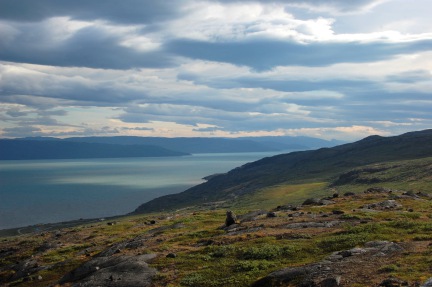
A professional colleague who is the principal investigator of the Sondrestrom incoherent scatter radar facility announced at a conference that they no longer had a scientific high-rate GPS receiver at the site for making ionospheric measurements. I enthusiastically volunteered to ship them one that I had on the shelf. She suggested that instead I should come install it myself and I found some support to do it (the National Science Foundation heavily subsidizes U.S. Greenland and Antarctic scientific travel during their respective summers, making this trip possible). Therefore unlike my previous trip in the winter, this trip did not involve travel with the most perverse of arrangements flying to Copenhagen only to hop on another plane and fly half-way back to the States. I set off for my second trip to Greenland, leaving Scotia, NY, early on Monday and returning mid-day on Friday.
On the past trip, conditions were really awful for radio with plenty of visible Aurora. I didn’t really mind that because the auroras were beautiful, but with only a small chance of NLC/PMC (noctilucent/polar mesospheric cloud) sighting in the summer, I was eager for some good radio conditions to sate my appetite for other nerdy activities. I set up the radio equipment almost right away the first evening to make sure that everything tuned up and immediately made 10 or so QSOs on 20-meter CW before heading to bed.
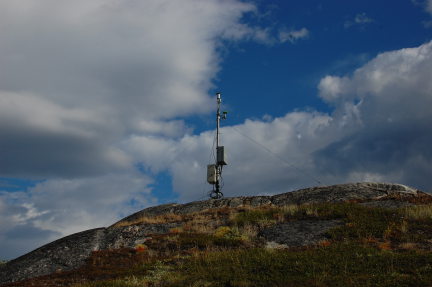
Instrument installation is always a hairy business, especially when you can’t just run to a hardware store, let alone going to RadioShack or calling McMaster-Carr. Sometimes, everything works smoothly; other times it doesn’t. In any case a flexible attitude (and some good old ham practicality) goes a long way. Wind gusts of 40-50 mph (18-22 m/s) on top of the hill made for exciting work, but having a couple of helpers made it go smoothly. Here is a photograph of the installed instrument on its hilltop (the box and green antenna on the right-hand side of the pole, which also held a weather station).
Work, especially some recalcitrant Windows 7 issues (At one point, I was running Windows 7 in a VirtualBox virtual machine on a Linux machine and logging into the Linux machine from a Mac!), kept me pretty busy on Tuesday and Wednesday and I only managed a few minutes of operating on each of those days. But, by Thursday, my schedule broke loose a little and I was able to operate for a few solid hours in the afternoon and evening. I had no idea that Greenland would be so popular on 30 meters! Wow. That’s definitely the most intense pileup I’ve ever experienced. Thanks for being patient.
There was some about S3 hash on 20 and 30 meters that the K3′s NR function would take care of but the NB function wouldn’t. NR is not good for running pileups, so I often had to get the caller isolated to use NR. On the receiving end, there was a lot of fast QSB, with a period of a few seconds (this is consistent with magnetospheric and plasmaspheric waves that impinge upon the auroral and subauroral regions.) In any case, callers were up and down, often in the span of a call. You all on the other end may or may not have observed the same from me.
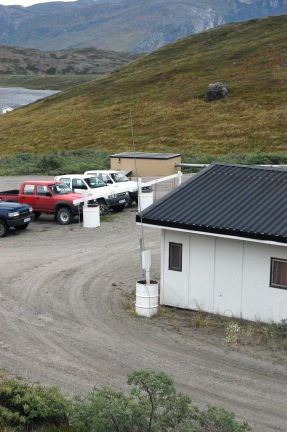
Per usual, the setup was an Elecraft K3 and the GU Special vertical with 2x 1/4-wavelength radials for each of 20 and 15 meters. Everything else was tuned by adjusting the length of the radiating section. This is a substantial improvement in performance-to-size ratio over the previous station I carried in January 2012, which was a Yaesu FT-840, DK9SQ 10-meter telescoping pole, and a variety of wire antennas. Below is a photograph of the GU Special deployed (it’s in the center, unceremoniously ty-wrapped to a wooden sign post sticking out of a barrel). The diesel Toyota HiLux pickups are the most popular vehicle in town. We gave a visiting graduate student lessons in driving a manual transmission. Great vehicle to teach/learn on with lots of torque and low gearing!
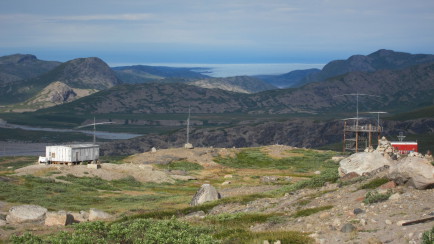
Although I was unable to connect with them, we did drive past the OX2A/XP1AB site on Black Ridge that overlooks downtown Kangerlussuaq:
Thanks for the QSOs. The log has been uploaded to LoTW this morning and QSL cards are ordered. I never ordered cards after the last trip, so it will be a shared card with a photograph of the aurora.
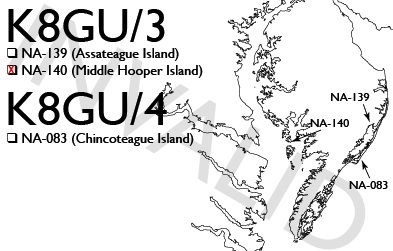
RSGB IOTA Contest expedition to NA-140
I forgot my camera at home and my mobile phone battery died so there are no photographs of this adventure…
I first experienced the passion of those pursuing RSGB’s Islands on the Air (IOTA) programm(e) when I was active from Adak (Andreanof Islands, NA-039) in August/September 2012. Matt, KB9UWU, and I made some tentative plans to do the 2013 RSGB IOTA Contest from NA-139 (Maryland State East, Assateague), returning to the site where he and W3CF had done the same contest over a decade prior. During the planning stage, I cast about for the nearest IOTA groups to activate. For the DC area, the easiest groups are surrounding the Delmarva Penninsula, NA-083 (Virgina State), NA-139 (Maryland State East) and NA-140 (Maryland State West). We did not execute the plan to go to NA-139 and I had really given up on the idea of doing anything for the IOTA contest…
That’s when work interviened. I scheduled a trip to Greenland (story about this to follow in a future posting) leaving late on Sunday of the IOTA contest weekend. My wife Sarah had a cousin with a baby shower in Ohio on Saturday…so, we did the logical thing…packed her and Evan off to Ohio on a Saturday morning flight. After dropping them off at the airport, I headed to the Eastern Shore for some IOTA action.
The principal mission for this trip would be to understand the difficulties in activating NA-140 and to make it widely available to the IOTA community because it is apparently rather rare (25% claimed, versus 19% claimed for Adak).
The station setup was simple and typical—an Elecraft K3 and an updated version of the GU Special. The GU Special had just returned Tuesday from KL2HD’s KL7NWR expedition to NA-064 back in June (he had left it on the research ship until it returned to port, so technically, it’s probably visited some other rare IOTAs, too).
In order to avoid discharging the car’s battery, a mistake that could leave me stranded far from home, I lugged along a few SLA batteries to power everything. I selected a couple of candidate sites using aerial imagery and ended up using my preferred site, which was very accessible to saltwater and the road, making it trivial to setup the radio in the car and
the antenna on the beach. I now understand why NA-083 and NA-139 have much more activity—they’re close to civilization! Nevermind, I love the middle of nowhere. So, it was fun.
I configured the antenna for 20 meters and launched a few CQs on CW. It took a while to get a run established, but after that the pileup was pretty much non-stop for about 3 hours. I even worked some JAs, which was pleasing considering that NA-140 is very rare there and I was not QRV during the peak hours for JA.
Unfortunately, I hadn’t rigorously tested the batteries beforehand (except for one) and only one (the one I tested, of course) of the five performed well. One performed acceptably and was relegated to running the inverter for the laptop once the battery warning came on. Even the “good” battery sagged under load at 100w transmitter power. So, I cranked the K3 down to 50w and let it rip. That was enough to produce a commanding signal in Europe, with RBN Skimmers showing my signal peaking at 47 dB SNR with many hits in the 30s of dB. As Matt said when we talked after I returned home, “I have trouble getting those kind of numbers with a small beam and the legal limit!” Verticals on saltwater rule. End of story. Hearing was a different issue as there was some line noise and the occasional passing boat, who provided more QRM in the audio range than the RF range.
My pileup thinned out a little bit around 2020 UT and I was exhausted. Evan didn’t sleep well the night before and that didn’t help anybody else sleep, either. Plus, it was hot, even with the nice breeze and pleasant temperatures. If all of that wasn’t enough, the battery in my mobile phone had discharged, the battery in the laptop was nearly dead and both the K3 and the inverter began
throwing low-voltage alarms. It was time to pack up. Fortunately, the GU Special deploys and stows in 15-20 minutes, so it wasn’t bad.
I ended the three-hour window with 215 QSOs and 11 (!!! that’s what you get for CQing the whole time) island multipliers, all on 20 meters. I’ll take it! Thanks for the QSOs. I just ordered cards today and they should be printed and ready to send by mid-August.
Minor Missive
I do love my radio. I really enjoy getting on air and always like the qso’s I have, even the rubber stamp ones. But recently, I’ve started to think about other aspects. The cost of equipment is one such thing (I’ve blithered on about that before) and the other is that in general you don’t see a very diverse age group in the hobby. There are you people who get into it through a number of different means and I’m fairly sure many drop the mic / key / keyboard. I suspect that getting on air is a costly business and that the pub may be a more alluring draw. A large portion of the people I have met or are involved with Ham Radio are ‘of a certain age’ ; i.e not in the 16-24 year old bracket. A bracket that I left behind nearly 20 years ago.
So I thought I’d write to the RSGB to see what their thoughts were and they decided to publish my letter. I didn’t offer any solutions but merely an opportunity to open the debate. I think its safe to say that the door has been shut now. The response to the letter was fairly swift and I read it is ‘We’re doing alright’. I remain unconvinced. I am very disappointed that they seem reluctant to grasp the nettle.
I’m a clanky by trade and the IMechE (along with just about every other professional body no doubt) make it part of your chartership that you must spend time mentoring the next generation. I spent 2 years teaching to 6th form students and thoroughly enjoyed it. Other ways include being on the young members board, who were represented at a national level. I firmly believe that the next generation is the key to this hobby and engaging them will bring us strength, diversity, enthusiasm and energy. I don’t know how much it costs to sponsor a trophy but I’ll be looking into it as a way reward the next generation. If there are any ideas I’d love to hear about them.
K2BSA
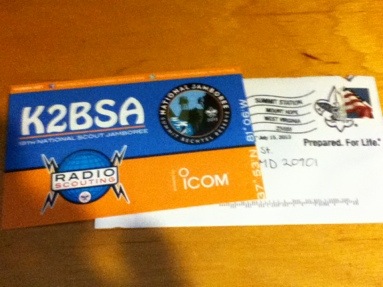
Worked my good friend and professional colleague Nathaniel, W2NAF, who is a radio instructor at the 2013 National Jamboree. Fast QSL with a special postmark. Ham radio continues to be cool.













