Archive for the ‘ham’ Category
 Stunning Video of the Sun Over Five Years, by SDO
 July 31st, 2015 |
  Author:
 Watch this video on a large screen. (It is HD). Discuss. Share.
This video features stunning clips of the Sun, captured by SDO from each of the five years since SDO’s deployment in 2010. In this movie, watch giant clouds of solar material hurled out into space, the dance of giant loops hovering in the corona, and huge sunspots growing and shrinking on the Sun’s surface.
April 21, 2015 marks the five-year anniversary of the Solar Dynamics Observatory (SDO) First Light press conference, where NASA revealed the first images taken by the spacecraft. Since then, SDO has captured amazingly stunning super-high-definition images in multiple wavelengths, revealing new science, and captivating views.
February 11, 2015 marks five years in space for NASA’s Solar Dynamics Observatory, which provides incredibly detailed images of the whole Sun 24 hours a day. February 11, 2010, was the day on which NASA launched an unprecedented solar observatory into space. The Solar Dynamics Observatory (SDO) flew up on an Atlas V rocket, carrying instruments that scientists hoped would revolutionize observations of the Sun.
Capturing an image more than once per second, SDO has provided an unprecedentedly clear picture of how massive explosions on the Sun grow and erupt. The imagery is also captivating, allowing one to watch the constant ballet of solar material through the sun’s atmosphere, the corona.
The imagery in this “highlight reel” provide us with examples of the kind of data that SDO provides to scientists. By watching the sun in different wavelengths (and therefore different temperatures, each “seen” at a particular wavelength that is invisible to the unaided eye) scientists can watch how material courses through the corona. SDO captures images of the Sun in 10 different wavelengths, each of which helps highlight a different temperature of solar material. Different temperatures can, in turn, show specific structures on the Sun such as solar flares or coronal loops, and help reveal what causes eruptions on the Sun, what heats the Sun’s atmosphere up to 1,000 times hotter than its surface, and why the Sun’s magnetic fields are constantly on the move.
Coronal loops are streams of solar material traveling up and down looping magnetic field lines). Solar flares are bursts of light, energy and X-rays. They can occur by themselves or can be accompanied by what’s called a coronal mass ejection, or CME, in which a giant cloud of solar material erupts off the Sun, achieves escape velocity and heads off into space.
This movie shows examples of x-ray flares, coronal mass ejections, prominence eruptions when masses of solar material leap off the Sun, much like CMEs. The movie also shows sunspot groups on the solar surface. One of these sunspot groups, a magnetically strong and complex region appearing in mid-January 2014, was one of the largest in nine years as well as a torrent of intense solar flares. In this case, the Sun produced only flares and no CMEs, which, while not unheard of, is somewhat unusual for flares of that size. Scientists are looking at that data now to see if they can determine what circumstances might have led to flares eruptions alone.
Scientists study these images to better understand the complex electromagnetic system causing the constant movement on the sun, which can ultimately have an effect closer to Earth, too: Flares and another type of solar explosion called coronal mass ejections can sometimes disrupt technology in space as well as on Earth (disrupting shortwave communication, stressing power grids, and more). Additionally, studying our closest star is one way of learning about other stars in the galaxy.
Goddard built, operates and manages the SDO spacecraft for NASA’s Science Mission Directorate in Washington, D.C. SDO is the first mission of NASA’s Living with a Star Program. The program’s goal is to develop the scientific understanding necessary to address those aspects of the sun-Earth system that directly affect our lives and society.
A Solar flare, A CME, A Proton Storm: Magnitude M2.5 X-ray Flare
Watch this amazing explosion on the Sun. From sunspot complex 1226-1227 comes an X-ray Flare peaking at a magnitude of M2.5 at 0640 UTC on 7 June, 2011.
Source: https://www.youtube.com/watch?v=KQMrRu8BWDo
This X-ray flare hurled a massive coronal mass ejection (CME) toward the Earth. This not-squarely Earth-directed CME is moving at 1400 km/s according to NASA models. The CME did not deliver even a noticeable glancing blow to Earth’s magnetic field late June 8th or June 9th.
What can be seen clearly in this movie is one of the most spectacular prominence eruptions ever observed. In fact, one could call it a “prominence explosion”. The prominence material expanded to a volume some 75 times as big across as the earth!
This X-ray flare also triggered an S1-level solar radiation storm, causing a long-lasting polar cap absorption (PCA) event. A polar cap absorption (PCA) event affects the propagation of a shortwave radio signal as it makes its way over the polar regions. In short, radio communications on lower shortwave radio frequencies become more difficult, as those radio signals are absorbed by the ionosphere (in the D-region) over the polar regions.
What does this mean in real-world communications? Trans-polar airline pilots may find it more difficult to communicate with regional air traffic control, shortwave radio listeners who want to hear a broadcast from a country by receiving a transmission from a country by way of a transmission beamed over the pole (like, from Europe into the USA via the North Pole), or other such communications, will find those signals all but gone. The stronger the PCA event, the higher the frequencies absorbed over the polar regions, with the greatest absorption occurring at the lower frequencies.
This movie spans the period of time from 0300 UTC through 1556 UTC, and is composed of the 171-Angstrom, 304-Angstrom, and 335-Angstrom wavelength views as captured by the filters of the Solar Dynamics Observatory (SDO) Atmospheric Imaging Assembly (AIA). In this movie, the AIA instruments capture the Sun’s extreme ultraviolet light and reveal a very large eruption of cool gas. It is somewhat unique because at many places in the eruption there seems to be even cooler material–at temperatures less than 80,000 K.
The following is a linked video that is part of this event: http://www.youtube.com/watch?v=L4CsjcUGoaw
Watch as we zoom out to see a total view of the June 7, 2011 moderately-powerful X-ray Flare and Prominence Eruption. This movie will give you a full perspective of the immense size of this prominence eruption as it spews out away from the Sun.
The X-ray Flare peaked at a moderate magnitude of M2.5 at 0640 UTC, but unleashed a huge prominence eruption. The massive cloud of plasma was ejected out into interplanetary space, but missed the Earth. This movie stars with a “close-up” view by the Solar Dynamics Observatory at a combined wavelength view at 94 and 304 Angstroms. Then, the movie views the event further back through the eyes of the COR1 spacecraft (with the SDO AIA 304 image superimposed in the middle). Next, we zoom out to the COR2 spacecraft and superimpose the COR1 and SDO views. Then, we zoom further back to the H1 view… and finally look again at the event close-up.
More info: http://sunspotwatch.com/
Google Plus:
http://g.nw7us.us/gplus_spacewx
Facebook:
http://www.facebook.com/spacewx.hfradio
http://www.facebook.com/NW7US
Twitter:
@hfradiospacewx
@NW7US
Source: SDO AIA NASA SOHO
Five X-class (Major) X-ray Flares in a Row (plus more!)
Well, thankfully, this is not happening during this contest weekend: one of the largest sunspot regions during this Sunspot Cycle 24, and one of the biggest in several decades, gave us quite a show, back in October 2014.
Five major X-class (very strong) and a number of moderate and “mild” solar x-ray flares erupted from a single sunspot region – this video covers the time period of October 19-27, 2014, as captured by NASA’s SDO spacecraft. This is from what has been one of the biggest sunspot regions in a number of decades.
Between October 19 and October 27, 2014, a particularly large active region on the Sun dispatched many intense x-ray flares. This region, labeled by NOAA as Active Region (AR) number 12192 (or, simply, NOAA AR 12192, and shortened as AR 2192), is the largest in 24 years (at that point in Solar Cycle 24).
The various video segments track this sunspot region during this period (Oct. 19 – Oct.27, 2014), during which we can see the intense explosions. There are five X-class flares during this time, and NASA’s Solar Dynamics Observatory (SDO), which watches the sun constantly, captured these images of the event.
Solar flares are powerful bursts of radiation. Harmful radiation from a flare cannot pass through Earth’s atmosphere to physically affect humans on the ground, however — when intense enough — they can disturb the atmosphere in the layer where GPS and communications signals travel.
When referring to these intense solar eruptions, the letter part of the classification, ‘X’, means, ‘X-class’. This denotes the most intense flares, while the number, after the classification letter, provides more information about its strength. For example, an X2 is twice as intense as an X1, an X3 is three times as intense, and so forth.
Solar Images Credit: NASA’s Goddard Space Flight Center & SDO
http://SunSpotWatch.com ~ http://NW7US.us
73 de NW7US
2 Meter Portable Ground Plane Gizmo Antenna
Portable, Ground Plane for 2 Meters made with BNC antennas
that you can ‘take down’
Its a compact ground plane antenna for portable use!

2 Meter Ground Plane Portable Gizmo Antenna in Operation 2
This antenna is built on a 2 inch washer. Holes were drilled in the washer to accommodate 4 radials. The center hole for the BNC to BNC connector was already there, but had to be reamed out. This (male to male) connector is where the coax from the radio is attached on the bottom of the washer. It also serves to hold (the center radiator element)!
(Note: The radiator, in the center, needs to attach to a BNC MALE connector, the cable from the radio also needs a BNC MALE connector. I used a male to male adapter for this purpose. It didn’t fit tightly so I used an old bike inner tube to cut a small spacer for taking up the slack. I’d have used a metal washer for ‘fitting’ the adapter, but I had already make 3 trips to the hardware store, so I used what I had)
Gizmo Portable Antenna
without the cover

Center Post of BNC Connector for the Radials are Shorted to the Shell Side
I used BNC female connectors from, Digikey, a good source for components! The center post of this connector is shorted to the ‘shell side’ to provide a ground plane with all the radials!
The 24 inch antennas from China were purchased on Ebay! CHEAP! The 2 inch washer is from the local hardware store. Everything fits on this washer, a 2 inch space, but the center coax is tedious to attach with all the radials in place, especially if you have big fingers.
The Cap is from a spice bottle!
I live alone so it was not a problem! LOL

Spice Bottle Cover
I love to use things for which they were never intended! This spice bottle cap is a good example of this. At this point, I’m not sure if I’ll seal it to the top BNC antenna radiator element or not? If I seal it (with hot glue, maybe) , the cap becomes permanently attached to the radiator element, and would be difficult if not impossible to remove. The whole idea here is to use this antenna as an impromptu portable antenna!

2 Meter Ground Plane Portable Gizmo Antenna Hanging from a Taped Tie Wrap
A tie wrap is used to ‘hang’ the antenna. Its hanging from a hook on my porch at the condo. I put 50 watts into it to get a repeater 10 miles away. SWR was 1:1 This is a portable antenna! Its not meant to be a permanent one. If you have ever needed a 2 meter antenna that you can pull up into a tree with a string or rope, this is it! Hauling it up 40 or 50 feet on a rope will get you better results than at ground level.
There is a joke that says, have you ever seen a golfer with only 1 club? Ham radio antennas are in the same category as golf clubs. You just can’t have too many!
All the elements can be removed for easy storage and transport, (radials as well as the vertical element)! I’m sure some clever ham will come up with a suitable case for this entire assembly. If I had one of those nifty clear plastic shipping tubes, I’d store in that! I’ll be on the lookout for one!
New Sunspot Region: Flare Activity Expected This Week
There is a new sunspot region rotating into view, producing moderately-strong (M-class) x-ray flares. This video shows you the first 11 hours of May 5, 2015
Expect flares throughout this week, which will degrade HF propagation DURING the flare, but enhance propagation overall (due to the higher Radio Flux). There might be occasional coronal mass ejections, too.
Watch stunning highlights, last 5 years of the Sun
We rely on the Sun for HF radio communication propagation. For the last five years, we have an amazing front-row seat: the SDO spacecraft. Here is a video with highlights of the last five years of solar activity as seen by NASA and the SDO AIA spacecraft. This is worth seeing on a larger monitor, so try to view it full screen on something larger than your palm. The music is pretty good too. It is worth the 20-some minutes of stunning viewing. Be sure to share!
Enjoy!
Details:
This video features stunning clips of the Sun, captured by SDO from each of the five years since SDO’s deployment in 2010. In this movie, watch giant clouds of solar material hurled out into space, the dance of giant loops hovering in the corona, and huge sunspots growing and shrinking on the Sun’s surface.
April 21, 2015 marks the five-year anniversary of the Solar Dynamics Observatory (SDO) First Light press conference, where NASA revealed the first images taken by the spacecraft. Since then, SDO has captured amazingly stunning super-high-definition images in multiple wavelengths, revealing new science, and captivating views.
February 11, 2015 marks five years in space for NASA’s Solar Dynamics Observatory, which provides incredibly detailed images of the whole Sun 24 hours a day. February 11, 2010, was the day on which NASA launched an unprecedented solar observatory into space. The Solar Dynamics Observatory (SDO) flew up on an Atlas V rocket, carrying instruments that scientists hoped would revolutionize observations of the Sun.
Capturing an image more than once per second, SDO has provided an unprecedentedly clear picture of how massive explosions on the Sun grow and erupt. The imagery is also captivating, allowing one to watch the constant ballet of solar material through the sun’s atmosphere, the corona.
The imagery in this “highlight reel” provide us with examples of the kind of data that SDO provides to scientists. By watching the sun in different wavelengths (and therefore different temperatures, each “seen” at a particular wavelength that is invisible to the unaided eye) scientists can watch how material courses through the corona. SDO captures images of the Sun in 10 different wavelengths, each of which helps highlight a different temperature of solar material. Different temperatures can, in turn, show specific structures on the Sun such as solar flares or coronal loops, and help reveal what causes eruptions on the Sun, what heats the Sun’s atmosphere up to 1,000 times hotter than its surface, and why the Sun’s magnetic fields are constantly on the move.
Coronal loops are streams of solar material traveling up and down looping magnetic field lines). Solar flares are bursts of light, energy and X-rays. They can occur by themselves or can be accompanied by what’s called a coronal mass ejection, or CME, in which a giant cloud of solar material erupts off the Sun, achieves escape velocity and heads off into space.
This movie shows examples of x-ray flares, coronal mass ejections, prominence eruptions when masses of solar material leap off the Sun, much like CMEs. The movie also shows sunspot groups on the solar surface. One of these sunspot groups, a magnetically strong and complex region appearing in mid-January 2014, was one of the largest in nine years as well as a torrent of intense solar flares. In this case, the Sun produced only flares and no CMEs, which, while not unheard of, is somewhat unusual for flares of that size. Scientists are looking at that data now to see if they can determine what circumstances might have led to flares eruptions alone.
Scientists study these images to better understand the complex electromagnetic system causing the constant movement on the sun, which can ultimately have an effect closer to Earth, too: Flares and another type of solar explosion called coronal mass ejections can sometimes disrupt technology in space as well as on Earth (disrupting shortwave communication, stressing power grids, and more). Additionally, studying our closest star is one way of learning about other stars in the galaxy.
Goddard built, operates and manages the SDO spacecraft for NASA’s Science Mission Directorate in Washington, D.C. SDO is the first mission of NASA’s Living with a Star Program. The program’s goal is to develop the scientific understanding necessary to address those aspects of the sun-Earth system that directly affect our lives and society.
Please visit my channel on YouTube, and subscribe ( https://YouTube.com/NW7US ).
— Twitter: https://Twitter.com/NW7US
— Facebook: https://www.facebook.com/spacewx.hfradio
— Web: http://SunSpotWatch.com
( Data feed Twitter https://Twitter.com/hfradiospacewx )
Credits:
Music Via YouTube “Free-for-use” Creation Tools
Video clips of the Sun are from NASA’s Goddard Space Flight Center/SDO which are in the Public Domain
By the way, this is an example of what I am trying to produce on a more regular basis, once I launch the space weather YouTube channel that I have started. If you wish to help, here is the GoFundMe link: http://www.gofundme.com/sswchnl
Today’s Sun Seen at the 304-Angstrom Wavelength (30 March 2015)
Today’s Sun (artificially-colored in red) seen at the 304-angstrom wavelength (Extreme Ultraviolet, or EUV), as viewed by the Solar Dynamics Observatory (SDO), by the Atmospheric Imaging Assembly (AIA).
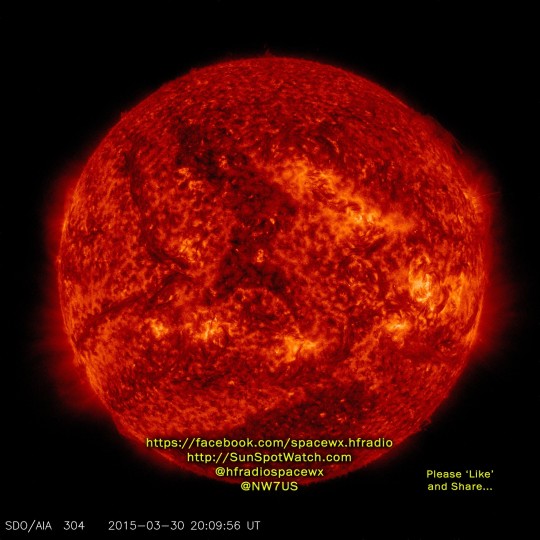
At this wavelength, at a wavelength not seen by the un-aided eye, we can see the Sun through the 30.4 nm (304 A) filter. This Extreme Ultraviolet (EUV) waveband is used to monitor the chromosphere and lower transition region. It is useful to see plasma and filament activity, including filamet eruptions and coronal mass ejections (CMEs).
The image is a “false color image”, meaning that observed data are in a range outside of what human eyes can see, so the data are digitally recast into colors that emphasize physically important features. This view is created from data gathered by the Solar Dynamics Observatory (SDO) satellite that flies above Earth”s atmosphere in an inclined geosynchronous orbit.
Emissions captured in this image come from helium (He), the second most abundant element in the solar atmosphere. Singly ionized Helium (He II) emits Extreme Ultraviolet (EUV) light when heated to temperatures of ~70,000 deg K. In the upper solar atmosphere the temperatures are so high that most chemical elements have lost many of their electrons. The remaining electron, which is still attached to the atom, emits EUV radiation in narrow wavebands or lines when it is in an excited state.
The 30.4 nm filter (also called channel or bandpass) is dominated by emissions from singly (once) ionized helium which has missing 1 electron–He II. The roman numeral descriptor is consistent with spectral notation: the level of ionization for a given roman numeral is one unit larger that the actual number of missing electrons. The temperatures associated with this level of ionization is range from 6 x 10^4 K to 8 x 10^4 K.
The bright regions in this image correspond to regions of closed magnetic field loops that trap the hot, emitting plasma. Large bright regions are often called active regions. The dark regions correspond to cooler temperatures and possibly to locations where magnetic field lines open into the heliosphere, and thus, do not trap hot plasma.
View live data and images at http://SunSpotWatch.com
Get the space weather and radio propagation self-study course, today. Visit http://nw7us.us/swc for the latest sale and for more information!
We”re on Facebook: http://NW7US.us/swhfr













