Archive for the ‘ham radio’ Category
 What Will You Say?
 December 14th, 2014 |
  Author:
 Ham radio continues to grow in popularity and it seems to be gathering even more interest from curious muggles. It’s no longer an oddity to see dozens of news stories about our hobby splashed from various news reporting services.
Just last night, my wife and I were driving to dinner, and the car radio was tuned to a local channel that has started playing Christmas music around the clock. At some point during a break in the music there was a short public service announcement about amateur radio. I suppose it was sponsored by the local radio club though I can’t be certain — it was an ARRL promotion.
My point is that there is an increasing possibility that one of these days, someone from the local newspaper or TV news station might approach YOU to ask a few questions about your hobby. And while none of us are going to be the perfect ambassador/evangelist/spokesperson for the entire hobby, if that fate should befall you, I hope you’re able to elicit a better headline than what appeared recently in the Des Moines Register:
Men support fading ham radio habit
Overall, the article is interesting and, if you can get past that headline and the initial wave of nausea, it’s not really all that bad. I’m assuming the interviewer who crafted these words was influenced by things shared by those being interviewed:
“But in the age of the smartphone, the amateur radio network is a dwindling hobby whose aging practitioners are the keepers of a fading but potentially still vital means of communication.”
No matter whose responsible for spinning that notion, it’s just flat out wrong. Poppycock. Hokum. There’s nothing “dwindling” about the hobby. The number of licensed hams in the US is at its highest level in history and it continues to enjoy strong growth.
On the air activity has changed significantly from the 1950’s but there are no fewer signals in the spectrum now than at some mythical touchpoint in the past. Forty years ago, its likely this story would never have even appeared in a newspaper as amateur radio was much too small a niche to waste newsprint on.
I’m not kidding, you really do need to prepare for how you’ll respond to a question about your hobby, and not just from someone working in popular media.
Sooner or later, your family, friends, and co-workers are bound to discover that you’re a radio ham. And when they do, someone is invariably going to ask the toughest question. One that’s not on any radio test exam but should be:
“So what do you talk about on the radio?”
This one can be a real stumper and you need to think long and hard about what you will say when it comes up, because it will eventually come up. How you answer will, at a minimum, become the basis for someone’s opinion of amateur radio. And at the very best, your answer might spark an interest that results in yet another new call sign for all of us to work.
What will you say?
This article first appeared in CALLING CQ a weekly letter for amateur radio enthusiasts.
Tagged: media 


This Spewed Out of the Internet #30
 Reporting on more critical information spewing forth from the interwebz, here’s some stuff you just can’t live without.
In a surprise move, Baofeng introduces yet another dualband HT, but this one might be the best yet. Maybe. See the PD0AC first impressions of the GT-3 Mark II.
Yaesu has announced a new dualband HT, the FT2DR, that has a Big Honking Display and touchscreen interface.
The crack reporting team over at Ham Hijinks keeps cranking out ham radio news: Turkey Takes Toll on Ham.
The ARRL is looking into changing some of the VHF contest rules. The first proposal includes allowing self-spotting and the use of non-amateur assistance. I say “heck yeah!”
If you ever thought it would be a good idea to use a banana as a Morse code keyer, check out this video. Meanwhile, Burger King has recognized the importance of ham radio for space communications (video).
The QRZNow web site got caught “borrowing” content from other ham radio web sites without permission or providing attribution.
Stu W0STU over at HamRadioSchool.com has been straining his brain on the topic of complex impedance. If you need some help understanding this (ahem) complex topic, take a look at his three part article on the subject: Part 1, Part 2, Part 3.
If you are worried about exposure to excessive EMF (Electromagnetic Field), you’ll want to consider this device over at Amazon.com. Be sure to read the reviews to get the full entertainment value.
73, Bob K0NR
The post This Spewed Out of the Internet #30 appeared first on The KØNR Radio Site.
Christmas Comes a Little Early
My Christmas present arrived last night. Being a patient and practical person, I waited until this morning to open it and as you can see, it’s the 2014 SKCC Club Key from LNR Precision. Click the image for a better look.
I had wanted to get this one in this calendar year as I’m not sure how much longer it will be available. I had picked up the Pro Pump NT9K Standard Version key while at Dayton this year and have been very pleased with its smooth action. This smaller version is just as well-built and enjoyable to use as the “Pro”.
I know that because the new key already has ten contacts to its credit…


How About a New 12 Volt Automotive Connector?
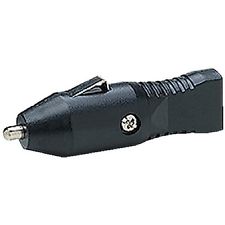 Don’t get me wrong — I do like standard connectors. A while back, I wrote about how the micro-USB connector became the standard power/data connector for mobile phones. Well, that is unless you own an iPhone.
The good news is that we do have a standard power connector for 12 VDC in automobiles. The bad news is that it is an ugly behemoth derived from — can you believe it? — a cigarette lighter. For some background and history, see the Wikipedia article. The Society of Automotive Engineers (SAE) has a standard that describes this power connector (SAE J563). Alan K0BG correctly warns us to “never, ever use existing vehicle wiring to power any amateur radio gear” including the 12 volt accessory plug. (I always follow this advice, except in the cases when I don’t.) I also found this piece by Bill W8LV on eham.net that describes the crappiness of these connectors.
Well, there is a new standard power connector showing up in cars: the USB port. These ports provide the data and power interface for mobile phones, integrating them into the auto’s audio system. Standard USB ports (USB 1.x or 2.0) have a 5V output that can deliver up to 0.5A, resulting in 2.5W of power. A USB Charging Port can source up to 1.5A at 5V, for 7.5 W of power. This is not that great for powering even low power (QRP) ham radio equipment.
Now a new standard, USB Power Delivery, is being developed that will source up to 100W of power. The plan is for the interface to negotiate a higher voltage output (up to 20V) with 5A of current. Wow, now that is some serious power. We will have to see if this standard is broadly adopted.
Two things are obvious to me: 1) the old cigarette lighter connector needs to go away and 2) it is not clear what the replacement will be.
What do you think? Any ideas for the next generation of 12V automotive connector?
73, Bob K0NR
The post How About a New 12 Volt Automotive Connector? appeared first on The KØNR Radio Site.
Counting Magic Beans
I’m a member of the Straight Key Century Club (3383T) and as such, have volunteered for the position of bean counter. That is to say, collecting awards and working toward an elevated status, which is at least half the fun of being in the club, requires a great deal of bookkeeping in the form of station logs and the curation of properly formatted electronic files for submission.
It’s not nearly as onerous a task as I’m making it out to be, if you’re a Windows user. If, on the other hand you’re as silly as me, and prefer another operating system, well, you’ve got your work cut out for you.
My main logging program is MacLoggerDX and a finer, more powerful electronic ham radio management tool has not been created. It does everything an operator could ask of it, and a lot more. But working inside the confines of certain specialty club rules is asking a lot from any application not crafted specifically for it.
On the other hand, there are several logging applications that have been built from the ground up to support the various awards and activities of the SKCC — all native Windows applications. Sure, there are ways to run Windows applications on a Mac, but this only minimizes the hardware required.
So over the holiday weekend, I spent time installing SKCC Logger on a Windows laptop that a client left in my possession over a year ago. It’s a beast of a machine. A 17-inch HP Envy with a non-lighted keyboard and Windows 8.1. It sports a fast, i7 processor and boatloads of memory, still, I’m perplexed why anyone would want to abuse themselves with such a combination (did I mention that the laptop was given to me for free?).
For the record, SKCC Logger is a brilliant application that handles SKCC tasks with ease. Connecting the laptop to my IC-7100 transceiver was a breeze and I can see how this will come in especially handy during the next Weekend Sprintathon.
But here’s where it gets a lot less enjoyable.
I first coaxed hundreds of valid SKCC contacts out of MLDX and into ADI format. This was no easy task as I had only noted that a contact was “SKCC” in the comment section of the log, and I didn’t consistently name them as such. Also, since I achieved the Centurion and Tribune levels last year, I thought I had to remove these from the pile, as well as the contacts made during the annual K3Y operation.
As it turned out, those were bad assumptions and I expended a lot of effort for nothing.
Once I had a base file created, I let SKCC Logger process the log and determine what, if any, new awards I might have become eligible for since achieving the Tribune level. Turns out, it wasn’t much. I qualified for the CX2 status which means I had 200 unique member contacts hiding in my log. I also discovered that I’m only a handful of contacts away from qualifying for Tx2 level – requiring another unique 100 confirmed contacts with select members – another step on the long road to ‘Senator‘.
I’ve no doubt that many valid Q’s were lost in the parsing and conversion. But i think I’m done with trying to go back and square the log. This has become like trying to balance a checkbook that just won’t be balanced and I’m tired and just want to move forward from this point and see where it goes.
By the way, if it all seems rather confusing, it is. I chuckle when I read this line at the bottom of the SKCC rules pages for differing levels: “Lets make it FUN and keep it SIMPLE!!”
It’s anything but simple – but it is fun and I do enjoy it very much. Except now I have two computers on my desk and I have to decide when sitting down whether tonight is going to be an ‘SKCC’ evening, or a ‘regular’ evening. And I still have to export the SKCC files back into main log on occasion.
Who was that idiot who said personal computers were going to make our lives easier and more enjoyable?
Filed under: Ham Radio, Syndicate Tagged: logging, mldx, skcc 


Announcing the January 2015 WØTLM Technician License Class
 Ham Radio Two-Day License Class
Sat Jan 31 and Sat Feb 7 (8 AM to 5 PM) 2015
Location: Black Forest Fire Station 1, Black Forest, CO
The Technician license is your gateway to the world-wide excitement of Amateur Radio …
- Earn your ham radio Technician class radio privileges
- Pass your FCC amateur radio license exam right in class on the second day
- Multiple-choice exam, No Morse Code Required
- Live equipment demonstrations
- Learn to operate on the ham bands, 10 Meters and higher
- Learn to use the many VHF/UHF FM repeaters in Colorado
- Find out how to participate in emergency communications
There is a non-refundable $25 registration fee for the class.
In addition, students must have the required study guide and read it before attending the two-day class: HamRadioSchool.com Technician License Course $20.95
(make sure you get the most recent edition of this book, updated for the new FCC exam questions)
Advance registration is required (no later than one week before the first session, earlier is better! This class usually fills up weeks in advance.)
To register for the class, contact: Bob Witte KØNR
Email: [email protected] or Phone: 719 659-3727
Sponsored by the Tri-Lakes Monument Fire Radio Association
For more information on amateur (ham) radio visit www.arrl.org or www.wedothat-radio.org
The post Announcing the January 2015 WØTLM Technician License Class appeared first on The KØNR Radio Site.
Twisted Phonetic Alphabet
 Stu W0STU just posted an article on HamRadioSchool.com about the use of phonetic alphabets. I had previously posted a Shack Talk article on the same subject.
The “standard” phonetic alphabet is the ITU alphabet but I am starting to think that we might need to get a little more creative on our use of phonetics. Why not innovate in this area, just like we innovate on the technical front?
Towards that end, I was reminded of his phonetic alphabet listed over at netfunny.com:
        A  Are               N  Nine
        B  Bee               O  Owe
        C  Cite              P  Pseudonym
        D  Double-U          Q  Queue
        E  Eye               R  Rap
        F  Five              S  Sea
        G  Genre             T  Tsunami
        H  Hoe               U  Understand?
        I  I                 V  Vie
        J  Junta             W  Why
        K  Knot              X  Xylophone
        L  Lye               Y  You
        M  Me                Z  Zero
Even this creative alphabet can be improved on. For example, I think H should be Honor.
What do you think?
73, Bob
The post Twisted Phonetic Alphabet appeared first on The KØNR Radio Site.













