Archive for the ‘ham radio’ Category
 2014 World Radiosport Team Championship
 February 28th, 2015 |
  Author:
 From the World Radiosport Team Championship (WRTC) website:
The World Radiosport Team Championship (WRTC) is a competition between two-person teams of amateur radio operators testing their skills to make contacts with other Amateur Radio operators around the world over a 24 hour period. All teams use identical antennas from the same geographic region, eliminating all variables except operating ability.
WRTC2014 included 59 competing teams from 29 qualifying regions around the world. Competitors represented 38 different countries.
This is a unique contest in that the stations used are roughly identical so that operator skill is the main variable. I love watching these guys work the radios, especially the CW ops. Even if you are not a contester, take a look at this excellent video and enjoy radio hams having fun messing around with radios.
WRTC 2014 Documentary from James Brooks on Vimeo.
The post 2014 World Radiosport Team Championship appeared first on The KØNR Radio Site.
Antenna testing is hard (II)
This article follows up on this one. The title could also be: doing measurements on hand held radios is hard. Actually, some measurements I did in the past might not be so accurate after all.
Measuring in dBm
If you measure in dBm, what I always did, you assume that the device at the other end is 50 Ohms, just like the manufacturer promises you in the specs. Slowly but surely we are finding out that this is not always the case. As a result I might have to switch to microvolt (µV), a method which doesn’t require a perfect 50 Ohms at the other end.
Can’t we just convert it? 0.5 µV @ 50 ohms = -113 dBm, a piece of cake, right? No. You must know the actual impedance of the receiver if you want to convert from dBm to µV. Erik PE1RQF did some measurements on a few hand held radios to find out the true impedance. The outcome was, well, a bit scary.

If a device is 50 Ohms, the SWR should be 1:1. Only a perfect dummy load and the Marconi RF generator are.
What this means for us
What this outcome basically means is that generating cold numbers on sensitivity and antenna performance are nice, but don’t tell the whole story, or could be misleading.
- Antennas which prove to be the best performers (RX/TX, VSWR), tested under optimal conditions, are not necessarily the best performers on a specific brand/model of hand held radio.
- There are antennas which aren’t 50 Ohms at all, but could very well outperform everything else on the market because your radio isn’t 50 Ohms either.
Do the test yourself
The best example I can give you is this one: take a Baofeng BF-666S, 777S or 888S, use the stock antenna, and make notes of the performance in the field. Try to hit repeaters which are barely in range. If you have a field strength meter, measure field strength when transmitting.
Remove the stock antenna and replace it by a Nagoya NA-701, NA-771, the $3.79 antenna, or the Baofeng UV-B5 antenna. I tried all of these; just pick whatever 3rd party antenna you have. Repeat the tests.
What happened here is that the short stock antenna was the best of the bunch, all 3rd party antennas had a negative influence on the performance of this specific Baofeng model. The same 3rd party antennas mentioned above did improve the performance of the Baofeng UV-5R, often by a wide margin.
Exception to the rules
The funny thing is that reception suffered greatly too. This is quite uncommon and a sign that hand held radios don’t follow the rules. For example, if you just want to receive on 20 meters and your dipole is 2×6 meters instead of 2×5 meters, you would never notice the difference. With your hand held radio however you will.


Trading freedom for safety

Courtesy hamnieuws.nl
Privacy and freedom are constantly traded in for a (often false) sense of security. This has nothing to do with ham radio, you’d probably think, but even our hobby isn’t immune.
Repeaters
Repeaters are only useful if the antennas can be placed high above ground. In the Netherlands we use a number of existing locations, most of which were once used for analog TV and radio. The owners of the towers decided that safety and security will prevail over (safe, terrorist-free) ham radio.
The following systems will be affected:
- ATV repeater PI6ATV, both analog and digital,
- 2 meter repeater PI3UTR,
- D-star repeater PI1UTR,
- DMR repeater PI1UTR,
- RX co-location for the 70cm repeater PI2NOS,
- RX co-location for the 10 meter repeater PI6TEN,
- Four Hamnet access points and links.
There is a chance that the equipment can be relocated to a lower section of the tower while keeping the antennas on the original altitude. Even in the best case scenario the costs of relocating will exceed the minimal financial reserves – good coax cable is expensive, and we would need a lot of it.
I’ll end with this quote: Those who would give up essential liberty to purchase a little temporary safety deserve neither liberty nor safety. (Benjamin Franklin)


Amateur Radio Newsline Report 1954 February 27 2015
- Ham radio responds as a pair of tropical cyclones hit Australia
- The FCC and the FDA look the future of medical remote electronics
- Printed FCC issued ham licenses come to an end
- Stunning images received from the latest ISS slow-scan television experiment
- And the nominating period opens for the 2015 Amateur Radio Newsline Young Ham of the Year Award
THIS WEEK'S NEWSCAST
Anytone Tech’s new models: User Manuals
As Brick also mentioned in in his last post about Anytone Tech: the reactions on the new models vary wildly. I think Brick said all there is to say, but I’ll add this thought:
– If a radio is cheap but crap, we complain, but buy it anyway.
– If a radio is good but costs more, we complain, but suddenly the price is all that matters.
Let’s see how these radios perform and at what price point before judging them. I know John of Miklor.com gets (or already has) review samples, and I’m on the list too. To give you some more insight in what these radios can and cannot do, here are some preliminary user manuals (PDF).

ANILE-8R User Manual (Preliminary)
NSTIG-8R User Manual (Preliminary)
OBLTR-8R + TERMN-8R User Manual (Preliminary)


2013 Ford F-150 Ham Radio Installation
After acquiring a Ford F-150 truck last year, I’ve been working on getting a ham radio installed in it. At times, I have loaded up my vehicle with multiple radios covering HF through 70 cm but lately I am content with just having a reasonable dualband 2m/70 cm FM rig in the mobile. Actually, I used a Yaesu FT-8900 that does FM on 10m, 6m, 2m and 70 cm but just set it up for the two bands.
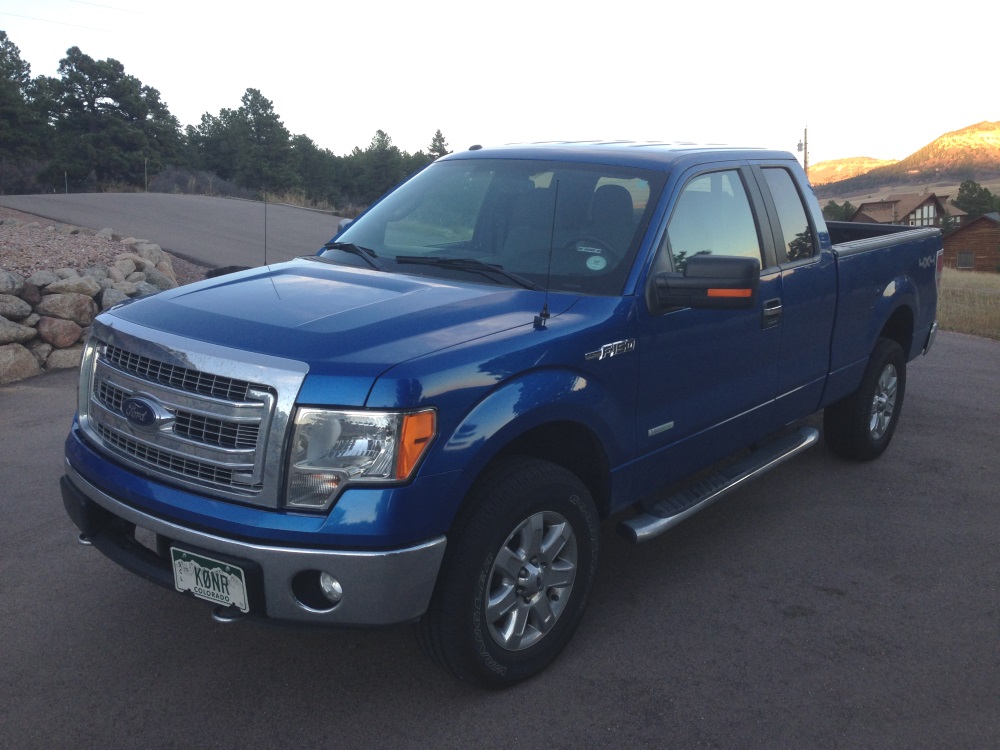
Ford F-150 with 2m/70cm antenna on the front fender
One of the most critical questions for a mobile installation is what kind of antenna to install and where to put it. In the end, the antenna is going to be the main determinant of mobile performance. Ideally, I’d like to have the antenna on the roof of the cab but the truck will not fit in my garage in that configuration. Another option I considered was mounting a longer dualband antenna using one of the stake pocket mounts from Breedlove. I prefer NMO mounts for VHF/UHF antennas and the stake pocket looked like a good way to go. However, a little measuring revealed that a 1/2-wave or 5/8-wave 2m antenna on the stack pocket was not going to clear my garage door. So it seemed that I was limited to a shorter antenna. I may still use the stake pocket mount for an additional antenna for road trips or to add 6m and 10m antennas.
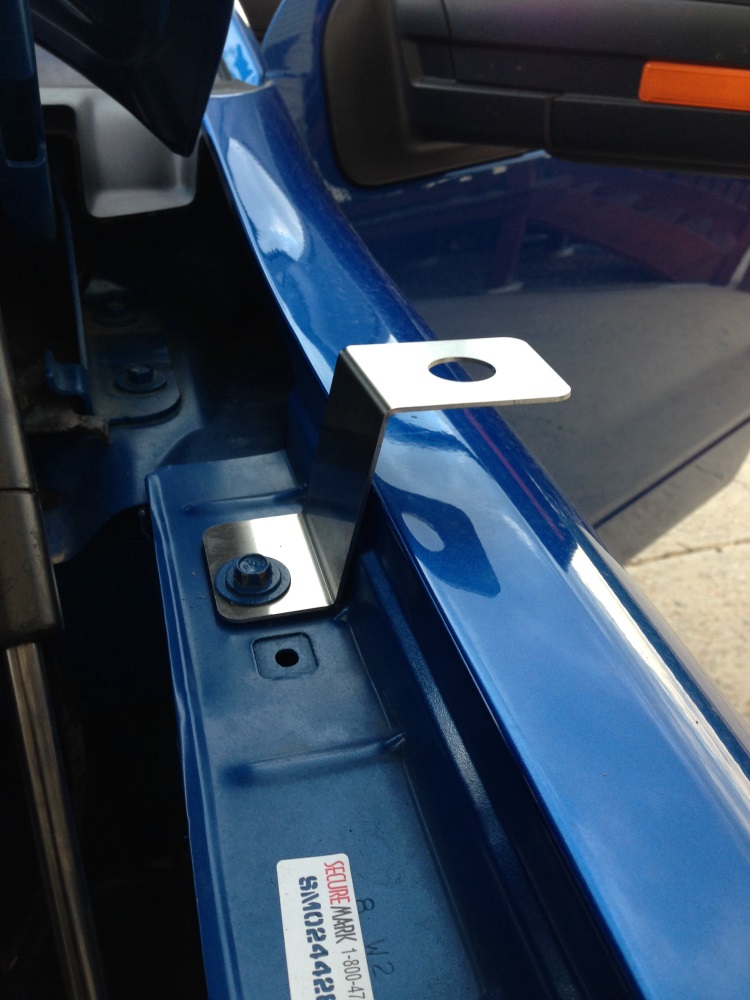
At this point, the F-150 bracket offered by The Antenna Farm looked like a good option. They have a number of these brackets made specifically for various vehicles, so check them out. This made the antenna installation quite simple. <click on any of the photos for a larger view>
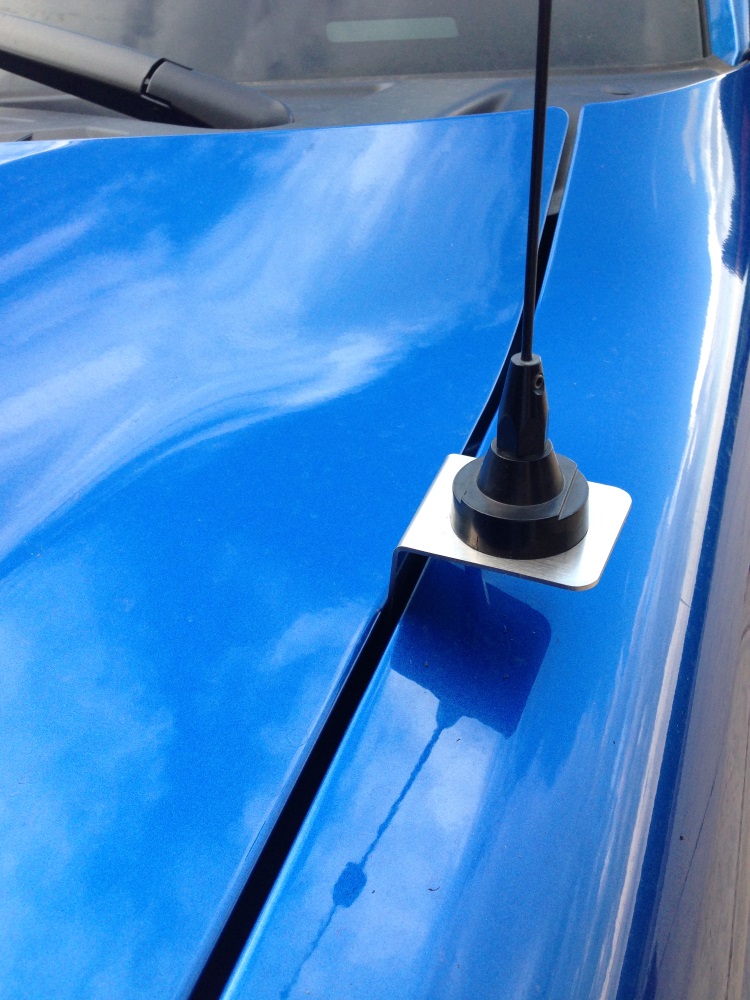
The antenna is an NMO-mount dualband that I had laying around the hamshack. I don’t recall the exact model number but these are very common, about 19-inch long for 1/4-wave operation on 2m and a small loading coil to make it work on the 70cm band.
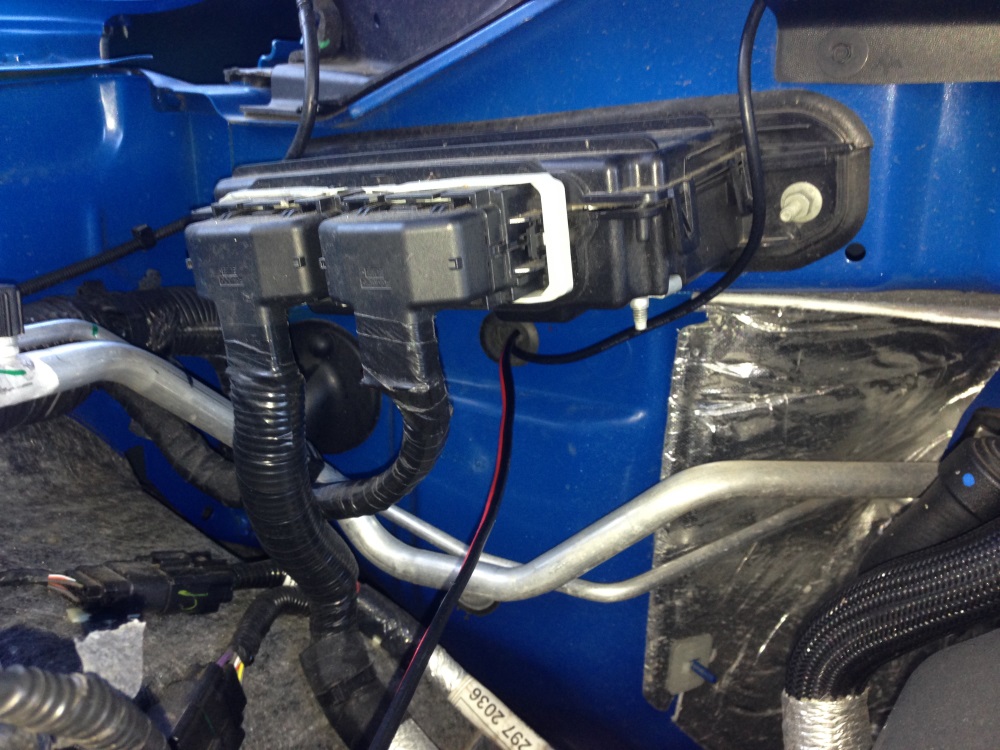
The F-150 has several precut holes for passing wires through the firewall. I used one that is on the passenger side just below a large module, as shown in the photo. It took a stiff wire and some force to punch my way through the rubber plug and into the cab compartment.
I don’t have a photo of the battery connection but I connected the positive lead right onto the battery terminal while the negative lead was attached to the truck chassis near the battery. You may have been told to always connect directly to the battery terminals but that advice no longer applies to some newer cars because there is a current monitoring device in the negative battery lead. To avoid confusing the vehicle battery monitoring system, the negative connection to your transceiver needs to be on the chassis side of the current monitor. Alan K0BG explains this issue on his web site. Actually, Alan has a wealth of information on mobile installations on his web site: www.k0bg.com. Oh, of course, I used inline fuses on both the positive and negative power cables.
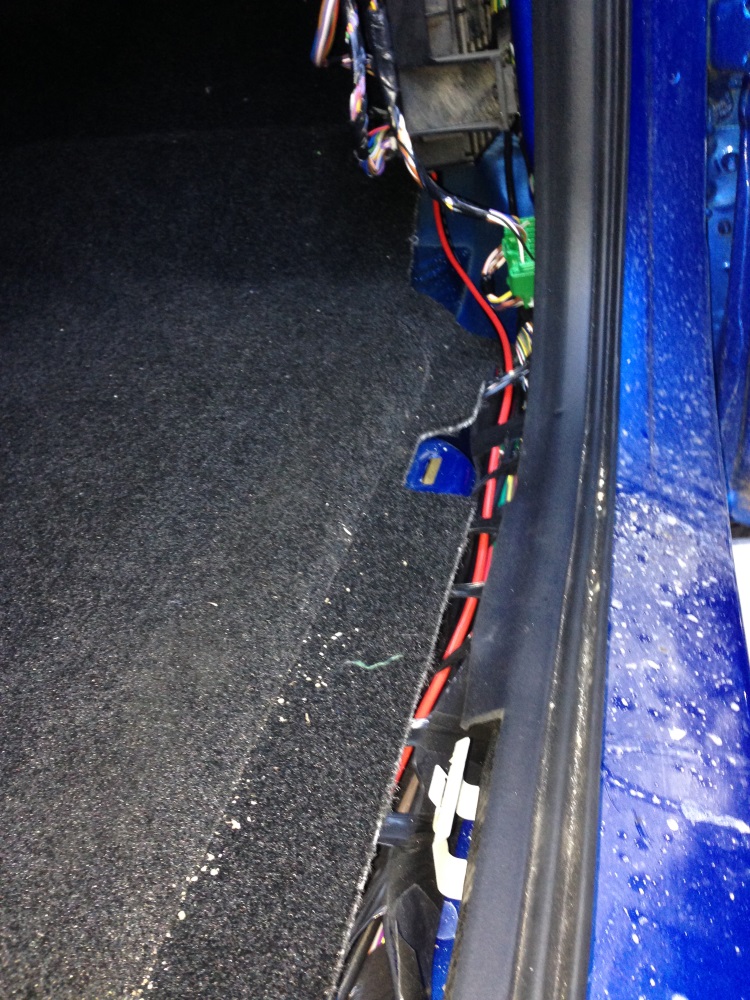
I mounted the FT-8900 transceiver on the floor under the back seat. To route the power cables and antenna coax, I pulled up the flat plastic trim piece that runs along the floor at the passenger door. I started from the front and did some careful prying (and praying) to remove the trim without breaking it. This exposes a trough with a factory wiring harness in it but there’s room for more. A few other plastic trim pieces were removed to get access to the wires coming through the firewall. All in all, this was not that difficult. (Yea, Ford!)
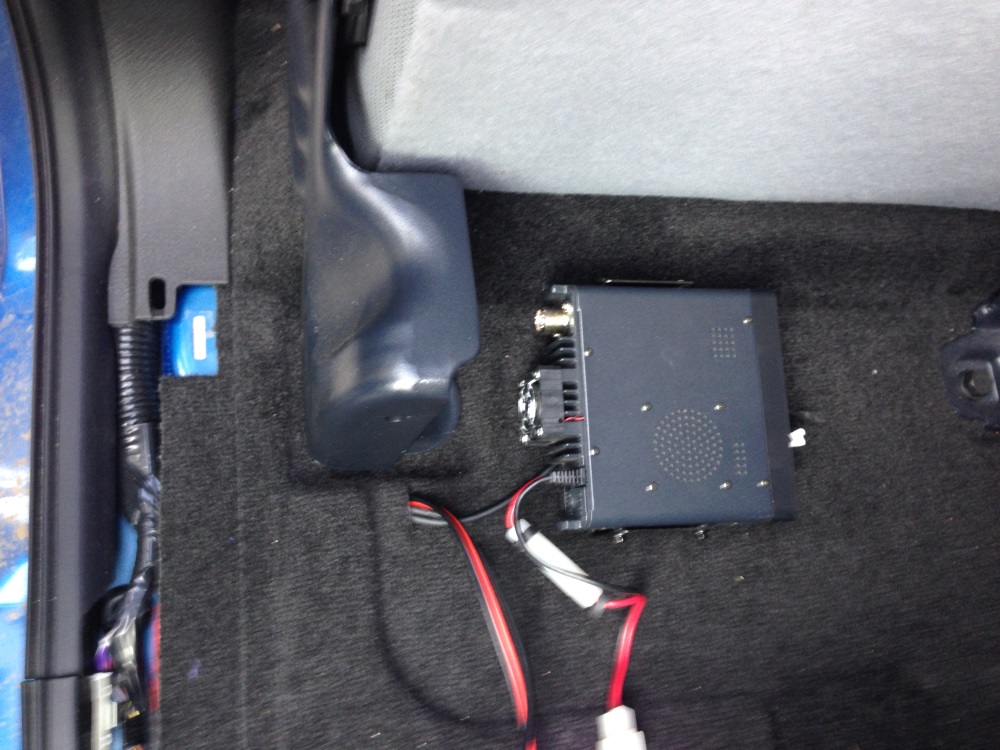
The photo to the left shows the FT-8900 radio installed under the passenger side rear seat. I drilled holes through the floor and mounted the radio with hefty sheet metal screws. The screws go right through the metal floor and and can be seen from under the truck. (Check that out before drilling!) Because the radio body is under the rear seat, I am using a small external speaker mounted near the drivers seat.
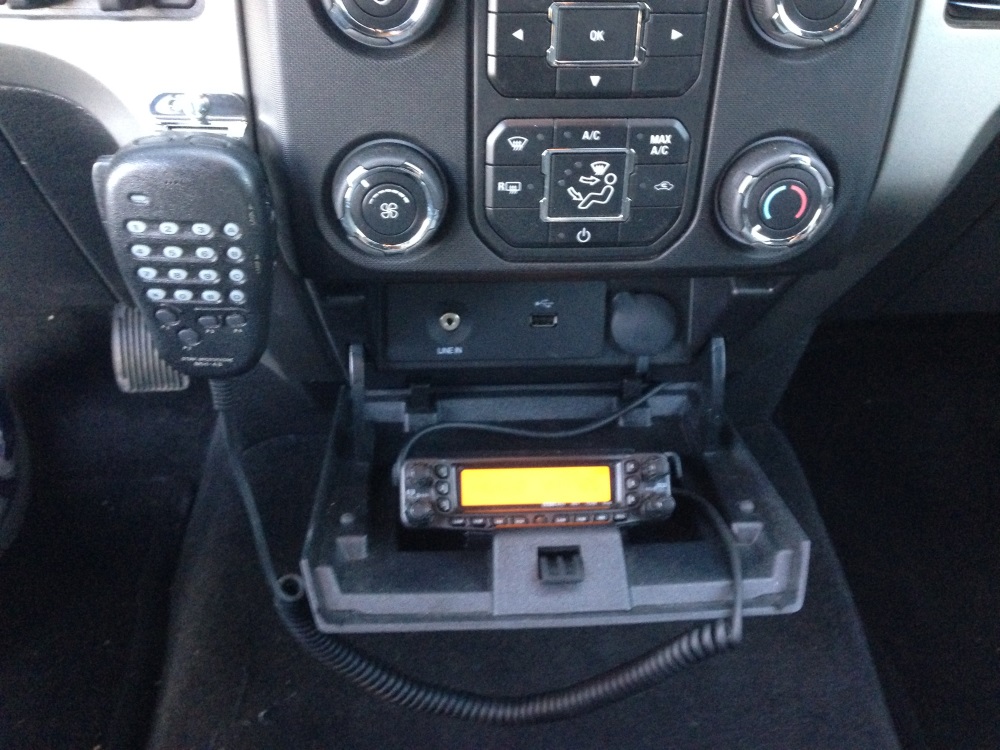
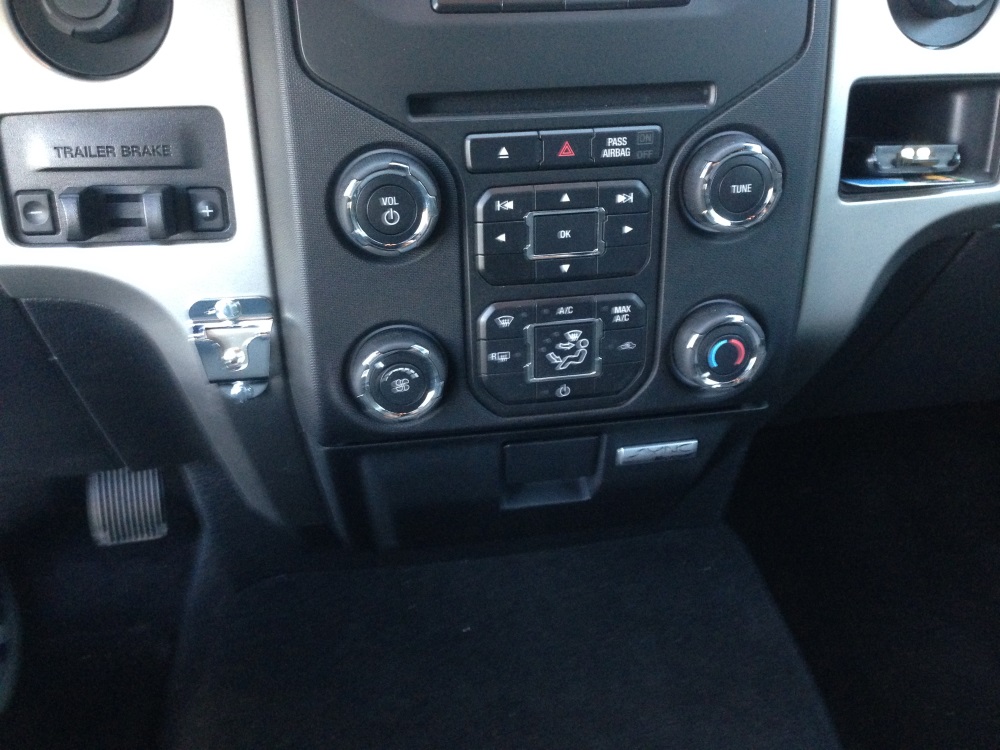
The radio control head is mounted inside a little door/shelf that normally pops open to reveal the USB port for plugging in a smartphone. (Note that Ford has multiple seat / dashboard configurations.)
 The FT-8900 control head just fits inside this little shelf, even when the door is closed (see photo). The microphone does have to be removed to close the door. I mounted a microphone hanger with a couple of sheet metal screws, as shown in the photo. I don’t like the crappy little hanger that usually comes with a ham transceiver so I bought some higher quality hangers on Amazon.
Overall, I am pleased with the radio install. The antenna location is clearly a compromise and I notice the performance is not as good as my previous vehicle (which was a small SUV with an NMO mount antenna in the middle of the roof.) But the antenna is “low profile” and sufficient for “around town” mobile operating. I am getting a little noise on the 2m band which needs some investigation. The 70cm band is very clean and is the band I use the most.
73, Bob K0NR
The post 2013 Ford F-150 Ham Radio Installation appeared first on The KØNR Radio Site.
Dorking With VHF Contest Rules
 One continuing discussion in the VHF community is how to promote more activity, especially during the major VHF contests. One central theme that always emerges is how to modify the VHF contest rules to make them better, to make them fairer and to encourage new contesters. (Let me say up front that there is room for improvement in the contest rules but I don’t think rule changes alone will change contest participation significantly.)
In 2013, the ARRL contests added the Three-Band Single Operator and Single Operator FM Only entry categories. In January 2015, the ARRL added three more categories: Single Operator Unlimited High Power, Single Operator Unlimited Low Power, and Single Operator Unlimited Portable. These “unlimited” categories allow “passive use of spotting assistance” which roughly means these operators can monitor the various DX spotting networks but not spot themselves. The CQ Worldwide VHF Contest already allows passive assistance for all participants and self-spotting for digital EME and meteor scatter contacts. See the CQ WW VHF rules.
In January, the ARRL announced additional changes:
The Board … adopted amendments to the General Rules for ARRL Contests Above 50 MHz to encourage greater participation and band utilization. The changes become effective with the 2015 June ARRL VHF Contest. The revisions stemmed from recommendations offered by the Board’s Programs and Services Committee’s ad-hoc VHF and Above Revitalization subcommittee, composed of active VHF/UHF contesters, and they received strong support from the VHF/UHF community.
The subcommittee was charged with developing recommendations to increase the level and breadth of ARRL VHF and above contest participation and encourage operation on lesser-used bands. As a start to the process, the Board approved three changes that will permit assistance for all operator categories, with no effect on entry category; permit self-spotting for all operator categories, and allow single operators to transmit on more than one band at a time.
The changes will permit assistance in arranging contacts, but not in conducting contacts. They will, for example, allow a station to announce its location in a chat room, on a repeater, or even via e-mail.
The self-spotting/assistance issue is a hotly debated issue among VHFers, with two main schools of thought:
1) Contacts should be made completely independent of non-amateur assistance. Sometimes passive spotting assistance is allowed, but some folks want to eliminate that practice as well.
2) Contacts can be made with non-amateur assistance (spotting networks, chat rooms, etc.) as long as a complete radio contact occurs over the ham bands. This follows the common practice of internet spotting for EME and meteor scatter. Also, some rover stations have requested the ability to spot themselves when they enter a new grid.
There are a number of shades of gray positions between these two points of view (see the CQ WW VHF rules, for example), but I won’t try to explain them here. In general, I support the move to loosening up the restrictions on assistance (#2). Without good 6m propagation, VHF contests tend to be “QSO poor” and expanded use of spotting will allow for additional contacts. The potential risk is that we’ll get sloppy with what constitutes a legitimate contact. Once I know the exact frequency and call sign of the other station, it will be easier to “hear” the other station even when the path is not there. Of course, we already have this situation when we complete a QSO on one band and QSY to another band to work the same station. We know the frequency and call sign (and the grid)…did we really hear the other guy or just think we did? In the end, it all comes down to the integrity of the radio hams involved in the contact.
Those are my thoughts. What do you think?
73, Bob K0NR
The post Dorking With VHF Contest Rules appeared first on The KØNR Radio Site.













